


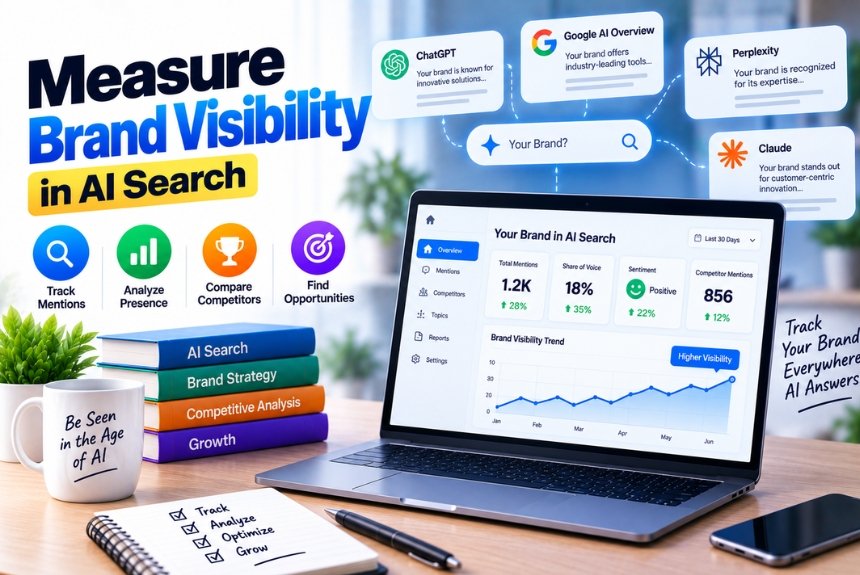
How to Measure Your Brand Visibility in AI Search Results
For years, SEO reporting revolved around a familiar set of numbers: keyword rankings, impressions, clicks, organic traffic, backlinks, and conversions.
But search is becoming increasingly conversational.
People can now ask AI-powered systems questions such as:
- Which hosting provider is suitable for a high-traffic website?
- What are the best CRM platforms for a small business?
- Which digital marketing agencies specialize in ecommerce?
- What are the best alternatives to a particular software?
- Which brands offer sustainable travel experiences?
Instead of receiving only a ranked list of webpages, users may receive a synthesized answer that mentions brands, products, services, and sources.
That creates a new measurement challenge for marketers.
How do you know whether your brand is visible when people search through AI?
Traditional SEO tools can tell you where a webpage ranks for a keyword. They cannot, by themselves, tell you everything about whether your brand is being mentioned, recommended, or cited inside AI-generated answers.
This is why AI search visibility has become a distinct measurement area within modern SEO.
AI visibility measurement generally looks at whether a brand appears in relevant AI answers, how often it appears, whether its website is cited, how it compares with competitors, and whether that visibility eventually contributes to traffic, leads, sales, or other business outcomes.
The important point is that AI search measurement should add to traditional SEO reporting rather than replace it.
This guide explains how to build a practical framework for measuring your brand visibility in AI search results.
What Is AI Search Visibility?
AI search visibility is the extent to which a brand, website, product, service, or organization appears in AI-generated answers for relevant questions and search journeys.
A brand can become visible in AI search in several ways.
It might be:
- directly mentioned
- recommended
- compared with competitors
- cited as a source
- linked to
- included in a list
- referenced through a specific webpage
- discussed in relation to a product or service
- associated with a particular topic or category
This is different from traditional search visibility.
In traditional SEO, marketers commonly ask:
“Where does my page rank?”
In AI search, additional questions become relevant:
“Does the AI mention my brand?”
“Does it cite my website?”
“Which pages does it reference?”
“Which competitors appear alongside my brand?”
“For which questions does my brand appear?”
“Is the information about my business accurate?”
These questions provide a broader view of how your brand is represented within AI-driven discovery.
Why Traditional SEO Metrics Are Not Enough
Traditional SEO metrics remain valuable.
You should still monitor:
- organic rankings
- impressions
- clicks
- organic sessions
- click-through rate
- backlinks
- indexed pages
- conversions
- revenue
However, AI search can create visibility without producing an immediate website visit.
For example, imagine a user asks an AI system:
“What are some reliable website hosting options for an ecommerce store?”
The AI answer mentions your company and explains why it may be suitable.
The user reads the answer but does not click your website.
Your brand received exposure, but traditional analytics may not record that interaction as a website session.
This creates a measurement gap.
Current AI-search measurement guidance therefore increasingly distinguishes between visibility inside the answer and traffic generated from the answer.
The two should be measured separately.
The Five Layers of AI Search Visibility Measurement
A practical AI visibility framework can be divided into five layers:
- Presence
- Mentions and citations
- Competitive visibility
- Traffic and engagement
- Business outcomes
This creates a measurement funnel.
AI exposure → Brand mention → Citation → Website visit → Conversion
Not every user will follow the entire path.
That is exactly why measuring only traffic can underestimate the impact of AI-driven discovery.
1. Measure Brand Presence
The first question is simple:
Does your brand appear at all?
Create a list of relevant prompts that potential customers might ask AI systems.
For example, a web hosting company could track:
- What is the best hosting for WordPress?
- Which hosting is suitable for ecommerce?
- What hosting is best for high-traffic websites?
- What are affordable hosting options for small businesses?
- Which hosting providers offer managed WordPress hosting?
Run these prompts across the AI platforms relevant to your audience.
Record whether your brand appears.
You can calculate a basic presence rate:
Brand Presence Rate = Prompts Mentioning Your Brand ÷ Total Prompts Tested × 100
For example:
If you test 100 relevant prompts and your brand appears in 25 responses:
Brand Presence Rate = 25%
This does not represent an official universal AI ranking metric. It is a measurement framework you can use consistently to monitor your own visibility.
Consistency is more important than pretending the number represents an absolute position in AI search.
2. Track Brand Mentions
Brand presence tells you whether you appeared.
Brand mentions tell you how often you appeared.
Suppose you test 200 prompts over a month.
Your brand appears in 42 responses.
That gives you a basic count of 42 AI-visible responses.
But you should go deeper.
Record:
- brand mentioned or not
- number of mentions
- context of mention
- product/service mentioned
- competitors mentioned
- recommendation status
- source cited
- accuracy of information
This turns random AI searches into structured measurement.
3. Track AI Citations Separately From Mentions
A mention and a citation are not necessarily the same thing.
A brand may appear in an AI answer without its website being cited.
For example:
“Company X is another provider used by small businesses.”
That is a brand mention.
A citation occurs when the AI answer references a source or webpage associated with the information.
For example:
Company X offers managed hosting for businesses. [company website]
That distinction matters.
Adobe’s current AI-search measurement guidance similarly separates AI visibility from citations: visibility indicates that a brand appears in an AI answer, while a citation indicates that owned content is being used as a supporting source.
Useful citation metrics include:
- citation frequency
- citation rate
- cited URLs
- cited domains
- citations by topic
- citations by prompt type
- competitor citation frequency
You can calculate:
Citation Rate = Responses Citing Your Website ÷ Total Relevant Responses × 100
4. Identify Which Pages Are Being Cited
Knowing that your domain is cited is useful.
Knowing which pages are cited is even more useful.
Suppose your website has:
- 500 blog posts
- 50 service pages
- 20 product pages
- 10 guides
You discover that AI systems repeatedly cite only five pages.
That tells you something important about your content.
Those pages may be particularly useful because they:
- answer specific questions
- provide clear explanations
- contain original information
- have strong topical relevance
- are easy to interpret
- contain trustworthy references
- satisfy a particular information need
Create a report containing:
| URL | Topic | AI Platform | Prompt | Cited? | Mentioned? |
|---|---|---|---|---|---|
| /hosting-guide/ | Hosting | AI Platform A | Best hosting for business | Yes | Yes |
| /wordpress-hosting/ | WordPress | AI Platform B | Hosting for WordPress | Yes | Yes |
| /pricing/ | Pricing | AI Platform A | Affordable hosting | No | Yes |
This helps connect AI visibility with your actual content strategy.
5. Measure AI Share of Voice
One of the most useful advanced metrics is AI share of voice.
Imagine users ask:
“What are the best email marketing platforms for small businesses?”
The AI response mentions:
- Brand A
- Brand B
- Brand C
- Brand D
You can track how frequently your brand appears compared with relevant competitors across a defined set of prompts.
A simple framework could be:
AI Share of Voice = Your Brand Mentions ÷ Total Tracked Brand Mentions × 100
For example:
If your brand accounts for 18 out of 100 tracked brand appearances:
AI Share of Voice = 18%
Again, this is a measurement framework, not an official universal AI metric.
The most important thing is to define the methodology and keep it consistent over time.
6. Track Visibility by Prompt Category
A single overall AI visibility number can hide important differences.
Your brand may be highly visible for informational queries but barely visible for commercial queries.
Therefore, divide prompts into categories.
Informational Prompts
Examples:
- What is web hosting?
- How does cloud hosting work?
- What is an SSL certificate?
Commercial Investigation
Examples:
- Best hosting for small businesses
- Best ecommerce hosting
- Hosting providers with managed support
Comparison Prompts
Examples:
- Company A vs Company B
- Best alternatives to Company A
- Which hosting provider is better for ecommerce?
Transactional Prompts
Examples:
- Where can I buy managed hosting?
- Which platform offers affordable VPS hosting?
Problem-Based Prompts
Examples:
- Why is my website slow?
- How can I reduce server response time?
This allows you to discover where your brand is visible and where it is absent.
7. Measure Visibility by AI Platform
Do not assume that visibility on one AI platform automatically means visibility everywhere.
AI search experiences can differ in:
- retrieval
- source selection
- interface
- query interpretation
- citations
- personalization
- response generation
Therefore, track platforms separately.
Depending on your audience, you might monitor:
- Google AI Overviews
- Google AI Mode
- ChatGPT
- Perplexity
- Gemini
- Microsoft Copilot
- other relevant AI search experiences
Current commercial AI visibility tools similarly provide platform-specific tracking because a brand’s visibility can vary between AI systems.
Your reporting could look like:
| Platform | Prompts Tested | Brand Mentions | Citations |
|---|---|---|---|
| Google AI | 100 | 32 | 21 |
| ChatGPT | 100 | 28 | 15 |
| Perplexity | 100 | 35 | 24 |
| Gemini | 100 | 19 | 11 |
The numbers above are illustrative, not industry benchmarks.
8. Measure Visibility by Topic
Platform-level reporting is useful, but topic-level reporting can reveal even more.
Imagine your company operates in digital marketing.
You might track:
SEO
- SEO agencies
- technical SEO
- local SEO
- ecommerce SEO
Content Marketing
- content strategy
- blog writing
- content optimization
Paid Advertising
- Google Ads
- Meta Ads
- PPC agencies
AI Marketing
- AI SEO
- AI search optimization
- generative engine optimization
You may discover that your brand is highly visible for traditional SEO but rarely appears for AI-search questions.
That is an actionable insight.
It tells your content team where additional authority and coverage may be needed.
9. Track Competitor Co-Mentions
AI answers often mention multiple brands together.
That makes competitor analysis particularly useful.
For every tracked prompt, record:
- your brand
- competitors mentioned
- number of competitors
- position or order of appearance
- whether your brand is recommended
- whether your brand is cited
- whether the answer distinguishes between brands
For example:
Prompt:
“Best ecommerce hosting providers for growing stores”
Response includes:
- Brand A
- Brand B
- Brand C
- Brand D
Your reporting system can record the competitive set.
Over time, you can identify which brands consistently appear alongside yours.
This gives you a different perspective from conventional keyword ranking reports.
10. Monitor How AI Describes Your Brand
Visibility alone is not enough.
Your brand might appear frequently but be described inaccurately.
For example, your website may specialize in:
enterprise ecommerce hosting
while an AI system repeatedly describes you as:
budget shared hosting.
That is a brand-accuracy problem.
Therefore, monitor:
- category association
- products
- services
- pricing information
- geographic information
- expertise
- target audience
- differentiators
- outdated claims
Create a simple classification:
Accurate
Partially accurate
Inaccurate
This can become an important part of AI brand monitoring.
11. Track Sentiment Carefully
Some AI visibility tools provide sentiment analysis.
It can be useful, but it should not be treated as a perfect measurement.
AI-generated language can be nuanced.
A brand might be described as:
- established
- affordable
- enterprise-focused
- beginner-friendly
- expensive
- specialized
- widely used
These are not always straightforward positive or negative statements.
Instead of relying exclusively on a single sentiment score, record how the brand is characterized.
For example:
| Attribute | Description |
|---|---|
| Pricing | Premium |
| Audience | Enterprise |
| Strength | Security |
| Limitation | Complexity |
| Positioning | Specialized |
This creates more useful information for marketing teams.
12. Measure AI Referral Traffic
AI visibility can sometimes generate website traffic.
Your analytics platform can help identify referral traffic from AI services when those visits are identifiable.
Monitor:
- sessions
- engaged sessions
- landing pages
- referral sources
- conversions
- revenue
For example:
AI referral traffic → /pricing/ → signup
is much more useful information than simply knowing that your brand appeared in an AI answer.
However, referral traffic should not be considered a complete measurement of AI influence.
A user may see your brand in an AI answer and later:
- search your brand on Google
- visit directly
- click a social profile
- return through an email
- contact sales
- convert later
The AI interaction may therefore influence the journey without appearing as a direct AI referral.
Industry measurement research and guidance have highlighted this attribution challenge.
13. Connect AI Visibility to Business Outcomes
This is where AI search reporting becomes more valuable to business leaders.
Do not stop at:
“Our brand appeared in 35% of AI answers.”
Ask:
“What happened after that visibility?”
Track:
- leads
- enquiries
- sign-ups
- product trials
- purchases
- revenue
- assisted conversions
- branded search growth
For example:
AI visibility → branded search → website visit → demo → customer
The complete journey may involve multiple channels.
Therefore, AI visibility should generally be treated as one layer of the customer journey, not necessarily as a standalone attribution channel.
Build an AI Search Visibility Tracking System
You do not need an extremely complicated system to start.
A spreadsheet can be enough for an initial program.
Create columns such as:
| Field | Purpose |
|---|---|
| Date | Track changes over time |
| Platform | Identify AI source |
| Prompt | Record the question |
| Topic | Group related prompts |
| Brand Mention | Yes/No |
| Citation | Yes/No |
| Cited URL | Identify the source page |
| Competitors | Track competing brands |
| Position/Order | Record appearance order |
| Description | Record how brand is characterized |
| Accuracy | Evaluate the response |
| Referral | Track measurable traffic |
| Conversion | Connect visibility to outcomes |
Run the same prompt set consistently.
This gives you a baseline.
Then repeat the measurement periodically.
Create a Representative Prompt Set
Your prompt list is one of the most important parts of the measurement process.
Do not randomly ask AI systems questions every week.
Build a structured prompt library.
Category 1: Brand Prompts
Examples:
- What is [Brand]?
- What services does [Brand] offer?
- Who is [Brand] suitable for?
Category 2: Category Prompts
Examples:
- Best SEO agencies
- Best hosting providers
- Best email marketing platforms
Category 3: Problem Prompts
Examples:
- How can I improve website speed?
- How can I increase ecommerce conversions?
Category 4: Comparison Prompts
Examples:
- [Brand A] vs [Brand B]
- Alternatives to [Brand]
Category 5: Recommendation Prompts
Examples:
- Which platform should a small business use?
- What tools are suitable for an ecommerce startup?
Category 6: Location-Based Prompts
Examples:
- Best digital marketing agencies in Delhi
- Best web hosting company for businesses in India
The exact prompt categories should reflect your customer journey.
Use Real Customer Questions
Your prompt library should not be built entirely from SEO keyword tools.
Look at real questions from:
- sales teams
- customer support
- website search
- FAQs
- product reviews
- Reddit discussions
- community forums
- social media
- Google Search Console
- keyword research
- customer interviews
This gives your AI search tracking program a stronger connection to actual customer behavior.
Use Search Console Alongside AI Visibility Data
Google Search Console remains useful because it shows how users discover your website through Google Search.
Monitor:
- queries
- impressions
- clicks
- CTR
- average position
- pages receiving search traffic
Then compare that information with your AI visibility data.
For example:
| Topic | Google Visibility | AI Visibility |
|---|---|---|
| Website hosting | High | High |
| Ecommerce hosting | Medium | Low |
| Cloud hosting | Low | Medium |
| WordPress hosting | High | High |
This can reveal gaps that a conventional SEO report might miss.
AI Visibility Tools
As AI search measurement has matured, dedicated tools have emerged for monitoring mentions, citations, prompts, competitors, and AI-generated responses.
For example, Ahrefs’ current Brand Radar product provides AI visibility tracking across several AI surfaces and separates concepts such as mentions, citations, AI share of voice, and estimated impressions.
Other SEO platforms have also introduced AI visibility reporting and measurement frameworks.
When choosing an AI visibility tool, look for capabilities such as:
- custom prompt tracking
- multiple AI platforms
- citation tracking
- cited URL identification
- competitor tracking
- historical reporting
- prompt categorization
- exportable data
- API access
- analytics integration
Do not choose a tool solely because it produces a large visibility score.
Understand how that score is calculated.
Why AI Visibility Scores Can Be Misleading
A common mistake is treating an AI visibility score like a universal Google ranking.
It is not.
Different tools can use:
- different prompt sets
- different AI platforms
- different sampling methods
- different refresh frequencies
- different definitions of visibility
- different weighting systems
Therefore:
Tool A’s 40% visibility does not necessarily equal Tool B’s 40% visibility.
Use the metric primarily for consistent internal comparison over time.
For example:
January: 18%
February: 22%
March: 27%
That trend can be useful if the methodology remains consistent.
How Often Should You Measure AI Search Visibility?
There is no universal frequency that applies to every business.
The right schedule depends on:
- industry
- search volatility
- brand size
- content publishing frequency
- competitive activity
- business importance
- available resources
A practical starting point is:
Weekly
Monitor high-priority prompts and major brand queries.
Monthly
Run a broader prompt set and compare:
- visibility
- mentions
- citations
- competitors
- cited pages
Quarterly
Perform a deeper strategic review.
Analyze:
- topic gaps
- content gaps
- citation patterns
- brand accuracy
- competitive movement
- business outcomes
The goal is not to collect data constantly.
The goal is to identify meaningful changes and trends.
What Should You Do If Your Brand Is Not Appearing?
If your brand rarely appears in relevant AI answers, do not immediately assume you need to publish hundreds of new articles.
First investigate.
Check Your Existing Content
Does your website clearly explain:
- who you are
- what you offer
- who you serve
- what problems you solve
- what makes your products or services distinct?
Check Topical Coverage
Do you have useful content around the questions your customers actually ask?
Check Technical Accessibility
Can search systems access and understand your important pages?
Check Internal Linking
Are your important pages connected logically?
Check External Mentions
Is your brand discussed across relevant websites and platforms?
Check Accuracy
Does the information available about your brand consistently describe the company correctly?
Check Competitor Coverage
Are competitors producing content that directly answers the questions you’re targeting?
These checks can help identify whether the problem is content, discoverability, authority, positioning, or simply insufficient measurement.
How to Improve Brand Visibility in AI Search
Measurement should lead to action.
Once you identify visibility gaps, you can improve your content strategy.
Build Strong Topic Coverage
Create useful resources around important customer questions.
Demonstrate Expertise
Provide detailed, accurate information instead of generic summaries.
Publish Original Information
Original research, first-party data, case studies, product information, and genuine expertise can make content more useful.
Strengthen Internal Linking
Connect related resources logically.
Maintain Accurate Brand Information
Keep your website, business profiles, author information, product details, and other important sources current.
Earn Relevant Mentions
Build legitimate authority through useful content, partnerships, PR, research, and other appropriate marketing activities.
Update Existing Content
Outdated information can reduce usefulness.
A content refresh strategy can help maintain accuracy and relevance.
AI Search Visibility vs Traditional SEO Visibility
These two measurement systems should work together.
| Traditional SEO | AI Search Visibility |
|---|---|
| Keyword rankings | Brand mentions |
| Search impressions | Prompt visibility |
| Organic clicks | AI citations |
| SERP CTR | AI share of voice |
| Backlinks | Cited sources |
| Organic traffic | AI referral traffic |
| Conversions | AI-influenced conversions |
| Page rankings | Brand representation |
Neither column should automatically replace the other.
Traditional SEO tells you how your website performs within conventional search.
AI visibility tells you how your brand appears within AI-driven answer experiences.
Together, they provide a broader picture of modern search visibility.
A Simple Monthly AI Visibility Report
A useful monthly report does not need dozens of metrics.
Start with these:
1. AI Presence Rate
Percentage of tracked prompts where your brand appeared.
2. Citation Rate
Percentage of tracked responses that cited your website.
3. AI Share of Voice
Your brand’s share of tracked brand appearances.
4. Top Cited Pages
Which pages were most frequently referenced?
5. Top Topics
Which subjects generated the most visibility?
6. Competitor Visibility
Which competitors appeared most frequently in your tracked prompts?
7. Brand Accuracy
How accurately did AI systems describe your brand?
8. AI Referral Traffic
How much identifiable traffic came from AI platforms?
9. Conversions
What measurable business outcomes came from that traffic?
10. Key Changes
What changed compared with the previous reporting period?
This is enough to create a useful starting dashboard.
Example AI Search Visibility Dashboard
Imagine a fictional SaaS company called ExampleCRM.
Its monthly report could look like this:
| Metric | Current Month | Previous Month |
|---|---|---|
| Prompts Tested | 200 | 200 |
| Brand Presence | 31% | 25% |
| Citation Rate | 18% | 14% |
| AI Share of Voice | 16% | 12% |
| Cited Pages | 14 | 10 |
| AI Referral Sessions | 420 | 310 |
| AI-Assisted Leads | 19 | 12 |
These figures are illustrative.
The important point is the structure.
You can see:
Visibility → Citations → Traffic → Leads
That makes AI search measurement easier to communicate to stakeholders.
Important Limitations of AI Search Measurement
AI search measurement is still developing.
There are several limitations marketers should understand.
AI Responses Can Change
The same prompt can produce different answers at different times.
Platforms Behave Differently
A prompt may generate different results across ChatGPT, Gemini, Perplexity, and Google AI experiences.
Personalization Can Affect Results
Location, account context, language, and other factors can influence what users see.
Not Every Mention Generates Traffic
A brand can receive AI visibility without a measurable website visit.
Attribution Is Imperfect
A user may discover your brand through AI and convert through another channel later.
Third-Party Metrics Are Methodology-Dependent
Different tools may calculate AI visibility differently.
These limitations do not make measurement useless.
They mean your reporting should be transparent and consistent.
The Future of AI Search Measurement
As AI search develops, SEO measurement is likely to become broader.
The traditional model was largely:
Keyword → Ranking → Click → Conversion
The AI-search model can look more like:
Prompt → AI Answer → Brand Mention → Citation → Website Visit → Conversion
But there can also be another path:
Prompt → Brand Mention → Brand Search → Website Visit → Conversion
Or:
Prompt → Brand Mention → Direct Visit → Conversion
This makes the customer journey harder to attribute perfectly.
At the same time, it makes brand visibility itself more important as a measurable marketing signal.
Recent industry reporting reflects this shift, with marketers increasingly separating mentions, citations, links, and business outcomes rather than treating them as one metric.
Frequently Asked Questions
1. What is AI search visibility?
AI search visibility measures how frequently and in what context a brand appears in AI-generated answers for relevant user questions across platforms such as Google AI experiences, ChatGPT, Gemini, Perplexity, and other AI-powered search interfaces.
2. How do you measure brand visibility in AI search?
Build a representative set of relevant prompts, run them consistently across the AI platforms important to your audience, and record brand mentions, citations, competitors, cited pages, topic coverage, and measurable referral traffic. You can then connect these signals with leads, sales, and other business outcomes.
3. What is an AI citation?
An AI citation occurs when an AI-generated answer references or links to a source that supports the information presented. A brand can be mentioned without its website being cited, so mentions and citations should be tracked separately.
4. What is AI share of voice?
AI share of voice is a comparative metric showing how frequently your brand appears in a defined set of AI-generated answers relative to other brands. Because different tools use different methodologies, it is best used for consistent comparisons within the same tracking system.
5. Can Google Search Console measure AI search visibility?
Search Console remains valuable for measuring your website’s performance in Google Search, but it should not be treated as a complete measurement system for every AI-generated answer across all AI platforms. AI visibility often requires additional prompt-based or platform-specific monitoring.
6. How often should I track AI visibility?
A practical approach is to monitor important prompts regularly and conduct a broader monthly review. High-priority or rapidly changing industries may benefit from more frequent tracking.
7. Does high AI visibility guarantee more sales?
No. Visibility is an exposure metric, not a guarantee of revenue. AI mentions can influence awareness or consideration without producing a measurable click, and conversions can occur through other channels. Business outcomes should therefore be measured separately.
8. Should AI search visibility replace traditional SEO reporting?
No. AI visibility should complement traditional SEO metrics. Rankings, impressions, clicks, organic traffic, conversions, and technical SEO remain important, while AI visibility adds another measurement layer for AI-driven discovery.
Final Takeaway
Measuring brand visibility in AI search requires a broader approach than traditional rank tracking.
Your brand may appear in an AI answer without receiving a click. Your website may be cited without ranking first for the original search query. A competitor may appear alongside your brand in one AI platform but not another.
That means there is no single number that completely describes AI search performance.
Instead, build a measurement framework around several connected signals:
Brand presence → Mentions → Citations → Share of voice → Traffic → Conversions
Start with a carefully selected set of real customer questions. Track the same prompts consistently. Separate brand mentions from website citations. Monitor competitors and cited pages. Measure identifiable AI referral traffic. Then connect those visibility signals to leads, sales, and other business outcomes wherever possible.
Most importantly, treat AI search visibility as an evolving measurement discipline.
The objective is not simply to get an impressive AI visibility score.
The objective is to understand whether your brand is being discovered, represented accurately, referenced as a source, and ultimately contributing to customer journeys in an increasingly AI-driven search environment.
Leave a Reply