


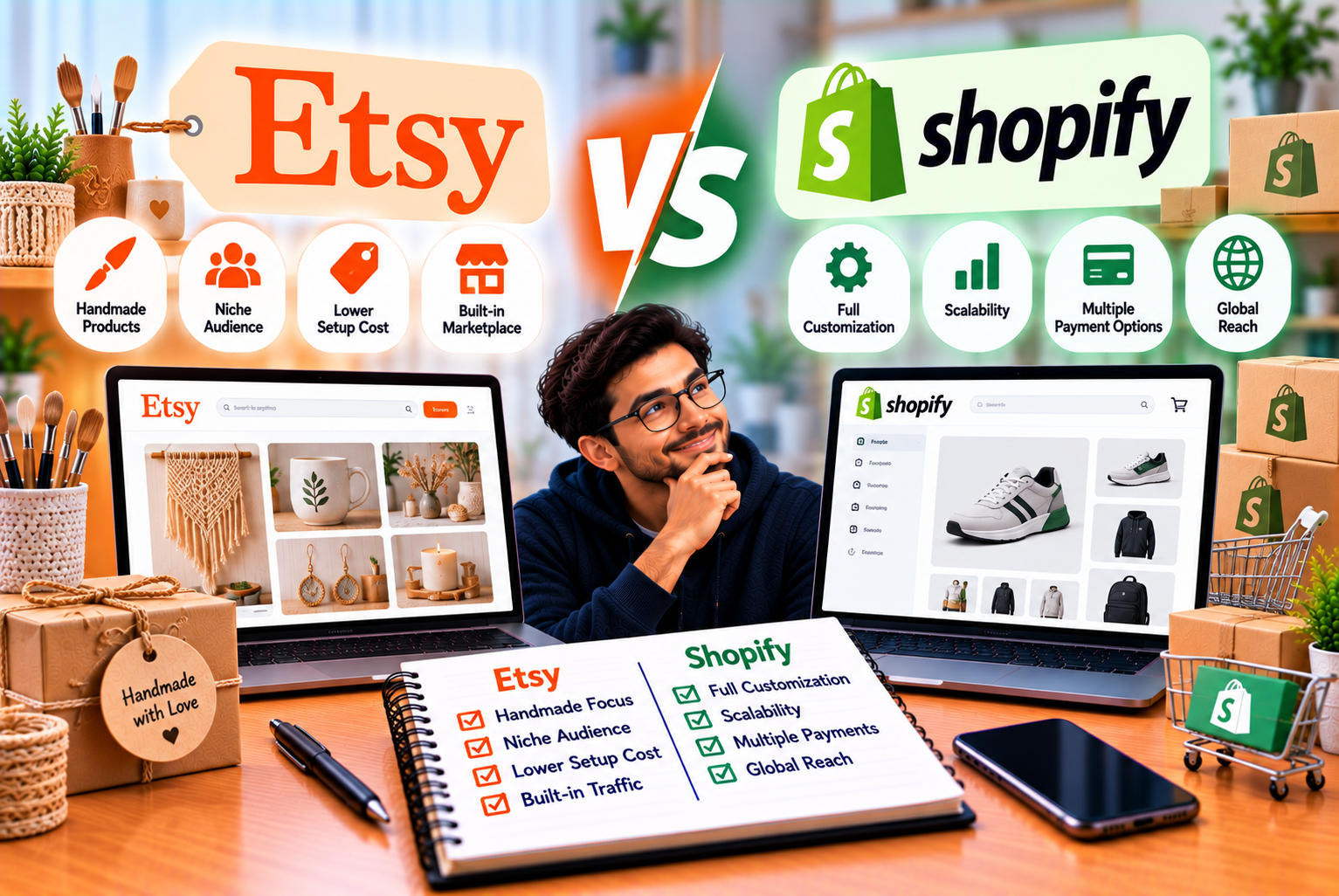
Etsy vs Shopify
Selling handmade products online gives independent creators an opportunity to reach customers beyond their local markets. Whether you make personalized jewelry, home decor, handmade candles, customized clothing, ceramics, artwork, or unique gifts, choosing the right e-commerce platform can influence your costs, customer acquisition strategy, and long-term business growth.
Two popular options are Etsy and Shopify. However, they work differently.
Etsy is an online marketplace where independent sellers list products alongside other shops. It gives shoppers a centralized place to discover handmade goods, vintage items, craft supplies, and original designs.
Shopify, on the other hand, is an e-commerce platform that allows businesses to build and operate their own online stores. You can customize your storefront, establish your brand identity, manage products, process orders, and sell through supported sales channels.
The difference is important because opening an Etsy shop and launching a Shopify store involve different challenges. Etsy provides access to an existing marketplace, while Shopify gives you greater control over your store but generally requires you to develop your own customer acquisition strategy.
So, which platform is better for selling handmade products?
In this Etsy vs Shopify comparison, we examine pricing, selling fees, product listings, website customization, marketing, customer relationships, inventory management, international selling, and business scalability. We also explain when using both platforms together might make sense.
Quick verdict: Etsy is often a practical starting point for handmade sellers who want to test product demand within an established marketplace. Shopify is often better for businesses that want to build an independent brand, control the shopping experience, and develop a long-term customer acquisition strategy. For some businesses, combining the two offers a useful balance.
What Is Etsy?
Etsy is an online marketplace focused on creative products and independent sellers.
It allows eligible sellers to offer handmade products, seller-designed items, qualifying vintage goods, and craft supplies. Shoppers can search across multiple stores and compare products without visiting each seller’s independent website.
You can explore the marketplace through the official Etsy website.
How Etsy Works for Handmade Sellers
Opening an Etsy shop generally involves creating a seller account, configuring shop details, listing products, setting prices, and arranging order fulfillment.
Once your products are published, they can appear in relevant Etsy search results and other marketplace discovery surfaces, subject to Etsy’s systems, policies, and competition.
For example, a seller making handmade silver jewelry could list necklaces, rings, and bracelets. Customers searching Etsy for personalized jewelry may discover those products alongside listings from other sellers.
This marketplace structure can help a new business reach potential customers without first building a complete independent e-commerce website.
However, visibility is not guaranteed. Sellers must compete with other listings, maintain attractive product pages, and provide products that match customer searches.
Etsy’s Main Advantages
- Access to an established marketplace.
- Product discovery through Etsy search and browsing.
- Listing tools designed for marketplace selling.
- Customer reviews and shop pages.
- Opportunities to sell eligible handmade and personalized products.
- Marketplace advertising options.
- A relatively straightforward way to test product demand.
Etsy’s Main Limitations
- Competition from other sellers.
- Marketplace selling fees.
- Restrictions on the products sellers may offer.
- Less control over the overall marketplace experience.
- Limited ability to customize the broader platform.
- Dependence on Etsy’s policies and discovery systems.
Etsy can be an attractive option for creators who want to focus on making products while using an established marketplace to find potential customers.
What Is Shopify?
Shopify is an e-commerce platform that businesses use to create and manage online stores.
Unlike Etsy, Shopify is not primarily a marketplace where customers browse every participating seller’s products through one centralized storefront.
Instead, Shopify provides the technology for a merchant to operate an independent online store.
You can explore its current features and plans through the official Shopify website.
How Shopify Works for Handmade Sellers
With Shopify, you create a storefront for your handmade business, add products, configure payment methods, organize shipping, and manage orders.
You can choose a theme, customize your product pages, create collections, publish brand content, and connect supported marketing channels.
For example, a handmade candle business could create a Shopify store featuring separate collections for scented candles, gift sets, seasonal products, and personalized orders.
The business can also publish educational content about candle ingredients, fragrance selection, and product care.
These features provide more opportunities to develop a recognizable brand experience.
However, building a store does not automatically generate traffic. You must attract potential customers through appropriate channels, such as search engines, social media, email marketing, paid advertising, partnerships, or existing customer relationships.
Shopify’s Main Advantages
- Greater control over storefront design and branding.
- No standard per-product marketplace listing fee.
- Flexible product organization and merchandising.
- Built-in e-commerce tools and supported integrations.
- Opportunities to develop customer relationships.
- Support for selling through multiple channels.
- A platform that can grow with the business.
Shopify’s Main Limitations
- Recurring subscription costs.
- Responsibility for customer acquisition.
- Potential payment processing and third-party transaction fees.
- Additional costs for certain apps, themes, or services.
- Greater responsibility for website configuration and ongoing store management.
- No automatic guarantee of marketplace traffic or sales.
Shopify is particularly useful for sellers who want to build an independent business rather than rely entirely on a third-party marketplace.
Etsy vs Shopify: Quick Comparison
The most important difference is that Etsy provides a marketplace, while Shopify provides the infrastructure for running your own store.
| Feature | Etsy | Shopify |
| Business model | Online marketplace | E-commerce platform |
| Store ownership | Operate a shop within Etsy | Operate an independent online storefront |
| Existing marketplace audience | Yes | No equivalent centralized handmade marketplace by default |
| Monthly platform subscription | Standard marketplace selling does not require a Shopify-style store subscription | Requires a paid plan for a full online store after any applicable introductory offer |
| Product listing fees | Standard listing fee applies | No standard per-product marketplace listing fee |
| Transaction fees | Standard 6.5% transaction fee | Depends on payment setup; third-party transaction fees may apply |
| Payment processing | Country-specific Etsy Payments fees | Payment provider and country-specific fees |
| Website customization | Limited to Etsy’s supported shop features | Broader storefront customization |
| Custom domain | Not the same as operating an independent store | Supported |
| Customer acquisition | Marketplace discovery plus external marketing | Merchant-led marketing and supported sales channels |
| SEO control | Primarily marketplace listings and shop content | Greater control over website pages and technical SEO |
| Customer relationships | Governed by Etsy’s platform and policies | Greater control over store-level customer experiences and permitted marketing |
| Product restrictions | Must comply with Etsy’s Creativity Standards and other policies | Must comply with Shopify’s policies, payment rules, and applicable laws |
| Inventory management | Marketplace listing and order tools | Store inventory tools and supported integrations |
| Best for | Testing and selling creative products in a marketplace | Building and growing an independent e-commerce brand |
Neither platform is automatically better for every handmade business. Your ideal choice depends on your product margins, marketing skills, sales volume, budget, and long-term goals.
1. Etsy vs Shopify Pricing: Which Is More Affordable?
Pricing is one of the first considerations when deciding where to sell handmade products.
Etsy generally charges sellers through listing fees, transaction fees, payment processing fees, and other applicable charges.
Shopify uses a subscription-based model for its full online store, with payment processing costs and potential additional charges depending on the plan and services used.
The more affordable platform depends on your sales volume and business requirements.
Etsy Pricing
Etsy’s published fee policy includes:
- A standard listing fee of $0.20 USD per listing.
- A 6.5% transaction fee on the applicable order amount.
- Payment processing fees that vary by country.
- Potential advertising charges.
- A potential one-time shop setup fee.
- Other applicable charges, such as currency conversion or regulatory operating fees.
The standard listing fee generally applies when a listing is created or renewed, whether or not it sells.
You can review the current details in Etsy’s official Fees & Payments Policy.
Shopify Pricing
Shopify charges a recurring subscription for its full online store plans.
Its pricing depends on the selected plan, billing arrangement, location, and applicable offers.
For example, Shopify’s US pricing page currently lists the Basic plan at $29 USD per month when billed annually, while monthly billing is listed at $39 USD per month. Higher-tier plans have higher subscription prices.
These are US pricing examples, not universal prices. Local pricing and available payment methods differ by market.
Check the official Shopify pricing page for current prices in your country.
Shopify generally does not charge a standard listing fee for every product you add to your online store. However, you must account for the subscription, payment processing, potential third-party transaction fees, and any additional services you use.
Etsy vs Shopify: Pricing Differences
| Cost Component | Etsy | Shopify |
| Platform subscription | No standard monthly subscription for ordinary marketplace selling | Recurring subscription for a full online store |
| Product listing | $0.20 USD standard listing fee | No standard per-product marketplace listing fee |
| Selling fee | 6.5% standard transaction fee | Depends on payment setup and applicable fees |
| Payment processing | Country-specific Etsy Payments rates | Payment provider and plan-specific rates |
| Advertising | Optional Etsy Ads; Offsite Ads charges may apply | Costs depend on advertising channels and campaigns |
| Domain | Shop operates within Etsy’s marketplace | Custom domain supported; registration may cost extra |
| Apps and extensions | Depends on services used | Some apps and services require additional payment |
| Website hosting | Etsy hosts the marketplace | Hosting is included with the Shopify subscription |
Which Platform Is Cheaper for a New Seller?
Etsy can be more accessible for someone who wants to list a small number of handmade products without paying for a full independent store subscription.
Shopify can be more attractive when a seller wants greater control over the brand experience or already has an audience that can generate sales.
However, the absence of a monthly subscription does not mean Etsy is always cheaper.
A high-volume seller may pay substantial marketplace and advertising fees on Etsy. A Shopify seller pays a recurring subscription but may avoid Etsy’s standard listing and transaction fees on orders processed through their own store.
The correct comparison depends on your actual order volume, payment costs, advertising expenses, and customer acquisition strategy.
2. Etsy vs Shopify Fees: Which Platform Takes More From Each Sale?
Comparing fees is more useful when you calculate them against a realistic order.
Let’s use an illustrative product priced at $50, with $5 charged for shipping.
Assume the seller uses Etsy’s standard transaction fee and, for the Shopify comparison, an illustrative payment processing rate of 2.9% plus $0.30.
These figures are for demonstrating the calculation. The Shopify processing rate is a US example, and actual rates depend on location, plan, and payment provider.
Etsy Fee Calculation
Product price: $50
Shipping charged: $5
Applicable transaction-fee base in this example: $55
Transaction fee:
$55 × 6.5% = $3.575
Rounded: approximately $3.58.
Assume an illustrative payment processing rate of 3% plus $0.25.
Payment processing:
$55 × 3% + $0.25 = $1.90
Add the standard listing fee:
$0.20
Total of these three fees:
$3.58 + $1.90 + $0.20 = approximately $5.68.
This excludes advertising, applicable taxes, currency conversion, and other potential charges.
Shopify Fee Calculation
Assume the same $55 order amount and an illustrative processing rate of 2.9% plus $0.30.
Payment processing:
$55 × 2.9% + $0.30 = $1.895
Rounded: approximately $1.90.
There is no standard per-product listing fee for the Shopify store.
However, the seller must allocate a share of the monthly subscription to the order and consider any applicable third-party transaction fees.
Comparison
| Fee Component | Etsy Example | Shopify Example |
| Order amount | $55.00 | $55.00 |
| Standard transaction fee | $3.58 | No separate Shopify marketplace transaction fee in this example |
| Payment processing | $1.90 | $1.90 |
| Listing fee | $0.20 | $0.00 |
| Subscription allocation | Not included | Not included |
| Total of illustrated per-order fees | Approximately $5.68 | Approximately $1.90 |
This example shows why Shopify’s per-order platform and payment costs can be lower in some circumstances.
However, the comparison does not mean Shopify is always cheaper overall. The subscription cost and cost of attracting customers must also be included.
Shopify may also charge additional transaction fees when you use certain third-party payment providers. Review the current Shopify payment-provider guidance before estimating your costs.
Why Total Cost Matters More Than the Percentage Alone
Suppose you sell only five products per month through Shopify.
Your subscription cost is divided across a small number of orders, potentially making each order more expensive.
If you sell hundreds of products per month, the subscription becomes a smaller cost per order.
By contrast, Etsy’s transaction and listing fees generally increase as you list and sell more products.
This creates a trade-off:
- Etsy: Lower fixed commitment for ordinary marketplace selling, but listing and sales-related fees.
- Shopify: Recurring subscription, but greater control over your store and potentially lower per-order platform costs.
Calculate both using your expected sales volume rather than relying on a single fee percentage.
3. Product Discovery and Built-In Traffic
One of the biggest differences between Etsy and Shopify is how customers discover products.
Etsy operates a marketplace where shoppers search for products across participating shops.
Shopify provides a store, but the merchant is generally responsible for attracting visitors through marketing and distribution channels.
Etsy’s Marketplace Discovery
Etsy’s existing marketplace is a major attraction for handmade sellers.
Customers can search for specific product types, browse categories, and discover shops through marketplace features.
For example, a customer searching for a personalized ceramic mug may encounter products from multiple Etsy sellers.
A new shop may therefore have an opportunity to reach customers who are already looking for the type of product it offers.
However, marketplace traffic is competitive. Your listings may compete against many similar products, and appearing in search results does not guarantee a sale.
Sellers need to optimize listing titles, attributes, tags, photographs, descriptions, pricing, and customer experience.
Shopify’s Customer Acquisition
Shopify does not automatically place your products in a centralized handmade marketplace with Etsy’s discovery model.
Instead, you operate your own store and attract visitors through channels such as:
- Organic search.
- Social media.
- Paid advertising.
- Email marketing.
- Influencer partnerships.
- Content marketing.
- Referral programs.
- Offline events and QR codes.
- Existing customers and word of mouth.
For example, a handmade jewelry brand could publish articles about jewelry materials, create short product videos, collect email subscribers with appropriate consent, and use social media to direct interested shoppers to its store.
These activities require time, planning, and potentially additional spending.
Which Platform Is Better for Traffic?
| Requirement | Better Starting Point |
| Reach shoppers already browsing a handmade marketplace | Etsy |
| Test demand for a niche creative product | Etsy can be useful |
| Build traffic around your own brand | Shopify |
| Develop an independent content marketing strategy | Shopify |
| Sell through an existing social audience | Either platform |
| Build a long-term email marketing channel | Shopify offers more direct store-level control, subject to consent and applicable rules |
Verdict: Etsy often provides a more convenient starting point for marketplace discovery. Shopify offers greater flexibility for developing an independent traffic strategy.
4. Branding and Store Customization
Brand identity can influence whether customers remember your business and return for future purchases.
Etsy and Shopify offer different levels of control over the shopping experience.
Branding on Etsy
Etsy allows sellers to establish a shop identity using supported features such as shop names, branding elements, product photography, descriptions, and shop policies.
These features help create a recognizable shop within the marketplace.
However, your shop remains part of Etsy. The overall navigation, checkout experience, and broader platform design are controlled by Etsy.
You also operate within Etsy’s marketplace policies and product requirements.
This structure can be suitable for creators who want to focus on products rather than designing and maintaining an independent storefront.
Branding on Shopify
Shopify gives you more control over the storefront’s design and presentation.
You can customize supported themes, organize product collections, build landing pages, publish brand stories, and create a more consistent experience across your store.
For example, a premium handmade leather goods brand could create:
- A dedicated homepage.
- Product collection pages.
- A brand story.
- A guide to leather materials.
- Product care instructions.
- A personalized gifting section.
- A customer service page.
- An email subscription form.
This can help customers understand the business and its products beyond individual listings.
Branding Comparison
| Branding Feature | Etsy | Shopify |
| Shop name and identity | Supported | Supported |
| Product photography | Supported | Supported |
| Custom homepage | Limited to marketplace features | Greater control |
| Custom landing pages | Limited | Supported |
| Brand storytelling | Shop and listing content | Dedicated pages and content |
| Custom domain | Limited marketplace identity | Supported |
| Checkout branding | Platform-controlled | Greater control within plan limits |
| Technical customization | Limited | Broader customization and integrations |
Verdict: Shopify is the stronger option for sellers who want to develop an independent brand experience. Etsy is often sufficient for businesses that prioritize marketplace selling over extensive website customization.
5. Product Listings and Catalog Management
Both platforms allow sellers to organize products, but their listing structures serve different purposes.
Etsy Product Listings
Etsy listings are designed for marketplace discovery.
A listing can include product images, a title, description, price, available variations, personalization options where supported, shipping information, and relevant listing attributes.
For handmade products, detailed descriptions are particularly important.
A jewelry seller, for example, should explain materials, dimensions, finishes, customization options, and care instructions.
Because buyers may compare multiple shops on the same marketplace, strong product photography and accurate descriptions can help differentiate your listing.
Shopify Product Management
Shopify provides product-management features within a store environment.
Depending on your configuration, you can manage products, variants, inventory, collections, product pages, and supported sales channels from the administration dashboard.
This is particularly useful when you have a larger catalog or want to organize products around your own brand strategy.
For example, a handmade furniture business could create separate collections for desks, chairs, storage products, and made-to-order furniture.
You can also build supporting pages to explain customization options, production processes, materials, and delivery expectations.
Which Platform Is Better for Product Management?
Etsy can be easier when you have a relatively small catalog and want to list products in an existing marketplace.
Shopify can be more flexible when you need to manage a broader catalog, operate an independent store, and coordinate multiple sales channels.
The best choice depends on the complexity of your products and how you plan to fulfill orders.
6. SEO: Etsy Search vs Shopify SEO
Search visibility matters because it helps potential customers discover your products.
However, Etsy SEO and Shopify SEO operate in different environments.
Etsy SEO
Etsy SEO focuses on making your listings relevant to searches performed within Etsy.
Important listing elements include:
- Product titles.
- Relevant tags.
- Listing attributes.
- Categories.
- Descriptions.
- Product photographs.
- Accurate product information.
- Customer experience and other factors used by Etsy’s search systems.
For example, a seller offering personalized wooden signs might target relevant phrases such as “custom wooden name sign” or “personalized nursery decor” when those phrases accurately describe the product.
Avoid adding unrelated keywords merely to attract clicks.
The goal is to connect relevant shoppers with products that meet their needs.
Shopify SEO
Shopify allows you to optimize your independent website for search engines.
Depending on the store and theme, you can manage elements such as:
- Page titles and meta descriptions.
- Product URLs.
- Product descriptions.
- Collection pages.
- Image alt text.
- Internal links.
- Blog articles.
- Structured data through supported themes or apps.
- Technical SEO settings.
- Redirects and canonicalization where relevant.
For example, a handmade skincare business could publish useful content about ingredient selection, product storage, and the differences between product types, provided the claims are accurate and compliant with relevant rules.
This content may help attract customers who are researching products before purchasing.
However, publishing a Shopify store does not guarantee search rankings. Search visibility takes time and depends on many factors, including content quality, technical implementation, competition, and website authority.
SEO Comparison
| SEO Factor | Etsy | Shopify |
| Marketplace search optimization | Core focus | Not applicable in the same way |
| Product title optimization | Supported | Supported |
| Listing tags and attributes | Marketplace-specific | Store and app dependent |
| Independent website SEO | Limited to Etsy-controlled pages | Greater control |
| Blog content | Limited marketplace content options | Built-in blogging functionality |
| Technical SEO customization | Limited | Broader control |
| Internal linking strategy | Limited | More flexible |
| Search traffic ownership | Dependent on Etsy’s platform | More direct control over your website |
Verdict: Etsy is a practical choice for marketplace search optimization. Shopify is stronger for sellers who want to build a broader organic search strategy around their own domain.
7. Marketing and Advertising
Marketing is another major consideration when choosing between Etsy and Shopify.
The platforms offer different starting points, but neither guarantees profitable sales.
Etsy Marketing Options
Etsy provides advertising and marketplace-related promotional opportunities.
These can include Etsy Ads, which promotes listings within Etsy, and Offsite Ads, which promotes eligible products externally.
Offsite Ads fees apply to qualifying attributed orders under Etsy’s current rules.
Sellers can also promote their shops through social media, email marketing where permitted, collaborations, and other external channels.
The advantage is that you can combine marketplace discovery with your own marketing.
The disadvantage is that competition and marketplace fees can affect profitability.
Shopify Marketing Options
Shopify stores can connect with supported marketing tools and sales channels.
Depending on your setup, you can use:
- Search engine optimization.
- Email marketing.
- Social media advertising.
- Organic social content.
- Paid search advertising.
- Influencer campaigns.
- Affiliate marketing.
- Customer referral programs.
- Content marketing.
- Abandoned checkout recovery features where available.
These tools can support a broader customer acquisition strategy.
However, paid advertising can become expensive if targeting, conversion rates, and product margins are not managed carefully.
A seller should not assume that Shopify’s lack of Etsy-style listing fees makes advertising-free sales easy to generate.
Which Platform Is Better for Marketing?
Etsy is useful when you want to combine marketplace discovery with optional promotional tools.
Shopify is more flexible when you want to build a coordinated marketing strategy around your own brand and website.
For a new seller without an established audience, Etsy may be a useful starting point. For a business with a strong social following, email list, or repeat-customer base, Shopify may offer greater strategic control.
8. Customer Relationships and Repeat Purchases
Repeat purchases can be valuable for businesses that sell consumable, collectible, seasonal, or giftable products.
However, the ability to manage customer relationships differs between Etsy and Shopify.
Customer Relationships on Etsy
Etsy provides order information, messaging, reviews, and other marketplace features that help sellers communicate with buyers.
However, sellers must follow Etsy’s rules when using customer information.
Purchasing an item does not automatically mean a customer has agreed to receive unrestricted marketing messages.
You should follow Etsy’s policies, applicable privacy laws, and consent requirements.
Customer Relationships on Shopify
Shopify provides more direct control over the customer experience within your store.
Depending on your setup and applicable requirements, you can manage customer profiles, offer account features, create email sign-up forms, and integrate marketing tools.
This can be useful for a handmade brand that wants to develop a repeat-customer strategy.
For example, a candle business might offer an optional email newsletter featuring new fragrances, seasonal collections, and product-care information.
However, marketing communications must comply with relevant consent, privacy, and unsubscribe requirements.
Customer Relationship Comparison
| Feature | Etsy | Shopify |
| Order communication | Supported through marketplace tools | Supported through store tools and integrations |
| Customer order history | Available within Etsy’s system | Available within the merchant’s store system |
| Email marketing | Subject to Etsy rules and applicable consent requirements | Supported through available tools and integrations |
| Loyalty programs | Limited to supported options and integrations | Available through supported apps and services |
| Repeat-purchase strategy | Marketplace-dependent | Greater store-level control |
| Brand-controlled customer experience | Limited | More flexible |
Verdict: Shopify generally offers more control over customer relationship management, while Etsy provides the tools needed to manage marketplace orders and customer communication.
9. Shipping, Fulfillment, and Inventory Management
Handmade products can present fulfillment challenges because they may require individual production, customization, or careful packaging.
Both Etsy and Shopify can support sellers, but your operational requirements determine which platform is more convenient.
Shipping on Etsy
Etsy allows sellers to configure shipping information, processing times, shipping profiles, and available delivery methods.
Eligible sellers in supported countries may also purchase shipping labels through Etsy.
For made-to-order products, accurate processing times are important because production can take longer than shipping itself.
A seller making customized wedding favors, for example, should account for design approval, production, packaging, and carrier transit time.
Shipping on Shopify
Shopify provides shipping and order-management features within its e-commerce platform.
Depending on your location and configuration, you may use supported shipping services, third-party fulfillment providers, shipping applications, or other integrations.
You can also manage order information through the store’s administration system.
For businesses selling through several channels, Shopify may help centralize certain inventory and order-management activities, depending on the integrations used.
Inventory Management
Etsy can be sufficient for sellers with a relatively small catalog or straightforward inventory.
Shopify may be more suitable for businesses managing larger product ranges, multiple variants, and sales through several channels.
For example, a handmade clothing business may need to manage different sizes, colors, fabrics, and made-to-order options.
The best platform depends on how complex your inventory is and whether you need integrations with external systems.
10. Product Restrictions and Handmade Policies
Before choosing a platform, confirm that your products comply with its rules.
This is particularly important for sellers whose products involve customization, production partners, vintage items, or regulated materials.
Etsy Product Requirements
Etsy operates under its Creativity Standards and other marketplace policies.
The platform permits eligible handmade products, seller-designed products, qualifying vintage items, and craft supplies.
Some seller-designed products may be produced with the help of disclosed production partners under Etsy’s requirements.
However, not every mass-produced product qualifies for sale under the same rules.
If your business uses outside manufacturers, print-on-demand services, or other production partners, review Etsy’s policies carefully before listing products.
You can read the official Etsy Creativity Standards to understand the marketplace’s product requirements.
Shopify Product Requirements
Shopify offers a broader general e-commerce framework, but sellers must still follow Shopify’s Acceptable Use Policy, applicable payment-provider rules, and relevant laws.
A product that is not suitable for Etsy may still be sellable through Shopify, provided it complies with the platform’s policies and applicable legal requirements.
However, having a Shopify store does not eliminate obligations concerning product safety, intellectual property, consumer protection, advertising, or shipping restrictions.
Verdict: Etsy is particularly suitable for products that fit its creative marketplace model. Shopify offers greater flexibility for broader product catalogs, subject to its policies and applicable law.
11. Etsy vs Shopify for Beginners
Beginners often want a platform that is affordable, easy to manage, and capable of generating their first sales.
The right choice depends on whether the seller already has an audience and how much control they need.
When Etsy Is Better for Beginners
Etsy can be a practical starting point if:
- You are testing a handmade product idea.
- Your catalog is relatively small.
- You do not want to build a complete website immediately.
- Your products fit Etsy’s marketplace rules.
- You want to learn how customers respond to your listings.
- You are comfortable competing within a shared marketplace.
The platform can reduce the initial work involved in creating an independent storefront.
However, you still need to research demand, optimize listings, price products correctly, and manage customer service.
When Shopify Is Better for Beginners
Shopify may be a better starting point if:
- You already have a recognizable brand.
- You have an existing social media audience.
- You plan to build an independent website.
- You want more control over the shopping experience.
- You intend to develop content marketing and email marketing.
- Your products or business model are not suited to Etsy’s marketplace requirements.
Shopify provides the infrastructure for operating a store, but you must still develop a plan for generating traffic and sales.
Beginner Comparison
| Beginner Requirement | More Suitable Option |
| Test a small handmade catalog | Etsy |
| Start selling through an existing marketplace | Etsy |
| Build an independent brand website | Shopify |
| Customize the storefront extensively | Shopify |
| Develop long-term website SEO | Shopify |
| Avoid a full online-store subscription initially | Etsy |
| Operate outside Etsy’s specialized product categories | Shopify, subject to policies |
| Use marketplace discovery and own-site branding together | Both |
For many beginners, the best decision is to start with the platform that matches their immediate business goals rather than selecting the one with the longest feature list.
12. Etsy vs Shopify for Established Handmade Businesses
As a handmade business grows, its requirements may change.
A seller who initially needs only a few product listings may eventually require a larger catalog, better inventory management, more sophisticated marketing, and a stronger independent brand.
Why Established Sellers May Choose Shopify
Shopify may become more attractive when a business:
- Has consistent monthly sales.
- Has an established audience.
- Wants to reduce dependence on a single marketplace.
- Needs a more customized storefront.
- Plans to sell through multiple channels.
- Wants to build a broader content marketing strategy.
- Needs more control over customer relationships.
- Wants to develop a recognizable independent brand.
The subscription cost may be easier to justify when the store generates consistent sales.
Why Established Sellers May Continue Using Etsy
Etsy may remain valuable for businesses that:
- Receive meaningful sales from marketplace discovery.
- Sell products that align strongly with Etsy’s audience.
- Have profitable listings after fees.
- Want to maintain a presence in the marketplace.
- Use Etsy as one part of a broader sales strategy.
Moving away from Etsy entirely may mean losing a source of marketplace traffic.
For this reason, a business should evaluate actual performance rather than assuming that an independent website is always superior.
Why Using Both Platforms Can Make Sense
An established seller may operate an Etsy shop while maintaining a Shopify store.
This approach can help diversify sales channels.
For example, Etsy may serve customers who discover handmade products through marketplace search, while Shopify serves customers who arrive through the brand’s website, social channels, email marketing, or other marketing activities.
However, selling through two platforms increases operational complexity.
You must account for inventory synchronization, order management, customer communication, pricing, and channel-specific policies.
The goal should be to diversify profitably, not simply to create more work.
13. Can You Sell on Etsy and Shopify at the Same Time?
Yes. A business can generally sell through Etsy and Shopify simultaneously, provided it follows both platforms’ policies and manages its operations appropriately.
For handmade sellers, this can be a useful strategy because each platform serves a different purpose.
Etsy can provide marketplace discovery, while Shopify offers an independent storefront and greater control over brand presentation.
Benefits of Selling on Both Platforms
- More than one sales channel
Your business is not dependent on a single platform for every sale.
- Different customer acquisition methods
Etsy can attract marketplace shoppers, while Shopify can serve visitors from search engines, social media, referrals, and other channels.
- Brand development
You can build an independent store while continuing to operate within Etsy’s marketplace.
- Business experimentation
You can compare performance across channels and identify where your products are most profitable.
Challenges of Selling on Both Platforms
Inventory synchronization: You need to avoid selling the same available unit twice.
Order management: Orders may arrive through different dashboards.
Customer communication: You must respond through the appropriate channel.
Pricing: Marketplace fees and payment costs may differ between platforms.
Marketing: You may need separate strategies for marketplace listings and your independent website.
Policy compliance: Each platform has its own rules for products, customer data, advertising, and transactions.
How to Manage Both Platforms
A practical approach is to:
- Maintain a centralized product catalog.
- Use an inventory system suitable for your business.
- Review available integrations for syncing products and orders.
- Monitor sales and fees separately for each channel.
- Calculate product-level profit by channel.
- Follow each platform’s customer communication and marketing rules.
- Review performance regularly before expanding further.
Shopify offers marketplace integrations that can help connect supported sales channels. For example, you can review the official Shopify Marketplace Connect information to understand its supported marketplaces and functionality.
Always verify the integration’s current compatibility and fees before relying on it.
14. Etsy vs Shopify for Sellers in India
For Indian handmade sellers, platform choice requires additional consideration of payment availability, fees, shipping logistics, customer location, and business compliance.
Etsy for Indian Sellers
Etsy’s published guidance states that Indian sellers enrolled in Etsy Payments use a Payoneer Payment Account to receive their sales funds.
The guidance also states that sellers need a valid and regular GSTIN on file to enroll in Etsy Payments.
Etsy has also stated that Indian shops enrolled in Etsy Payments cannot currently accept domestic sales through the platform.
These requirements can make Etsy more relevant to sellers targeting eligible international markets than to businesses primarily focused on selling to customers within India.
Because platform rules may change, check Etsy’s current country-specific onboarding and payment guidance before making a business decision.
Shopify for Indian Sellers
Shopify provides localized pricing and supports online stores operated by businesses in India.
However, the availability of payment gateways and payment methods depends on the merchant’s location and current provider support.
Indian merchants should verify which payment providers can be used with their business and what transaction charges apply.
Shopify’s India pricing page lists the Basic plan at ₹1,499 per month when billed annually, with monthly billing shown at ₹1,994 per month in its current published pricing comparison.
These figures are subject to change, and introductory offers may differ from standard subscription rates.
You can check the official Shopify India pricing page for current details.
Which Platform Is Better for Indian Handmade Sellers?
| Business Requirement | Potentially Better Fit |
| Sell eligible handmade products to international Etsy shoppers | Etsy, subject to seller eligibility and shipping requirements |
| Primarily target Indian customers | Shopify may offer a more suitable independent-store approach |
| Build a local brand website | Shopify |
| Test eligible products in Etsy’s marketplace | Etsy |
| Control the storefront and customer experience | Shopify |
| Use both marketplace discovery and an independent store | Both, where operationally practical |
Important Costs for Indian Sellers
Indian sellers should calculate more than the displayed subscription or listing fee.
Consider:
- Payment processing fees.
- Applicable marketplace transaction fees.
- Currency conversion.
- Payment withdrawal costs.
- International shipping.
- Customs and export requirements.
- Product packaging.
- Applicable taxes.
- Returns and replacement costs.
- Advertising expenses.
The most suitable platform depends on your target market and the profit remaining after these expenses.
15. Etsy vs Shopify: Which Platform Offers Better Scalability?
Scalability means being able to grow sales and operations without creating disproportionate costs or complexity.
Both platforms can support successful businesses, but their growth models differ.
Scaling on Etsy
Etsy can help sellers expand product catalogs and reach customers through marketplace discovery.
However, growth may increase marketplace fees, competition, listing management requirements, and fulfillment demands.
Your business also remains subject to Etsy’s policies and platform changes.
For some sellers, this is a reasonable trade-off because the marketplace continues to generate valuable sales.
Scaling on Shopify
Shopify can support growth through additional products, storefront customization, supported integrations, marketing channels, and higher-tier plans.
As the business grows, you may introduce new product collections, launch a content strategy, build customer retention programs, or integrate additional inventory and fulfillment systems.
However, scaling also requires careful financial management.
Subscription costs, payment fees, advertising expenses, app subscriptions, and fulfillment costs can increase as the business becomes more complex.
Scalability Comparison
| Growth Factor | Etsy | Shopify |
| Product catalog growth | Supported, subject to marketplace policies | Supported |
| Marketplace discovery | Built into the platform | Not equivalent to Etsy’s centralized marketplace |
| Brand independence | Limited by marketplace structure | Greater control |
| Marketing flexibility | Marketplace tools plus external channels | Broad marketing integrations |
| Multi-channel operations | Marketplace-focused | Broader supported sales-channel options |
| Customer acquisition control | Shared with marketplace systems | Greater responsibility and control |
| Platform dependence | Depends on Etsy’s marketplace | Depends on Shopify and connected providers |
| Best growth model | Marketplace-centered business | Independent brand and multi-channel business |
Verdict: Shopify offers greater control over the infrastructure of an independent brand. Etsy can remain valuable as a marketplace channel. For many growing businesses, the strongest strategy depends on the actual profitability of each channel rather than a universal preference for one platform.
16. Etsy vs Shopify: Which Is Better for Different Handmade Products?
Different handmade businesses have different requirements.
A seller producing one-of-a-kind gifts may benefit from Etsy’s marketplace audience. A brand with a broad product catalog and an established customer base may benefit more from Shopify.
Handmade Jewelry
Etsy can be useful for jewelry makers offering custom engravings, handmade designs, and personalized gifts.
Shopify may be more suitable when a jewelry business wants an independent brand website, detailed collections, and a broader marketing strategy.
Recommendation: Etsy for marketplace discovery; Shopify for brand-led growth. Both can be useful.
Handmade Candles
Etsy can help candle makers reach shoppers searching for gifts and decorative products.
Shopify can support a dedicated candle brand with product collections, subscription-related functionality through suitable integrations, and customer retention marketing.
Recommendation: Etsy for testing product demand; Shopify for a business developing its own brand and repeat-customer strategy.
Custom Clothing
Etsy may suit eligible handmade or seller-designed clothing products.
Shopify may be more practical for a clothing brand managing a larger catalog, size variations, inventory, and multiple marketing channels.
Recommendation: Choose based on product eligibility, inventory complexity, and the importance of independent branding.
Personalized Gifts
Etsy can be useful for sellers offering customized gifts because customers can discover products through marketplace searches.
Shopify may be better for businesses that already have a recognizable gift brand or generate traffic through social media and other marketing channels.
Recommendation: Etsy for marketplace discovery; Shopify for greater control over the full brand experience.
Handmade Home Decor
Etsy provides access to customers looking for distinctive decor, artwork, and handmade household products.
Shopify can help home decor brands build collections, publish design guides, and create a more customized shopping experience.
Recommendation: Both platforms can be suitable, depending on how the business acquires customers.
Digital Designs and Creative Products
Etsy supports eligible digital products, while Shopify can support digital selling through suitable features and apps.
The better choice depends on marketplace fit, file-delivery requirements, licensing, branding, and customer acquisition.
Recommendation: Etsy for marketplace discovery; Shopify for a broader independent digital-product business.
17. A Simple Decision Framework: Etsy or Shopify?
If you are still unsure, answer these questions.
Question 1: Do You Already Have an Audience?
If you have an established audience on social media, a customer email list, or an existing website, Shopify may be a practical choice.
If you have no audience and want to test demand for eligible handmade products, Etsy may be a useful starting point.
Question 2: How Much Control Do You Need?
If marketplace shop features are sufficient, Etsy may meet your needs.
If you want an independent domain, extensive storefront customization, and greater control over the customer experience, Shopify is the stronger option.
Question 3: What Are Your Expected Sales Volumes?
For a small catalog and limited sales, Etsy’s lack of a standard monthly store subscription can make it appealing.
For consistent sales, Shopify’s subscription may become easier to justify, especially if the store generates customers through cost-effective channels.
Question 4: How Will You Attract Customers?
If you want to use Etsy’s marketplace discovery, start by evaluating whether your products fit its audience.
If you are prepared to invest in SEO, content marketing, social media, email marketing, or paid advertising, Shopify can provide a platform for that strategy.
Question 5: What Is Your Long-Term Business Goal?
If you want to operate a shop within an established marketplace, Etsy may be sufficient.
If you want to build an independent brand with a customized storefront and multiple marketing channels, Shopify may be the better long-term foundation.
Final Decision Table
| Your Situation | Recommended Platform |
| You are testing your first handmade product | Etsy |
| You want to reach shoppers browsing handmade products | Etsy |
| You already have a strong audience | Shopify |
| You want an independent brand website | Shopify |
| You need more storefront customization | Shopify |
| You want to combine marketplace and independent-store sales | Both |
| You have limited resources for customer acquisition | Consider Etsy first, if eligible |
| You have a developed marketing strategy | Shopify may be a stronger fit |
Etsy vs Shopify: Final Verdict
Etsy and Shopify are both useful for handmade businesses, but they solve different problems.
Etsy provides a marketplace where customers can discover products from independent sellers. It can be a practical starting point for makers who want to test demand, sell a small catalog, and reach shoppers already searching for creative products.
Shopify provides the infrastructure for running an independent e-commerce store. It offers more control over branding, storefront customization, customer experience, and supported marketing channels, but you must plan how to attract visitors and justify the recurring subscription.
Choose Etsy If:
- You are starting a handmade business.
- You want to test demand before investing in a separate store.
- Your products fit Etsy’s marketplace requirements.
- You want access to marketplace discovery.
- You have a relatively small catalog.
- You are comfortable operating within Etsy’s rules and fee structure.
Choose Shopify If:
- You want to build an independent brand.
- You already have a customer base or marketing plan.
- You need greater control over the website experience.
- You want to develop your own SEO and content strategy.
- You plan to sell through multiple channels.
- You want more direct control over store-level customer relationships.
Consider Both If:
- Etsy generates meaningful sales.
- You want to develop an independent brand alongside marketplace selling.
- You can manage inventory and orders across channels.
- Your margins support the combined costs.
- You have a plan for measuring each channel’s performance.
Our Recommendation
For many new handmade sellers, Etsy is a sensible place to test eligible products and learn what customers want. As the business grows, Shopify can provide a stronger foundation for independent branding and customer acquisition.
However, moving to Shopify should not be treated as an automatic upgrade. If Etsy consistently generates profitable sales, it may remain an important part of your business.
Final verdict: Etsy is often better for getting started with marketplace selling, while Shopify is often better for building an independent e-commerce brand. The best choice is the platform—or combination of platforms—that produces sustainable profit and supports your business goals.
Frequently Asked Questions About Etsy vs Shopify
1. Is Etsy better than Shopify for handmade products?
Etsy can be better for sellers who want access to an established marketplace for eligible handmade products. Shopify can be better for businesses that want an independent online store and greater control over branding, marketing, and the customer experience.
2. Is Shopify cheaper than Etsy?
It depends on sales volume and expenses. Etsy charges listing fees and transaction fees, while Shopify charges a recurring subscription and payment-related fees. Shopify may have lower per-order platform costs in some circumstances, but the subscription and customer acquisition costs must be included.
3. Can I sell handmade products on both Etsy and Shopify?
Yes, businesses can generally operate on both platforms, provided they follow each platform’s policies and manage inventory, orders, and customer information appropriately.
4. Does Etsy have a monthly fee?
Ordinary Etsy marketplace selling does not require a Shopify-style monthly store subscription. However, listing fees, transaction fees, payment processing, optional subscriptions, and other charges may apply.
5. Does Shopify charge listing fees?
Shopify does not generally charge a standard marketplace listing fee for each product added to your online store. You still need to account for the subscription and other applicable costs.
6. Which platform has lower transaction fees?
The answer depends on your country, payment provider, plan, and transaction type. Etsy charges a standard 6.5% transaction fee, in addition to applicable payment processing. Shopify’s fee structure depends on your plan and payment setup, and third-party transaction fees may apply.
7. Which platform is easier for beginners?
Etsy may be easier for beginners who want to list eligible handmade products in an existing marketplace. Shopify may be more suitable for beginners who want to create an independent brand website and are prepared to develop a customer acquisition strategy.
8. Does Shopify provide built-in traffic like Etsy?
Shopify does not provide an equivalent centralized handmade marketplace audience by default. Merchants generally need to attract visitors through SEO, social media, paid advertising, email marketing, partnerships, or other channels.
9. Can Etsy sellers use their own domain?
Etsy’s marketplace shop structure is different from operating an independent website with a custom domain. Shopify supports custom domains for independent online stores.
10. Which platform is better for SEO?
Etsy is designed for marketplace listing optimization. Shopify provides greater control over independent website SEO, including product pages, collection pages, blog content, and technical SEO settings.
11. Is Shopify good for selling personalized gifts?
Yes. Shopify can support a personalized-gift business through product options and suitable apps or integrations. Etsy can also be useful because shoppers can discover eligible personalized products through marketplace search.
12. Is Etsy better for handmade jewelry?
Etsy can be useful for handmade jewelry makers seeking marketplace discovery. Shopify may be more suitable for jewelry businesses that want to build an independent brand, manage larger collections, and develop their own marketing channels.
13. Can I move my Etsy products to Shopify?
You can generally recreate or import eligible product information into Shopify using supported tools or apps. However, product data, images, variants, inventory, and order history may require additional preparation. Review the current import options before migrating.
14. Will I lose Etsy customers if I open a Shopify store?
Opening a Shopify store does not automatically remove your Etsy shop or its listings. However, customers who discover you through Etsy may continue purchasing there. Your independent store needs its own customer acquisition strategy, and you must follow Etsy’s rules when communicating with marketplace customers.
15. Which platform is better for international selling?
Both platforms can support international commerce, subject to seller eligibility, payment availability, shipping arrangements, and applicable rules. Etsy offers marketplace discovery, while Shopify provides an independent store with supported international selling features.
16. Is Shopify suitable for small handmade businesses?
Yes. Shopify can support small handmade businesses that want an independent storefront. However, sellers should ensure that expected sales and business benefits justify the subscription and other expenses.
17. Does Etsy restrict which products I can sell?
Yes. Etsy has Creativity Standards and other policies defining eligible product categories and seller requirements. Review these rules before listing products, particularly if you use production partners or sell items that are not traditionally handmade.
18. Can I build a brand on Etsy?
Yes, you can establish a shop identity through supported branding features, product presentation, and customer service. However, the overall shopping experience remains part of Etsy’s marketplace. Shopify offers greater control over an independent brand website.
19. Should I start with Etsy and move to Shopify later?
That can be a practical strategy if your products fit Etsy’s rules and marketplace sales help validate demand. You can later launch Shopify when your business needs more customization or an independent marketing channel. You do not necessarily need to leave Etsy when opening a Shopify store.
20. Which platform is better for a handmade business in India?
The answer depends on your target customers and seller eligibility. Etsy’s India-specific payment and domestic-sales conditions are important to verify. Shopify can support an independent store targeting Indian customers, subject to payment-provider availability and local business requirements.
21. Can I use Shopify without buying a domain?
Shopify provides a default store address, so you can begin setting up a store without immediately purchasing a custom domain. A custom domain can help establish a more recognizable independent brand.
22. Does Etsy handle shipping for sellers?
Etsy provides shipping settings and, in supported locations, shipping-label purchasing. Sellers generally remain responsible for preparing orders and fulfilling them according to their shop policies and applicable requirements.
23. Is Shopify better for repeat customers?
Shopify generally provides more control over store-level customer relationships and supported marketing integrations. However, building repeat purchases still depends on product quality, customer service, pricing, and appropriate marketing.
24. Can Shopify help me sell through social media?
Yes. Shopify supports selling through various channels and integrations, subject to availability and account requirements. Sellers should verify the compatibility of their chosen social platforms and payment arrangements.
25. What is the biggest difference between Etsy and Shopify?
Etsy is a marketplace where shoppers discover products from multiple sellers. Shopify is an e-commerce platform for building and operating your own online store. Etsy emphasizes marketplace discovery, while Shopify provides greater control over an independent storefront and its marketing strategy.
Official References
Use these official resources to verify platform features, fees, and policies before publishing.
- Etsy Fees & Payments Policy — Listing fees, transaction fees, currency conversion, and other selling costs.
- Etsy Seller Information — Shop setup and an overview of Etsy’s selling process.
- Etsy Creativity Standards — Eligible products and marketplace requirements.
- Shopify Pricing — Current US plan pricing and fee information.
- Shopify India Pricing — Current pricing information for India.
- Shopify vs Etsy Comparison — Shopify’s comparison of the two platforms.
- Shopify Payments Fees — Payment processing and transaction-fee information.
- Shopify Third-Party Payment Providers — Fees and considerations when using third-party gateways.
- Shopify Marketplace Connect — Information about marketplace integrations.
Leave a Reply