


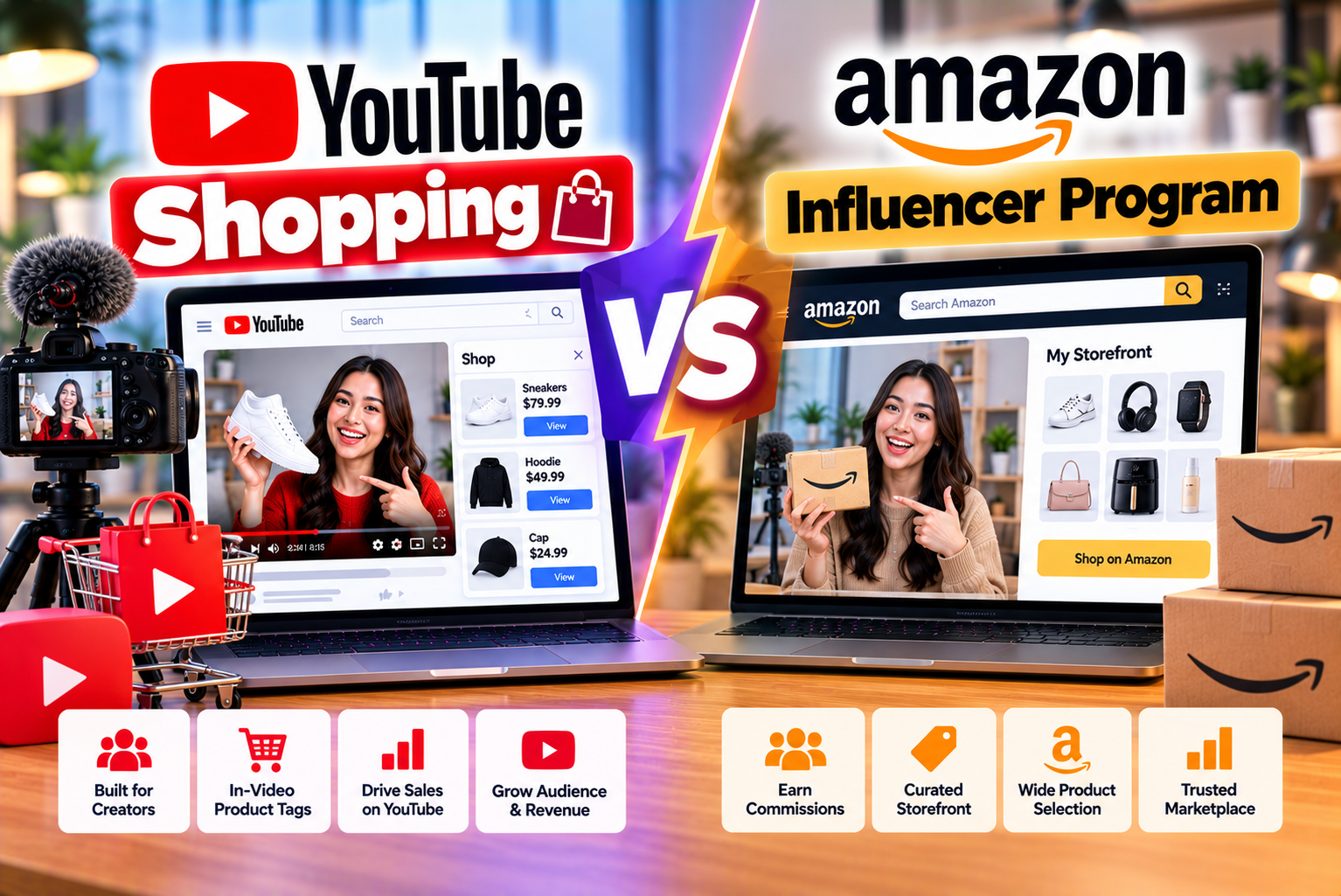
YouTube Shopping vs Amazon Influencer Program
Affiliate marketing has become an important monetization opportunity for content creators who want to earn money by recommending products. Instead of relying entirely on advertising revenue, creators can use their videos, product demonstrations, tutorials, and reviews to connect viewers with products they may want to purchase.
Two programs that creators frequently compare are the YouTube Shopping affiliate program and the Amazon Influencer Program.
Both allow eligible creators to monetize product recommendations, but they approach affiliate marketing differently.
YouTube Shopping integrates product discovery and tagging into eligible YouTube content. Creators can tag participating products in supported videos, Shorts, and live streams, allowing viewers to explore product information and continue to a retailer’s website.
The Amazon Influencer Program gives approved creators a personalized Amazon storefront and affiliate links they can use to direct their audiences to recommended products. Depending on the country and program features available, creators may also have opportunities to earn from eligible content displayed on Amazon.
The difference matters because choosing an affiliate program is not just about comparing commission rates. Creators must also consider where their audiences shop, which products they recommend, how they publish content, and how much time they want to spend managing affiliate links.
For example, a technology reviewer who regularly compares smartphones may benefit from Amazon’s product catalog and storefront features. The same creator may also benefit from YouTube Shopping’s integrated product-tagging tools when the relevant retailers and products are available.
So, which option is better?
YouTube Shopping may be the better fit for creators who want integrated product tagging and shopping analytics within YouTube. The Amazon Influencer Program may be more suitable for creators who want a dedicated product storefront and Amazon affiliate links. Some creators may benefit from using both, provided they meet the requirements and follow each program’s rules.
This guide compares the two programs in detail to help you decide which one best fits your content strategy.
What Is YouTube Shopping?
The YouTube Shopping affiliate program allows eligible creators to tag participating products in supported YouTube content and earn commissions on qualifying purchases.
The program connects product recommendations with the videos viewers are already watching.
For example, a creator publishing a laptop review can tag an eligible laptop or related accessory. Viewers can explore the tagged product and continue to the retailer’s website to complete a purchase.
YouTube Shopping supports product discovery across eligible content formats, including long-form videos, Shorts, and live streams.
Creators can use the relevant Shopping tools in YouTube Studio to explore products, add tags, and review available shopping-performance information.
Main Features of YouTube Shopping
Integrated product tagging: Creators can associate eligible products with supported content.
Product discovery: Viewers can explore tagged items while interacting with YouTube content.
Shopping analytics: Eligible creators can review available product-performance and earnings information in YouTube Studio.
Participating retailers: Creators can select from products offered through the Shopping program’s participating retailers.
Multiple content formats: Eligible creators can use supported shopping features in videos, Shorts, and live streams.
Potential additional income: Creators may earn commissions when viewers make qualifying purchases through eligible shopping interactions.
YouTube has expanded access to its Shopping affiliate program over time. In March 2026, it announced expanded access for eligible YouTube Partner Program creators with at least 500 subscribers, subject to the applicable requirements.
However, reaching that subscriber count does not automatically guarantee access. Creators must meet the other eligibility conditions and be able to enroll in the program.
For the latest requirements, consult the official YouTube Shopping affiliate program guidance.
What Is the Amazon Influencer Program?
The Amazon Influencer Program is an extension of Amazon’s Associates affiliate program designed for eligible social media creators.
Approved creators receive a personalized storefront on Amazon where they can organize and recommend products to their audiences.
Depending on the country and features available, creators may also be able to publish product-related content, create curated product lists, share affiliate links, and participate in additional creator opportunities.
For example, a beauty creator could build a storefront featuring makeup products, skincare accessories, and beauty tools. A technology creator could organize recommendations into categories such as laptops, microphones, cameras, and gaming accessories.
Instead of sharing a separate product link every time, the creator can direct viewers to a centralized storefront.
When shoppers make qualifying purchases through eligible affiliate interactions, the creator may earn commissions according to the applicable program terms.
Main Features of the Amazon Influencer Program
Personalized storefront: Approved creators receive a dedicated Amazon page where they can organize product recommendations.
Affiliate links: Creators can generate eligible links to recommended products.
Curated product collections: Storefronts can help organize products into categories or lists.
Product-focused content: Depending on the marketplace and available features, creators may be able to publish product-related content for shoppers.
Commission opportunities: Qualifying purchases can generate advertising fees according to the relevant commission schedule.
Creator resources: Amazon offers educational materials and other resources to help creators improve their product recommendations and content strategy.
The Amazon Influencer Program is available in selected marketplaces, and its features are not identical in every country.
Creators in India should review the official Amazon India Influencer Program and its eligibility requirements before applying.
YouTube Shopping vs Amazon Influencer Program: Quick Comparison
The following table summarizes the major differences.
| Feature | YouTube Shopping Affiliate Program | Amazon Influencer Program |
| Primary purpose | Integrate product recommendations into eligible YouTube content | Provide creators with a storefront and Amazon affiliate opportunities |
| Main platform | YouTube | Amazon storefront plus permitted promotional channels |
| Product discovery | Product tags on eligible YouTube content | Storefronts, affiliate links, and eligible product content |
| Creator storefront | Not the central feature of the affiliate program | A core feature of the program |
| Product tagging | Integrated into supported YouTube workflows | Product links and storefront recommendations are central; other features vary |
| Product selection | Participating retailers and eligible products | Products available through the applicable Amazon marketplace and program |
| Eligibility | YouTube Partner Program and other Shopping requirements | Application review and qualifying social media presence |
| Subscriber requirements | Depends on current YouTube Shopping eligibility; eligible YPP creators with 500+ subscribers can qualify under the 2026 expansion | No single universal follower threshold applies across all marketplaces; applications are reviewed against relevant criteria |
| Commission rates | Vary by product, retailer, and campaign | Vary by product category, marketplace, and program terms |
| Analytics | Available Shopping information within YouTube Studio | Affiliate reports and other account analytics |
| Content formats | Supported videos, Shorts, and live streams | Social content, storefront promotion, and eligible Amazon-hosted content |
| External promotion | Subject to YouTube Shopping affiliate terms | Permitted promotional methods depend on Amazon’s applicable policies |
| Payment system | Through the applicable YouTube payment process, including AdSense for YouTube for affiliate commissions | Through the applicable Amazon Associates payment system |
| Best suited for | Creators who want integrated YouTube product tagging | Creators who want a centralized Amazon product storefront |
| Main limitation | Restricted to eligible creators, participating retailers, and supported products | Restricted to Amazon’s marketplace, approval rules, and applicable program terms |
The most important difference is the shopping experience each program provides. YouTube Shopping connects product recommendations directly to YouTube content, while Amazon’s Influencer Program gives creators a dedicated place to organize and promote products.
1. Eligibility Requirements: Which Program Is Easier to Join?
Eligibility is one of the first factors to consider when choosing between the two programs.
YouTube Shopping and Amazon evaluate creators differently, so a creator who qualifies for one program may not automatically qualify for the other.
YouTube Shopping Eligibility
YouTube Shopping is connected to the YouTube Partner Program.
According to YouTube’s published guidance, eligible creators must meet requirements that include:
- Being accepted into the YouTube Partner Program.
- Meeting the applicable subscriber threshold.
- Being based in an eligible country.
- Not operating a restricted music channel or Official Artist Channel.
- Meeting the relevant Made for Kids restrictions.
- Following YouTube’s applicable policies and Shopping affiliate terms.
YouTube announced in March 2026 that it was expanding Shopping affiliate access to eligible YPP creators with at least 500 subscribers.
This makes the program potentially accessible to smaller creators, but the subscriber threshold is only one part of eligibility.
Creators should check the Earn section in YouTube Studio to confirm whether the program is available to their channel.
Amazon Influencer Program Eligibility
Amazon’s Influencer Program uses an application-based process.
Creators can apply using qualifying social media accounts, including YouTube. Amazon evaluates the submitted account and other relevant factors to determine whether the applicant qualifies.
The evaluation can consider:
- Follower or subscriber count.
- Content quality.
- Audience engagement.
- Account activity.
- The suitability of the creator’s social media presence.
Amazon does not publish one universal follower threshold that guarantees acceptance across every marketplace.
Its requirements and review process can differ by country and program.
For example, Amazon India publishes social-network eligibility guidance for its Associates program that refers to an established public social profile and, in most cases, at least 500 organic followers or likes. That guidance should not be interpreted as a universal guarantee of acceptance into every Amazon Influencer marketplace.
Which Program Is Easier for Beginners?
The answer depends on the creator’s current situation.
A YouTube creator who is already accepted into YPP and meets the Shopping requirements may find YouTube Shopping convenient because the relevant tools are integrated into YouTube Studio.
A creator with a qualifying social media account may be able to apply to Amazon’s Influencer Program, but approval is not automatic.
| Creator Situation | Program to Explore First |
| Already in YPP and eligible for Shopping | YouTube Shopping |
| Has an established YouTube audience but is not yet in YPP | Review Amazon’s application requirements and work toward YPP eligibility |
| Wants a dedicated Amazon storefront | Amazon Influencer Program |
| Wants product tagging integrated into YouTube videos | YouTube Shopping |
| Has multiple qualifying social media accounts | Explore Amazon’s application options and YouTube Shopping eligibility separately |
Verdict: YouTube Shopping is a natural starting point for creators who already qualify for its integrated tools. Amazon may be attractive to creators who want a storefront, but acceptance depends on its review process.
2. Product Selection and Retailer Availability
The range of products you can recommend can strongly influence your affiliate strategy.
A program may have attractive features but still be less useful if it does not include the products your audience wants.
Product Selection With YouTube Shopping
YouTube Shopping lets eligible creators select from the products and retailers available through the program.
Depending on the creator’s market, the catalog may include products across categories such as:
- Electronics and technology.
- Fashion and accessories.
- Beauty and personal care.
- Home and kitchen.
- Lifestyle products.
- Other participating retail categories.
The exact catalog varies by market, retailer participation, and channel access.
YouTube announced in August 2026 that Amazon was joining its Shopping affiliate program for eligible creators in the United States. In an October 2026 announcement about Indian creators, Google also described plans to expand the partnership with Amazon to India, alongside additional retail partnerships.
Because these rollouts can happen at different times, creators should not assume that every Amazon product is available for YouTube Shopping tagging in every country.
Check the products and retailers shown in your own YouTube Studio account.
Product Selection With Amazon
The Amazon Influencer Program gives creators access to products listed on the applicable Amazon marketplace, subject to program eligibility and link-generation rules.
This can be useful for creators who want to recommend products from a familiar retailer with a broad product catalog.
For example, a technology creator could organize products into categories such as:
- Smartphones and accessories.
- Laptops and computer peripherals.
- Cameras and photography equipment.
- Microphones and recording tools.
- Gaming accessories.
- Home office equipment.
A lifestyle creator could create lists for kitchen essentials, travel accessories, home organization, and everyday products.
The available inventory, prices, and product details can change, so creators should periodically review their recommendations.
Which Program Offers Better Product Variety?
Amazon may be more convenient when you want to curate products from Amazon’s extensive marketplace.
YouTube Shopping may be more useful when the relevant products are already available through its participating retailers and you want viewers to discover them directly through tagged content.
The better option depends on the products your audience actually purchases, not just the total number of listings available.
3. Commission Rates: Which Program Pays More?
Commission rates are an important consideration, but they should not be the only factor used to select an affiliate program.
Both programs can offer different rates depending on the product, retailer, country, and applicable terms.
YouTube Shopping Commission Rates
YouTube Shopping commissions vary by product and retailer.
Eligible creators may see commission information in the Shopping affiliate tools. Some campaigns may offer custom commission rates or other incentives.
The amount earned from a qualifying purchase depends on the applicable commission rate and the program’s attribution and validation rules.
For example, if an eligible product has a commission rate of 5% and a qualifying transaction generates commission on a ₹2,000 sale value, the illustrative commission would be ₹100.
This is only a calculation example. It does not establish a standard YouTube Shopping commission rate or guarantee that commission will be calculated on the entire purchase value.
Amazon Influencer Program Commission Rates
Amazon’s commission rates vary by product category and marketplace.
For example, the rate applicable to one category may differ from the rate for electronics, fashion, home products, or other categories.
The amount a creator earns can also depend on qualifying purchases, attribution rules, returns, cancellations, and the applicable commission schedule.
Creators should consult the current commission information for their Amazon marketplace rather than relying on old commission charts.
Example: Comparing Hypothetical Commissions
Suppose a creator promotes a product priced at ₹3,000.
The following example illustrates how different commission rates affect the potential earnings from a qualifying purchase.
| Item | Example A | Example B |
| Product price | ₹3,000 | ₹3,000 |
| Hypothetical commission rate | 4% | 6% |
| Illustrative commission per qualifying purchase | ₹120 | ₹180 |
| Qualifying purchases | 20 | 20 |
| Illustrative gross commissions | ₹2,400 | ₹3,600 |
These percentages are hypothetical and are not intended to represent the current standard rates of either program.
The example demonstrates that commission rates matter, but it does not establish which program pays more in practice.
Why the Highest Commission Rate Is Not Always Best
A higher commission rate does not guarantee higher earnings.
Consider two products:
- Product A offers a 6% commission but receives very few purchases.
- Product B offers a 3% commission but is highly relevant to the audience and generates substantially more qualifying sales.
Product B may generate greater total commission income despite its lower rate.
Creators should compare:
- Product relevance.
- Audience interest.
- Purchase conversion.
- Product price.
- Commission rate.
- Returns and cancellations.
- Product availability.
- The effort required to create and maintain the content.
Verdict: Neither program can be declared the universal winner on commissions. Compare the actual products and rates available to your account.
4. Product Tagging and the Shopping Experience
Product discovery is one of the biggest differences between these programs.
The easier it is for viewers to understand and access a recommendation, the more useful the shopping experience can become.
How Product Tagging Works in YouTube Shopping
YouTube Shopping integrates eligible product tags into supported content.
A creator reviewing a camera, for example, can tag the camera and relevant accessories if they are available in the catalog.
Viewers can interact with the product information and continue to the retailer’s website.
This allows the creator to connect the recommendation directly with the video demonstration.
For example, a creator could say:
“If you’re interested in the camera shown in this review, open the tagged product to check its current details and availability.”
The product tag becomes part of the content’s shopping experience.
How Product Promotion Works With Amazon
Amazon’s Influencer Program uses a different approach.
Creators can direct viewers to a personalized storefront or share eligible affiliate links through permitted promotional channels.
For example, a creator might say:
“I’ve organized the camera and recording accessories I recommend in my Amazon storefront.”
The viewer can then visit the storefront and explore the creator’s curated products.
Amazon’s storefront model is particularly useful when a creator wants to organize many recommendations in one place.
Which Experience Is Better for Viewers?
YouTube Shopping is convenient when a viewer wants to explore a product featured in a video without searching for it separately.
Amazon’s storefront can be more convenient when a viewer wants to browse a creator’s broader collection of recommendations.
| Viewer Need | More Suitable Experience |
| Find the exact product shown in a video | YouTube Shopping product tag, if available |
| Browse a creator’s recommended products by category | Amazon Influencer storefront |
| Discover products while watching a Short | YouTube Shopping, where supported |
| Explore a creator’s wider shopping list | Amazon storefront |
| Find products from multiple participating retailers | YouTube Shopping, subject to the available catalog |
| Browse recommendations specifically from Amazon | Amazon Influencer Program |
The best experience depends on how viewers prefer to shop and whether the required products are available.
5. Storefronts: Does Amazon Have an Advantage?
Yes, if your main goal is to create a dedicated Amazon page for your recommendations.
The Amazon Influencer Program provides an influencer storefront, which can act as a central destination for a creator’s curated products.
Benefits of an Amazon Influencer Storefront
A storefront can help creators:
- Organize products by category.
- Share one destination instead of multiple individual product links.
- Create collections for different interests.
- Build a recognizable shopping destination.
- Update recommendations as product availability changes.
- Give viewers a convenient place to explore recommended products.
For example, a technology creator could organize a storefront into categories such as:
- Beginner YouTube equipment.
- Budget microphones.
- Camera accessories.
- Home office essentials.
- Gaming equipment.
This can be especially useful when the creator regularly recommends products across multiple videos.
Does YouTube Shopping Offer the Same Storefront Model?
The YouTube Shopping affiliate program is primarily designed around product discovery and tagging within YouTube content.
It should not be treated as an identical replacement for Amazon’s personalized influencer storefront.
YouTube also offers separate Shopping features for eligible creators and businesses that want to connect their own stores. These features serve a different purpose from an affiliate storefront for recommending products from retailers.
Which Is Better for Building a Product Collection?
Amazon’s Influencer Program is the more direct choice when you specifically want an Amazon storefront.
YouTube Shopping is more directly suited to creators who want to connect individual products with videos, Shorts, and live streams.
Some creators may benefit from using both approaches if they qualify and follow the applicable rules.
6. Content Formats: Videos, Shorts, Live Streams, and More
The types of content you publish can influence which program is most suitable.
A creator who primarily publishes long-form reviews may have different needs from someone who posts short product demonstrations or runs regular live streams.
YouTube Shopping Content Formats
Eligible creators can use Shopping features across supported YouTube formats, including:
- Long-form videos.
- YouTube Shorts.
- Live streams.
This creates opportunities for creators to experiment with different ways of presenting products.
For example, a technology creator could publish a detailed laptop review, a Short highlighting one useful feature, and a live stream answering audience questions.
Product tagging may be available across those formats, subject to the current tools and eligibility rules.
Amazon Influencer Program Content Formats
Amazon’s Influencer Program supports promotion through qualifying social media accounts and provides a storefront for curated product recommendations.
Creators can direct viewers to the storefront using permitted promotional methods.
Amazon also offers additional creator-content opportunities in certain marketplaces, but eligibility and availability vary.
For example, certain approved creators may be able to submit videos or other product content for display on Amazon. Such features should not be assumed to be available to every participant in every country.
Which Program Is Better for Shorts Creators?
YouTube Shopping is particularly relevant when you want to connect product tags directly to eligible Shorts.
A Short can demonstrate one useful feature, answer a quick product question, or compare two products.
However, a short video should still provide genuine value. Merely displaying a product without explaining why it matters may not persuade viewers to investigate it.
Amazon’s storefront can complement this strategy by providing a place for viewers to browse broader product recommendations, where the applicable rules permit that promotion.
Which Program Is Better for Long-Form Review Channels?
Both can be useful.
YouTube Shopping may make it easier to associate specific products with the video being watched.
Amazon’s Influencer Program can help viewers explore a wider collection of recommended products through a storefront.
For creators who publish detailed buying guides and product comparisons, testing both options may help identify which produces better results for their audience.
7. Affiliate Links and External Promotion Rules
Creators should pay close attention to each program’s link-sharing policies.
An affiliate link is not simply a URL that can be copied anywhere without restrictions. Its permitted use depends on the program agreement, platform policies, and applicable disclosure requirements.
YouTube Shopping Affiliate Links
YouTube Shopping uses product tags and links associated with participating retailers.
Its terms restrict how creators may route traffic to retailers through Shopping affiliate links. Creators should not assume that links generated through YouTube Shopping can be copied into websites, newsletters, or unrelated social media posts.
Review the current terms before sharing or repurposing these links outside YouTube.
Amazon Influencer Affiliate Links
Amazon’s Influencer Program permits creators to promote their storefronts and qualifying affiliate links through methods allowed by the applicable agreement.
The permitted methods can differ by marketplace and channel.
Amazon requires clear and conspicuous affiliate disclosures, and creators must also follow relevant platform rules.
For example, a creator sharing an Amazon affiliate link should make the commercial relationship clear to viewers rather than hiding the disclosure in an obscure location.
Amazon’s published policy gives examples of disclosures such as “#ad” and “(paid link)” and requires the appropriate Amazon Associate identification.
Can You Use Both Programs on the Same YouTube Channel?
Potentially, yes, but each program’s rules must be followed independently.
For example, a creator might participate in YouTube Shopping while maintaining a separate Amazon Influencer storefront.
However, the creator must not assume that a YouTube Shopping affiliate link can be used as a substitute for an Amazon affiliate link, or that every external promotion method is allowed under both programs.
If Amazon products are available through YouTube Shopping in the creator’s market, the creator should follow the relevant YouTube Shopping process and terms for those products.
If the creator is promoting an Amazon storefront separately, the creator should use the applicable Amazon-approved links and disclosures.
Important: Program availability and integration are different questions. Amazon’s standalone Influencer Program may be available even when Amazon products are not yet available for tagging through YouTube Shopping in a particular market.
8. Payment Methods and Commission Tracking
Understanding how commissions are tracked and paid is essential before committing time to an affiliate program.
YouTube Shopping Payments
YouTube’s published guidance states that eligible Shopping affiliate commissions are paid through AdSense for YouTube.
The program’s published documentation indicates that commissions are generally paid within 60 to 120 days after purchase, allowing time for returns and other adjustments.
The final amount may differ from the initial commission estimate because of returns, cancellations, attribution rules, and other program conditions.
Creators should review the relevant Shopping reports and payment information associated with their accounts.
Amazon Influencer Program Payments
Amazon Influencer earnings are managed through the applicable Amazon Associates payment system.
Creators can review their affiliate reports to understand qualifying purchases and advertising fees.
Payment methods, thresholds, schedules, and account requirements vary by marketplace.
Creators using Amazon India should review the current payment information in their Amazon Associates account rather than assuming that the payment rules for Amazon.com are identical.
Which Program Has Better Analytics?
YouTube Shopping offers Shopping-related reporting within YouTube Studio, making it convenient for creators who want to connect product activity with their YouTube content.
Amazon’s reporting tools provide information about affiliate activity under the relevant Associates account.
The available metrics and attribution details differ between the programs.
| Analytics Requirement | YouTube Shopping | Amazon Influencer Program |
| Review shopping performance | Available through supported YouTube Studio reports | Available through Amazon Associates reporting |
| Monitor affiliate earnings | Available for eligible Shopping activity | Available for eligible Amazon affiliate activity |
| Connect recommendations with YouTube content | Integrated with supported Shopping workflows | Depends on the reporting and promotional method |
| Review Amazon-specific purchases | Only where the relevant Shopping arrangement supports it | Through the applicable Amazon reporting system |
| Compare product categories | Depends on available Shopping reports | Depends on available Associates reports |
Neither program should be assumed to provide every metric a creator might want.
Use the reports available in your account to understand performance, and compare results over an appropriate period.
9. Which Program Is Better for Creators in India?
For creators based in India, the choice depends on current eligibility, product availability, and audience behavior.
Both programs are relevant to Indian creators, but they operate differently.
YouTube Shopping in India
India is one of the countries listed in YouTube’s Shopping affiliate eligibility guidance.
Eligible creators can explore participating retailers and products through the Shopping tools available to their channels.
YouTube announced an expansion of the program in March 2026 to eligible YPP creators with at least 500 subscribers.
In October 2026, Google also announced plans to expand YouTube Shopping’s retail partnerships in India, including Amazon alongside other retailers. The announcement described the expansion as a rollout planned for the near future, so creators should confirm the actual availability of Amazon products in their own Shopping catalog.
This distinction is important: being eligible for YouTube Shopping in India does not necessarily mean that every Amazon product is already available to tag through YouTube Shopping.
Amazon Influencer Program in India
Amazon offers an Influencer Program for eligible Indian creators.
Approved creators can receive a personalized Amazon storefront and recommend products available through Amazon India.
The program may be suitable for creators whose audiences frequently shop on Amazon and who want to organize recommendations into a dedicated destination.
Amazon India also offers creator resources and specialized initiatives for certain categories, including technology, fashion, and home.
Which Should Indian Creators Choose?
| Creator Profile | Recommended Starting Point |
| Already eligible for YouTube Shopping | Explore YouTube Shopping first |
| Wants to build a dedicated Amazon storefront | Apply to the Amazon Influencer Program |
| Reviews products available on Amazon India | Explore Amazon’s program and check YouTube Shopping catalog availability |
| Creates Shorts and long-form reviews | Explore YouTube Shopping if eligible |
| Wants to curate product collections for followers | Amazon Influencer Program |
| Wants to diversify affiliate income | Consider both, subject to eligibility and terms |
For Indian creators, there is no reason to choose based only on the name of the program.
Check the actual products, retailers, and tools available to your accounts, then select the option that best supports your audience.
10. Pros and Cons of YouTube Shopping
Before deciding whether to join, consider both the benefits and limitations.
Advantages of YouTube Shopping
- Integrated product tagging
Creators can associate eligible products with the videos in which they are discussed.
- Convenient product discovery
Viewers can explore tagged products without having to search for every item independently.
- Support for multiple content formats
Eligible creators can use supported Shopping features across videos, Shorts, and live streams.
- YouTube Studio reporting
Shopping tools and available performance reports are integrated into the creator’s YouTube workflow.
- Potential access to multiple retailers
The program includes participating retailers rather than relying exclusively on one marketplace.
- Additional monetization opportunities
Creators can potentially earn commissions alongside other permitted monetization methods.
Disadvantages of YouTube Shopping
- Eligibility restrictions
Creators must meet the relevant YPP, subscriber, country, and channel requirements.
- Limited product catalog
Only participating retailers and eligible products are available for tagging.
- Changing retailer availability
Products, commission rates, and participating retailers may change over time.
- Program-specific restrictions
Creators must follow YouTube Shopping’s rules concerning product tagging, links, and traffic sources.
- No guaranteed earnings
Product tagging does not guarantee clicks, purchases, or commissions.
- Different availability by country
Features and retailer partnerships may not be available in every market at the same time.
11. Pros and Cons of the Amazon Influencer Program
Amazon’s program offers a different set of benefits and limitations.
Advantages of the Amazon Influencer Program
- Personalized storefront
Creators can organize recommended products in a centralized destination.
- Broad product selection
The applicable Amazon marketplace may offer products across many categories.
- Affiliate-link flexibility
Creators can use eligible storefront links and affiliate links through permitted promotional channels.
- Familiar shopping destination
Audiences who already shop on Amazon may find it convenient to explore recommended products there.
- Product collection management
Creators can organize recommendations around themes, use cases, or audience interests.
- Additional creator opportunities
Depending on the marketplace, approved creators may be able to access other Amazon creator features and content opportunities.
Disadvantages of the Amazon Influencer Program
- Application approval is not guaranteed
Amazon evaluates applicants according to its applicable criteria.
- Marketplace limitations
Products and program features depend on the country-specific Amazon marketplace.
- Category-dependent commissions
Commission rates vary by category and program terms.
- Reliance on Amazon’s marketplace
The program is designed around Amazon rather than a broad selection of independent retailers.
- Disclosure requirements
Creators must clearly disclose their affiliate relationships and follow applicable policies.
- Separate link management
Creators may need to manage storefront links and promotional materials alongside their YouTube content workflow.
12. Which Program Is Better for Different Types of Creators?
The most useful comparison is not simply which program has more features. It is which program fits the way you create content and the way your audience shops.
Technology Reviewers
Technology creators often publish detailed product reviews, comparisons, tutorials, and setup guides.
YouTube Shopping can be useful when the relevant products are available for tagging in the creator’s market.
Amazon’s Influencer Program can help creators organize recommended technology products in a storefront.
Recommendation: Explore both if eligible, especially if your audience regularly researches products before purchasing.
Beauty and Fashion Creators
Beauty and fashion creators may benefit from product collections, tutorials, and recommendations.
Amazon’s storefront can help organize products into categories, while YouTube Shopping can connect eligible products directly to supported videos.
Recommendation: Choose based on product availability, audience preferences, and which shopping experience is more convenient for viewers.
Gaming Creators
Gaming channels often discuss peripherals, headsets, keyboards, controllers, and other accessories.
YouTube Shopping can connect product recommendations with gameplay-related reviews or equipment demonstrations.
Amazon’s storefront may help organize a complete gaming setup or equipment list.
Recommendation: Consider both options, especially if your channel publishes recurring equipment reviews.
Home and Lifestyle Creators
Home, cooking, cleaning, and lifestyle creators may recommend products used in demonstrations.
Amazon’s storefront can help organize broad collections of home products, while YouTube Shopping can link specific recommendations to eligible content.
Recommendation: Test the option that offers the most relevant products and the clearest experience for your audience.
Shorts-First Creators
Creators who publish primarily Shorts may value a quick and convenient way to connect products to their videos.
YouTube Shopping is particularly relevant because its supported Shopping features can integrate with eligible Shorts.
Amazon’s storefront can provide an additional destination for broader recommendations, where permitted.
Recommendation: Start with YouTube Shopping if you qualify, then evaluate whether a separate storefront would add value.
Small or Emerging Creators
Smaller creators should avoid assuming that they need a massive audience to begin learning about affiliate marketing.
YouTube’s 2026 expansion opened Shopping affiliate access to eligible YPP creators with at least 500 subscribers, subject to the applicable requirements.
Amazon’s Influencer Program also reviews creator applications, but acceptance is not guaranteed.
Recommendation: Check both programs’ actual requirements and focus on building useful, trustworthy content rather than chasing follower counts alone.
13. Can You Use YouTube Shopping and Amazon Influencer Together?
Potentially, yes.
Some creators may benefit from using both programs as part of a broader monetization strategy.
However, they should understand the difference between participating in two affiliate programs and using a specific program’s links across multiple platforms.
Example of a Combined Strategy
Imagine a technology creator who publishes smartphone reviews, accessory comparisons, and setup tutorials.
The creator could:
- Join YouTube Shopping if eligible.
- Tag relevant products that are available through participating retailers.
- Apply to the Amazon Influencer Program.
- Build an Amazon storefront with recommended technology products.
- Use permitted Amazon storefront links in appropriate promotional locations.
- Disclose affiliate relationships clearly.
- Review each program’s reports separately.
- Compare the performance of the different approaches.
The creator should not automatically assume that an Amazon storefront product is available for YouTube Shopping tagging.
Likewise, a YouTube Shopping affiliate link should not be treated as an unrestricted Amazon affiliate link.
Each program has its own rules, reporting, and commission conditions.
Why Using Both May Be Useful
Using both programs may help creators diversify their product recommendations and test different shopping experiences.
YouTube Shopping can connect products to eligible videos and Shorts, while an Amazon storefront can organize a wider collection of recommendations.
However, maintaining multiple affiliate programs requires additional attention to product availability, link accuracy, disclosures, and reporting.
Only use both if the additional work is worthwhile for your content strategy.
14. How to Choose the Right Program for Your Channel
If you are still unsure which program to join, use the following decision-making process.
Step 1: Check Your Eligibility
Confirm whether your channel qualifies for YouTube Shopping.
Then review Amazon’s application requirements for the relevant marketplace.
Do not assume that approval for one program means you automatically qualify for the other.
Step 2: Identify Your Main Content Format
Ask yourself what you publish most often:
- Product reviews.
- Tutorials.
- YouTube Shorts.
- Live demonstrations.
- Buying guides.
- Lifestyle content.
- Product comparisons.
If your strategy relies heavily on product tags directly within YouTube content, Shopping may be a natural fit.
If you want to organize products in a central storefront, Amazon may be more attractive.
Step 3: Understand Your Audience’s Shopping Habits
Review comments, audience questions, and previous video performance.
Do your viewers ask for individual product links, complete shopping lists, product alternatives, or advice about specific retailers?
These questions can help you determine which shopping experience is most useful.
Step 4: Check Product Availability
Search the relevant product catalogs before committing to a strategy.
If your most frequently recommended products are available through YouTube Shopping, its integrated tags may be convenient.
If you primarily recommend products listed on Amazon, its Influencer Program may be worth exploring.
Step 5: Compare Actual Commission Terms
Check the rates available to your account and the terms governing qualifying purchases.
Avoid relying on old blog posts that may show outdated commission rates.
Step 6: Review Link and Disclosure Requirements
Understand where each program allows you to share links and how you must disclose affiliate relationships.
This step is essential if you publish content on multiple platforms.
Step 7: Measure Results
Track the performance of your eligible affiliate activity over time.
Where available, compare product interactions, qualifying purchases, commissions, and the effort required to manage each program.
The objective is to find the approach that creates the most value for your audience and your business.
15. Common Mistakes to Avoid When Choosing an Affiliate Program
Creators can make better decisions by avoiding these common mistakes.
Mistake 1: Choosing Only by Commission Rate
A higher rate does not guarantee greater income.
A product with stronger audience demand may generate more qualifying purchases even when its commission rate is lower.
Mistake 2: Assuming Both Programs Have Identical Eligibility Rules
YouTube Shopping is tied to YouTube’s monetization and channel requirements. Amazon evaluates applicants under its own program criteria.
Review both sets of requirements independently.
Mistake 3: Assuming Every Amazon Product Can Be Tagged in YouTube Shopping
The YouTube Shopping catalog depends on participating retailers, product eligibility, and regional availability.
An item being listed on Amazon does not automatically make it available for YouTube Shopping tagging.
Mistake 4: Ignoring Link-Sharing Restrictions
Do not copy links between platforms without checking the relevant program terms.
Use the appropriate links and promotional methods for each program.
Mistake 5: Failing to Disclose Affiliate Relationships
Viewers should understand when a recommendation may generate commission income.
Follow Amazon’s disclosure requirements, YouTube’s applicable policies, and the advertising rules that apply to your location.
Mistake 6: Promoting Too Many Unrelated Products
Tagging or recommending irrelevant items can make content less useful.
Prioritize products that genuinely match the video’s subject and your audience’s needs.
Mistake 7: Expecting Immediate Income
Affiliate earnings depend on audience behavior, product demand, and qualifying purchases.
Joining a program does not guarantee revenue.
Mistake 8: Ignoring Product Availability Changes
Products can become unavailable, offers can change, and commission rates can be updated.
Review important recommendations periodically.
Mistake 9: Comparing Programs Using Outdated Information
Affiliate features and policies change.
Check current official documentation and your own account dashboards before making decisions.
Final Verdict: YouTube Shopping vs Amazon Influencer Program
Both programs can help creators earn commissions from product recommendations, but they serve different purposes.
YouTube Shopping is built around integrating products into eligible YouTube content. It is especially relevant to creators who publish product reviews, comparisons, demonstrations, and Shorts and want to manage shopping activity within YouTube Studio.
The Amazon Influencer Program is designed around an Amazon storefront and affiliate links. It can be useful for creators who want to organize recommendations into product collections and direct audiences to Amazon.
Which Program Should You Choose?
Choose YouTube Shopping if:
- You already qualify for the program.
- You want to tag products directly in eligible YouTube content.
- Your audience regularly watches product-focused videos.
- The products you recommend are available through participating retailers.
- You want Shopping-related reporting within YouTube Studio.
Choose the Amazon Influencer Program if:
- You want a personalized Amazon storefront.
- You regularly recommend products available on Amazon.
- You want to organize products into curated collections.
- Your audience prefers shopping through Amazon.
- You qualify for the applicable marketplace’s program.
Consider both if:
- You qualify for both programs.
- Each program offers products relevant to your audience.
- You can manage their different rules and reporting requirements.
- You want to test which shopping experience works best.
Overall Recommendation
There is no universal winner.
For eligible YouTube creators who want an integrated product-tagging experience, YouTube Shopping is a logical starting point. For creators who want a centralized Amazon storefront, the Amazon Influencer Program is a strong option to investigate.
The most effective approach is to compare the products and features actually available in your country, review the current commission terms, and measure results.
Ultimately, your success depends less on the name of the affiliate program and more on the relevance of your recommendations, the trust you build with your audience, and the usefulness of your content.
Frequently Asked Questions
1. What is the difference between YouTube Shopping and the Amazon Influencer Program?
YouTube Shopping lets eligible creators tag participating products in supported YouTube content. The Amazon Influencer Program provides approved creators with a personalized Amazon storefront and affiliate-link opportunities. Both can generate commissions on qualifying purchases, but their features and terms differ.
2. Which is better: YouTube Shopping or Amazon Influencer Program?
YouTube Shopping may be better for creators who want integrated product tags on YouTube. Amazon’s Influencer Program may be better for creators who want a dedicated Amazon storefront. The right choice depends on eligibility, product availability, audience preferences, and commission terms.
3. Can I join both YouTube Shopping and the Amazon Influencer Program?
Potentially, yes. You must independently qualify for each program and follow their respective terms. Do not assume that links created through one program can be used without restrictions under the other.
4. Is YouTube Shopping available in India?
Yes. India is included in YouTube’s published list of eligible Shopping affiliate markets. Creators must still meet the applicable channel and program requirements.
5. Is the Amazon Influencer Program available in India?
Yes. Amazon operates an Influencer Program for eligible creators in India. Approval is subject to the relevant application requirements and marketplace terms.
6. How many subscribers do I need for YouTube Shopping?
YouTube announced expanded Shopping affiliate access in March 2026 for eligible YouTube Partner Program creators with at least 500 subscribers. Other eligibility requirements still apply, and having 500 subscribers does not automatically guarantee access.
7. How many followers do I need for the Amazon Influencer Program?
Amazon evaluates applicants using factors such as follower count, engagement, and content quality. There is no single universal follower threshold that guarantees acceptance across all marketplaces. Check the requirements for your country.
8. Which program pays higher commissions?
Neither program consistently pays more across all products. Commission rates vary by product category, retailer, marketplace, and campaign. Compare the actual rates available to your account.
9. Can I earn money through YouTube Shopping without millions of views?
Potentially. Earnings depend on qualifying purchases and the applicable commission terms, not views alone. However, no level of earnings is guaranteed, and your channel must meet the program’s eligibility requirements.
10. Does Amazon Influencer Program require a YouTube channel?
No. Amazon accepts applications from qualifying creators on supported social media platforms, subject to the applicable marketplace rules. YouTube is one possible application platform.
11. Does YouTube Shopping provide a personal storefront like Amazon?
The YouTube Shopping affiliate program primarily focuses on product tagging and shopping discovery within YouTube content. It should not be treated as identical to Amazon’s personalized influencer storefront. YouTube also has separate Shopping features for eligible businesses and creators who promote their own products.
12. Can I tag Amazon products directly in YouTube videos?
Only when the relevant Amazon products are available through the YouTube Shopping program for your channel and market. Amazon’s participation and regional rollout do not mean every product is available everywhere. Check your YouTube Studio catalog.
13. Can I use Amazon affiliate links in YouTube descriptions?
Amazon affiliate links may be used through permitted promotional methods, subject to Amazon’s terms, YouTube’s policies, and applicable disclosure rules. Follow the current requirements for the relevant marketplace.
14. Can I put YouTube Shopping affiliate links on my website?
Do not assume that YouTube Shopping affiliate links can be used on external websites. YouTube’s terms restrict routing traffic from non-YouTube sources to merchants through its Shopping affiliate links. Review the current terms before sharing these links elsewhere.
15. How does YouTube Shopping pay commissions?
YouTube’s published guidance states that eligible Shopping affiliate commissions are paid through AdSense for YouTube. Payment timing and final commission amounts depend on program rules and adjustments.
16. How does Amazon pay Influencer Program commissions?
Amazon pays eligible commissions through the applicable Associates payment system. Payment methods, thresholds, and schedules depend on the marketplace and account requirements.
17. Which program is better for YouTube Shorts?
YouTube Shopping is particularly relevant for creators who want to tag products directly in eligible Shorts. Amazon’s storefront can complement a Shorts strategy when creators use permitted promotional methods to direct viewers to their recommendations.
18. Which program is better for technology reviewers?
Both can be useful. YouTube Shopping can connect eligible products to specific reviews, while Amazon’s storefront can organize a wider collection of recommended devices and accessories. Availability and audience behavior should guide the choice.
19. Which program is better for small creators?
Eligible small creators may benefit from YouTube Shopping’s expanded access for YPP creators with at least 500 subscribers. Amazon also reviews applications from qualifying social media creators. Neither program guarantees approval or earnings.
20. Can I earn YouTube Shopping commissions from every tagged product?
No. The product must be eligible, and a purchase must qualify under the program’s attribution and validation rules. Returns, cancellations, and other conditions can affect final commissions.
21. Can I use Amazon’s Influencer Program without owning the products?
Generally, the program is designed for creators to recommend products without having to own or sell the inventory themselves. However, recommendations must be accurate, and creators should not claim to have tested products when they have not.
22. Do both programs require affiliate disclosures?
Creators must follow the applicable disclosure requirements. Amazon explicitly requires clear and conspicuous affiliate disclosures. YouTube’s applicable policies and local advertising laws may impose additional requirements depending on the content and relationship.
23. Can I use both programs for the same product?
Potentially, if the product is available through both programs and each program’s rules permit the intended activity. Use the correct link or tagging method for each program, and do not assume that one program’s affiliate link can substitute for the other’s.
24. Do I have to pay to join either program?
The standard application and enrollment processes do not generally require creators to purchase a paid membership simply to join. Be cautious of third parties claiming they can guarantee approval in exchange for a fee. Review the official terms for your market.
25. How should I decide which program to use first?
Check your eligibility, identify the products your audience wants, compare the available commission rates, review link-sharing rules, and evaluate the shopping experience each program provides. Start with the option that best fits your content and measure performance before expanding your strategy.
Official References
Use these official resources to verify program requirements, current features, and country availability before publication.
- YouTube Shopping affiliate program eligibility and setup: https://support.google.com/youtube/answer/13376398
- YouTube Partner Program requirements: https://support.google.com/youtube/answer/72851
- YouTube’s March 2026 Shopping expansion: https://blog.youtube/creator-and-artist-stories/youtube-shopping-expansion-500-subscribers/
- YouTube’s August 2026 announcement about Amazon joining Shopping in the United States: https://blog.youtube/news-and-events/youtube-shopping-amazon-creator-affiliates/
- Google’s October 2026 update on Indian creators and retail partnerships: https://blog.google/intl/en-in/products/platforms/helping-indian-creators-build-thriving-businesses-on-youtube-shopping/
- Amazon India Influencer Program information: https://affiliate-program.amazon.in/help/topic/influencers/
- Amazon India Associates Program Operating Agreement: https://affiliate-program.amazon.in/help/operating/agreement
- Amazon India social-network eligibility guidance: https://affiliate-program.amazon.in/help/node/topic/G8TW5AE9XL2VX9VM
Program eligibility, commission schedules, product availability, and payment terms can change. Verify the current rules for the relevant country and account before publishing or making financial projections.
Conclusion
YouTube Shopping and the Amazon Influencer Program provide different ways for creators to earn from product recommendations.
YouTube Shopping focuses on integrating eligible product tags into YouTube content, while Amazon’s Influencer Program provides a personalized storefront and Amazon affiliate opportunities.
For creators who qualify for both, testing the two approaches may help identify which products, links, and shopping experiences work best for their audience.
The most important factors are product relevance, audience trust, accurate recommendations, and compliance with the applicable program rules. Choose the approach that supports your content strategy, then use performance data to refine it over time.
Leave a Reply