


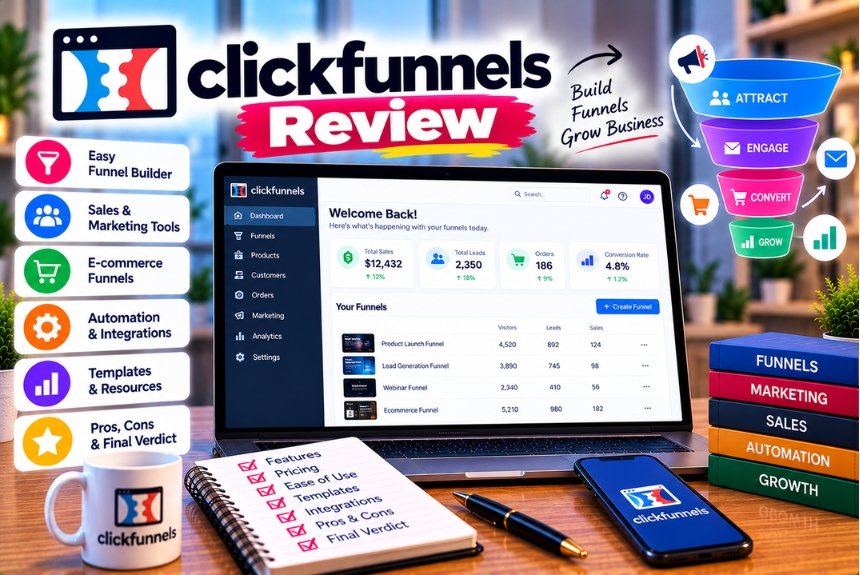
ClickFunnels Review
Building an online business involves more than creating a website and publishing a few products. Businesses need to attract visitors, capture leads, nurture potential customers, present relevant offers, process payments, and encourage repeat purchases. Managing these activities across several disconnected tools can become complicated, especially for entrepreneurs who lack technical expertise or a dedicated marketing team.
This is where ClickFunnels enters the picture.
ClickFunnels is an online sales funnel and marketing platform designed to help entrepreneurs, coaches, consultants, course creators, and businesses build customer journeys that turn visitors into leads and buyers. Instead of relying entirely on separate applications for landing pages, checkout experiences, email communication, and digital product delivery, users can manage many of these activities through one platform.
However, an all-in-one platform is not automatically the best solution for every business. Its value depends on your marketing strategy, technical requirements, budget, audience, and expected return on investment.
In this ClickFunnels review, we examine its major features, advantages, disadvantages, usability, business applications, and overall value. We will also explain who should consider using it, who may be better served by an alternative, and what to evaluate before committing to a paid subscription.
Quick verdict: ClickFunnels is worth considering if your business depends on structured sales funnels, lead generation, digital product sales, or conversion-focused landing pages. However, businesses that need only a basic website, a simple online store, or an inexpensive landing page solution may find it more expensive than necessary.
What Is ClickFunnels?
ClickFunnels is a cloud-based software platform that helps businesses build websites, landing pages, sales funnels, checkout experiences, and related marketing workflows.
Its central idea is straightforward: guide potential customers through a planned sequence of steps rather than sending every visitor to a general website and hoping they make a purchase.
For example, a business selling an online course might create a landing page explaining the course, offer a free resource to collect email addresses, send educational follow-up emails, and direct interested subscribers to a sales page with a checkout option.
These connected steps form a sales funnel.
ClickFunnels provides tools for building and managing many parts of this process without requiring users to develop every page or workflow from scratch.
The platform has expanded beyond its original focus on sales funnels. Its current offering includes website creation, email marketing, automation, online courses, payment-related functionality, customer management tools, analytics, and other features, although availability can vary by subscription plan.
You can explore the platform and its current offering on the official ClickFunnels website.
How Does ClickFunnels Work?
ClickFunnels works by allowing users to create a series of pages and actions designed around a specific business objective.
A typical sales funnel might include the following stages:
- Traffic generation: Attract visitors through search engines, social media, paid advertisements, partnerships, or email campaigns.
- Lead capture: Encourage visitors to submit their contact information in exchange for a useful resource, consultation, or offer.
- Lead nurturing: Share relevant information, answer objections, and build trust through email or other available communication tools.
- Sales presentation: Explain the product or service, demonstrate its value, and present an appropriate offer.
- Checkout: Allow customers to purchase the product or service through a configured checkout experience.
- Post-purchase engagement: Deliver the purchased product, recommend relevant upgrades, or encourage repeat purchases.
Not every funnel needs all six stages. A simple product may require only a landing page and checkout, while a high-value consulting service might benefit from lead qualification, appointment booking, and follow-up communication.
The main advantage of this approach is that every step has a defined purpose.
Rather than measuring only website traffic, a business can examine how many visitors become leads, how many leads become customers, and where potential buyers leave the process.
However, ClickFunnels does not automatically create demand or guarantee conversions. Your offer, audience targeting, messaging, pricing, and traffic quality remain essential.
ClickFunnels Review: Key Features Explained
ClickFunnels combines several tools that are commonly used in online marketing. Understanding these features is important because the platform’s value comes from how effectively they work together for your particular business.
1. Sales Funnel Builder
The sales funnel builder is the core of ClickFunnels.
It allows users to create connected pages for different stages of the customer journey. Depending on the business model, these pages may include opt-in forms, sales pages, order forms, upsell pages, and confirmation pages.
For example, an entrepreneur selling a ₹2,999 online marketing course could build a funnel that introduces the course, explains its benefits, answers common questions, and directs interested visitors to checkout.
After the purchase, customers could be sent to a confirmation page with instructions for accessing the course.
This structure makes it easier to create a consistent customer journey.
Why it matters: A dedicated funnel can help businesses focus on a particular conversion objective instead of sending every visitor to a general homepage.
Potential limitation: A funnel is only as effective as its messaging, design, offer, and traffic. Creating additional pages does not automatically increase sales.
2. Landing Page Builder
Landing pages are designed to encourage a specific action, such as registering for a webinar, downloading a guide, requesting a consultation, or purchasing a product.
ClickFunnels provides page-building functionality that enables users to arrange content and design pages without writing an entire website from scratch.
Common landing page elements include:
- Headlines and supporting text
- Images and videos
- Product and service descriptions
- Lead capture forms
- Calls to action
- Testimonials and customer proof
- Pricing information
- Frequently asked questions
- Checkout or registration elements
A consultant, for example, could create a landing page describing a service package, explaining the expected outcomes, presenting relevant case studies, and inviting visitors to book a discovery call.
The objective is to remove unnecessary distractions and make the next step clear.
When evaluating the builder, pay attention to mobile responsiveness, editing flexibility, page-loading performance, and the ease of maintaining consistent branding.
3. Funnel and Page Templates
Starting from a blank page can consume considerable time, particularly for beginners.
ClickFunnels offers templates that can provide a starting point for different marketing objectives. Depending on the available template library and account features, users may find designs suited to lead generation, product sales, webinars, and other funnel types.
Templates can be useful for businesses that want to launch quickly or do not have an in-house designer.
However, a template should be treated as a starting framework rather than a finished marketing strategy.
Before publishing a template-based funnel, customize its:
- Headlines and value propositions
- Brand colors and typography
- Images and supporting visuals
- Product descriptions
- Testimonials and proof points
- Calls to action
- Pricing and payment information
- Privacy disclosures and consent language
A page that looks attractive but communicates an unclear offer is unlikely to perform well.
Businesses should also avoid publishing unsupported testimonials or exaggerated promises simply because those elements appear in a template.
4. Website Building
ClickFunnels is not limited to individual sales funnels. Its current platform also supports website creation, allowing businesses to build pages that provide broader information about their brand, products, and services.
A business may use a website to introduce its company, explain its offerings, publish supporting content, and direct visitors into specific sales funnels.
For example, a coaching business could maintain pages for its services, instructor biography, resources, and contact information while directing visitors to a dedicated funnel for each coaching package.
This arrangement can help connect general website navigation with focused conversion experiences.
Nevertheless, businesses that depend heavily on extensive editorial content, complex custom functionality, or a large e-commerce catalog should evaluate whether ClickFunnels meets those requirements as effectively as a specialized website or commerce platform.
5. Email Marketing and Automation
Email marketing is an important component of many sales funnels.
ClickFunnels includes email marketing and automation capabilities, with the specific functionality depending on the plan and configuration.
These tools can help businesses send follow-up messages after someone subscribes, registers for an event, or purchases a product.
For example, a digital product seller might create the following sequence:
- Immediately after registration: Deliver the promised free resource.
- Day 1: Explain a common problem the audience faces.
- Day 3: Share practical advice related to that problem.
- Day 5: Introduce the paid product as a potential solution.
- Day 7: Answer common objections and remind interested subscribers about the offer.
The purpose is to provide useful information while helping interested prospects understand the product.
Automation can reduce repetitive work, but it should not replace thoughtful communication. Poorly targeted messages, excessive promotional emails, or irrelevant follow-ups can damage engagement.
Before choosing a plan, verify its contact limits, monthly email allowances, automation features, and any additional requirements for your intended sending volume.
6. Checkout and Payment Functionality
A checkout page is one of the most commercially important parts of an online sales funnel.
ClickFunnels provides checkout-related functionality that can be used to present products, collect customer information, and facilitate purchases through supported payment integrations.
Depending on the product and configuration, a checkout experience may include:
- Product and order details
- Customer information fields
- Payment options
- Order summaries
- Additional product offers
- Purchase confirmation
- Post-purchase redirects
For example, a business selling a ₹4,999 course might offer a related workbook during checkout or present an optional advanced course after the original purchase.
Such offers can increase the average order value when they are relevant and genuinely useful.
However, payment functionality should be evaluated carefully. Confirm supported payment gateways, transaction costs, subscription capabilities, refund handling, tax requirements, and regional availability before launching.
Businesses operating in India should pay particular attention to payment gateway compatibility, settlement arrangements, applicable taxes, and the customer payment methods they need to support.
7. Digital Product and Course Delivery
ClickFunnels can be useful for businesses that sell digital products, online courses, and membership-based content.
Depending on the subscription and configuration, the platform can help businesses organize educational material, provide customer access, and connect the purchase experience with product delivery.
Potential use cases include:
- Online training programs
- Downloadable resources
- Educational courses
- Paid workshops
- Membership content
- Coaching programs
Consider an instructor selling a digital marketing course. The instructor could use a landing page to explain the curriculum, a checkout page to accept payment, and a course area to provide access to lessons.
Connecting these stages can simplify the customer journey.
However, businesses with sophisticated learning management requirements should evaluate course organization, student progress tracking, assessment functionality, certificates, community features, and integrations before choosing the platform.
A straightforward course delivery requirement is different from the needs of a large educational institution.
8. Analytics and Conversion Tracking
Analytics help businesses understand whether their marketing activities are producing meaningful results.
ClickFunnels provides analytics and reporting functionality, although the exact capabilities and available metrics depend on the plan and implementation.
Businesses should pay attention to metrics such as:
- Landing page conversion rate
- Lead acquisition rate
- Checkout conversion rate
- Sales revenue
- Average order value
- Cost per lead
- Customer acquisition cost
- Refund rate
- Return on advertising spend
For example, suppose a landing page receives 2,000 visitors and generates 100 leads.
Its lead conversion rate is:
100 ÷ 2,000 × 100 = 5%
If 10 of those leads subsequently purchase a product, the lead-to-customer conversion rate is:
10 ÷ 100 × 100 = 10%
These calculations help identify where improvements may be needed.
A low lead conversion rate may indicate an unclear headline, an unsuitable offer, or poor traffic quality. A low checkout conversion rate may indicate pricing concerns, insufficient trust, unexpected costs, or payment friction.
Businesses should verify which reports are built in and which metrics require external analytics or advertising integrations.
9. Integrations and Workflow Connectivity
Even an all-in-one platform may need to connect with other business tools.
ClickFunnels supports integrations and API-related capabilities, with access depending on the plan and specific integration.
These connections may be useful for coordinating marketing, payment processing, customer information, analytics, and other business activities.
For example, a company might need to connect its funnel with an external advertising platform, a payment provider, or a customer management system.
Before subscribing, create a list of your essential integrations and confirm that each one works with your intended setup.
Do not assume that every integration is included in every plan or that every connection works without additional configuration.
For official information about available capabilities, consult the ClickFunnels platform and pricing pages.
ClickFunnels Pros and Cons
ClickFunnels offers a focused set of advantages, but its limitations are important when evaluating whether it is the right investment.
Advantages of ClickFunnels
- Combines multiple marketing activities
ClickFunnels brings together several functions that businesses might otherwise manage across separate tools. Depending on the requirements, this can reduce the complexity of maintaining multiple subscriptions and integrations.
- Designed around conversions
Its funnel-based approach encourages businesses to build specific journeys for lead generation, product sales, and other measurable objectives.
- Reduces dependence on custom development
Users can create many pages and funnels without building the entire experience through custom code. This can be particularly helpful for entrepreneurs without technical teams.
- Supports different business models
The platform can serve coaches, consultants, course creators, digital product sellers, service providers, and businesses that need conversion-focused landing pages.
- Provides reusable templates
Templates can accelerate the initial design process and give users a starting point for common marketing campaigns.
- Connects marketing with sales activities
Connecting landing pages, lead capture, follow-up messages, and checkout experiences can make it easier to manage the customer journey.
- Supports experimentation
Businesses can evaluate different headlines, offers, page structures, and calls to action. Available testing capabilities should be verified against the selected plan.
- Can support business growth
Businesses that expand their product range or marketing campaigns may benefit from a centralized platform, provided the plan’s contact, email, workspace, and other limits remain suitable.
Disadvantages of ClickFunnels
- Subscription costs can be significant
ClickFunnels is a paid platform, and its subscription may be difficult to justify for businesses that generate little revenue or require only basic website functionality.
- Not every feature is available on every plan
Contact limits, email allowances, workspaces, team seats, courses, and advanced functionality can vary by subscription.
- Requires marketing knowledge
The software can help build a funnel, but users still need to understand their target audience, offers, messaging, and conversion objectives.
- May be excessive for simple websites
A business that only needs a few informational pages may not benefit enough from a specialized funnel platform to justify its recurring cost.
- Can create platform dependence
Building many pages, automations, and customer journeys inside one platform can make future migrations more complicated. Businesses should understand their export options and integration requirements before committing.
- Advanced customization may require extra effort
A visual builder can handle many standard use cases, but highly customized layouts or complex business logic may require technical knowledge, workarounds, or external tools.
- Email and contact limits need monitoring
Businesses with large lists or high email volumes must confirm that their subscription accommodates their needs.
- Conversion results are not guaranteed
A well-designed funnel cannot compensate for an unsuitable product, weak demand, poor traffic targeting, or an unconvincing offer.
ClickFunnels Pricing: Is It Expensive?
Price is an important part of any ClickFunnels review because the platform is an ongoing business expense rather than a one-time purchase.
ClickFunnels publishes multiple subscription tiers, with monthly and annual billing options for eligible plans. Its official pricing page currently lists the following standard monthly prices, alongside discounted effective monthly prices for annual billing.
| Plan | Standard Monthly Price | Advertised Effective Monthly Price With Annual Billing | General Positioning |
| Launch | $97/month | Approximately $81/month | Starting a business |
| Scale | $197/month | Approximately $164/month | Growing businesses |
| Optimize | $297/month | Approximately $248/month | Larger marketing operations |
| Dominate | Annual-only plan | $5,997/year | Higher-scale operations |
Important: These figures reflect the pricing displayed on the official website when researched for this article. Promotions, regional taxes, plan limits, and subscription terms can change. Annual billing requires paying for the applicable annual subscription, so the advertised monthly equivalent is not the same as a monthly payment. Check the official ClickFunnels pricing page before purchasing.
What Should You Consider Before Paying?
The monthly subscription price is only one part of the total cost of running a funnel.
Your overall marketing budget may also include:
- Advertising expenditure
- Domain registration
- Payment gateway charges
- Email deliverability services or additional sending costs, where applicable
- Third-party integrations
- Design or copywriting services
- Video hosting or other external tools
- Customer support and fulfillment
- Taxes and currency conversion
The exact additional costs depend on how you operate your business.
For example, a business paying for ClickFunnels but receiving little qualified traffic may spend money without generating enough leads or sales to justify the subscription.
By contrast, a business with a proven offer and a reliable acquisition strategy may find that the platform’s convenience and integrated workflows justify the expense.
For a detailed breakdown of subscription tiers, features, and plan selection, see our related article: ClickFunnels Pricing Explained: Which Plan Should You Choose?
Is ClickFunnels Worth It for Small Businesses?
ClickFunnels can be worth considering for small businesses, but its suitability depends on the business model.
A small business selling consultations, digital products, workshops, or specialized services may benefit from creating targeted funnels for different offers.
For example, a marketing consultant could use one funnel to generate leads for an SEO audit and another to promote a monthly consulting package.
Each funnel could feature a tailored headline, a clear explanation of the service, relevant proof, and a suitable call to action.
This structure can help the business measure which offer attracts more qualified prospects.
However, a local business that primarily needs opening hours, service information, a contact form, and a location page may not need a dedicated funnel-building subscription.
Before investing, ask three questions:
- Does the business have a clearly defined conversion goal?
- Will the platform replace tools or manual work that currently create unnecessary complexity?
- Is there a realistic plan to generate enough leads or sales to justify the recurring cost?
If the answer to these questions is unclear, begin by validating the offer and acquisition strategy before investing heavily in software.
Is ClickFunnels Good for Beginners?
ClickFunnels can be useful for beginners because it provides visual page-building tools and ready-made funnel structures.
A new entrepreneur can start with a simple funnel rather than developing an entire marketing system from scratch.
For example, a beginner selling an introductory online workshop might create a registration page, collect email addresses, send confirmation messages, and direct registered participants to the event.
This is more manageable than trying to launch a complex marketing campaign with numerous pages and automations at once.
However, beginners should understand that ease of use does not eliminate the need for planning.
Before building a funnel, define:
- The target audience
- The problem the offer solves
- The main benefit of the product or service
- The desired visitor action
- The information needed before a purchase
- The follow-up process after a visitor converts
Beginners should also consider the learning curve associated with email automation, payment configuration, analytics, and integrations.
Our recommendation: Start with one simple funnel, measure its performance, and add complexity only when the data or customer journey justifies it.
Who Should Use ClickFunnels?
ClickFunnels is most suitable for businesses that need to guide visitors through a defined conversion process.
1. Coaches and Consultants
Coaches and consultants can use landing pages to explain their services, collect inquiries, offer discovery calls, and follow up with potential clients.
For example, a business coach could create a lead-generation funnel that offers a free business assessment before presenting a paid consulting package.
The platform may be especially useful when a business has multiple service offers that require different messaging.
2. Online Course Creators
Course creators can use funnels to promote training programs, collect leads, present course details, accept payments, and provide access to digital learning products.
A course seller might create a free introductory lesson to attract potential students before offering a complete paid program.
However, creators with advanced educational requirements should confirm that the available course features meet their needs.
3. Digital Product Sellers
Entrepreneurs selling e-books, templates, downloadable resources, training materials, and other digital products can use funnels to present their products and streamline the purchase process.
They may also test related offers to determine whether customers respond to bundles, upgrades, or complementary products.
4. Affiliate Marketers
Affiliate marketers may use landing pages and lead-generation funnels to build an audience around a particular subject.
For example, a marketer focused on productivity software could offer a free planning guide and use email content to explain relevant tools.
Affiliate marketing must be conducted transparently. Users should disclose affiliate relationships where required and comply with the rules of the relevant advertising platforms and affiliate programs.
5. E-Commerce Businesses
Some e-commerce businesses may use funnels to promote specific products, introduce bundles, or encourage customers to consider complementary purchases.
However, businesses operating large catalogs, complex inventory systems, shipping workflows, or marketplace integrations should evaluate whether ClickFunnels meets their commerce requirements.
A specialized e-commerce platform may be more appropriate for some operations.
6. Service-Based Businesses
Agencies, marketing professionals, and other service providers can create funnels for consultations, assessments, quotations, and lead qualification.
For example, an SEO agency could offer a free website review and invite interested prospects to book a strategy call.
This can provide a more focused experience than directing every potential client to a general contact page.
Who Should Avoid ClickFunnels?
Although ClickFunnels supports different business models, it is not necessarily the best choice for every organization.
Businesses With Very Limited Budgets
If your business has not yet validated its offer, a substantial recurring software expense may create unnecessary financial pressure.
Consider whether lower-cost tools can help you test demand before committing to a more comprehensive platform.
Businesses That Need Only a Basic Website
If you need a small website with a homepage, service pages, a blog, and contact details, a conventional website builder or content management system may be sufficient.
You do not necessarily need a specialized funnel platform to publish basic business information.
Large E-Commerce Stores
Businesses that depend on advanced inventory management, complex shipping rules, extensive product catalogs, and specialized retail integrations should compare ClickFunnels with dedicated e-commerce platforms.
The best solution depends on whether the primary requirement is a conversion-focused sales journey or comprehensive store management.
Organizations With Highly Specialized Requirements
Companies that need extensive custom workflows, unusual integrations, complex user permissions, or tightly controlled infrastructure should assess the platform’s technical capabilities before migrating essential business operations.
Businesses Without a Clear Offer
A funnel cannot fix an offer that does not solve a meaningful problem for the intended audience.
If you are still determining what to sell, whom to target, or how to price your services, validate those decisions before investing in a complex marketing setup.
ClickFunnels vs Traditional Website Builders
One common question is whether ClickFunnels can replace a traditional website builder.
The answer depends on the purpose of the website.
A traditional website is often designed to provide broad information, support navigation, publish content, and serve visitors with different needs.
A sales funnel is usually designed around a narrower objective, such as collecting leads, registering participants, or selling a specific product.
| Comparison Factor | ClickFunnels | Traditional Website Builder |
| Primary focus | Conversion-focused customer journeys | General website creation |
| Sales funnels | Central part of the platform | May require separate tools or integrations |
| Landing pages | Designed for funnel-based campaigns | Often available, depending on the builder |
| General business website | Supported | Usually a core use case |
| Content publishing | Available capabilities depend on the platform and plan | Varies; some platforms specialize in blogging |
| Marketing workflows | Integrated tools are available, with plan-dependent limits | May require extensions or third-party services |
| Large online stores | Requires careful suitability assessment | Specialized commerce platforms may be better |
| Best fit | Businesses with defined lead-generation or sales objectives | Businesses needing broader website functionality |
These are general distinctions rather than absolute rules. Modern website builders can support landing pages, payments, and marketing integrations, while ClickFunnels can also support broader website needs.
The decision should be based on the actual features and workflows your business requires.
ClickFunnels vs Using Multiple Marketing Tools
Another option is to assemble a marketing system using separate tools.
For example, a business might use one platform for website hosting, another for landing pages, a separate email marketing service, an external payment processor, and an analytics tool.
This approach can provide flexibility because each application can be selected for its individual strengths.
However, managing multiple applications may introduce several challenges:
- Different billing arrangements
- Multiple user accounts
- Integration maintenance
- Inconsistent customer data
- More complicated troubleshooting
- Additional setup and training
- Potential gaps in reporting
ClickFunnels can reduce some of this complexity by consolidating supported functions.
On the other hand, a business that already has reliable tools may not benefit enough from switching to an all-in-one system.
Which Approach Offers Better Value?
The answer depends on your current setup.
Choose an integrated platform when:
- You are starting from scratch.
- Your business relies on repeatable sales funnels.
- You want to reduce the number of tools you manage.
- Your required features are available within the subscription.
- Your team values having related workflows in one place.
Consider separate tools when:
- You already have a reliable website and marketing stack.
- You need specialized functionality.
- You want to select the strongest tool for each task.
- Your current costs are lower than the integrated alternative.
- Your team has the technical resources to maintain integrations.
Calculate the total cost of ownership rather than comparing subscription prices alone.
Include the software fees, integration costs, staff time, maintenance requirements, and potential cost of migrating existing assets.
How to Evaluate ClickFunnels Before Buying
A product review should help you make a practical decision, not simply list features.
Before subscribing to ClickFunnels, use the following evaluation process.
Step 1: Define Your Main Business Goal
Identify the primary result you want the platform to help achieve.
Examples include generating qualified leads, selling digital products, increasing consultation bookings, or promoting an online course.
Avoid choosing software simply because it has many features.
Step 2: Map Your Customer Journey
Write down the steps a potential customer takes from discovering your business to completing a purchase.
Identify where you need landing pages, forms, email follow-ups, payment processing, or product delivery.
This helps you determine whether ClickFunnels supports your actual requirements.
Step 3: Verify Plan Limits
Review the current subscription details for:
- Workspaces
- Team members
- Contact capacity
- Monthly email allowances
- Courses or digital products
- Custom domains
- Automation functionality
- Integrations and API access
- Support availability
Do not assume that all features are available on the entry-level plan.
Step 4: Check Your Essential Integrations
List the tools you already use and identify which ones must connect with ClickFunnels.
Confirm compatibility and investigate any additional costs before building your business around the platform.
Step 5: Test the Complete Customer Experience
If a trial is available, build a small test funnel.
Check the experience from the visitor’s perspective, including:
- Mobile page layout
- Form submissions
- Confirmation messages
- Email delivery
- Checkout functionality
- Payment confirmation
- Product access
- Tracking and reporting
Testing the complete journey can reveal issues that are not obvious when examining the page editor alone.
Step 6: Calculate Your Break-Even Point
Estimate how many additional sales or leads you need to justify the subscription.
For a simplified example, suppose your monthly software cost is $97 and your contribution margin per sale is $50.
Your break-even requirement is:
$97 ÷ $50 = 1.94 sales
You would therefore need approximately two additional sales per month to cover that software expense, assuming the $50 represents the amount remaining from each sale after the relevant variable costs.
This calculation does not mean ClickFunnels will generate those sales. It simply gives you a way to evaluate the economics of the subscription.
Step 7: Review Cancellation and Migration Requirements
Before committing, check the current cancellation terms, renewal conditions, data export options, and the practical steps required to move your pages or customer information elsewhere.
Understand what happens to hosted pages, integrations, digital products, and automations if you stop subscribing.
Planning for portability reduces the risk of becoming dependent on a platform without a clear exit strategy.
How to Get Better Results With ClickFunnels
Purchasing the platform is only the beginning. The quality of your marketing strategy determines whether the resulting funnel is useful.
Create One Funnel for One Main Objective
A funnel should have a clear purpose.
A page designed to collect leads may need a different message and call to action from a page designed to sell a product immediately.
Avoid adding too many unrelated actions to the same page.
Write Benefit-Focused Headlines
Your headline should explain what the visitor can gain or what problem the offer addresses.
Instead of using a vague headline such as “Welcome to Our Business,” describe the offer more specifically.
For example, a consultant might write: “Build a Practical SEO Plan for Your Small Business.”
The headline should accurately reflect the product or service rather than promise unsupported outcomes.
Make Calls to Action Clear
Visitors should understand what happens when they click a button.
Examples include:
- Download the Free Guide
- Register for the Webinar
- Book a Consultation
- Explore the Course
- Purchase the Template
Use action-oriented language that matches the actual next step.
Build Trust With Relevant Evidence
Trust can be improved through transparent pricing, clear policies, accurate product information, relevant testimonials, case studies, and explanations of what customers receive.
Use only genuine testimonials and substantiated performance claims.
Where relevant, make refund terms, recurring charges, privacy information, and customer support details easy to find.
Optimize for Mobile Devices
Many visitors will reach a funnel through mobile advertising, social media, messaging applications, or mobile search.
Review your pages on different screen sizes.
Check that headings are readable, buttons are easy to tap, forms are manageable, and important information is not hidden behind awkward layouts.
Monitor the Entire Funnel
Do not evaluate a funnel using only its landing page conversion rate.
Track the journey from visitor acquisition through lead generation and purchase.
For example, a funnel may generate many leads but few sales. The problem could be the quality of the leads, the follow-up process, the product offer, or the checkout experience.
Use data to identify the actual bottleneck before making changes.
Test Changes Systematically
Avoid changing several major elements at once if you want to understand what improved performance.
Where suitable testing functionality is available, experiment with headlines, calls to action, pricing presentation, or page layouts.
Allow tests to gather sufficient data before drawing conclusions, and consider the quality of the traffic and the number of conversions.
Is ClickFunnels Worth It? Final Verdict
ClickFunnels can be a valuable platform for businesses that need to create and manage conversion-focused customer journeys.
Its main strength is the ability to connect landing pages, sales funnels, email marketing, checkout experiences, and other supported business functions within one environment.
This can be especially useful for entrepreneurs who sell digital products, offer coaching or consulting services, promote online courses, or run lead-generation campaigns.
However, the platform’s subscription cost and plan-specific limitations mean that it is not automatically the right choice for everyone.
A business with an established marketing stack may find that its current tools already meet its needs. A company that only requires a basic website may prefer a simpler solution. Organizations with advanced commerce or technical requirements should compare the platform against more specialized alternatives.
Our Recommendation
ClickFunnels is worth considering if your business has a clear offer and relies on structured sales funnels to generate leads or revenue.
It is less compelling if you have not validated your offer, have very limited software budget, or need only basic website functionality.
Before purchasing, define your requirements, review the current plan limits, test your essential workflows, and calculate the sales or operational savings needed to justify the subscription.
The best platform is not necessarily the one with the most features. It is the one that helps your business achieve its goals at a cost and level of complexity you can reasonably sustain.
Frequently Asked Questions About ClickFunnels
1. What is ClickFunnels used for?
ClickFunnels is used to create sales funnels, landing pages, websites, checkout experiences, and related marketing workflows. Businesses use it to generate leads, promote products, collect payments, and guide potential customers through a structured buying journey.
2. Is ClickFunnels worth the money?
ClickFunnels can be worth the money for businesses that regularly use its funnel-building and marketing features. Its value depends on your requirements, the revenue or time savings it helps generate, and whether its subscription costs are justified by your results.
3. Is ClickFunnels good for beginners?
ClickFunnels can be suitable for beginners because it offers visual page-building tools and templates. However, beginners still need to understand their audience, offer, messaging, and conversion goals to build effective funnels.
4. How much does ClickFunnels cost?
The official pricing page currently lists Launch at $97 per month, Scale at $197 per month, and Optimize at $297 per month. Annual billing offers discounted effective monthly prices, while Dominate is an annual-only plan. Check the official pricing page for current rates and terms.
5. Does ClickFunnels offer a free plan?
ClickFunnels has advertised a free trial rather than a permanent free plan for its main subscription offering. Trial availability, duration, eligibility, and billing conditions should be checked on the official website before registration.
6. Can I build a website with ClickFunnels?
Yes. ClickFunnels supports website creation in addition to sales funnels. However, businesses that need advanced editorial publishing, specialized functionality, or complex e-commerce capabilities should compare its features with dedicated website platforms.
7. Can ClickFunnels sell digital products?
Yes. ClickFunnels can support digital product sales and related customer journeys, depending on the product type and configuration. Businesses should verify the available delivery and access-management features for their chosen plan.
8. Is ClickFunnels suitable for online courses?
ClickFunnels can be useful for course creators who want to connect marketing pages, payments, and course delivery. Those with advanced educational requirements should verify features such as assessments, progress tracking, certificates, and student management.
9. Does ClickFunnels include email marketing?
ClickFunnels offers email marketing capabilities. However, contact limits, monthly sending allowances, and automation features depend on the subscription and current product configuration.
10. Can I accept payments through ClickFunnels?
ClickFunnels supports checkout and payment-related functionality through supported payment integrations. Verify payment gateway availability, transaction costs, supported currencies, and regional requirements before launching your checkout.
11. Is ClickFunnels suitable for small businesses?
It can be suitable for small businesses that rely on lead generation, consultations, digital products, or structured sales campaigns. Businesses that only need a basic website may find a simpler platform more economical.
12. Does ClickFunnels guarantee more sales?
No. ClickFunnels provides tools for building and managing sales funnels, but it does not guarantee higher sales or conversion rates. Results depend on factors such as product-market fit, traffic quality, pricing, messaging, and customer experience.
13. Can ClickFunnels replace WordPress?
ClickFunnels can replace some website and landing-page functions that a business might otherwise manage through WordPress. Whether it can replace an entire WordPress setup depends on the website’s content, customization, integrations, e-commerce requirements, and publishing needs.
14. Can I connect my own domain to ClickFunnels?
ClickFunnels supports custom-domain connections, subject to current plan limits and setup requirements. Check the documentation for the steps involved and confirm how many domains your subscription permits.
15. Is ClickFunnels good for affiliate marketing?
ClickFunnels can help affiliate marketers create landing pages and lead-generation funnels. Affiliate marketers must still follow the applicable affiliate program terms, advertising rules, disclosure requirements, and privacy regulations.
16. Can ClickFunnels be used for service-based businesses?
Yes. Service businesses can use it to promote services, collect inquiries, qualify leads, schedule consultations through supported tools, and follow up with potential customers.
17. What are the main disadvantages of ClickFunnels?
Its main disadvantages may include subscription costs, plan-specific feature limits, a learning curve for marketing automation, possible platform dependence, and limited suitability for certain specialized website or commerce requirements.
18. Does ClickFunnels include analytics?
ClickFunnels offers analytics and reporting capabilities, but the exact metrics and functionality depend on the current product configuration. Businesses may need external analytics or advertising integrations for more comprehensive reporting.
19. Can I use ClickFunnels in India?
Businesses in India can investigate ClickFunnels as an online marketing platform, but they should verify payment gateway compatibility, billing currency, applicable taxes, settlement arrangements, and any regional requirements before subscribing.
20. Is ClickFunnels better than a traditional website builder?
Neither option is universally better. ClickFunnels is particularly relevant when a business needs structured sales funnels and related marketing workflows. A traditional website builder may be sufficient for informational websites, content publishing, or simpler online business requirements.
21. Is ClickFunnels suitable for e-commerce?
ClickFunnels may suit businesses that want to promote selected products through conversion-focused funnels. Businesses with large catalogs, complex inventory management, shipping requirements, or advanced retail integrations should compare it with specialized e-commerce platforms.
22. Can I cancel my ClickFunnels subscription?
Cancellation depends on the applicable subscription terms and account conditions. Review the current cancellation policy, renewal dates, refund eligibility, and the steps required to prevent future billing before subscribing.
23. What should I check before starting a ClickFunnels trial?
Confirm the trial duration, billing conditions, available features, plan limits, cancellation process, payment gateway compatibility, and the integrations your business needs. Build and test a complete customer journey before making a longer-term commitment.
24. What is the best ClickFunnels alternative?
The best alternative depends on your requirements. Businesses may compare dedicated website builders, e-commerce platforms, landing-page tools, and broader marketing automation solutions. Consider pricing, required integrations, technical flexibility, and the type of funnel or website you need to build.
25. Who should buy ClickFunnels?
ClickFunnels is worth evaluating for entrepreneurs, coaches, consultants, course creators, digital product sellers, and businesses that depend on conversion-focused landing pages and sales funnels. It is less suitable when a simpler or more specialized tool can meet the same requirements at a lower total cost.
Leave a Reply