


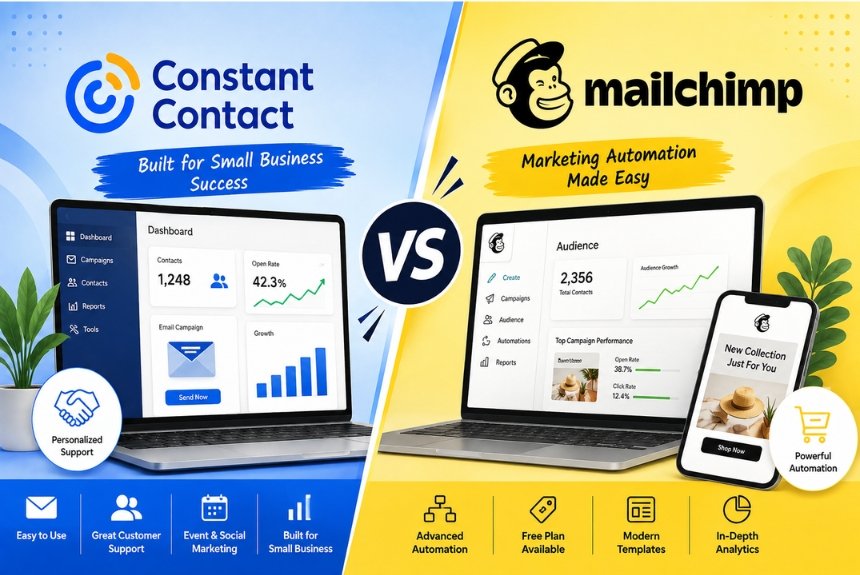
Constant Contact vs Mailchimp: Which One is Better?
Email marketing continues to be one of the most effective digital marketing strategies for businesses of all sizes. Whether you’re a startup, small business, ecommerce store, nonprofit organization, or content creator, choosing the right email marketing platform can significantly impact your marketing success.
Among the many email marketing tools available today, Constant Contact and Mailchimp remain two of the most recognized names in the industry. Both platforms help businesses create professional email campaigns, manage subscriber lists, automate communication, and measure campaign performance. However, each platform has its own strengths, pricing model, and target audience.
For many businesses, deciding between Constant Contact and Mailchimp can be challenging. Constant Contact is widely appreciated for its beginner-friendly interface, dependable customer support, and straightforward marketing tools. Mailchimp, on the other hand, is known for its generous free plan, advanced integrations, AI-powered features, and flexible automation capabilities.
The best choice depends on several factors, including your budget, technical expertise, business size, and marketing objectives. A freelancer with a small email list may prioritize affordability and ease of use, while a growing ecommerce business might require more advanced automation and detailed analytics.
This comprehensive comparison examines both platforms across key areas such as usability, email design, automation, landing pages, reporting, pricing, customer support, and overall value. Rather than declaring a universal winner, the goal is to help you understand which platform aligns better with your specific needs.
By the end of this guide, you’ll have a clear understanding of where each platform excels, where it falls short, and which one is likely to deliver the best results for your business in 2026.

Quick Comparison
| Feature | Constant Contact | Mailchimp |
| Ease of Use | ⭐⭐⭐⭐⭐ | ⭐⭐⭐⭐☆ |
| Email Templates | ⭐⭐⭐⭐⭐ | ⭐⭐⭐⭐☆ |
| Automation | ⭐⭐⭐⭐☆ | ⭐⭐⭐⭐⭐ |
| Landing Pages | ⭐⭐⭐⭐☆ | ⭐⭐⭐⭐☆ |
| Analytics | ⭐⭐⭐⭐☆ | ⭐⭐⭐⭐⭐ |
| Customer Support | ⭐⭐⭐⭐⭐ | ⭐⭐⭐⭐☆ |
| Free Plan | ❌ Trial Only | ✔ Available |
| Best For | Small Businesses | Businesses of All Sizes |
Company Overview
Before comparing features, it’s helpful to understand the background and focus of each platform.
Constant Contact Overview
Constant Contact is one of the oldest email marketing platforms, having served businesses since 1995. It was created with the goal of helping small businesses communicate effectively with customers through email marketing.
Over the years, the platform has evolved from a basic newsletter tool into a comprehensive digital marketing solution. Today, it includes email marketing, automation, SMS marketing, landing pages, signup forms, social media tools, and ecommerce integrations.
One of Constant Contact’s greatest strengths is its simplicity. The interface is intuitive, making it easy for beginners to create campaigns without technical expertise. The platform also offers responsive customer support, making it a popular choice among small businesses and nonprofit organizations.
Key Strengths
- Beginner-friendly interface
- Professional email templates
- Reliable email deliverability
- Built-in marketing automation
- Excellent customer support
- Easy contact management
Mailchimp Overview
Mailchimp was launched in 2001 and has grown into one of the world’s most widely used email marketing platforms. Initially focused on email campaigns, it has expanded into a broader marketing platform offering automation, customer journey mapping, AI-powered content creation, landing pages, social media advertising, and ecommerce integrations.
A major reason for Mailchimp’s popularity is its free plan, which allows beginners and small businesses to start email marketing with minimal upfront costs. As businesses grow, they can upgrade to paid plans that unlock more advanced features, including predictive analytics, multistep automation, and enhanced reporting.
Mailchimp is particularly attractive to marketers who want flexibility and a wide range of integrations. However, its interface includes more advanced features, which may require additional time for new users to learn.
Key Strengths
- Free plan for beginners
- Advanced automation
- AI-powered marketing tools
- Extensive third-party integrations
- Powerful analytics
- Scalable pricing options
Constant Contact vs Mailchimp: Company Comparison
| Feature | Constant Contact | Mailchimp |
| Founded | 1995 | 2001 |
| Primary Focus | Email Marketing for Small Businesses | All-in-One Marketing Platform |
| Free Plan | No | Yes |
| Free Trial | Yes | Limited Free Tier |
| Ease of Learning | Excellent | Good |
| Marketing Automation | Good | Advanced |
| Customer Support | Excellent | Good |
| Best For | Small Businesses, Nonprofits | Startups, Ecommerce, Growing Businesses |
Core Services Offered
Both platforms provide many of the same core capabilities, but their focus differs slightly.
Constant Contact
- Email marketing
- Drag-and-drop email editor
- Marketing automation
- Landing pages
- Signup forms
- SMS marketing
- Event management
- Ecommerce integrations
- Reporting and analytics
- Contact management
Mailchimp
- Email marketing
- Customer journey automation
- Landing pages
- AI content generation
- Social media advertising
- Audience segmentation
- Website builder
- Ecommerce marketing
- Behavioral targeting
- Advanced reporting
Similarities Between the Platforms
Despite their differences, Constant Contact and Mailchimp share several essential features that make them suitable for modern email marketing.
Both platforms allow users to:
- Create professional email campaigns.
- Design emails using drag-and-drop editors.
- Build and manage subscriber lists.
- Automate common marketing tasks.
- Track campaign performance.
- Create landing pages.
- Integrate with ecommerce platforms.
- Personalize email content.
- Schedule campaigns in advance.
- Access mobile-friendly dashboards.
These shared capabilities ensure that either platform can support the basic email marketing needs of most businesses.
Key Differences at a Glance
While both platforms are capable email marketing solutions, their priorities differ.
Constant Contact focuses on simplicity, ease of use, and dependable customer support, making it ideal for beginners and small businesses that want a straightforward marketing solution.
Mailchimp places greater emphasis on automation, AI-powered tools, integrations, and scalability, making it attractive to businesses that expect their marketing needs to become more sophisticated over time.
Understanding these differences provides the foundation for the detailed feature-by-feature comparison in the following sections, where we’ll examine usability, email builders, automation, landing pages, analytics, pricing, and overall value.
Ease of Use
When selecting an email marketing platform, ease of use is one of the most important factors, especially for beginners and small business owners. A platform with a simple interface allows users to create campaigns quickly, manage subscribers efficiently, and spend more time focusing on marketing rather than learning complicated software.
Both Constant Contact and Mailchimp are designed to simplify email marketing, but they take different approaches. Constant Contact focuses on providing a clean and straightforward experience, while Mailchimp offers a broader set of features that may require additional learning.
Constant Contact: User Experience
Constant Contact is widely recognized for its beginner-friendly interface. The dashboard is well organized, making it easy to locate contacts, campaigns, reports, and automation tools.
The platform guides users through the campaign creation process with clear instructions and helpful prompts. Even users with no prior experience can quickly learn how to create professional email campaigns.
Advantages
- Clean and intuitive dashboard
- Simple navigation
- Easy contact management
- Quick campaign setup
- Minimal learning curve
- Helpful onboarding process
Because of its simplicity, Constant Contact is often preferred by local businesses, nonprofits, and entrepreneurs who want to launch campaigns without spending significant time learning the software.
Mailchimp: User Experience
Mailchimp also offers a modern interface, but it includes a wider range of marketing tools beyond email marketing. Users can access audience management, automation, landing pages, social media advertising, website creation, and customer journey mapping from a single dashboard.
Although these features provide greater flexibility, they can also make the interface feel more complex for beginners. New users may need extra time to explore menus and understand the available options.
Advantages
- Modern dashboard
- Comprehensive marketing tools
- Flexible navigation
- Detailed customization options
- Suitable for growing businesses
Once users become familiar with the platform, Mailchimp provides a smooth and efficient experience, particularly for businesses planning to expand their marketing efforts.
Ease of Learning
The learning curve differs noticeably between the two platforms.
Constant Contact emphasizes simplicity. Most users can create and send their first campaign within a short time because the interface highlights only the essential tools.
Mailchimp offers more advanced functionality, which is beneficial in the long run but may feel overwhelming for users who are completely new to email marketing.
Ease of Use Comparison
| Feature | Constant Contact | Mailchimp |
| Dashboard Simplicity | Excellent | Very Good |
| Navigation | Excellent | Good |
| Learning Curve | Easy | Moderate |
| Beginner Friendly | Excellent | Very Good |
| Advanced Features | Good | Excellent |
| Overall User Experience | ⭐⭐⭐⭐⭐ | ⭐⭐⭐⭐☆ |
Customer Support Experience
Support plays a significant role when learning a new platform.
Constant Contact offers multiple support channels, including phone support, live chat, email assistance, tutorials, webinars, and an extensive knowledge base. Its reputation for responsive customer service is one of the reasons many beginners choose the platform.
Mailchimp also provides documentation, guides, and chat support, but the availability of direct support depends on the subscription plan. Users on lower-tier plans may have fewer support options compared to premium subscribers.
For beginners who value immediate assistance, Constant Contact generally provides a more accessible support experience.
Email Builder Comparison
The email builder is the heart of any email marketing platform. It determines how easily users can design attractive emails, personalize content, and maintain consistent branding.
Both Constant Contact and Mailchimp include drag-and-drop editors, but each platform offers a unique design experience.
Constant Contact Email Builder
Constant Contact’s editor is designed with simplicity in mind. Users can create professional emails by dragging content blocks such as text, images, buttons, videos, dividers, and social media icons into the layout.
No coding knowledge is required, making it ideal for beginners.
Key Features
- Drag-and-drop editing
- Mobile-responsive templates
- Image library
- Button customization
- Social media integration
- Brand logo support
- Reusable email blocks
The editor updates changes in real time, allowing users to preview their designs while editing.
Mailchimp Email Builder
Mailchimp also offers a drag-and-drop editor but includes additional customization options.
Users can modify layouts, colors, fonts, spacing, and content blocks with greater flexibility. Mailchimp also incorporates AI-powered suggestions that help improve subject lines and email content.
Advanced users often appreciate the additional design controls, while beginners may initially find the interface slightly more complex.
Key Features
- Flexible drag-and-drop editor
- AI content suggestions
- Advanced layout controls
- Dynamic content blocks
- Mobile preview
- Creative Assistant
- Brand management tools
Email Templates
Templates save time and ensure professional-looking campaigns.
Constant Contact
Constant Contact provides a large collection of professionally designed templates suitable for various industries, including:
- Retail
- Restaurants
- Healthcare
- Education
- Nonprofits
- Real estate
- Professional services
- Events
Templates can be customized by changing colors, fonts, images, and logos while maintaining a responsive layout.
Mailchimp
Mailchimp also offers high-quality templates with extensive customization options. Users can build layouts from scratch or modify existing templates according to their branding.
Mailchimp provides greater creative flexibility, making it attractive for businesses with experienced marketing teams or designers.
Design Flexibility
Both platforms support attractive email designs, but they differ in complexity.
Constant Contact focuses on speed and simplicity. Users can create polished emails quickly without adjusting numerous settings.
Mailchimp provides more detailed customization, allowing users to refine layouts and visual elements with greater precision.
The best choice depends on whether you value simplicity or advanced creative control.
Personalization Features
Personalized emails generally achieve better engagement because they make subscribers feel that the content is relevant to them.
Both platforms support personalization through merge tags and audience data.
Examples include:
- First name
- Company name
- Location
- Purchase history
- Subscriber interests
Mailchimp extends personalization further through behavioral targeting and advanced audience segmentation available in higher-tier plans.
Mobile Responsiveness
Today, a large percentage of emails are opened on smartphones and tablets.
Both Constant Contact and Mailchimp automatically create mobile-friendly email layouts that adapt to different screen sizes.
Users can preview emails before sending to ensure they display correctly across desktop and mobile devices.
Email Builder Comparison Table
| Feature | Constant Contact | Mailchimp |
| Drag-and-Drop Editor | ✔ | ✔ |
| Ready-Made Templates | Extensive | Extensive |
| AI Writing Assistance | Basic | Advanced |
| Design Flexibility | High | Very High |
| Mobile Optimization | ✔ | ✔ |
| Brand Customization | ✔ | ✔ |
| Dynamic Content | Limited | Advanced |
| Ease of Editing | Excellent | Very Good |
Which Platform Offers the Better Email Builder?
For beginners and small businesses, Constant Contact’s email builder stands out because of its simplicity, intuitive layout, and fast editing process. Users can design professional campaigns without feeling overwhelmed by technical options.
Mailchimp, however, provides more advanced design capabilities and AI-powered tools, making it an excellent choice for marketers who want greater creative control and expect to build more sophisticated campaigns as their business grows.
Ultimately, both platforms deliver high-quality email builders, but the better option depends on your experience level and design requirements.
Automation Features
Marketing automation helps businesses save time by sending emails automatically based on customer actions or predefined conditions. Instead of manually sending every email, automation allows you to communicate with subscribers at the right time with minimal effort.
Both Constant Contact and Mailchimp offer automation tools, but the level of flexibility and customization differs.
Constant Contact Automation
Constant Contact includes automation features that are easy to configure, making them ideal for beginners and small businesses. Users can create automated workflows without needing technical expertise.
Some of the most commonly used automation features include:
- Welcome emails for new subscribers
- Birthday and anniversary emails
- Automated follow-up emails
- Abandoned cart reminders (supported integrations)
- Event registration confirmations
- Email scheduling
The workflow setup uses a simple interface that allows users to define triggers and actions in just a few steps. This makes automation accessible even for first-time users.
Advantages of Constant Contact Automation
- Beginner-friendly workflow creation
- Easy setup process
- Reliable automation for common marketing tasks
- Good integration with ecommerce platforms
- Time-saving email sequences
While Constant Contact handles everyday automation well, it offers fewer advanced workflow options than some competitors.
Mailchimp Automation
Mailchimp provides a more advanced automation system designed for businesses that require greater control over customer journeys.
Users can build multi-step workflows based on customer behavior, purchase activity, audience segments, and engagement levels. This enables businesses to create highly personalized campaigns.
Common automation features include:
- Welcome email sequences
- Customer journey builder
- Behavioral targeting
- Product recommendations
- Abandoned cart recovery
- Re-engagement campaigns
- Date-based automation
- Purchase follow-up emails
Mailchimp also supports branching workflows, allowing different actions based on how subscribers interact with previous emails.
Automation Workflow Comparison
| Feature | Constant Contact | Mailchimp |
| Welcome Emails | ✔ | ✔ |
| Drip Campaigns | ✔ | ✔ |
| Abandoned Cart Emails | ✔ | ✔ |
| Customer Journey Builder | Limited | Advanced |
| Behavioral Automation | Basic | Advanced |
| Multi-Step Workflows | Moderate | Extensive |
| Ease of Setup | Excellent | Very Good |
Which Platform is Better for Automation?
If your business requires straightforward automation such as welcome emails, reminders, or follow-up campaigns, Constant Contact provides everything you need with minimal complexity.
However, if your marketing strategy involves detailed customer journeys, advanced segmentation, and personalized automation, Mailchimp offers greater flexibility and customization.
For beginners, Constant Contact is easier to master. For growing businesses with more sophisticated marketing needs, Mailchimp has the advantage.
Landing Pages
Landing pages are dedicated web pages designed to encourage visitors to complete a specific action, such as subscribing to a newsletter, downloading a guide, or registering for an event.
Both Constant Contact and Mailchimp include landing page builders, allowing businesses to generate leads without needing a separate website builder.
Constant Contact Landing Pages
Constant Contact offers a simple landing page builder that focuses on lead generation and event promotion. Users can customize layouts, add branding, include signup forms, and publish pages quickly.
Key features include:
- Drag-and-drop editor
- Mobile-responsive layouts
- Signup forms
- Event registration pages
- Branding customization
- Easy publishing
The interface is designed for speed, enabling businesses to create landing pages without technical knowledge.
Mailchimp Landing Pages
Mailchimp provides a more flexible landing page builder with additional customization options.
Users can create pages for:
- Newsletter subscriptions
- Product launches
- Special offers
- Free downloads
- Webinar registrations
- Online events
Mailchimp also supports audience targeting and integrates landing pages with its automation system, making lead nurturing more seamless.
Design and Customization
Constant Contact prioritizes ease of use by offering pre-designed layouts that require minimal editing.
Mailchimp allows greater control over page design, giving marketers the ability to customize layouts, branding, and content blocks in more detail.
Businesses that value simplicity may prefer Constant Contact, while those seeking more creative flexibility may find Mailchimp a better fit.
Lead Generation Features
Effective landing pages should make it easy for visitors to take action.
Both platforms provide:
- Signup forms
- Mobile optimization
- Call-to-action buttons
- Basic customization
- Integration with email lists
Mailchimp extends these capabilities by connecting landing pages directly to advanced customer journeys and audience segmentation.
Landing Page Comparison
| Feature | Constant Contact | Mailchimp |
| Landing Page Builder | ✔ | ✔ |
| Mobile Responsive | ✔ | ✔ |
| Signup Forms | ✔ | ✔ |
| Branding Options | Good | Excellent |
| Design Flexibility | Good | Very Good |
| Automation Integration | Good | Excellent |
Overall Comparison
Both platforms provide useful landing page functionality for collecting leads and growing email lists.
Constant Contact is the better choice for users who want to create professional landing pages quickly with minimal setup.
Mailchimp is more suitable for businesses that want additional customization and deeper integration between landing pages, automation, and audience segmentation.
For most small businesses and beginners, either platform will provide the essential tools needed to build effective landing pages and support email marketing campaigns.
Analytics
Creating email campaigns is only one part of successful email marketing. To improve future campaigns, businesses need to understand how subscribers interact with their emails. This is where analytics becomes essential.
Both Constant Contact and Mailchimp provide reporting dashboards that help users measure campaign performance. However, the depth of reporting and available insights differ between the two platforms.
Constant Contact Analytics
Constant Contact offers a clean and easy-to-understand reporting dashboard. The reports are designed for beginners and small businesses that want actionable insights without dealing with overly complex data.
Users can monitor important performance metrics such as:
- Open rate
- Click-through rate (CTR)
- Bounce rate
- Unsubscribe rate
- Email delivery status
- Link performance
Reports are updated after campaigns are sent, allowing marketers to evaluate performance and make improvements for future emails.
Advantages
- Beginner-friendly dashboard
- Easy-to-read charts
- Real-time campaign tracking
- Campaign comparison reports
- Mobile-friendly reporting interface
Mailchimp Analytics
Mailchimp provides more advanced reporting capabilities. In addition to standard email metrics, it includes audience insights, engagement trends, purchase tracking (with supported integrations), and predictive analytics on higher-tier plans.
Users can analyze subscriber behavior in greater detail, making it easier to optimize campaigns and personalize future communications.
Key reporting features include:
- Campaign performance reports
- Audience engagement insights
- Revenue tracking
- Conversion reports
- Geographic data
- Device reports
- Customer journey reporting
Businesses that rely heavily on data-driven marketing often prefer Mailchimp because of its deeper reporting capabilities.
Analytics Comparison Table
| Feature | Constant Contact | Mailchimp |
| Open Rate Tracking | ✔ | ✔ |
| Click Tracking | ✔ | ✔ |
| Bounce Reports | ✔ | ✔ |
| Conversion Tracking | Basic | Advanced |
| Revenue Reporting | Limited | Advanced |
| Audience Insights | Good | Excellent |
| Dashboard Simplicity | Excellent | Very Good |
Which Platform Offers Better Analytics?
Constant Contact provides all the essential reporting features required by most small businesses. Its straightforward dashboard makes it easy to understand campaign performance without requiring advanced marketing knowledge.
Mailchimp offers a more comprehensive analytics suite, making it the stronger choice for marketers who want detailed audience insights, conversion tracking, and advanced reporting.
For beginners, Constant Contact’s simplicity is often an advantage. For experienced marketers, Mailchimp’s richer analytics provide greater opportunities for optimization.
Pricing Comparison
Pricing plays an important role when selecting an email marketing platform. Businesses should consider not only the monthly subscription cost but also the features included in each plan and how pricing changes as their subscriber list grows.
Both Constant Contact and Mailchimp use tiered pricing, but their pricing structures are different.
Constant Contact Pricing
Constant Contact primarily offers paid subscription plans, with pricing based on the number of contacts and selected features.
Typical benefits include:
- Email marketing
- Professional templates
- Contact management
- Marketing automation
- Reporting
- Landing pages
- Customer support
A free trial is available, allowing users to explore the platform before subscribing.
Best For
- Small businesses
- Local businesses
- Nonprofits
- Service providers
Mailchimp Pricing
Mailchimp offers greater flexibility by providing a free plan alongside several paid options.
The free plan allows users to explore the platform with limited features, making it attractive for startups and beginners.
As businesses grow, they can upgrade to unlock:
- Advanced automation
- AI-powered tools
- Predictive analytics
- Customer journey builder
- Premium support
- Advanced segmentation
Pricing increases based on subscriber count and feature requirements.
Best For
- Freelancers
- Bloggers
- Startups
- Growing ecommerce businesses
Pricing Comparison
| Feature | Constant Contact | Mailchimp |
| Free Plan | ❌ | ✔ |
| Free Trial | ✔ | ✔ (Free Tier) |
| Entry-Level Pricing | Moderate | Affordable |
| Advanced Features | Included in Higher Plans | Included in Premium Plans |
| Pricing Scalability | Good | Good |
Value for Money
The best value depends on your business requirements.
Constant Contact offers excellent value for users who prioritize simplicity, dependable support, and an intuitive experience.
Mailchimp provides better value for businesses that want advanced marketing features while benefiting from a free plan during the early stages.
Businesses should compare the features included in each pricing tier instead of focusing solely on monthly subscription costs.
Pros & Cons
Every email marketing platform has strengths and limitations. Understanding these can help businesses choose the platform that aligns with their marketing goals.
Constant Contact
Pros
- Easy to learn and use
- Excellent customer support
- Large collection of email templates
- Reliable deliverability
- Simple automation tools
- Good contact management
- Suitable for beginners
Cons
- No permanent free plan
- Fewer advanced automation options
- Higher cost as contact lists grow
- Limited advanced analytics compared to competitors
Mailchimp
Pros
- Free plan available
- Advanced automation capabilities
- Strong analytics and reporting
- AI-powered marketing tools
- Extensive integrations
- Flexible design options
Cons
- Steeper learning curve
- Premium features require higher-tier plans
- Customer support varies by subscription
- Pricing can become expensive for large subscriber lists
Pros & Cons Comparison
| Constant Contact | Mailchimp |
| Beginner-friendly | Advanced automation |
| Excellent support | Free plan |
| Simple interface | Powerful analytics |
| Professional templates | Extensive integrations |
| Easy campaign creation | Greater customization |
| Limited advanced workflows | More complex interface |
Overall Assessment
Both platforms are excellent choices for email marketing, but they cater to different audiences.
Constant Contact is ideal for businesses seeking a straightforward platform with dependable support and easy campaign management.
Mailchimp is better suited to businesses that need advanced automation, richer analytics, and a scalable marketing ecosystem.
Choosing between them ultimately depends on your experience level, marketing objectives, and long-term business growth plans.
Which Platform Should You Choose?
After comparing Constant Contact and Mailchimp across usability, email design, automation, landing pages, analytics, and pricing, it is clear that both platforms are capable email marketing solutions. However, the better choice depends on your business requirements, budget, and marketing experience.
Instead of asking which platform is universally better, consider which one best supports your current goals while allowing room for future growth.
Choose Constant Contact If You:
Constant Contact is an excellent option for businesses that value simplicity and want to start email marketing without a steep learning curve.
It is the better choice if you:
- Own a small or local business.
- Are new to email marketing.
- Prefer a clean and easy-to-use interface.
- Want responsive customer support.
- Need professional templates with minimal setup.
- Plan to send newsletters, announcements, promotions, and event invitations.
- Want an uncomplicated automation system.
For many small businesses and nonprofit organizations, Constant Contact offers everything needed to manage successful email marketing campaigns without unnecessary complexity.
Choose Mailchimp If You:
Mailchimp is designed for businesses that expect their marketing strategy to become more advanced over time.
It is a suitable choice if you:
- Need a permanent free plan to get started.
- Want advanced automation and customer journeys.
- Require detailed analytics and reporting.
- Manage a growing ecommerce business.
- Need extensive third-party integrations.
- Prefer greater customization in campaign design.
- Plan to scale your marketing operations.
Frequently Asked Questions (FAQs)
1. Which platform is easier for beginners?
Constant Contact is generally easier for beginners because of its intuitive interface, guided setup process, and responsive customer support.
2. Does Mailchimp offer a free plan?
Yes. Mailchimp provides a free plan with basic email marketing features, making it suitable for individuals and small businesses that are just getting started.
3. Which platform has better automation?
Mailchimp offers more advanced automation, including customer journeys, behavioral targeting, and multi-step workflows. Constant Contact provides simpler automation that is easier for beginners to use.
4. Which platform has better email templates?
Both platforms offer professional, mobile-responsive templates. Constant Contact focuses on ease of customization, while Mailchimp provides more design flexibility.
5. Which platform is better for ecommerce?
Mailchimp is generally the stronger choice for ecommerce businesses because of its advanced automation, customer segmentation, and integration capabilities.
6. Which platform offers better customer support?
Constant Contact is widely recognized for providing excellent customer support through phone, chat, email, tutorials, and webinars.
7. Can I switch from one platform to another?
Yes. Most email marketing platforms allow you to export subscriber lists and import them into another platform, making migration relatively straightforward.
8. Are both platforms suitable for small businesses?
Yes. Both Constant Contact and Mailchimp support small businesses, but Constant Contact is often preferred for its simplicity, while Mailchimp is favored for its scalability.
9. Which platform offers better analytics?
Mailchimp provides more advanced reporting and audience insights, while Constant Contact focuses on easy-to-understand reports suitable for everyday campaign analysis.
10. Which platform provides better overall value?
The answer depends on your priorities. Constant Contact delivers excellent value for businesses seeking simplicity and reliable support, whereas Mailchimp offers greater value for users who need advanced marketing features and a free entry point.
Final Recommendation
Both Constant Contact and Mailchimp are among the leading email marketing platforms available in 2026, and each excels in different areas.
If your priority is simplicity, excellent customer support, and a beginner-friendly experience, Constant Contact is the better choice. Its intuitive dashboard, professional templates, and straightforward automation tools make it ideal for small businesses, nonprofits, and entrepreneurs who want to launch effective campaigns without dealing with unnecessary complexity.
If you need advanced automation, detailed analytics, AI-powered tools, and extensive integrations, Mailchimp is the stronger option. It is well suited for growing businesses, ecommerce brands, and marketers who want greater control over customer journeys and campaign optimization.
Final Verdict
| Category | Winner |
| Ease of Use | Constant Contact |
| Customer Support | Constant Contact |
| Email Builder | Tie |
| Automation | Mailchimp |
| Analytics | Mailchimp |
| Pricing Flexibility | Mailchimp |
| Best for Beginners | Constant Contact |
| Best for Growing Businesses | Mailchimp |
Ultimately, there is no one-size-fits-all winner. The right platform depends on your business goals, marketing experience, and long-term growth strategy. Evaluate your current needs, consider the features that matter most, and choose the platform that will help you build stronger customer relationships and achieve consistent marketing success.
Which Email Marketing Platform Should You Choose?
Choosing between Constant Contact and Mailchimp ultimately depends on your business needs, budget, and marketing goals. If you value ease of use, reliable customer support, and professionally designed email templates, Constant Contact is an excellent choice. On the other hand, if you need a free plan, advanced integrations, and greater customization, Mailchimp may be the better option. Compare their features carefully, take advantage of their free trials, and select the platform that best aligns with your email marketing strategy and long-term business growth.
Leave a Reply