


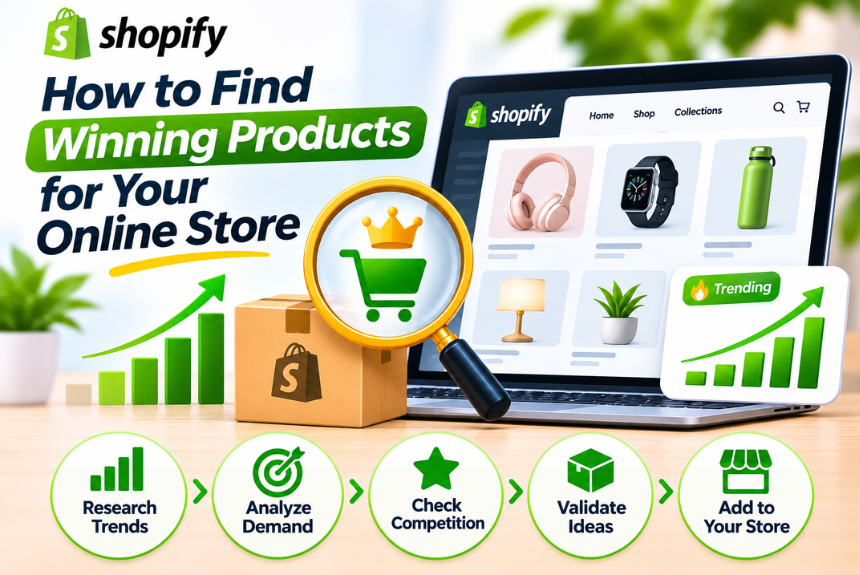
How to Find Winning Products for Your Online Store
Choosing the right products is one of the most important decisions when starting or growing an ecommerce business. A well-designed website, effective marketing campaigns, and a smooth checkout experience can help attract customers, but your business ultimately depends on offering products that people actually want to purchase.
Many entrepreneurs struggle with product selection because they rely on personal preferences, viral trends, or assumptions instead of conducting proper research. As a result, they may invest in products that generate little demand, face intense competition, or offer insufficient profit margins.
Learning how to find winning products for your online store requires a combination of market research, customer understanding, competitor analysis, trend monitoring, and product validation.
Whether you operate a traditional ecommerce store, a dropshipping business, or a print-on-demand website, this guide will help you identify promising product opportunities, evaluate their commercial potential, and make informed decisions before investing your money.
Let’s explore the complete process.
What Is a Winning Product?
A winning product is an item that attracts consistent customer interest, solves a specific problem, offers competitive value, and generates sustainable revenue for an online business.
A product does not become successful simply because it is trending on social media or selling well on another website.
A truly promising product should demonstrate several characteristics:
- There is a clear target audience.
- Customers have a genuine need or desire for it.
- Demand is sufficient to support sales.
- The product offers a competitive advantage.
- Its selling price supports profitable operations.
- Customers can understand its value quickly.
- It can be sourced or produced reliably.
- It has opportunities for marketing and differentiation.
- It can provide a positive customer experience.
Winning Product vs. Trending Product
These terms are often used interchangeably, but they are not exactly the same.
| Trending Product | Winning Product |
| Experiencing increased attention | Demonstrates commercial potential |
| May generate temporary interest | Can generate sustainable demand |
| Often driven by viral content | Supported by customer needs and market demand |
| May have intense competition | Has opportunities for differentiation |
| Popularity may decline quickly | Can remain relevant over time |
| Sales potential may be uncertain | Validated through research and testing |
Important: A trending product can become a winning product, but only after you validate its demand, competition, profitability, and long-term potential.
Characteristics of Winning Ecommerce Products
Before researching specific products, understand the characteristics that make certain products attractive for ecommerce businesses.
1. Solves a Specific Problem
Products that solve customer problems often have clear value propositions.
For example, an ergonomic laptop stand addresses discomfort associated with working on a laptop for extended periods.
Customers are more likely to understand the product’s benefits when it solves a recognizable problem.
2. Has Consistent Demand
A promising product should have a reasonable level of demand.
Look for products that people actively search for, discuss, compare, or purchase.
Avoid relying entirely on temporary viral attention.
3. Offers Healthy Profit Potential
A product’s selling price should leave room for product costs, shipping, packaging, marketing, transaction fees, returns, and other operating expenses.
High sales volume does not automatically mean high profitability.
4. Is Easy to Demonstrate
Products that can be demonstrated visually may be easier to promote through videos, social media, and product advertisements.
For example, kitchen organizers, cleaning accessories, and creative tools can often be showcased through demonstrations.
5. Has Opportunities for Differentiation
A product should offer opportunities to stand out.
You may differentiate through:
- Product quality
- Design
- Branding
- Bundles
- Customer service
- Packaging
- Product education
- Customization
- Convenience
6. Has Manageable Shipping Requirements
Shipping costs and complexity can affect profitability.
For beginners, products that are relatively lightweight, durable, and easy to package may be more manageable.
However, product suitability depends on your target market and fulfillment capabilities.
7. Has Reliable Supply
A promising product is only useful if you can source it consistently.
Research supplier availability, product quality, minimum order quantities, lead times, and fulfillment reliability.
8. Encourages Repeat Purchases or Complementary Sales
Products that customers purchase repeatedly or alongside other products can create additional revenue opportunities.
Examples include consumable products, accessories, replacement components, and complementary product bundles.
Step 1: Understand Your Target Audience
Product research should begin with your customers, not with random product ideas.
Before searching for products, identify the people you want to serve and understand their needs, preferences, and purchasing behavior.
Create a Customer Profile
Consider the following questions:
- Who is your ideal customer?
- What age group are you targeting?
- What problems do they experience?
- What products do they currently purchase?
- What are their interests and hobbies?
- What motivates them to buy?
- What price range can they afford?
- Where do they discover new products?
- What concerns influence their purchasing decisions?
Example: Target Audience for a Fitness Store
| Customer Attribute | Example |
| Age Group | 20–40 years |
| Interests | Fitness, wellness, active lifestyle |
| Main Problems | Limited workout space, convenience |
| Product Preferences | Practical workout accessories |
| Buying Motivation | Comfort, functionality, convenience |
| Discovery Channels | Google, Instagram, YouTube |
| Purchase Considerations | Quality, price, reviews |
Once you understand your target audience, you can identify products that match their needs instead of selecting items based solely on popularity.
Where to Understand Customer Interests
Explore relevant communities on Reddit to identify customer discussions, recurring problems, product recommendations, and dissatisfaction with existing products.
Quora
Use Quora to explore questions people ask about specific product categories and everyday challenges.
Social Media
Analyze comments, discussions, product demonstrations, and customer feedback on Instagram, YouTube, Pinterest, and other relevant platforms.
Pro Tip: Look for recurring problems mentioned by different people. A repeated customer frustration can indicate an opportunity for a useful product or an improved alternative.
Step 2: Identify Problems Customers Want to Solve
Products that address specific problems often have stronger value propositions than products selected simply because they look interesting.
Start by identifying common frustrations in your target market.
Examples of Customer Problems and Product Opportunities
| Customer Problem | Potential Product Opportunity |
| Limited storage space | Space-saving organizers |
| Uncomfortable desk setup | Ergonomic desk accessories |
| Difficulty organizing cables | Cable management products |
| Messy kitchen storage | Kitchen organizers |
| Traveling with multiple accessories | Compact travel organizers |
| Pet hair on furniture | Pet grooming and cleaning accessories |
| Limited home workout space | Compact fitness equipment |
| Difficulty maintaining plants | Practical gardening accessories |
| Poor lighting while working | Adjustable desk lighting |
| Protecting devices during travel | Protective cases and accessories |
These are product research examples, not guaranteed winning products.
Use Customer Reviews to Find Opportunities
Customer reviews can reveal weaknesses in existing products.
Read both positive and negative reviews to understand what customers value and what they dislike.
Look for comments such as:
- “I wish this product were larger.”
- “The material feels cheap.”
- “This is difficult to use.”
- “The instructions are confusing.”
- “It would be better if it included…”
- “The product works, but…”
- “I would buy this again if…”
These observations can help you identify product improvements, better positioning, or complementary products.
Key takeaway: You do not always need to invent a completely new product. Improving an existing product or providing a better customer experience can create a valuable business opportunity.
Step 3: Research Trending Products
Trend research helps you identify products that are receiving increased attention.
However, you should distinguish between temporary popularity and sustainable market demand.
1. Google Trends
Google Trends is a useful tool for exploring search interest over time.
You can use it to:
- Compare multiple product ideas.
- Identify seasonal demand.
- Explore regional interest.
- Observe rising search interest.
- Examine long-term demand patterns.
How to Use Google Trends
- Visit Google Trends.
- Enter a product keyword.
- Select a relevant country or region.
- Choose an appropriate time range.
- Review the interest-over-time graph.
- Compare related search terms.
- Explore related topics and queries.
- Identify whether interest is seasonal, stable, or increasing.
Example
Suppose you are researching travel accessories.
Compare keywords such as:
- Travel organizer
- Packing cubes
- Luggage accessories
- Travel toiletry bag
The comparison may help you identify which product categories are attracting more search interest.
Important: Google Trends shows relative search interest, not actual product sales or guaranteed demand.
2. TikTok and Short-Form Video Platforms
Short-form videos can reveal emerging product trends and creative marketing opportunities.
Explore product demonstrations, customer reactions, and repeated discussions around specific products.
Pay attention to whether the interest appears across multiple creators or is concentrated in a single viral video.
A product receiving attention from several independent sources may deserve further research.
3. Pinterest Trends
Pinterest Trends can be useful for discovering visual and lifestyle-related product interests.
It may be particularly relevant for categories such as:
- Home decor
- Fashion
- Beauty
- Weddings
- Crafts
- Lifestyle accessories
- Seasonal products
4. Google Search Suggestions
Google autocomplete can reveal related searches and customer interests.
Start typing a product keyword and examine the suggested search phrases.
For example:
- Best travel organizer for women
- Compact travel organizer
- Waterproof travel organizer
- Travel organizer for toiletries
These suggestions can help you identify product variations and customer needs.
5. YouTube Product Reviews
Search for product reviews, comparisons, demonstrations, and buyer experiences.
YouTube can help you understand:
- How products are used
- Common product limitations
- Customer expectations
- Product features that attract attention
- Questions potential customers ask before purchasing
How to Evaluate a Trend
| Question | What to Look For |
| Is search interest increasing? | Growing or stable interest |
| Is the product seasonal? | Demand patterns across months |
| Are multiple creators discussing it? | Broader visibility |
| Are people asking purchase-related questions? | Commercial intent |
| Are customers discussing real benefits? | Practical value |
| Is the trend limited to one platform? | Potentially narrow exposure |
| Does demand exist outside social media? | Broader market validation |
Step 4: Explore Ecommerce Marketplaces
Online marketplaces provide valuable information about products customers are already purchasing.
They can help you understand product demand, pricing, competition, reviews, and customer preferences.
1. Amazon
Amazon and the relevant regional marketplace can help you research popular product categories and customer feedback.
What to Analyze
- Best Sellers
- Movers & Shakers
- New Releases
- Product ratings
- Customer reviews
- Frequently purchased products
- Product variations
- Pricing patterns
- Competitor listings
How to Research Products on Amazon
- Select a product category relevant to your audience.
- Explore its Best Sellers section.
- Identify products with consistent visibility.
- Review customer feedback.
- Compare pricing and product features.
- Identify complaints and improvement opportunities.
- Investigate whether multiple sellers offer similar products.
Remember that marketplace rankings can change and do not guarantee that the same product will perform well on your own website.
2. Etsy
Etsy can be useful for researching handmade, customized, creative, and personalized products.
Explore:
- Personalized gifts
- Home decor
- Handmade accessories
- Wedding products
- Craft supplies
- Digital downloads
- Custom artwork
Etsy can also help you understand how product customization and niche positioning influence customer interest.
3. eBay
eBay offers product listings and marketplace information that can help you explore different categories and competitive pricing.
Review sold listings where available to gain insights into completed transactions rather than relying only on active listings.
4. AliExpress
AliExpress can be useful for exploring products, variations, supplier listings, and potential sourcing opportunities.
If you are considering dropshipping, evaluate:
- Product availability
- Supplier ratings
- Customer reviews
- Shipping options
- Delivery estimates
- Product variations
- Supplier communication
- Order fulfillment reliability
Do not select a supplier based only on low product prices.
5. Other Relevant Marketplaces
Depending on your target audience and location, you can also research:
- Walmart Marketplace
- Flipkart
- Meesho
- Regional niche marketplaces
- Industry-specific ecommerce websites
Marketplace Research Comparison
| Platform | Useful for Researching |
| Amazon | Popular products, reviews, demand signals |
| Etsy | Handmade, personalized, and creative products |
| eBay | Product variety and completed sales |
| AliExpress | Product sourcing and supplier research |
| Flipkart | India-focused consumer product trends |
| Meesho | Value-oriented categories and product ideas |
| Visual trends and lifestyle interests |
Step 5: Analyze Your Competitors
Competitor research helps you understand what is already available in the market and how you can position your products more effectively.
Instead of simply copying competitors, analyze their strengths, weaknesses, product selection, and customer experience.
What to Analyze on Competitor Websites
1. Product Selection
Identify their best-selling products, product categories, and variations.
2. Pricing Strategy
Compare product prices, discounts, bundles, and shipping charges.
3. Product Descriptions
Evaluate how competitors communicate product features, benefits, and specifications.
4. Customer Reviews
Look for recurring complaints, product expectations, and opportunities for improvement.
5. Website Experience
Analyze navigation, product filtering, checkout, and mobile usability.
6. Marketing Strategy
Observe how competitors promote their products through social media, search engines, email campaigns, and advertisements.
7. Unique Selling Proposition
Understand why customers might choose a particular competitor.
Do they offer better quality, lower prices, exclusive products, convenience, or specialized customer service?
Competitor Research Framework
| Research Area | Questions to Ask |
| Products | What are they selling? |
| Pricing | How are products priced? |
| Audience | Who are they targeting? |
| Reviews | What do customers appreciate or dislike? |
| Marketing | Which channels do they use? |
| Branding | What makes them recognizable? |
| Website | Is the shopping experience convenient? |
| Fulfillment | What shipping options do they provide? |
| Differentiation | How can your store offer something better? |
How to Identify Product Opportunities
Suppose several competitors sell laptop stands.
You notice recurring complaints about stability, adjustability, or portability.
You could investigate whether a better-designed laptop stand, a bundle with complementary accessories, or more detailed product guidance would create a competitive advantage.
The opportunity is not necessarily to sell a completely different product. It may be to serve customers better.
Step 6: Use Product Research Tools
Product research tools can help you collect information about search demand, competition, advertising activity, and ecommerce trends.
The best tool depends on your business model and the type of research you want to conduct.
1. Semrush
Semrush offers keyword research and competitive analysis features.
You can use it to:
- Research product-related keywords.
- Analyze search volume estimates.
- Identify keyword variations.
- Explore competitor websites.
- Discover organic search opportunities.
- Examine advertising-related data.
Semrush is particularly useful when you want to understand whether customers are actively searching for products or related information.
2. Ahrefs
Ahrefs provides SEO and competitive research tools.
Its features can help you explore:
- Search demand
- Keyword opportunities
- Competitor content
- Organic traffic estimates
- Backlink profiles
- Search visibility
These insights can support product selection and ecommerce SEO planning.
3. Google Keyword Planner
Google Keyword Planner helps you research keywords and discover related search terms.
You can use it to understand estimated search activity, keyword competition in advertising, and potential commercial interest.
Remember that advertising competition is not the same as organic SEO competition or product-market competition.
4. Exploding Topics
Exploding Topics focuses on emerging trends and growing topics.
It can help you discover product categories or consumer interests that are receiving increased attention.
5. Similarweb
Similarweb offers website traffic and digital market intelligence.
You can use it to investigate competitor websites, traffic sources, and broader market activity.
6. Dropshipping Research Tools
If you are researching dropshipping products, you may also explore specialized tools such as:
These tools focus on product discovery and related ecommerce research features. Evaluate their capabilities and suitability before subscribing.
Product Research Tool Comparison
| Tool | Primary Research Purpose |
| Google Trends | Search interest and seasonality |
| Semrush | Keyword and competitor research |
| Ahrefs | SEO and search demand analysis |
| Google Keyword Planner | Keyword research and advertising estimates |
| Exploding Topics | Emerging trends |
| Similarweb | Competitor traffic and digital market insights |
| Minea | Ecommerce product and advertising research |
| Sell The Trend | Dropshipping product discovery |
Pro Tip: You do not need to subscribe to every tool. Start with free research methods and invest in paid tools only when they provide insights that support your business decisions.
Step 7: Evaluate Product Profitability
A product can attract strong demand and still be unsuitable for your business if the costs are too high.
Before selecting a product, estimate its potential profitability.
Calculate Your Product Costs
Include all relevant expenses:
- Product purchase cost
- Shipping and freight
- Packaging
- Customs duties, where applicable
- Payment processing fees
- Marketplace or platform fees
- Advertising costs
- Storage and fulfillment
- Returns and refunds
- Customer support
- Applicable taxes
Example of Product Profitability
Suppose you are considering selling a desk organizer.
| Expense | Amount |
| Selling Price | ₹1,499 |
| Product Cost | ₹450 |
| Shipping | ₹120 |
| Packaging | ₹50 |
| Payment Processing | ₹45 |
| Advertising Cost per Sale | ₹250 |
| Other Allocated Expenses | ₹100 |
| Estimated Contribution | ₹484 |
In this example, the estimated contribution is ₹484 before any additional expenses not included in the calculation.
Basic Profit Calculation
Contribution per Order = Selling Price − Variable Costs
Variable costs may include product cost, shipping, packaging, payment processing, advertising, and other order-related expenses.
Calculate Gross Margin
Gross Margin (%) = (Selling Price − Cost of Goods Sold) ÷ Selling Price × 100
For example:
Selling Price = ₹1,499
Product Cost = ₹450
Gross Margin = (₹1,499 − ₹450) ÷ ₹1,499 × 100
Gross Margin ≈ 69.98%
This calculation does not account for all operating expenses.
Evaluate Pricing Potential
Ask yourself:
- Can the product support a competitive selling price?
- Are customers willing to pay for its benefits?
- Can you offer discounts without destroying margins?
- Are shipping costs manageable?
- Can you bundle the product with complementary items?
- Is there an opportunity for repeat purchases?
- Can you afford customer acquisition costs?
Important: Avoid selecting products based only on a high markup. Evaluate the complete cost structure and realistic selling price.
Step 8: Analyze Product Demand and Competition
The next step is determining whether a product has sufficient demand and whether you can compete effectively.
Analyze Search Demand
Research keywords associated with your product.
For example, if you are considering selling ergonomic office accessories, investigate keywords such as:
- Ergonomic desk accessories
- Adjustable laptop stand
- Laptop stand for home office
- Desk organizer for office
- Compact workspace accessories
Search demand can indicate customer interest, but it should be combined with other research.
Analyze Competition
Evaluate how many businesses are selling similar products and how effectively they serve customers.
Consider:
- Number of competing stores
- Product quality
- Brand recognition
- Pricing
- Reviews
- Shipping speed
- Product differentiation
- Marketing activity
Evaluate Demand and Competition Together
| Demand Level | Competition Level | Potential Opportunity |
| High | Low | Attractive, but validate carefully |
| High | High | Competitive market requiring differentiation |
| Moderate | Low | Potential niche opportunity |
| Moderate | Moderate | Worth further investigation |
| Low | High | Often challenging |
| Low | Low | May indicate limited demand |
This framework is a starting point, not a guarantee of success.
Look for Niche Opportunities
Instead of targeting a broad category, consider a specific audience or use case.
For example:
Broad Category: Home Decor
More Focused Niche: Space-Saving Decor for Small Apartments
A focused niche may help you develop more relevant products, content, and marketing campaigns.
Step 9: Validate Products Before Investing
Product validation helps you determine whether a product has genuine commercial potential before committing significant capital.
Do not rely only on keyword research, marketplace rankings, or supplier claims.
Use multiple validation methods.
1. Order Product Samples
If possible, purchase samples before listing products.
Evaluate:
- Product quality
- Materials
- Packaging
- Functionality
- Durability
- Appearance
- Ease of use
- Shipping time
This is particularly important for dropshipping and private-label businesses.
2. Create a Test Product Page
Develop a product page that includes:
- Product title
- Product description
- High-quality images
- Product benefits
- Price
- Shipping information
- Frequently asked questions
- Clear call to action
Observe customer interest and behavior.
3. Run Small Marketing Campaigns
If your budget allows, conduct controlled advertising tests.
Track:
- Impressions
- Click-through rate
- Website visits
- Add-to-cart activity
- Checkout initiation
- Purchases
- Customer acquisition cost
Do not increase advertising expenditure simply because a product receives clicks.
4. Collect Customer Feedback
Ask potential customers what they think about the product.
Explore:
- Whether they understand its value
- Whether they would purchase it
- What concerns they have
- Whether the price feels reasonable
- What improvements they would like
5. Test Through Preorders or Limited Launches
Where legally and operationally appropriate, you may test interest through a limited launch or preorder campaign.
Clearly communicate product availability and expected delivery timelines.
Do not accept orders unless you can fulfill them responsibly.
6. Analyze Actual Sales
Real customer purchases provide stronger evidence than likes, views, or survey responses.
Monitor sales alongside returns, customer satisfaction, and profitability.
Product Validation Checklist
| Validation Method | What It Helps Determine |
| Product Samples | Quality and usability |
| Keyword Research | Search interest |
| Marketplace Research | Existing demand |
| Competitor Analysis | Market positioning |
| Test Campaigns | Advertising response |
| Customer Feedback | Product appeal |
| Preorders | Purchase intent |
| Actual Sales | Commercial validation |
| Profit Analysis | Financial viability |
Step 10: Choose the Right Suppliers
Finding a promising product is only the beginning.
Your supplier plays an important role in product quality, pricing, inventory availability, and customer satisfaction.
What to Look for in a Supplier
Product Quality
Verify whether the product meets your quality expectations.
Pricing
Compare product costs and determine whether they support your target margins.
Minimum Order Quantity
Understand how many units you must purchase initially.
Shipping and Fulfillment
Check shipping methods, delivery estimates, tracking, and fulfillment capabilities.
Reliability
Investigate supplier communication, consistency, and business reputation.
Return and Refund Policies
Understand how defective, damaged, or incorrect products are handled.
Inventory Availability
Ensure the supplier can maintain sufficient stock as demand increases.
Supplier Research Platforms
Depending on your business model, you can explore:
- Alibaba — Manufacturers and wholesale suppliers
- AliExpress — Product sourcing and supplier listings
- IndiaMART — India-focused supplier discovery
- Faire — Wholesale product sourcing
- CJdropshipping — Dropshipping-related sourcing and fulfillment
Questions to Ask Suppliers
Before working with a supplier, ask:
- What is your minimum order quantity?
- What is the product cost at different order volumes?
- How long does order processing take?
- What shipping methods are available?
- Can you provide product samples?
- Do you support branded packaging?
- How do you handle defective products?
- How frequently is inventory updated?
- Can you maintain consistent product quality?
- What happens if a product becomes unavailable?
Pro Tip: Never rely entirely on product photographs or supplier descriptions. Whenever possible, inspect samples and verify supplier reliability before committing to significant inventory or advertising expenses.
Best Product Categories to Research for Your Online Store
The following categories can provide ideas for further research. Their suitability depends on your audience, market, competition, and business model.
1. Home and Kitchen Products
Examples:
- Kitchen organizers
- Storage accessories
- Space-saving products
- Cleaning tools
- Home improvement accessories
Why Research This Category?
Many home and kitchen products address everyday needs and can be demonstrated visually.
2. Fitness and Wellness Accessories
Examples:
- Resistance bands
- Workout accessories
- Yoga accessories
- Fitness storage products
- Recovery accessories
Why Research This Category?
Fitness-related products can appeal to specific customer segments and lifestyle interests.
3. Travel Accessories
Examples:
- Packing organizers
- Travel toiletry bags
- Luggage accessories
- Compact storage products
- Travel convenience items
Why Research This Category?
Travel accessories can target customers seeking convenience, organization, and portability.
4. Pet Products
Examples:
- Pet grooming accessories
- Pet toys
- Feeding accessories
- Pet travel products
- Cleaning accessories
Why Research This Category?
Pet owners often seek products that improve convenience, comfort, and care.
5. Beauty and Personal Care Accessories
Examples:
- Makeup organizers
- Beauty storage
- Cosmetic accessories
- Hair styling accessories
- Personal care organizers
Why Research This Category?
This category offers opportunities for visual marketing, product bundles, and niche positioning.
6. Office and Productivity Products
Examples:
- Desk organizers
- Laptop stands
- Cable management accessories
- Workspace lighting
- Ergonomic accessories
Why Research This Category?
Remote work, studying, and home office setups create multiple potential product use cases.
7. Hobby and Creative Products
Examples:
- Craft supplies
- Art accessories
- Journaling products
- DIY kits
- Creative organization tools
Why Research This Category?
Specific hobbies can have dedicated audiences interested in specialized products.
8. Digital Products
Examples:
- Templates
- Printable planners
- Ebooks
- Digital artwork
- Educational resources
- Productivity tools
Why Research This Category?
Digital products can be delivered online without physical shipping, although they require valuable content, differentiation, and effective marketing.
Important: These categories are research starting points, not recommendations to invest immediately. Always validate individual products before launching.
Product Research Mistakes to Avoid
Even experienced ecommerce entrepreneurs can make mistakes when evaluating products.
1. Choosing Products Only Because They Are Trending
A viral product may experience short-lived demand.
Investigate whether interest is sustainable and whether customers have a genuine need.
2. Ignoring Competition
High demand can attract many competitors.
Analyze the market carefully and identify opportunities for differentiation before entering a crowded category.
3. Focusing Only on Product Cost
A low-cost product does not automatically produce high profits.
Include shipping, packaging, advertising, payment processing, returns, and other operating expenses.
4. Relying Entirely on Supplier Information
Supplier claims may not accurately represent product quality, demand, or shipping performance.
Conduct independent research and inspect samples where possible.
5. Ignoring Customer Reviews
Reviews can reveal problems that product descriptions and advertisements do not mention.
Use customer feedback to identify opportunities and risks.
6. Testing Too Many Products at Once
Testing numerous products simultaneously can make it difficult to identify what works.
Start with a manageable number of products and analyze their performance carefully.
7. Neglecting Product Differentiation
Selling the same product as numerous competitors without a clear value proposition can make customer acquisition difficult.
Explore ways to improve quality, branding, convenience, or customer experience.
8. Overlooking Shipping and Returns
Shipping expenses, delays, and return rates can significantly affect profitability.
Understand these costs before launching.
9. Confusing Traffic With Demand
A product page receiving thousands of visitors does not necessarily mean customers will purchase the product.
Track conversion rates and actual sales.
10. Ignoring Long-Term Potential
A product may perform well initially but become less relevant over time.
Evaluate whether you can build a sustainable product category, brand, or customer base.
Winning Product Research Checklist
Use this checklist before adding a product to your online store.
| Research Area | Checklist |
| Target Audience | Have I identified the ideal customer? |
| Customer Problem | Does the product solve a real problem or fulfill a clear desire? |
| Demand | Is there evidence of customer interest? |
| Trends | Is demand sustainable or purely temporary? |
| Competition | Have I analyzed competing products and sellers? |
| Differentiation | Can I offer something meaningfully better? |
| Pricing | Is the selling price competitive and realistic? |
| Profitability | Have I calculated all relevant expenses? |
| Supplier | Is the supplier reliable? |
| Product Quality | Have I inspected a sample where possible? |
| Shipping | Are shipping costs and timelines manageable? |
| Customer Experience | Can I provide accurate information and reliable service? |
| Validation | Have I tested customer interest or purchase intent? |
| Scalability | Can I source and fulfill the product consistently? |
| Business Fit | Does the product align with my brand and strategy? |
If several important questions remain unanswered, conduct more research before investing heavily.
Frequently Asked Questions
1. How do I find winning products for my online store?
Start by understanding your target audience and identifying customer problems. Research search trends, marketplaces, competitor websites, customer reviews, and product research tools. Evaluate demand, competition, profitability, and supplier reliability before validating a product.
2. What is the easiest way to find products to sell online?
Explore ecommerce marketplaces, Google Trends, social media discussions, and customer reviews. Look for products that solve specific problems and have evidence of demand. Shortlist a few ideas and evaluate them systematically.
3. How do I find winning products for dropshipping?
Research trending products, analyze competitor stores and advertisements, explore product discovery tools, and evaluate suppliers. Order samples where possible and test product demand before increasing advertising expenditure.
4. Are trending products always profitable?
No. Trending products may attract attention but still have low profit margins, intense competition, unreliable suppliers, or temporary demand. Profitability depends on your complete cost structure and ability to serve customers effectively.
5. Which tools can help with product research?
Google Trends, Semrush, Ahrefs, Google Keyword Planner, Exploding Topics, Similarweb, and specialized ecommerce research tools can provide useful insights into trends, search demand, and competition.
6. How can I identify products with low competition?
Research specific niches, customer segments, and product variations. Analyze search results, marketplace listings, and competitor websites. Look for underserved customer needs rather than relying only on broad product keywords.
7. How much profit should I make from an ecommerce product?
There is no universal profit margin that applies to every product. Your target should account for product cost, shipping, packaging, marketing, payment fees, returns, operating expenses, and applicable taxes.
8. Can I find winning products without paid tools?
Yes. You can start with free resources such as Google Trends, marketplace research, customer reviews, social media, Google search suggestions, and competitor analysis.
9. How do I know whether a product has long-term potential?
Investigate historical search interest, recurring customer needs, seasonal patterns, competitor activity, and repeat purchase opportunities. Products addressing consistent needs may have more sustainable potential than short-lived trends.
10. Should I sell products that competitors are already selling?
Yes, existing competition can indicate market demand. However, you should identify how your store can differentiate itself through product quality, pricing, branding, customer service, convenience, or specialized positioning.
11. How many products should I test before launching?
There is no fixed number. Start with a manageable selection that allows you to conduct meaningful research, create quality product pages, and evaluate customer response without spreading your resources too thin.
12. Is product research important for traditional ecommerce?
Yes. Traditional ecommerce often involves purchasing inventory in advance, making product research especially important. Validating demand before investing in inventory can help reduce the risk of unsold stock.
13. Can I use customer reviews to find winning products?
Yes. Customer reviews can reveal product benefits, common frustrations, missing features, and improvement opportunities. These insights can help you identify promising products or ways to differentiate existing products.
14. What is the difference between product research and product validation?
Product research helps you identify and evaluate potential product opportunities. Product validation tests whether customers are genuinely interested in purchasing a product through samples, feedback, marketing experiments, preorders, or actual sales.
15. Should I focus on one niche or sell multiple product categories?
For beginners, focusing on a specific niche can simplify product research, branding, content creation, and customer targeting. You can expand into related categories after understanding your audience and identifying successful products.
Conclusion
Finding winning products for your online store requires more than identifying trending items or copying popular competitors.
The most effective approach combines customer research, market analysis, trend monitoring, product evaluation, supplier research, and validation.
Start by identifying your target audience and understanding their needs. Explore marketplaces, analyze customer reviews, research search trends, and investigate competitors to discover potential product opportunities.
Then evaluate each product based on demand, competition, pricing, profitability, supplier reliability, and long-term potential.
Most importantly, validate your ideas before making significant investments.
A winning product is not simply something people want to buy. It is something your business can source reliably, market effectively, sell profitably, and deliver in a way that satisfies customers.
Ready to Grow Your Online Store?
Explore more ecommerce guides, product research tutorials, and digital marketing resources on NextBloggers to discover practical strategies for building and growing your online business.
Research smarter, validate your ideas, and make product decisions based on evidence rather than assumptions.
Leave a Reply