


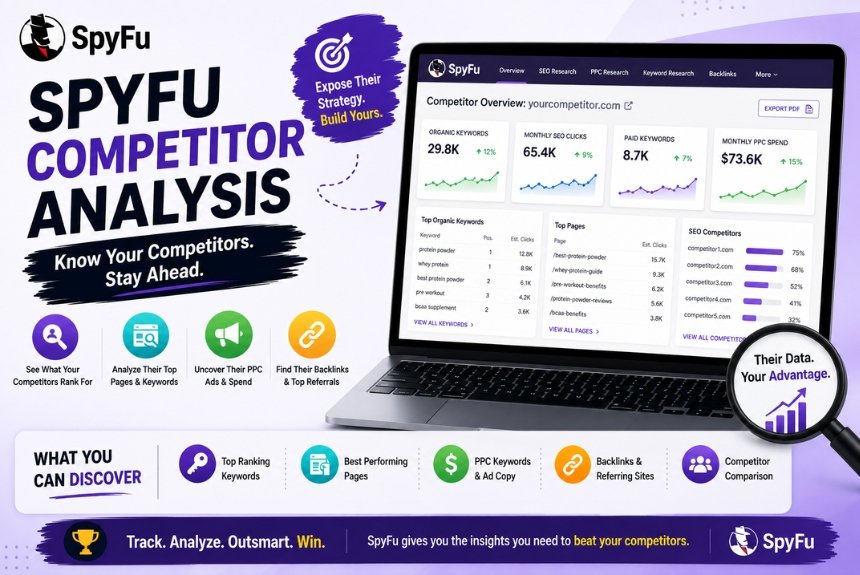
How to Do Competitor Analysis Using SpyFu
Competitor analysis is one of the most valuable activities in search engine optimization (SEO) and digital marketing. Instead of relying solely on your own website data, competitor analysis helps you understand how other successful websites attract visitors, rank for important keywords, and build their online presence. By learning from competitors, businesses can identify opportunities, avoid common mistakes, and develop more effective SEO strategies.
SpyFu is a powerful competitive intelligence platform that simplifies this process by providing detailed insights into both organic and paid search performance. Rather than spending hours collecting information from multiple sources, SpyFu brings together keyword rankings, competitor domains, PPC campaigns, historical performance, backlink data, and SEO reports in a single dashboard. This allows marketers to quickly evaluate competing websites and make informed decisions based on real search data.
One of the greatest advantages of competitor analysis is that it reveals strategies that are already producing results. If a competing website consistently ranks on the first page of Google, there is valuable information to learn from its keyword targeting, content structure, and advertising campaigns. Instead of guessing what works, you can study successful competitors and adapt proven ideas to fit your own business.
Competitor analysis is useful for businesses of all sizes. Bloggers can discover content ideas, freelancers can strengthen SEO strategies for clients, small businesses can identify local search opportunities, and agencies can prepare detailed reports that support data-driven marketing decisions. Regular competitor monitoring also helps businesses stay updated with changes in search trends and industry competition.
SpyFu makes this process accessible even for beginners. Its intuitive interface allows users to compare multiple domains, analyze keyword rankings, uncover keyword gaps, evaluate paid search campaigns, and identify the pages generating the most traffic for competitors. These insights help marketers prioritize their efforts and focus on strategies with the highest potential impact.
In this comprehensive guide, you’ll learn how to perform competitor analysis using SpyFu, choose the right competitors, analyze organic and paid search performance, identify keyword opportunities, evaluate top-performing pages, generate professional reports, and use competitor data to improve your overall SEO strategy.
What is Competitor Analysis?
Competitor analysis is the process of evaluating other websites that compete for the same audience, keywords, or market share. The goal is to understand what competitors are doing successfully and identify opportunities to improve your own digital marketing strategy.
Rather than copying competitors, effective analysis focuses on learning from their strengths, recognizing their weaknesses, and discovering gaps that your business can use to gain a competitive advantage.
SpyFu simplifies competitor analysis by providing valuable insights into both SEO and PPC performance, helping marketers make informed decisions based on actual search data instead of assumptions.
Why Competitor Analysis Matters
Search engines are highly competitive, and achieving strong rankings requires more than simply publishing content. Understanding how successful competitors approach SEO provides valuable direction for your own strategy.
Competitor analysis helps businesses:
- Discover profitable keywords
- Identify successful content topics
- Understand search intent
- Improve SEO planning
- Analyze advertising strategies
- Monitor industry trends
- Build stronger content
- Increase organic visibility
Instead of starting from scratch, you can build upon proven strategies while creating unique, higher-quality content.
Types of Competitor Analysis
SpyFu supports several types of competitor research, including:
Organic SEO Analysis
Understand which keywords competitors rank for and how they generate unpaid search traffic.
PPC Analysis
Study Google Ads campaigns, paid keywords, and advertising strategies.
Keyword Analysis
Identify the keywords driving traffic and compare them with your own rankings.
Content Analysis
Discover the topics and pages that attract the most visitors.
Historical Analysis
Review changes in keyword rankings and advertising campaigns over time.
Benefits of Competitor Analysis
Using SpyFu for competitor analysis provides several advantages:
- Better keyword selection
- Improved content planning
- Smarter PPC campaigns
- Faster SEO decision-making
- Identification of ranking opportunities
- More effective reporting
- Stronger long-term marketing strategies
These insights help businesses compete more effectively while reducing unnecessary trial and error.
What Information Can SpyFu Provide?
SpyFu offers a wide range of competitor data, including:
- Organic keywords
- Paid keywords
- Ranking history
- Keyword difficulty
- Search volume
- Cost Per Click (CPC)
- Ad history
- Top competitors
- Domain comparisons
- SEO reports
Access to this information allows marketers to develop comprehensive strategies based on reliable data.
Common Uses of Competitor Analysis
Businesses use SpyFu competitor analysis for many purposes, such as:
- Planning new content
- Improving keyword targeting
- Launching PPC campaigns
- Benchmarking website performance
- Identifying content gaps
- Preparing client reports
- Tracking competitor growth
Regular competitor analysis helps businesses remain competitive in constantly changing search environments.
Best Practices
To maximize the value of competitor analysis:
- Analyze several competitors instead of just one.
- Focus on businesses targeting the same audience.
- Review both SEO and PPC performance.
- Monitor competitors regularly.
- Create original content based on your findings.
The objective is not to imitate competitors but to build a stronger and more effective strategy using the insights you gather.
Choosing Competitors
Choosing the right competitors is one of the most important steps in competitor analysis. The quality of your research depends largely on the websites you compare against. If you analyze irrelevant or overly broad websites, the insights you gather may not help improve your own SEO strategy.
SpyFu makes competitor identification easier by suggesting websites that compete for similar keywords. However, understanding which competitors are most relevant to your business is equally important.
The goal is to study websites targeting the same audience, products, services, or topics so the data you collect can be applied effectively.
Who Is Your SEO Competitor?
An SEO competitor is any website that ranks for the same keywords you want to target, regardless of whether they sell the same products or services.
For example, if you own a digital marketing agency, your SEO competitors could include:
- Marketing agencies
- SEO blogs
- Software review websites
- Educational websites
- Freelance SEO consultants
Even though these businesses may operate differently, they compete for the same search visibility.
Business Competitors vs SEO Competitors
Many beginners confuse business competitors with SEO competitors.
| Business Competitors | SEO Competitors |
| Sell similar products or services | Rank for similar keywords |
| Compete in the marketplace | Compete in search results |
| May not rank online | Often dominate search rankings |
| Focus on customers | Focus on search visibility |
Understanding this difference helps you analyze the right websites in SpyFu.
Finding Competitors with SpyFu
SpyFu automatically identifies competing domains based on shared keyword rankings.
To find competitors:
- Log in to SpyFu.
- Enter your website’s domain.
- Open the Competitors section.
- Review the list of suggested competitor websites.
- Select the most relevant domains for analysis.
This feature saves time by eliminating the need for manual competitor searches.
Evaluate Competitor Relevance
Before selecting a competitor, consider:
- Industry relevance
- Target audience
- Website authority
- Similar products or services
- Content quality
- Search visibility
Avoid comparing your website with unrelated brands simply because they have high traffic.
Analyze Multiple Competitors
Studying multiple competitors provides a broader understanding of your market.
Benefits include:
- Discovering more keyword opportunities
- Comparing different content strategies
- Identifying industry trends
- Finding overlooked topics
- Reducing reliance on a single competitor
Comparing three to five competitors often produces the most balanced insights.
Create a Competitor List
Organize your competitors into categories for easier analysis.
Example:
| Competitor Type | Purpose |
| Direct Competitors | Same products or services |
| SEO Competitors | Target similar keywords |
| Industry Leaders | Learn best practices |
| Emerging Websites | Discover new trends |
This organization makes ongoing competitor monitoring much easier.
Review Competitors Regularly
Search rankings change frequently, so your competitor list should be updated periodically.
Review competitors every few months to:
- Identify new websites
- Monitor ranking changes
- Discover new keywords
- Track industry developments
Regular monitoring ensures your SEO strategy stays current.
Organic Search Analysis
Once you’ve selected your competitors, the next step is analyzing their organic search performance. Organic search analysis helps you understand how competitors attract visitors without paying for advertisements.
SpyFu provides detailed reports showing the keywords competitors rank for, their estimated traffic, ranking history, and top-performing pages. These insights help you identify opportunities to improve your own website.
What Is Organic Search Analysis?
Organic search analysis involves studying a website’s unpaid search performance.
This includes evaluating:
- Ranking keywords
- Search volume
- Ranking positions
- Organic traffic
- Keyword trends
- Top-performing pages
The objective is to understand which SEO strategies contribute to a competitor’s success.
Access Organic Search Data
After entering a competitor’s domain into SpyFu:
- Open the SEO Research section.
- Select Organic Keywords.
- Review the keyword report.
The report typically includes:
- Keyword
- Ranking position
- Search volume
- Keyword difficulty
- Estimated clicks
- Ranking history
- Cost Per Click (CPC)
These metrics provide a clear picture of the competitor’s organic visibility.
Analyze High-Ranking Keywords
Focus on keywords where competitors consistently rank on the first page.
Ask questions such as:
- Which keywords generate the most traffic?
- Which keywords match my niche?
- Which keywords have moderate competition?
- Which topics are missing from my website?
These insights help prioritize future content.
Study Ranking Trends
SpyFu’s historical data allows you to monitor keyword performance over time.
Look for:
- Consistently high rankings
- Improving keyword positions
- Declining rankings
- Seasonal fluctuations
Understanding these trends helps identify stable keyword opportunities.
Evaluate Search Intent
Each keyword reflects a specific user intent.
Common categories include:
Informational
Users are looking for knowledge.
Examples:
- What is SEO?
- Keyword research guide
- How to use SpyFu
Commercial
Users are comparing solutions.
Examples:
- SpyFu vs SEMrush
- Best SEO tools
- SpyFu pricing
Transactional
Users are ready to take action.
Examples:
- Buy SEO software
- Start SpyFu trial
- SEO tool subscription
Creating content that matches search intent improves the likelihood of ranking and satisfying users.
Identify Long-Tail Keyword Opportunities
Long-tail keywords often have lower competition and more specific user intent.
Examples include:
- How to perform competitor analysis using SpyFu
- Best keyword research strategy for beginners
- Affordable SEO competitor research tools
These keywords can help newer websites gain visibility more quickly.
Analyze Top Ranking Pages
Review the pages that attract the most organic traffic.
Study:
- Content length
- Heading structure
- Internal links
- Keyword placement
- User experience
- Content depth
Understanding why these pages perform well can help you create more valuable content.
Build a Better SEO Strategy
Use your findings to improve your own website by:
- Targeting overlooked keywords
- Expanding existing articles
- Publishing new content
- Updating outdated pages
- Improving internal linking
- Optimizing on-page SEO
The objective is not to duplicate competitor content but to produce more comprehensive and useful resources.
Paid Search Analysis
While organic search focuses on earning traffic through search engine rankings, paid search analysis helps you understand how competitors use advertising to attract customers. Many successful businesses combine SEO with Google Ads to maximize their online visibility. Studying these paid campaigns can reveal valuable insights into keyword selection, ad messaging, promotional offers, and budget priorities.
SpyFu is particularly useful for paid search analysis because it stores historical Google Ads data. Instead of only showing current advertisements, it lets you review campaigns that competitors have run over time. This historical perspective helps you identify long-term strategies rather than temporary experiments.
Why Paid Search Analysis Matters
Analyzing competitor PPC campaigns helps businesses make smarter advertising decisions before investing their own budget.
Benefits include:
- Discovering profitable paid keywords
- Understanding competitor advertising strategies
- Identifying high-converting search terms
- Improving ad copy
- Planning advertising budgets
- Reducing campaign guesswork
Instead of testing hundreds of keywords yourself, you can begin with keywords that competitors have already invested in.
Accessing Paid Search Data in SpyFu
To analyze a competitor’s paid search activity:
- Enter the competitor’s domain into SpyFu.
- Open the PPC Research section.
- Review the overview dashboard.
- Explore paid keywords and ad history.
- Compare results with your own website if needed.
The dashboard provides a snapshot of the competitor’s advertising performance and keyword strategy.
Analyze Paid Keywords
SpyFu lists the keywords competitors actively target through Google Ads.
For each keyword, you can review metrics such as:
- Monthly search volume
- Estimated Cost Per Click (CPC)
- Competition level
- Estimated clicks
- Keyword position
- Commercial intent
Focus on keywords that are relevant to your products, services, or content goals rather than trying to target every keyword.
Study Historical Advertising Activity
One of SpyFu’s biggest advantages is its historical advertising database.
Historical reports help answer questions like:
- Which keywords have competitors advertised consistently?
- How has their ad strategy changed?
- Which campaigns appear to be long-term investments?
- Are there seasonal advertising trends?
Long-running campaigns often suggest that certain keywords are delivering positive results.
Evaluate Ad Copy
Competitor advertisements provide insight into how businesses communicate with potential customers.
Pay attention to:
- Headlines
- Descriptions
- Promotional offers
- Calls-to-action
- Unique selling points
Use these observations to understand what types of messages resonate with your target audience. Always create original ad copy instead of copying competitors.
Identify Commercial Intent
Paid keywords usually indicate strong commercial intent because advertisers spend money only when they believe those searches can generate business.
Examples include:
- Buy SEO software
- Best keyword research tool
- SEO audit services
- Digital marketing agency
These keywords can also inspire SEO content such as comparison pages, product reviews, and service guides.
Compare Multiple Competitors
Analyzing several competitors provides a broader understanding of your industry.
Compare:
- Paid keyword overlap
- Advertising frequency
- Promotional messaging
- Seasonal campaigns
- Budget priorities
This helps you identify common strategies as well as opportunities that competitors may have overlooked.
Key Takeaways from Paid Search Analysis
Paid search analysis enables you to:
- Learn from successful advertisers
- Improve campaign planning
- Discover valuable keywords
- Understand customer intent
- Build stronger advertising strategies
Using these insights alongside SEO research creates a more balanced digital marketing approach.
Keyword Gap Analysis
Keyword gap analysis is one of the most powerful features available in SpyFu. It compares your website with competitors to identify keywords that they rank for but your website does not.
Instead of brainstorming content ideas from scratch, keyword gap analysis highlights real opportunities based on proven search performance.
What Is a Keyword Gap?
A keyword gap is a search term that competitors rank for while your website is absent from the search results or ranks significantly lower.
For example:
| Keyword | Competitor | Your Website |
| SpyFu Competitor Analysis | ✔ | ✘ |
| PPC Research Guide | ✔ | ✘ |
| SEO Competitor Tools | ✔ | ✘ |
Each missing keyword represents a potential opportunity to increase your organic visibility.
Why Keyword Gap Analysis Is Important
Understanding keyword gaps helps businesses:
- Discover untapped topics
- Expand website content
- Increase keyword coverage
- Improve search visibility
- Strengthen topical authority
- Prioritize future SEO efforts
Rather than creating random articles, you can focus on topics with demonstrated search demand.
Performing Keyword Gap Analysis in SpyFu
Follow these steps:
- Enter your website’s domain.
- Add one or more competitor domains.
- Generate the comparison report.
- Review keywords competitors rank for that your site does not.
- Export the results for content planning.
This workflow provides a clear roadmap for future content creation.
Prioritize Missing Keywords
Not every missing keyword should become an immediate priority.
Evaluate keywords based on:
- Search volume
- Keyword difficulty
- Search intent
- Business relevance
- Conversion potential
- Existing content coverage
Starting with achievable keywords often produces faster SEO improvements.
Organize Keywords by Intent
Grouping keywords by intent helps build a balanced content strategy.
Informational
Examples:
- What is competitor analysis?
- How to use SpyFu
- SEO keyword research guide
These keywords are ideal for educational blog posts and tutorials.
Commercial
Examples:
- SpyFu vs Ahrefs
- Best SEO software
- SpyFu pricing
These keywords are well suited for comparison articles and product reviews.
Transactional
Examples:
- Start SpyFu trial
- Buy SEO tool
- SEO software subscription
These keywords are valuable for landing pages and conversion-focused content.
Turn Gaps into Content Opportunities
After identifying keyword gaps, develop content around them using formats such as:
- Ultimate guides
- Tutorials
- Comparison articles
- Case studies
- Checklists
- FAQs
- Product reviews
Publishing high-quality content consistently helps close keyword gaps and strengthen your website’s authority.
Monitor Progress Over Time
Keyword gap analysis should be repeated regularly.
Monitor:
- Newly discovered keywords
- Ranking improvements
- Competitor content updates
- Emerging search trends
- Changes in keyword difficulty
Ongoing analysis ensures your SEO strategy evolves alongside the competitive landscape.
Top Performing Pages
One of the most valuable insights you can gain from competitor analysis is identifying which pages generate the most organic traffic. Instead of guessing what type of content performs well, you can study the pages that already rank highly in search results and understand why they are successful.
SpyFu helps users identify the keywords competitors rank for, making it easier to determine which pages are likely driving the majority of their search traffic. By analyzing these pages, you can uncover content ideas, keyword opportunities, and optimization strategies for your own website.
The goal is not to duplicate competitor content but to create more comprehensive, up-to-date, and user-focused resources.
Why Analyze Top Performing Pages?
Top-performing pages reveal what your audience is searching for and which topics have the highest potential to generate traffic.
Analyzing these pages helps you:
- Discover high-demand topics
- Understand user intent
- Identify successful content formats
- Improve content planning
- Increase organic visibility
- Build stronger SEO strategies
Instead of creating random content, you can prioritize topics that already have proven search demand.
Finding Top Pages with SpyFu
To identify a competitor’s strongest pages:
- Enter the competitor’s domain into SpyFu.
- Navigate to the SEO Research section.
- Review the highest-ranking keywords.
- Identify the pages associated with those keywords.
- Analyze the content structure and optimization techniques.
This process helps you understand which pages contribute most to a competitor’s organic success.
Evaluate Content Quality
When reviewing a competitor’s top-performing pages, pay attention to the overall quality of the content.
Consider factors such as:
- Accuracy of information
- Content depth
- Readability
- Organization
- Use of headings
- Internal linking
- Multimedia integration
- User experience
Ask yourself how you can provide even greater value through your own content.
Analyze Keyword Usage
Successful pages often rank because they target keywords naturally throughout the content.
Review:
- Primary keywords
- Secondary keywords
- Long-tail keywords
- Heading structure
- Meta title
- Meta description
- URL structure
Rather than stuffing keywords into your content, focus on writing naturally while covering the topic comprehensively.
Study Content Structure
Well-organized pages are easier for both users and search engines to understand.
Look for:
- Clear introductions
- Logical heading hierarchy
- Short paragraphs
- Bullet points
- Tables
- FAQs
- Actionable tips
A clean structure improves readability and encourages visitors to stay on the page longer.
Identify User Intent
Every successful page satisfies a specific search intent.
Examples include:
Informational
Users want to learn something.
Examples:
- How to use SpyFu
- SEO competitor analysis
- Keyword research guide
Commercial
Users are comparing products or services.
Examples:
- SpyFu vs SEMrush
- Best SEO tools
- SpyFu pricing
Transactional
Users are ready to take action.
Examples:
- Buy SEO software
- Start free trial
- Book SEO services
Matching content to user intent increases the likelihood of ranking well and improving user satisfaction.
Create Better Content
After analyzing competitor pages, identify ways to improve upon them.
For example:
- Add more detailed explanations.
- Include updated information.
- Answer additional questions.
- Improve formatting.
- Enhance readability.
- Include practical examples.
Creating content that is more useful than existing pages increases your chances of earning higher rankings over time.
SEO Opportunities
Competitor analysis is not just about observing what others are doing—it is about identifying opportunities that can improve your own website’s performance.
SpyFu provides valuable data that helps marketers uncover keyword opportunities, content gaps, ranking improvements, and advertising insights.
The most successful SEO strategies focus on finding opportunities where effort is likely to produce measurable results.
Discover Untapped Keywords
One of the easiest ways to grow organic traffic is by targeting keywords your competitors rank for but your website has not yet addressed.
Focus on keywords that are:
- Relevant
- Achievable
- Valuable
- Aligned with your business goals
These keywords often become the foundation for future content.
Improve Existing Content
Not every opportunity requires creating a new article.
Sometimes you can improve rankings by updating existing content.
Consider:
- Expanding sections
- Adding missing keywords
- Improving internal links
- Refreshing outdated information
- Updating statistics
- Enhancing readability
Regular content updates help maintain search visibility.
Strengthen Internal Linking
Competitor websites often have strong internal linking structures.
Review how competitors connect related articles and use similar strategies to:
- Improve navigation
- Distribute page authority
- Increase time on site
- Help search engines discover content
A well-planned internal linking strategy supports overall SEO performance.
Build Topical Authority
Instead of publishing isolated articles, develop comprehensive topic clusters.
For example:
Main topic:
SpyFu
Supporting articles:
- SpyFu Review
- SpyFu Pricing
- SpyFu Keyword Research
- SpyFu Competitor Analysis
- SpyFu PPC Research
- SpyFu Alternatives
Interlinking these articles signals expertise to search engines and improves the user experience.

Monitor Competitor Changes
Competitor analysis should be an ongoing process.
Regularly review:
- New content
- Keyword rankings
- PPC campaigns
- Search trends
- Emerging competitors
Continuous monitoring allows you to adapt your SEO strategy before competitors gain a significant advantage.
Reporting
Collecting competitor data is only valuable if the information can be organized into actionable insights. Reporting helps transform raw SEO data into clear recommendations that support better decision-making.
SpyFu offers reporting features that simplify the process of sharing competitor insights with team members, clients, or stakeholders.
Why Reporting Matters
SEO reports help businesses:
- Track competitor performance
- Measure keyword growth
- Identify new opportunities
- Monitor campaign progress
- Support strategic planning
Well-prepared reports make it easier to prioritize SEO activities and demonstrate the impact of optimization efforts.
What to Include in a Competitor Analysis Report
A complete report should summarize the most important findings.
Include:
- Competitor overview
- Organic keyword rankings
- Paid keyword insights
- Keyword gaps
- Top-performing pages
- SEO opportunities
- Recommended actions
Organizing information into sections makes reports easier to understand.
Use Reports for Better Decisions
Rather than collecting data without action, use reports to:
- Plan new content.
- Update existing pages.
- Improve keyword targeting.
- Refine advertising campaigns.
- Track progress over time.
Regular reporting ensures that competitor analysis leads to measurable improvements instead of becoming a one-time activity.
Summary
Analyzing top-performing pages, identifying SEO opportunities, and preparing organized reports are the final steps in an effective competitor analysis strategy. SpyFu provides the insights needed to understand why competitors succeed and where your website can improve.
By consistently reviewing competitor content, targeting valuable keyword opportunities, strengthening your website’s structure, and documenting your findings through clear reports, you can build a sustainable SEO strategy that supports long-term growth.
Frequently Asked Questions (FAQs)
1. What is SpyFu Competitor Analysis?
SpyFu Competitor Analysis is a feature that helps businesses evaluate competitors’ SEO and PPC strategies. It provides insights into organic keywords, paid keywords, keyword rankings, advertising history, and content opportunities, allowing marketers to make informed decisions.
2. Who should use SpyFu for competitor analysis?
SpyFu is suitable for SEO professionals, digital marketers, bloggers, business owners, freelancers, and marketing agencies. Anyone looking to improve search visibility or understand competitor strategies can benefit from its insights.
3. Can SpyFu analyze both SEO and PPC competitors?
Yes. SpyFu offers comprehensive analysis for both organic search performance and paid advertising campaigns. This enables users to compare keyword rankings, advertising strategies, and keyword opportunities within a single platform.
4. How often should competitor analysis be performed?
Competitor analysis should be conducted regularly, ideally every one to three months. Frequent monitoring helps businesses identify new competitors, track ranking changes, discover emerging keyword opportunities, and respond to industry trends.
5. Can competitor analysis improve SEO rankings?
Competitor analysis does not directly improve rankings, but it provides valuable insights that help marketers optimize content, target better keywords, strengthen internal linking, and create more effective SEO strategies, all of which can contribute to improved search performance over time.
Final Checklist
Before completing your SpyFu competitor analysis, make sure you have completed the following steps:
- ✔ Identify your primary SEO competitors.
- ✔ Compare multiple competitor domains.
- ✔ Review organic keyword rankings.
- ✔ Analyze paid search campaigns.
- ✔ Perform keyword gap analysis.
- ✔ Identify top-performing pages.
- ✔ Look for content and SEO opportunities.
- ✔ Export and organize competitor data.
- ✔ Prepare a structured competitor analysis report.
- ✔ Review competitor performance regularly and update your SEO strategy.
Using this checklist ensures that your competitor research is thorough, organized, and focused on actionable improvements.
Leave a Reply