


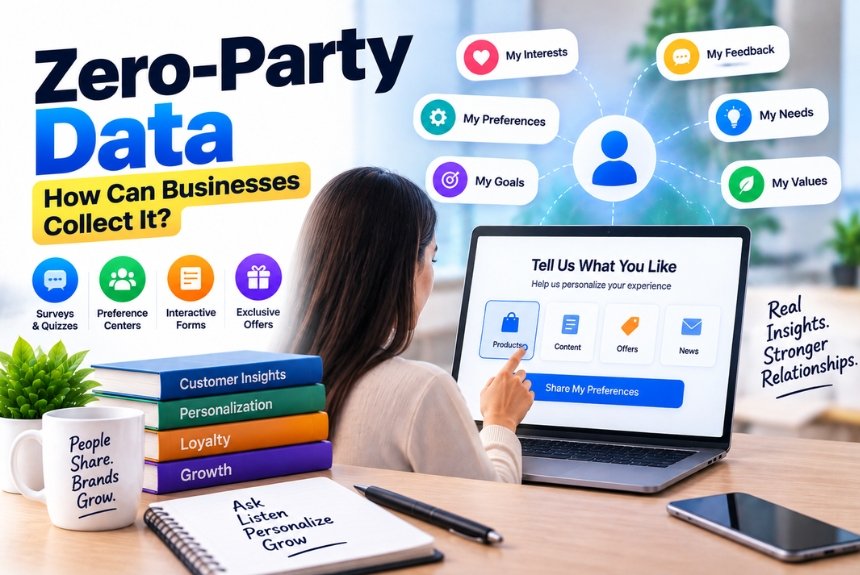
What Is Zero-Party Data and How Can Businesses Collect It?
Introduction
Businesses have always relied on customer data to understand audiences, personalize experiences, improve products, and create more relevant marketing campaigns.
But the way companies collect and use that data is changing.
Privacy expectations are increasing, regulations continue to shape data practices, and businesses are becoming more cautious about relying on data collected indirectly through third-party systems.
This has increased interest in zero-party data.
Zero-party data is information that customers intentionally and proactively share with a business, such as their preferences, interests, needs, purchase intentions, or communication choices.
For example, when an online store asks:
“Which products are you most interested in?”
and a customer voluntarily selects:
- skincare
- haircare
- fragrances
the customer is directly telling the business what they want.
That information can then be used to improve personalization, segmentation, recommendations, and marketing communication.
Zero-party data is particularly relevant to email marketing, customer segmentation, ecommerce personalization, lead generation, and privacy-conscious marketing strategies.
But it is important to understand what zero-party data actually means, how it differs from first-party data, and how businesses can collect it without creating a poor customer experience.
What Is Zero-Party Data?
Zero-party data is information that a customer intentionally and proactively provides to a company.
The term was popularized in the marketing industry to describe information that customers deliberately share rather than information a company simply observes or collects indirectly.
Examples include:
- product preferences
- personal interests
- communication preferences
- purchase intentions
- preferred categories
- feedback
- stated goals
- preferred content
- desired frequency of communication
- demographic information voluntarily provided by the customer
Imagine signing up for an email newsletter and being asked:
“What type of content would you like to receive?”
You choose:
- SEO
- content marketing
- email marketing
Those selections are zero-party data.
The customer has directly communicated their interests.
Why Is Zero-Party Data Important?
The value of zero-party data comes from its directness.
A business does not have to infer what someone wants from their browsing behavior alone.
The customer can simply tell the company.
For example, an ecommerce website might observe that a visitor repeatedly views running shoes.
That behavior could suggest an interest in running.
But the business could ask:
“What type of running are you interested in?”
The customer might answer:
Trail running.
That is more specific information.
The business can use that preference to provide more relevant content and recommendations.
This makes zero-party data particularly useful for personalization.
Zero-Party Data vs First-Party Data
These terms are often confused.
They are related, but they are not identical.
First-Party Data
First-party data is information a company collects directly from its audience through its own interactions and channels.
Examples include:
- website activity
- purchase history
- account activity
- email engagement
- customer service interactions
- transactions
Zero-Party Data
Zero-party data is information the customer deliberately tells the company.
Examples include:
- “I prefer premium products.”
- “I want emails once a week.”
- “I am interested in digital marketing.”
- “I am planning to buy within three months.”
- “My business has 10–50 employees.”
A simple way to remember the difference is:
First-party data = what the business directly observes or collects.
Zero-party data = what the customer intentionally tells the business.
Zero-party data can therefore be considered a particularly explicit form of customer-provided information within a broader first-party data strategy.
Zero-Party Data vs Second-Party and Third-Party Data
Understanding the broader data ecosystem makes the distinction clearer.
| Data Type | How It Is Obtained | Example |
|---|---|---|
| Zero-party | Customer intentionally provides it | Preference survey |
| First-party | Company collects directly | Purchase history |
| Second-party | Another organization shares its first-party data | Partner data |
| Third-party | External provider aggregates or provides data | Audience segments |
The exact legal and operational treatment of data depends on the jurisdiction, consent framework, and how the information is collected and processed.
Businesses should therefore distinguish the marketing terminology from actual privacy and legal requirements.
Calling something “zero-party data” does not automatically make its collection or use compliant.
Examples of Zero-Party Data
Zero-party data can be collected in many forms.
Product Preferences
“What products are you interested in?”
Communication Preferences
“How often would you like to hear from us?”
Content Interests
“Which topics would you like to receive?”
Purchase Intent
“When are you planning to buy?”
Customer Goals
“What are you trying to achieve?”
Business Information
“What size is your company?”
Personal Preferences
“Which style do you prefer?”
Feedback
“What would you like us to improve?”
The key characteristic is intentional disclosure.
How Can Businesses Collect Zero-Party Data?
There are many practical collection methods.
1. Preference Centers
A preference center allows subscribers to tell a company what they want.
For example:
Email preferences
☐ SEO
☐ Email marketing
☐ Web hosting
☐ Digital advertising
Frequency
○ Weekly
○ Monthly
○ Important updates only
This information can then be used to segment the subscriber database.
2. Signup Forms
Traditional signup forms can collect basic zero-party information.
Instead of asking only:
Name + Email
you might ask:
What are you interested in?
or:
What best describes you?
For example:
- Small business owner
- Marketing professional
- Ecommerce seller
- Student
- Enterprise marketer
However, every additional field creates friction.
Do not turn a simple newsletter signup into a 15-question survey.
Ask only for information that has a clear purpose.
3. Surveys
Surveys are one of the simplest ways to collect zero-party data.
You can ask:
- What challenges are you facing?
- Which products interest you?
- What content would you like?
- What features matter most?
- What are your goals?
- What would make our product more useful?
Surveys can provide valuable qualitative and quantitative information.
The best surveys are usually focused.
A customer is more likely to complete five useful questions than a lengthy questionnaire containing dozens of unnecessary fields.
4. Interactive Quizzes
Quizzes can make data collection more engaging.
For example, a skincare brand could create:
“Find Your Ideal Skincare Routine.”
The quiz might ask:
- What is your skin type?
- What is your main concern?
- What texture do you prefer?
- How much time do you spend on skincare?
The customer receives personalized recommendations.
The company receives preference information.
This creates a value exchange.
5. Product Finders
Product recommendation tools are particularly effective for ecommerce.
For example:
“Help me choose the right laptop.”
The website could ask:
- What will you use it for?
- What is your budget?
- How important is battery life?
- Do you prefer portability?
- Which operating system do you prefer?
The customer receives a recommendation.
The business receives explicit preference data.
6. Interactive Calculators
Calculators can collect useful information while providing immediate value.
Examples include:
- mortgage calculators
- calorie calculators
- hosting cost calculators
- marketing ROI calculators
- shipping calculators
- savings calculators
A business can ask for relevant inputs as part of the experience.
For example:
“How many monthly website visitors do you receive?”
“What type of website do you operate?”
“What is your monthly hosting budget?”
The information can help personalize the result.
7. Post-Purchase Questions
After a purchase, ask customers about their experience.
For example:
“Why did you choose this product?”
or:
“What problem were you trying to solve?”
This can reveal customer motivations that transaction data alone may not show.
8. Onboarding Forms
Software companies can collect zero-party data during onboarding.
For example:
“What is your primary goal?”
Options:
- Generate leads
- Improve SEO
- Automate email
- Increase sales
- Analyze customers
The platform can then customize the onboarding experience.
9. Email Preference Surveys
Email marketers can ask subscribers what they want to receive.
For example:
Choose your interests:
- Industry news
- Tutorials
- Product updates
- Offers
- Case studies
This can reduce irrelevant email communication.
It can also create more useful segments.
10. Feedback Forms
Feedback forms provide another source of explicit customer information.
Ask questions such as:
“What would you like us to improve?”
or:
“Which feature would you like us to add?”
This information can support:
- product development
- customer experience
- content strategy
- marketing
- customer retention
How Zero-Party Data Helps Email Marketing
Zero-party data has a particularly strong use case in email marketing.
Traditional email segmentation may rely on:
- previous purchases
- website activity
- email clicks
- engagement history
Zero-party data adds information the subscriber has explicitly provided.
For example:
Subscriber A
Interest: SEO
Frequency: Weekly
Business type: Agency
Subscriber B
Interest: Email Marketing
Frequency: Monthly
Business type: Ecommerce
Instead of sending identical campaigns to both subscribers, the business can tailor communication based on their stated preferences.
This can make email communication more relevant.
Zero-Party Data and Personalization
Personalization is one of the strongest potential applications.
Consider an online clothing store.
A customer tells the company:
Preferred style: Casual
Preferred category: Sneakers
Preferred budget: Mid-range
The company can use those preferences to personalize:
- product recommendations
- email content
- website experiences
- promotional messages
The advantage is that the company does not have to infer everything from behavior.
The customer has provided the information directly.
Zero-Party Data and Customer Segmentation
Customer segmentation means dividing an audience into groups based on meaningful characteristics.
Zero-party data can create segments such as:
Interest
SEO / Email Marketing / Paid Advertising
Purchase Intent
Ready now / Researching / Future purchase
Communication Preference
Weekly / Monthly / Product updates
Business Size
Solo / Small / Medium / Enterprise
Goal
Lead generation / Sales / Awareness / Retention
These segments can then support targeted communication.
Zero-Party Data Can Improve the Customer Experience
Data collection should provide value to the customer.
Imagine two approaches.
Approach A
A website asks:
“Tell us your preferences.”
No explanation.
Approach B
A website asks:
“Tell us what you’re interested in and we’ll personalize your recommendations.”
The second approach creates a clear value exchange.
This principle is important:
Customers are more likely to share information when they understand what they receive in return.
The value could be:
- personalization
- better recommendations
- relevant content
- discounts
- faster service
- improved onboarding
- useful reports
- customized experiences
How to Collect Zero-Party Data Without Annoying Customers
More data is not automatically better.
The biggest mistake is asking too many questions.
Keep Forms Short
Only ask for information you actually need.
Explain the Benefit
Tell customers why you are asking.
Make Optional Questions Optional
Not every field needs to be mandatory.
Use Progressive Profiling
Collect additional information gradually rather than requesting everything at signup.
Allow Preferences to Change
Customers’ interests can change.
Provide a way to update preferences.
Avoid Sensitive Questions Unless Necessary
Do not collect sensitive personal information merely because it could be useful for marketing.
If sensitive information is genuinely necessary, make sure the collection and use follow applicable privacy requirements.
What Is Progressive Profiling?
Progressive profiling is the practice of collecting additional customer information gradually over multiple interactions rather than asking for everything at once.
For example:
First Interaction
Name + Email
Second Interaction
Industry
Third Interaction
Primary interest
Fourth Interaction
Business size
Over time, the company develops a richer customer profile.
This can reduce friction.
Zero-Party Data and Consent
Zero-party data is voluntarily provided, but voluntary disclosure does not automatically answer every privacy or legal question.
Businesses should consider:
- what information is being collected
- why it is being collected
- how it will be used
- how long it will be retained
- who can access it
- whether it will be shared
- what rights users have
- which privacy laws apply
Privacy requirements differ by jurisdiction.
Depending on where your customers are located and how your business operates, different rules may apply.
Therefore, zero-party data should be part of a broader privacy and data-governance strategy.
Zero-Party Data and Privacy-First Marketing
One reason zero-party data has gained attention is that customers are increasingly conscious of how their information is used.
A privacy-first approach focuses on transparency.
Tell customers:
What are you collecting?
Why are you collecting it?
How will it improve their experience?
Can they change their preferences?
How can they withdraw or modify their choices where applicable?
Clear communication can create greater trust than collecting information silently.
Zero-Party Data Collection Ideas by Industry
Different industries can ask different questions.
Ecommerce
- What categories interest you?
- What is your preferred price range?
- What style do you prefer?
- What products are you considering?
SaaS
- What is your primary goal?
- What is your company size?
- Which features matter most?
- What tools are you currently using?
Travel
- What type of trip do you prefer?
- What is your approximate budget?
- Which destinations interest you?
- What activities do you enjoy?
Education
- What are you trying to learn?
- What is your current skill level?
- What is your preferred learning format?
- What is your career goal?
Digital Marketing
- Which marketing channel interests you?
- What is your biggest challenge?
- What is your monthly advertising budget?
- What result are you trying to achieve?
The questions should always be relevant to the customer’s experience.
How to Store and Organize Zero-Party Data
Collecting information is only the first step.
You need a system for managing it.
Common systems include:
- CRM platforms
- email marketing platforms
- customer data platforms
- ecommerce platforms
- marketing automation tools
Create standardized fields.
For example:
Interest
SEO
Email
PPC
Customer Type
B2B
B2C
Agency
Purchase Intent
High
Medium
Low
Standardization makes segmentation easier.
Connect Zero-Party Data With Your CRM
Suppose a visitor completes a quiz and identifies themselves as:
Ecommerce business
Interested in SEO
Planning to invest within three months
That information can be stored in the CRM.
The sales and marketing teams can then use the information appropriately.
However, access should be controlled according to your organization’s privacy, security, and data-governance policies.
Use Zero-Party Data to Improve Email Segmentation
Imagine an email database containing 50,000 subscribers.
Instead of sending the same newsletter to everyone, you could create segments based on stated preferences.
Segment A
SEO
Segment B
Email Marketing
Segment C
Web Hosting
Segment D
Digital Advertising
Then deliver content aligned with each segment.
This can improve relevance.
But segmentation should not become excessive.
If you create 500 tiny segments that are difficult to manage, the complexity may outweigh the benefit.
Zero-Party Data and Lead Qualification
Zero-party data can also help sales teams understand leads.
For example, a lead form could ask:
What are you looking for?
- SEO services
- PPC management
- Website development
- Content marketing
Then:
When do you plan to start?
- Immediately
- Within 1–3 months
- Within 3–6 months
- Just researching
The answers can help the business understand intent.
This is more informative than simply knowing that someone submitted a contact form.
Zero-Party Data Examples
Here are some simple examples.
Example 1: Newsletter
“Which topics interest you?”
Customer selects:
SEO + AI Search
Example 2: Ecommerce
“What products are you shopping for?”
Customer selects:
Running shoes
Example 3: SaaS
“What is your main goal?”
Customer selects:
Lead generation
Example 4: Travel
“What type of holiday do you prefer?”
Customer selects:
Luxury + Cultural experiences
Example 5: Education
“What are you learning for?”
Customer selects:
Career development
In every example, the customer intentionally provides information.
Common Zero-Party Data Mistakes
Mistake 1: Collecting Data Without a Purpose
If you cannot explain why you need a field, consider removing it.
Mistake 2: Asking Too Many Questions
Long forms reduce completion rates.
Mistake 3: Hiding the Purpose
Explain the value of providing the information.
Mistake 4: Treating Voluntary Data as Automatically Permission-Free
Consent and other legal bases depend on the circumstances and applicable law.
Mistake 5: Never Updating Preferences
Customer interests change.
Mistake 6: Collecting Data but Never Using It
If customers share preferences and then receive irrelevant content anyway, the data collection process loses credibility.
Mistake 7: Over-Personalization
Personalization can become uncomfortable if it feels intrusive.
Use customer information in ways that are expected and useful.
Zero-Party Data Strategy: A Step-by-Step Framework
A practical strategy can follow these steps.
Step 1: Define Your Objective
Decide what you want to improve.
Examples:
- email personalization
- lead qualification
- product recommendations
- customer segmentation
- onboarding
- content personalization
Step 2: Identify the Information You Need
Only collect information that supports the objective.
Step 3: Choose the Collection Method
Select:
- survey
- quiz
- form
- preference center
- onboarding
- calculator
- product finder
Step 4: Create a Value Exchange
Explain what customers receive in return.
Step 5: Store the Data Correctly
Use your CRM, email platform, or customer data system.
Step 6: Create Useful Segments
Turn responses into meaningful groups.
Step 7: Personalize Carefully
Use the information to improve relevance.
Step 8: Measure Results
Monitor:
- engagement
- conversion
- retention
- revenue
- unsubscribe rates
- customer satisfaction
Step 9: Let Customers Update Preferences
Make preference management accessible.
Step 10: Review Data Practices
Regularly check whether the data is still necessary and being handled appropriately.
How to Measure Zero-Party Data Collection
Do not measure success simply by the amount of data collected.
Instead, monitor the business outcome.
Useful metrics include:
Collection Rate
How many eligible users provide information?
Completion Rate
How many people finish the survey or quiz?
Preference Update Rate
How often do customers update their preferences?
Engagement
Do personalized campaigns perform differently?
Conversion
Does stated preference data help generate more conversions?
Retention
Does personalization contribute to customer retention?
Unsubscribe Rate
Does better targeting reduce irrelevant communication?
The right metrics depend on your objective.
Zero-Party Data and Email Marketing Automation
Zero-party data can become particularly powerful when connected to automation.
For example:
Customer selects “SEO”
↓
Customer enters email
↓
CRM stores SEO interest
↓
Customer enters SEO segment
↓
SEO email sequence begins
↓
Customer receives relevant content
↓
Customer updates preference
↓
Email journey adjusts
This creates a more responsive customer experience.
However, automation should respect the customer’s stated preferences and applicable communication requirements.
Zero-Party Data Is Not a Shortcut Around Privacy
One misconception is that because a customer willingly provides information, a business can use it however it wants.
That is not necessarily true.
Businesses still need to consider:
- transparency
- purpose limitation
- data minimization
- security
- retention
- access
- deletion rights where applicable
- marketing communication rules
- applicable privacy laws
Zero-party data should be viewed as customer-provided information, not as a way to bypass privacy responsibilities.
Zero-Party Data vs Cookies
Cookies and zero-party data serve different purposes.
Cookies can be used for technical functions, analytics, personalization, and other purposes depending on implementation.
Zero-party data is information explicitly supplied by the customer.
For example:
Cookie-based signal:
Customer viewed running shoes three times.
Zero-party signal:
Customer says:
“I’m training for a marathon.”
The second provides explicit context.
Neither approach automatically replaces the other.
Why Zero-Party Data Can Be Valuable for Small Businesses
Small businesses may not have massive amounts of behavioral data.
Zero-party data can provide useful information directly.
A small ecommerce store could ask:
“Which products are you interested in?”
and use the responses to:
- improve email campaigns
- plan content
- organize product recommendations
- identify customer interests
- understand demand
The strategy does not require millions of customers.
It requires asking useful questions and acting responsibly on the answers.
The Future of Zero-Party Data
As digital marketing becomes increasingly focused on privacy, consent, personalization, and customer experience, directly shared preferences can become an important part of a company’s data strategy.
The value is not simply in collecting information.
The real value comes from the exchange:
Customer provides useful information → Business provides a better experience.
If customers tell you what they want, your job is to use that information responsibly.
That could mean:
- more relevant emails
- better product recommendations
- customized onboarding
- more useful content
- improved customer service
- better product development
The strongest zero-party data strategies therefore focus on trust and usefulness, not maximum data collection.
Frequently Asked Questions
1. What is zero-party data?
Zero-party data is information that a customer intentionally and proactively shares with a business, such as preferences, interests, purchase intentions, goals, or communication choices.
2. What is an example of zero-party data?
If an ecommerce website asks, “Which product category interests you?” and a customer selects “running shoes,” that stated preference is an example of zero-party data.
3. What is the difference between zero-party and first-party data?
First-party data is information a company collects directly through its own customer interactions, while zero-party data is information the customer intentionally and explicitly provides.
4. How can businesses collect zero-party data?
Businesses can collect zero-party data through surveys, preference centers, signup forms, quizzes, product finders, calculators, onboarding forms, feedback forms, and interactive experiences.
5. Is zero-party data better than first-party data?
They serve different purposes. Zero-party data provides explicit customer statements, while first-party data can provide behavioral and transactional information. Businesses can use both to understand customers more effectively.
6. Is zero-party data more privacy-friendly?
Directly asking customers can provide greater transparency than collecting information without their active participation, but zero-party data is not automatically exempt from privacy requirements. Businesses still need to handle it according to applicable laws and their stated purposes.
7. How is zero-party data used in email marketing?
Email marketers can use stated preferences to create segments and deliver more relevant content. Customers might choose topics, product categories, communication frequency, or other preferences.
8. Can zero-party data improve personalization?
Yes. Because customers directly communicate their interests or preferences, businesses can use that information to personalize relevant content, recommendations, onboarding, and communication.
9. What is progressive profiling?
Progressive profiling is the practice of collecting customer information gradually across multiple interactions instead of requesting many details during the first interaction.
10. How much zero-party data should a business collect?
Collect only the information that has a clear and legitimate purpose. Asking for unnecessary information can increase friction and create additional privacy and data-management responsibilities.
Final Takeaway
Zero-party data gives customers a direct voice in how businesses understand their preferences.
Instead of relying entirely on behavioral signals or inferred interests, companies can ask customers what they actually want.
That can be as simple as:
“Which topics interest you?”
or as advanced as:
“What are your goals, preferences, budget, timeline, and product requirements?”
The best strategy is not to collect as much information as possible.
It is to collect useful information through a clear value exchange.
Use preference centers, surveys, quizzes, onboarding forms, product finders, calculators, and feedback systems to collect relevant customer information. Then connect that information to appropriate systems such as your CRM or email marketing platform.
Most importantly, remember that voluntary data collection does not remove privacy responsibilities.
Customers are giving you information because they expect you to use it responsibly.
When businesses combine transparency, relevance, personalization, data minimization, and customer control, zero-party data can become a valuable component of a modern privacy-conscious marketing strategy.
The fundamental principle is simple:
Don’t just collect data about your customers. Give customers an opportunity to tell you what they actually need.
Leave a Reply