


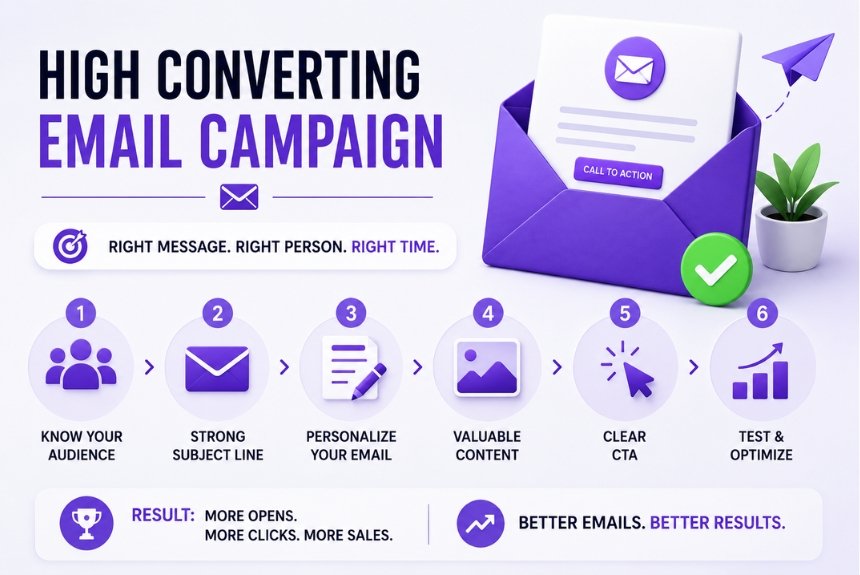
How to Create High-Converting Email Campaigns
Email marketing remains one of the most effective digital marketing channels for businesses of all sizes. Whether you operate a small startup, an ecommerce store, a consulting business, or a multinational company, email campaigns allow you to communicate directly with customers, build relationships, and drive measurable business results.
However, sending emails alone is not enough. Every day, people receive dozens of promotional emails competing for their attention. If your email fails to capture interest, provide value, or encourage action, it may be ignored or deleted without being opened.
This is why creating high-converting email campaigns has become essential for businesses that want to maximize the return on their marketing efforts. A high-converting campaign not only attracts opens but also persuades subscribers to click, engage, and complete a desired action such as making a purchase, downloading a resource, registering for an event, or booking a consultation.
Successful email campaigns are built on a combination of strategy, creativity, and data. From understanding your audience and writing compelling subject lines to designing visually appealing emails and optimizing calls-to-action, every element influences campaign performance.
Today’s email marketing platforms also provide powerful features such as automation, audience segmentation, personalization, and analytics, allowing businesses to deliver highly relevant messages to the right people at the right time. These capabilities improve customer engagement while saving valuable time.
Another important factor is trust. Subscribers are more likely to interact with businesses that consistently provide useful content rather than focusing solely on promotions. Educational newsletters, product updates, exclusive offers, and personalized recommendations help establish credibility and encourage long-term customer loyalty.
In this comprehensive guide, you’ll learn how to create email campaigns that not only reach inboxes but also generate meaningful engagement and conversions. Whether you’re launching your first campaign or looking to improve existing results, the strategies discussed here will help you create more effective and profitable email marketing campaigns.
What is a High-Converting Email Campaign?
A high-converting email campaign is an email marketing campaign that successfully encourages recipients to complete a specific action. The desired action may vary depending on the campaign objective, but common examples include:
- Purchasing a product
- Registering for a webinar
- Downloading an ebook
- Booking an appointment
- Visiting a website
- Completing a survey
- Signing up for a free trial
- Sharing content with others
Unlike traditional newsletters that simply provide updates, high-converting campaigns are carefully planned with a clear objective and a strong call-to-action.
Every component of the email works together to guide the reader toward that goal.
Characteristics of High-Converting Email Campaigns
Successful campaigns usually share several important characteristics.
Clear Purpose
Every email should have one primary objective.
Instead of trying to promote multiple products or services simultaneously, focus on a single message that encourages one specific action.
Relevant Content
Subscribers expect content that matches their interests and needs.
Sending personalized and relevant emails increases engagement and reduces unsubscribe rates.
Strong Subject Line
The subject line determines whether subscribers open your email.
A compelling subject line should be:
- Short
- Clear
- Interesting
- Relevant
- Honest
Valuable Information
High-converting emails provide genuine value.
Examples include:
- Helpful tips
- Educational content
- Product recommendations
- Exclusive discounts
- Industry insights
- Free resources
When subscribers consistently receive valuable information, they become more likely to engage with future campaigns.
Effective Call-to-Action
Every campaign should include a visible and persuasive CTA that tells readers exactly what to do next.
Examples include:
- Shop Now
- Download Free Guide
- Register Today
- Start Free Trial
- Learn More
- Book Your Consultation
Types of High-Converting Email Campaigns
Businesses use different campaign types depending on their marketing objectives.
Welcome Emails
Sent immediately after a user subscribes.
Purpose:
- Introduce the brand
- Build trust
- Deliver lead magnets
- Encourage first engagement
Promotional Emails
Designed to increase sales through discounts, product launches, or limited-time offers.
Educational Newsletters
Provide valuable industry information while positioning the business as an expert.
Abandoned Cart Emails
Encourage customers to complete unfinished purchases by reminding them about products left in their shopping cart.
Re-engagement Emails
Target inactive subscribers and encourage them to reconnect with the business.
Event Invitations
Promote webinars, workshops, product launches, or community events.
Benefits of High-Converting Email Campaigns
Well-planned campaigns provide several business advantages.
These include:
- Higher open rates
- Increased click-through rates
- Better customer engagement
- More website traffic
- Greater lead generation
- Improved customer retention
- Increased revenue
- Stronger brand loyalty
Rather than focusing solely on sending more emails, businesses should prioritize creating higher-quality campaigns that provide value and encourage meaningful interactions.
Why Email Campaigns Still Work
Despite the growth of social media, messaging apps, and digital advertising, email marketing continues to deliver exceptional results for businesses around the world.
One of the main reasons is that email provides direct communication with subscribers who have already expressed interest in receiving your content. Unlike social media platforms, where visibility depends on algorithms, email campaigns reach subscribers’ inboxes without relying on third-party distribution systems.
Direct Communication
Email allows businesses to communicate directly with customers whenever necessary.
Whether announcing a product launch, sharing educational content, or promoting a seasonal offer, email ensures that your message reaches people who have chosen to hear from you.
Personalization
Modern email marketing platforms enable businesses to personalize campaigns based on subscriber information.
Personalization can include:
- First name
- Location
- Purchase history
- Browsing behavior
- Customer interests
- Previous interactions
Personalized emails often generate higher engagement because subscribers receive content that feels more relevant to their needs.
Cost-Effective Marketing
Compared to many advertising channels, email marketing requires relatively low investment while producing significant returns.
Businesses can communicate with thousands of subscribers without paying for every impression or click, making email an efficient marketing solution for organizations of all sizes.
Measurable Results
Email marketing platforms provide detailed analytics that help businesses evaluate campaign performance.
Common metrics include:
- Open rate
- Click-through rate
- Conversion rate
- Bounce rate
- Unsubscribe rate
- Revenue generated
These insights allow marketers to continuously improve future campaigns based on real data.
Supports Customer Relationships
Email marketing is not only about selling products.
Regular communication helps businesses:
- Educate customers
- Build trust
- Share company updates
- Deliver exclusive content
- Provide personalized recommendations
- Encourage repeat purchases
Strong customer relationships contribute to higher lifetime value and long-term business growth.
Benefits Across Industries
Email marketing is valuable for nearly every industry.
| Industry | Example Campaign |
| Ecommerce | Product promotions and abandoned cart reminders |
| Healthcare | Appointment reminders and wellness newsletters |
| Education | Course updates and admission announcements |
| Real Estate | Property listings and market reports |
| Finance | Investment insights and financial newsletters |
| Hospitality | Seasonal offers and booking confirmations |
| Nonprofits | Fundraising campaigns and volunteer updates |
Because of its flexibility, affordability, and measurable performance, email marketing continues to be one of the most reliable channels for generating leads, increasing conversions, and strengthening customer relationships in 2026.
Know Your Audience Before Creating Email Campaigns
Creating a successful email campaign starts with understanding who you are communicating with. Even the best-designed email will fail if it is sent to the wrong audience or does not address their needs.
A high-converting email campaign is not about sending more emails; it is about sending the right message to the right people at the right time.
Before creating your campaign, you need to understand:
- Who your subscribers are
- What problems they face
- What solutions they need
- What motivates them to take action
- What type of content they prefer
When businesses understand their audience, they can create more relevant emails that increase engagement and conversions.
Why Audience Understanding Matters in Email Marketing
Every subscriber has different:
- Interests
- Buying behavior
- Expectations
- Problems
- Purchase decisions
A new visitor who has never interacted with your brand should not receive the same email as a loyal customer.
For example:
A new subscriber may need educational content about your product.
A returning customer may be more interested in upgrades, offers, or loyalty rewards.
Sending identical emails to everyone reduces relevance and lowers conversion rates.
Steps to Understand Your Email Audience
1. Collect Subscriber Information
The first step is gathering useful information about your audience.
Businesses can collect data through:
- Signup forms
- Surveys
- Website behavior
- Purchase history
- Social media interactions
- Customer feedback
Important information includes:
| Data Type | Examples |
| Basic Information | Name, age, location |
| Interests | Products they like, topics they follow |
| Behavior | Pages visited, emails opened |
| Purchase Data | Previous purchases, order value |
| Engagement | Clicks, downloads, responses |
The more you understand your subscribers, the more personalized your campaigns become.
2. Create Customer Personas
A customer persona is a fictional representation of your ideal customer based on real audience data.
Creating personas helps marketers understand customer needs and create targeted email messages.
Example Customer Persona
| Category | Details |
| Name | Marketing Manager Maya |
| Age | 28–35 years |
| Goal | Improve online marketing results |
| Challenge | Limited time and resources |
| Interested In | Marketing tools, automation, analytics |
| Buying Motivation | Saves time and increases productivity |
Using personas helps answer important questions:
- What type of content will interest my audience?
- What problems can my product solve?
- What language should I use?
- What offer will encourage action?
3. Segment Your Email List
Email segmentation is one of the most important strategies for creating high-converting email campaigns.
Segmentation means dividing subscribers into smaller groups based on specific characteristics.
Instead of sending one generic email to everyone, businesses send targeted messages to different groups.
Types of Email Segmentation
1. Demographic Segmentation
Based on personal characteristics.
Examples:
- Age
- Location
- Gender
- Profession
Example:
A clothing brand may send different product recommendations based on customer preferences and location.
2. Behavioral Segmentation
Based on subscriber actions.
Examples:
- Website visits
- Email opens
- Previous purchases
- Downloads
Example:
A customer who viewed a product but did not purchase can receive a reminder email.
3. Engagement-Based Segmentation
Based on how subscribers interact with emails.
Groups may include:
- Highly active subscribers
- Occasionally active subscribers
- Inactive subscribers
Different strategies can be used for each group.
Example:
Active subscribers:
- New product announcements
- Exclusive offers
Inactive subscribers:
- Re-engagement campaigns
- Special incentives
4. Customer Lifecycle Segmentation
Subscribers can be divided according to their stage in the customer journey.
| Customer Stage | Email Strategy |
| New Subscriber | Welcome emails |
| Interested Lead | Educational content |
| First-Time Buyer | Product guidance |
| Existing Customer | Loyalty offers |
| Inactive Customer | Re-engagement emails |
Personalization Through Audience Insights
Understanding your audience allows you to create personalized experiences.
Personalization can include:
- Using subscriber names
- Recommending relevant products
- Sending location-based offers
- Sharing content based on interests
- Sending emails based on behavior
Example:
Generic Email:
“Check out our latest products.”
Personalized Email:
“Hi Sarah, based on your recent purchase, you may love these new skincare products.”
The personalized version feels more relevant and increases the chance of conversion.
Understanding Customer Pain Points
High-converting emails focus on solving customer problems.
Before writing an email, identify:
- What challenge does the customer have?
- What solution does your product provide?
- Why should they choose your brand?
A powerful email structure is:
Problem → Solution → Benefit → Action
Example:
Problem:
“Managing customer emails manually takes hours.”
Solution:
“Our automation tools help organize and manage campaigns easily.”
Benefit:
“Save time and improve customer communication.”
Action:
“Start your free trial today.”
Research Methods to Understand Your Audience
1. Analyze Existing Customers
Study:
- Purchase patterns
- Frequently asked questions
- Customer reviews
- Support conversations
This helps identify common needs.
2. Monitor Website Behavior
Website analytics can reveal:
- Popular pages
- Products viewed
- Time spent on pages
- Conversion paths
This information helps create more relevant emails.
3. Use Surveys
Direct customer feedback provides valuable insights.
Questions can include:
- What challenges are you facing?
- What type of content would you like to receive?
- What products interest you most?
Write Better Subject Lines That Increase Open Rates
The subject line is the first thing subscribers see before opening an email.
A great email with a weak subject line may never get read.
Your subject line has one main purpose:
Convince people to open the email.
Importance of Email Subject Lines
A strong subject line can improve:
- Open rates
- Engagement
- Click-through rates
- Overall campaign performance
A weak subject line can result in:
- Low visibility
- More deleted emails
- Lower conversions
Characteristics of High-Converting Subject Lines
1. Keep It Short and Clear
Most users check emails on mobile devices.
Long subject lines may get cut off.
Recommended length:
30–50 characters
Example:
❌ “Our company is launching an amazing new collection with special discounts”
✅ “20% Off Your Favorite Products Today”
2. Create Curiosity
Curiosity encourages users to open emails.
Examples:
- “You won’t believe what’s inside”
- “A simple way to save more time”
3. Highlight Benefits
Subscribers want to know:
“What will I get from opening this email?”
Examples:
❌ “Newsletter Update”
✅ “5 Ways to Improve Your Email Marketing Results”
4. Create Urgency
Urgency encourages quick action.
Examples:
- “Last chance: Offer ends tonight”
- “Only 24 hours left”
- “Your discount expires today”
Use urgency honestly and avoid creating false pressure.
Email Copywriting Tips for Higher Conversions
Writing an email that converts requires more than simply describing a product or sharing information. Effective email copy connects with the reader, creates interest, builds trust, and encourages action.
The goal of email copywriting is to move subscribers from:
Attention → Interest → Desire → Action
A high-converting email should answer three important questions:
- Why should the subscriber care?
- How can this solve their problem?
- What should they do next?
1. Start With a Strong Email Opening
The first few sentences determine whether readers continue reading or leave.
Most subscribers quickly scan emails, so the opening should immediately communicate value.
Weak Opening:
“Dear customer, we are excited to announce our latest product update.”
This focuses on the company instead of the customer.
Strong Opening:
“Still spending hours managing your email campaigns manually? Our latest automation features can help you save valuable time.”
This immediately addresses a problem and introduces a solution.
2. Focus on Benefits Instead of Features
One of the biggest mistakes in email marketing is focusing only on product features.
Customers are more interested in how a product improves their lives
3. Use Simple and Clear Language
High-converting emails are easy to understand.
Avoid:
- Complicated words
- Long paragraphs
- Technical language
- Unnecessary information
Instead:
- Use short sentences
- Write naturally
- Keep the message focused
- Make the value clear
Example:
Complex:
“Our innovative solution provides businesses with advanced capabilities to optimize their communication strategies.”
Simple:
“Create better customer emails and increase engagement with easy-to-use tools.”
4. Use Storytelling in Email Marketing
Stories create emotional connections and make emails more memorable.
Instead of directly selling, brands can tell stories about:
- Customer experiences
- Problems and solutions
- Brand journeys
- Success stories
Basic Storytelling Structure:
Situation
Explain the customer’s problem.
Challenge
Show the difficulty they experience.
Solution
Introduce your product or service.
Result
Explain the positive outcome.
Example:
“Many small businesses struggle to manage customer communication. After using automated email campaigns, they were able to save hours every week and improve customer engagement.”
5. Create Scannable Email Content
People rarely read every word of an email. They scan before deciding whether to continue.
Make your emails easy to read using:
- Short paragraphs
- Bullet points
- Subheadings
- Bold highlights
- White space
6. Create a Strong Value Proposition
A value proposition explains why customers should choose your product or service.
A good value proposition should communicate:
- What you offer
- Who it helps
- Why it is useful
- What makes it different
7. Use Psychological Triggers Carefully
Certain psychological principles can improve conversions when used ethically.
Scarcity
Encourages quick decisions.
Example:
“Only 2 days left to claim your discount.”
Social Proof
Shows that others trust your product.
Examples:
- Customer reviews
- Testimonials
- Case studies
- User numbers
Example:
“Trusted by more than 50,000 businesses worldwide.”
Authority
Builds credibility.
Examples:
- Expert recommendations
- Industry awards
- Research data
CTA Best Practices for High-Converting Emails
A Call-to-Action (CTA) is one of the most important elements of an email campaign.
The CTA tells subscribers what action they should take next.
Examples:
- Buy Now
- Start Free Trial
- Download Guide
- Register Today
- Learn More
- Book a Demo
Without a clear CTA, subscribers may read your email but do nothing.
Characteristics of a High-Converting CTA
1. Make CTA Action-Oriented
A good CTA uses strong action words.
Weak CTA:
“Click Here”
Strong CTA:
“Get Your Free Marketing Guide”
2. Create One Main CTA
Too many CTAs can confuse readers.
Example:
Email Goal:
Generate product sales
Primary CTA:
“Shop Now”
Secondary CTA:
“Learn More”
The main action should always be clear.
3. Highlight the Value
Users should understand what happens after clicking.
Examples:
Instead of:
“Submit”
Use:
“Get My Free Report”
Instead of:
“Sign Up”
Use:
“Start My Free Trial”
4. Create CTA Urgency
Urgency encourages immediate action.
Examples:
- Claim Your Offer Today
- Reserve Your Spot Now
- Start Before The Offer Ends
5. CTA Placement Matters
Important CTA locations:
Above The Fold
The CTA should appear early so users can see it without scrolling.
After Explaining Benefits
Place CTA after building interest.
At The End
Repeat the CTA for users who read the entire email.
Personalization Strategies for Better Email Performance
Personalization is one of the most effective ways to improve email engagement.
Modern customers expect brands to send relevant messages rather than generic emails.
Personalized emails make subscribers feel understood and valued.
Types of Email Personalization
1. Name Personalization
The simplest form of personalization.
Example:
“Hi Emma, here is your exclusive offer.”
Using a subscriber’s name can create a more personal connection.
2. Product Recommendations
Recommend products based on:
- Previous purchases
- Browsing history
- Interests
Example:
“Based on your recent purchase, you may also like these products.”
3. Behavioral Emails
Send emails based on user actions.
Examples:
- Abandoned cart emails
- Product reminders
- Welcome emails
- Re-engagement emails
4. Location-Based Personalization
Use customer location to create relevant campaigns.
Examples:
- Local events
- Regional offers
- Weather-based promotions
Common Personalization Mistakes
Using Wrong Customer Data
Incorrect names or information damage trust.
Over-Personalization
Too much personal information can feel uncomfortable.
Personalizing Without Purpose
Adding a name alone is not enough. The entire email should be relevant.
A/B Testing Email Campaigns for Better Conversion Rates
Creating a successful email campaign is not a one-time activity. Even experienced marketers cannot always predict which email version will perform better.
This is where A/B testing becomes important.
A/B testing, also known as split testing, is a method of comparing two different versions of an email to identify which version generates better results.
Instead of making assumptions, marketers use real subscriber behavior to improve campaign performance.
What Is A/B Testing in Email Marketing?
A/B testing involves sending different versions of an email to small groups of subscribers and analyzing which version performs better.
The winning version is then sent to the remaining audience.
For example:
Version A:
Subject Line:
“Get 20% Off Your First Order”
Version B:
Subject Line:
“Your Exclusive Discount Is Waiting”
After testing, marketers analyze which subject line receives more opens.

Campaign Analytics and Measuring Email Success
Creating and sending emails is only one part of email marketing.
To create consistently high-converting email campaigns, marketers must analyze performance data.
Email analytics provide insights into:
- Subscriber behavior
- Campaign effectiveness
- Areas needing improvement
Frequently Asked Questions (FAQs)
1. What is a high-converting email campaign?
A high-converting email campaign is designed to encourage subscribers to take actions like purchasing, signing up, or downloading content through targeted messaging and strong CTAs.
2. How can I improve email conversion rates?
Improve conversions by using better subject lines, personalization, audience segmentation, engaging copy, clear CTAs, and regular testing.
3. Why is personalization important in email marketing?
Personalized emails create relevant experiences for subscribers, improving engagement and increasing the chances of conversion.
4. What is A/B testing in email campaigns?
A/B testing compares different versions of an email to find which performs better and helps optimize future campaigns.
5. Which metrics should be tracked in email marketing?
Important metrics include open rate, click-through rate, conversion rate, bounce rate, and ROI.
Final Checklist
✓ Define a clear campaign goal
✓ Understand and segment your audience
✓ Write engaging subject lines
✓ Create valuable email content
✓ Add a clear CTA
✓ Optimize emails for mobile devices
✓ Personalize messages
✓ Test and analyze performance
Start Creating High-Converting Email Campaigns Today
Put these proven email marketing strategies into action and start creating campaigns that engage your audience and drive more conversions. Focus on compelling subject lines, personalized content, strong calls to action, and continuous optimization to maximize your results. By consistently analyzing performance and refining your approach, you can build lasting customer relationships and achieve long-term email marketing success.
Leave a Reply