


Introduction
Publishing content consistently is important for organic growth, but publishing more articles does not automatically lead to better search visibility. A successful content strategy requires keyword research, competitor analysis, clear writing, effective page structure, internal linking, and regular performance reviews.
The challenge is that these activities often happen in separate tools. A writer might research keywords in one platform, prepare an outline in another, draft an article in a document editor, and then use a different tool to optimize the finished page.
This fragmented process can consume time and make it harder to maintain consistent content quality.
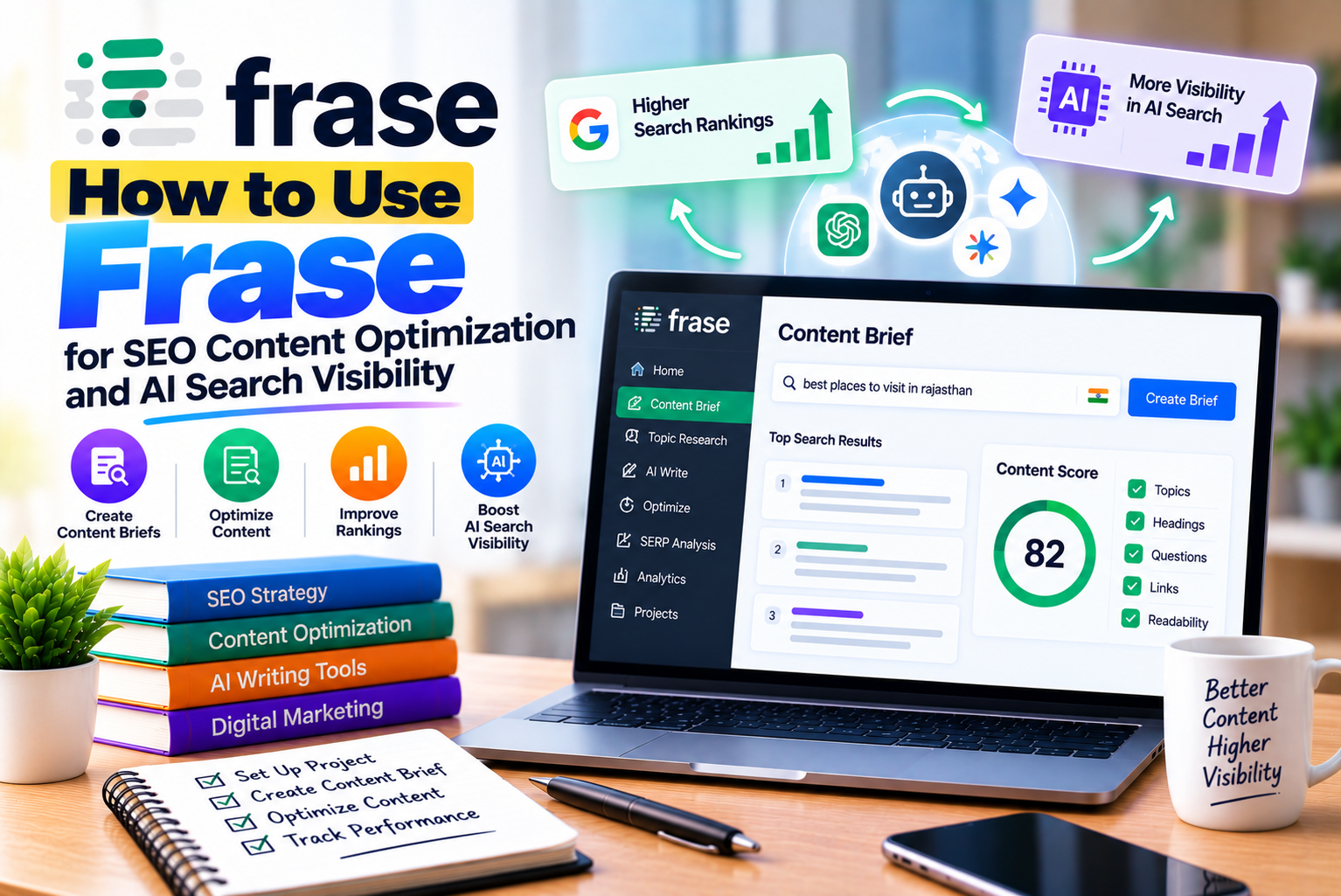
Frase helps bring several of these activities together by supporting content research, brief creation, AI-assisted writing, SEO optimization, generative engine optimization (GEO), publishing, and content monitoring. Its available capabilities and usage limits depend on the subscription plan.
You can explore its current features through the official Frase website.
Frase is also relevant to the changing search landscape. In addition to traditional search results, businesses increasingly want their content to be discoverable and cited by AI-powered search experiences.
That introduces two related but different objectives:
- SEO: Help search engines understand, index, and rank useful content for relevant queries.
- AI search visibility: Improve the chances that your content is discovered, understood, and selected as a source in AI-generated answers.
Neither objective can be guaranteed by a software tool. Frase can help identify potential improvements and track certain visibility signals, but rankings and AI citations depend on factors beyond a content score.
In this guide, you will learn how to use Frase for SEO content optimization and AI search visibility, from selecting a topic to monitoring a published article.
We will also cover practical examples, common mistakes, optimization checklists, and a repeatable workflow you can adapt to your website.
What Is Frase?
Frase is an AI-powered content platform designed to support the creation, optimization, publishing, and maintenance of search-focused content.
Its workflow connects several stages of content production:
- Research a topic and examine competing pages.
- Develop a structured content brief.
- Create or improve an article.
- Evaluate SEO and GEO optimization.
- Publish content through a supported workflow.
- Monitor performance and identify opportunities for improvement.
Frase’s current platform also includes features such as site auditing, AI Visibility tracking, Content Guard, and Frase Answers. Access varies by plan.
For a beginner, the main benefit is having a structured process for moving from a content idea to a researched, optimized article.
For an experienced SEO professional, the value may lie in identifying content gaps, improving existing pages, and connecting content production with monitoring.
How Frase Fits Into an SEO Workflow
| SEO Activity | How Frase Can Help | What You Still Need to Do |
| Topic research | Investigate search results and content opportunities | Choose topics that match your audience and business objectives |
| Keyword research | Identify relevant queries and topic coverage | Validate demand, competition, and intent using appropriate data |
| Content briefing | Organize headings, questions, and research findings | Define the unique value of the article |
| Article creation | Support AI-assisted drafting and editing | Verify facts and add expertise |
| SEO optimization | Review content coverage and optimization suggestions | Keep the article natural and useful |
| GEO optimization | Assess factors associated with AI citation readiness | Provide trustworthy evidence and direct answers |
| Publishing | Send content to supported CMS platforms | Check metadata, links, formatting, and technical settings |
| Monitoring | Track selected search and AI visibility signals | Interpret the data and decide what to improve |
The important distinction is that Frase assists the process rather than replacing SEO judgment.
A page can receive a strong optimization score and still perform poorly if it targets the wrong keyword, provides weak information, or competes against substantially stronger resources.
Understanding SEO and AI Search Optimization in Frase
Before using Frase, it helps to understand what its optimization features are intended to measure.
What Is SEO Content Optimization?
SEO content optimization is the process of improving a webpage so that it satisfies the search intent behind a query and communicates its subject clearly to search engines and readers.
It can involve:
- Selecting an appropriate primary keyword.
- Addressing relevant secondary topics.
- Creating useful headings.
- Answering important questions.
- Improving readability.
- Adding relevant internal links.
- Supporting factual claims with reliable references.
- Improving title tags and meta descriptions.
- Reviewing existing information for accuracy.
- Making the page easy to navigate.
Frase can help with parts of this process by analyzing content and offering optimization recommendations.
However, keyword usage alone is not sufficient. An article should answer the reader’s question more effectively than a generic collection of keywords and headings.
What Is Generative Engine Optimization?
Generative engine optimization, or GEO, refers to efforts to improve the likelihood that content is understood, retrieved, referenced, or cited by generative AI search systems.
These systems may produce answers using information gathered from multiple sources. Their selection and citation behavior can differ from traditional search rankings.
Frase provides GEO scoring alongside its SEO optimization features. Its published explanation describes three key dimensions of citation readiness:
- Authority: Support claims with credible sources and evidence.
- Readability: Present information in clear, understandable language.
- Structure: Organize information into passages that are easy to interpret and extract.
These principles are useful editorial practices, but a GEO score is not a direct measurement of future citations.
SEO vs. GEO: What Is the Difference?
| Factor | Traditional SEO | GEO and AI Search Optimization |
| Main objective | Improve relevant search visibility and rankings | Improve the likelihood of being referenced in AI-generated answers |
| Content structure | Clear hierarchy and relevant sections | Clear hierarchy and self-contained, informative passages |
| Keyword usage | Relevant terms and topic coverage | Natural language that addresses questions and related concepts |
| Evidence | Accurate, trustworthy information | Clear factual support and credible sources |
| Visibility measurement | Impressions, clicks, rankings, and organic traffic | AI mentions, citations, cited URLs, and share of voice where measurable |
| Optimization approach | Improve relevance, quality, accessibility, and usefulness | Improve discoverability, clarity, evidence, and answerability |
| Guaranteed outcome? | No | No |
SEO and GEO should not be treated as competing strategies. A well-researched, accessible, useful page can support both objectives.
Step 1: Identify the Right Topic Before Opening Frase
One of the most common content mistakes is starting with a tool before defining the purpose of the article.
Frase can help analyze topics, but you should first understand your audience, website category, and business goals.
Define Your Target Audience
Ask yourself:
- Who will read this article?
- What problem are they trying to solve?
- What information do they need before taking action?
- Are they beginners, experienced professionals, or potential buyers?
- How does this topic relate to the products or services offered on your website?
For example, an article targeting beginners who want to understand AI search should explain the concept and provide practical examples.
An article targeting SEO agencies may instead need workflows, reporting methods, and implementation considerations.
Both articles can discuss AI search, but their structure and level of detail should differ.
Choose a Search Intent
Search intent describes the underlying reason someone searches for a particular phrase.
The main categories include:
Informational intent: The user wants to learn something.
Example: “How does AI search work?”
Navigational intent: The user wants to find a particular website or resource.
Example: “Frase login.”
Commercial investigation: The user is comparing products or services before making a decision.
Example: “Best Frase alternatives.”
Transactional intent: The user is ready to take an action, such as purchasing a product.
Example: “Frase subscription plans.”
Your article should match the dominant intent rather than forcing every query into the same template.
Example: Selecting a Topic for a Digital Marketing Website
Suppose your website publishes content about SEO, content marketing, AI writing, and website technology.
You identify the following possible topics:
| Topic | Likely Intent | Recommended Content Type |
| What Is GEO in SEO? | Informational | Educational guide |
| Best GEO Tools for Marketers | Commercial investigation | Comparison article |
| How to Track AI Search Visibility | Informational | Step-by-step tutorial |
| Frase vs. Surfer SEO | Commercial investigation | Product comparison |
| How to Optimize Existing Blog Posts | Informational | Practical workflow |
This initial classification helps you choose the appropriate content format before researching competitors.
How Frase Helps at This Stage
Use Frase’s research and content opportunity capabilities to investigate topics and identify potential gaps.
Depending on your available data and plan, you may also use site auditing, topic clusters, or content opportunity features to decide whether a topic deserves a new article.
Do not assume that every suggested topic should become a separate URL. Some topics may be better covered within an existing page.
Practical tip: Before creating a new article, check whether your website already has a page targeting the same intent. This helps reduce unnecessary overlap and keyword cannibalization.
Step 2: Research the Search Results and Understand Competitor Coverage
Once you have selected a topic, the next step is to understand what users expect from the search results.
Frase’s research workflow helps users examine competing content and develop a brief from the information they find.
Why Competitor Research Matters
Competitor research is not about copying the pages that already rank.
It helps you understand:
- What questions existing pages answer.
- Which subtopics appear repeatedly.
- How competing articles organize their information.
- Which important details are missing from the results.
- Whether searchers expect a guide, comparison, tutorial, or product page.
- How you can create a more useful resource.
A strong article should satisfy the basic intent behind the query while offering additional value.
How to Research a Topic in Frase
The precise interface can change, but the general workflow is straightforward.
- Open the research or document workflow.
Start a new content task and enter your target topic or keyword.
- Review the competing pages.
Examine the pages surfaced for the query. Look at their headings, content scope, and the questions they answer.
- Identify recurring subtopics.
If several relevant pages discuss the same concept, that may indicate an important part of the topic.
However, do not automatically include every repeated heading. Check whether it genuinely helps your reader.
- Find information gaps.
Look for questions that competing articles answer poorly or omit.
For a guide about AI search visibility, potential gaps might include how to measure citations, distinguish mentions from citations, and interpret changes in visibility over time.
- Develop a differentiated angle.
Decide what your article will do better.
Your advantage might be more detailed examples, clearer explanations, current evidence, a practical checklist, or guidance tailored to a specific audience.
Example: Researching an Article About AI Search Visibility
Suppose the target keyword is “how to track AI search visibility.”
A preliminary competitor review might reveal these recurring subjects:
- What AI search visibility means.
- Why brand mentions matter.
- How AI-generated answers cite sources.
- Which tools track AI visibility.
- How to monitor changes.
- How to improve content discoverability.
You can turn these observations into a useful outline.
But a stronger article would also explain how to establish a baseline, separate brand mentions from URL citations, and evaluate results over time.
These additional sections create practical value beyond repeating competitors’ headings.
What to Avoid During Research
Do not treat search-result frequency as proof that a topic is essential.
Also avoid:
- Copying competitor wording.
- Adding irrelevant headings just to increase article length.
- Treating every related query as a separate section.
- Assuming that a top-ranking page is factually correct.
- Using competitor coverage as the only measure of quality.
The goal is to understand the search landscape and identify the best way to serve the reader, not to reproduce existing content.
Step 3: Create a Detailed Content Brief
After researching the topic, prepare a content brief before drafting.
A brief helps maintain a clear direction and reduces the likelihood of writing repetitive or irrelevant sections.
Frase can help turn research findings into an outline containing headings, related topics, and questions.
What Should a Content Brief Include?
A practical SEO content brief should cover the following elements.
| Brief Element | Purpose |
| Primary keyword | Defines the main search query |
| Secondary keywords | Identifies relevant related queries |
| Search intent | Clarifies what the reader wants |
| Target audience | Establishes the intended reader |
| Content objective | Defines what the article should accomplish |
| Proposed title | Establishes the main subject and angle |
| H1 | Defines the article’s central topic |
| H2 and H3 headings | Organize the discussion |
| Questions to answer | Helps cover important reader concerns |
| Evidence requirements | Identifies facts and claims requiring verification |
| Internal links | Connects the article to relevant existing pages |
| External references | Supports claims using trustworthy sources |
| Call to action | Defines the appropriate next step |
| Metadata | Establishes the SEO title and meta description |
How to Build the Brief in Frase
- Enter the target query.
Begin with the main keyword or topic.
- Review the suggested structure.
Use Frase’s research to identify possible headings and questions.
- Organize the information logically.
Group related sections and remove unnecessary repetition.
- Add your own expertise.
Include examples, recommendations, and questions that matter to your audience.
- Define the article’s unique value.
Specify what the reader should understand or be able to do after reading.
- Establish the evidence requirements.
Identify claims that require official documentation, current data, expert sources, or practical verification.
Example Content Brief
For the topic “How to Use Frase for SEO Content Optimization and AI Search Visibility,” the brief could look like this:
| Element | Example |
| Primary keyword | How to Use Frase for SEO Content Optimization |
| Search intent | Informational |
| Audience | Bloggers, SEO professionals, and content teams |
| Main objective | Explain a complete Frase workflow |
| H1 | How to Use Frase for SEO Content Optimization and AI Search Visibility |
| Main sections | Research, briefs, writing, SEO scoring, GEO scoring, publishing, monitoring |
| Practical examples | Keyword research, article refresh, AI visibility tracking |
| Evidence | Frase documentation and relevant official sources |
| Internal links | Frase review, pricing guide, Frase vs. Surfer SEO |
| CTA | Explore Frase’s current features or compare alternatives |
The purpose of this brief is to establish a coherent article before writing begins.
Why You Should Edit AI-Generated Outlines
An automatically generated outline is a starting point, not a finished editorial plan.
Review it for:
- Duplicate sections.
- Missing steps.
- Irrelevant topics.
- Weak heading order.
- Questions that deserve direct answers.
- Opportunities to add original examples.
A useful brief gives the writer direction without making the article unnecessarily rigid.
Step 4: Create or Improve the Article
Once your brief is ready, you can use Frase to support article drafting or work on an existing page.
The right approach depends on whether you are creating a new article or optimizing content already published on your website.
Option A: Create a New Article
For a new article, use the brief as the foundation.
A practical drafting process is:
- Write an introduction that directly addresses the reader’s problem.
- Explain the topic before introducing advanced details.
- Follow a logical heading structure.
- Use examples to make complex concepts understandable.
- Add evidence to support factual claims.
- Address relevant questions.
- Finish with a useful conclusion and appropriate CTA.
Frase can help generate or refine text, but every section should serve a clear purpose.
Option B: Optimize an Existing Article
For an existing page, begin by examining its current performance and content quality.
Ask:
- Does the page answer the original query?
- Is the information accurate and current?
- Are important questions missing?
- Are the headings clear?
- Does the page contain unnecessary repetition?
- Are there relevant internal links?
- Does the title accurately describe the content?
- Does the article offer anything valuable beyond generic explanations?
Then use Frase’s optimization recommendations to identify additional opportunities.
Do not rewrite a strong article simply because a tool suggests changes. First establish whether the suggested changes improve accuracy, usefulness, or relevance.
Write for Readers, Not Just for Scores
A common mistake is inserting every recommended term into the article.
That can lead to awkward sentences and repetitive explanations.
Instead, ask whether the suggested concept helps answer the reader’s question.
For example, an article about AI search visibility might naturally discuss:
- Brand mentions.
- URL citations.
- AI-generated answers.
- Search intent.
- Content quality.
- Visibility tracking.
If a suggested phrase is unrelated to the article’s actual scope, leave it out.
Use AI as a Drafting Assistant
AI can help you:
- Develop initial outlines.
- Rewrite unclear passages.
- Summarize research notes.
- Generate alternative headings.
- Identify possible information gaps.
- Simplify complex explanations.
However, the final article should reflect editorial judgment.
Verify names, dates, prices, technical explanations, and other factual details. Add examples that make sense for your audience, and remove generic filler.
Google’s guidance on AI-generated content emphasizes the importance of helpful, reliable, people-first content rather than treating AI use itself as the deciding factor. Review the official Google Search guidance about AI-generated content.
Step 5: Optimize Your Article Using Frase’s SEO Score
After creating a draft, review its SEO optimization recommendations.
Frase provides an SEO score intended to help users assess how their content aligns with relevant optimization considerations.
The score can be useful for identifying potential gaps, but it should not be interpreted as a direct prediction of Google rankings.
What Should You Review?
Focus on the following areas.
1. Primary Keyword Relevance
Make sure the article clearly addresses the intended query.
Use the primary keyword naturally in appropriate locations, such as:
- The SEO title.
- The H1.
- The introduction, where it fits naturally.
- Relevant subheadings, when appropriate.
- The body text.
- The meta description, where suitable.
You do not need to repeat the exact phrase in every section.
2. Related Topic Coverage
Review the concepts and questions identified during research.
Include relevant supporting topics that help explain the subject comprehensively.
For an article about Frase, this might include content briefs, optimization scores, GEO scoring, publishing, and visibility tracking.
3. Heading Structure
Use headings to organize the information.
A simple hierarchy is:
- H1: Main article title.
- H2: Major sections.
- H3: Supporting points within an H2 section.
Headings should communicate what each section covers.
Avoid creating headings solely to repeat keywords.
4. Readability
Review long sentences, unexplained terminology, and paragraphs containing several unrelated ideas.
Break up complex explanations when doing so improves comprehension.
However, readability does not mean eliminating all technical detail. Experienced readers may need precise explanations, examples, and qualifications.
5. Completeness
Ask whether the article answers the important questions associated with its search intent.
A long article is not automatically comprehensive. A shorter article may be more useful if it answers the question directly and accurately.
6. Internal Links
Link to relevant pages on your website.
For example, a tutorial about using Frase could link to a detailed Frase review and a comparison with Surfer SEO.
Internal links help readers discover related information and help search engines understand relationships between pages.
7. Evidence and Accuracy
Review claims that could affect a reader’s decision.
For software articles, this includes pricing, usage limits, available integrations, and feature descriptions.
Prefer official documentation for product-specific information and update the article when important details change.
How to Interpret Frase’s SEO Score
Suppose an article’s SEO score improves after you add a missing explanation and clarify the headings.
That tells you the draft aligns more closely with the tool’s optimization criteria.
It does not establish that Google will rank the article higher.
To evaluate actual results, monitor search impressions, clicks, query relevance, and other performance indicators after publication.
SEO Optimization Checklist
Before moving to GEO optimization, verify that:
- The article satisfies the intended search intent.
- The primary keyword accurately represents the topic.
- Relevant supporting topics are covered.
- The heading structure is logical.
- The content is clear and readable.
- Factual claims have been checked.
- Internal links point to relevant pages.
- The title and meta description are accurate.
- The content provides meaningful value beyond generic summaries.
- No sections have been added solely to increase the score.
Step 6: Improve AI Search Visibility With Frase’s GEO Score
Traditional SEO optimization is only part of the workflow for publishers who want to understand their visibility in AI-generated answers.
Frase includes GEO scoring to evaluate aspects of content that may help make a page more suitable for citation by generative AI systems.
The objective is not to write content that sounds like an AI answer. It is to publish reliable, clear, well-structured information that can be understood and used by readers and search systems.
How GEO Scoring Works
Frase describes its GEO scoring approach using three main dimensions: authority, readability, and structure.
These dimensions provide a practical editorial framework.
1. Strengthen Authority With Evidence
AI search optimization should not be confused with simply adding more outbound links.
The important question is whether the article’s factual claims are supported.
To improve this aspect of a page:
- Cite official documentation for software features.
- Link to primary research when discussing research findings.
- Identify the source of statistics.
- Distinguish verified facts from opinions.
- Avoid unsupported claims about performance or outcomes.
- Update references when information becomes outdated.
For example, if you state that a software product supports a particular integration, verify that claim against the provider’s current documentation.
If you describe a pricing plan, check the official pricing page rather than relying on an older third-party article.
Evidence makes the article more useful to readers and gives systems evaluating the page a clearer basis for understanding its claims.
2. Improve Readability
Clear writing helps readers understand the information and makes individual passages easier to interpret.
Improve readability by:
- Explaining technical terms when they first appear.
- Keeping paragraphs focused on one idea.
- Removing unnecessary introductory language.
- Using examples to explain abstract concepts.
- Avoiding ambiguous pronouns.
- Separating facts from recommendations.
- Writing direct answers to important questions.
Consider these two examples.
Less clear:
“Optimization is an important aspect of the evolving content ecosystem, particularly as multiple technological developments influence how users interact with information.”
Clearer:
“SEO optimization helps search engines understand your content. AI search optimization also considers whether your information is clear and useful enough to be referenced in an AI-generated answer.”
The second version communicates the distinction more directly.
3. Structure Content for Easy Interpretation
Readers should be able to identify the answer to a question without searching through several unrelated paragraphs.
Useful techniques include:
- Descriptive headings.
- Short explanations of important concepts.
- Step-by-step instructions.
- Comparison tables where they genuinely help.
- Definitions near the first use of a term.
- Direct answers followed by supporting details.
- Clearly labeled examples and limitations.
For instance, an article about Frase pricing should state the plan’s current price and billing conditions clearly, then explain what the plan includes.
An article about a technical process should identify the steps in the order a reader needs to follow them.
This is good information design even without considering AI search.
A Practical GEO Optimization Example
Imagine you have written an article about choosing an SEO content tool.
Your original passage reads:
“Several platforms provide different capabilities, and businesses should compare them according to their requirements before deciding which one is appropriate.”
This is not necessarily incorrect, but it is vague.
A stronger version might say:
“Choose an SEO content tool based on your main task. Surfer SEO and NEURONwriter are worth comparing for content optimization, while Ahrefs and Semrush offer broader SEO research capabilities. Check current plan limits before purchasing.”
The revised passage provides concrete examples and a useful decision rule.
It is also easier to interpret as a standalone answer.
GEO Optimization Checklist
Before publishing, ask:
- Are important claims supported by reliable sources?
- Are statistics and product details verified?
- Does the article explain technical terminology?
- Are important questions answered directly?
- Can individual sections be understood in context?
- Are headings descriptive?
- Are lists and tables used where they improve comprehension?
- Does the article distinguish facts from opinions?
- Does it avoid unsupported promises about AI citations?
- Does it provide meaningful information that helps readers make decisions?
These practices support content clarity and trustworthiness. They do not guarantee that a specific AI system will cite the page.
Step 7: Use Frase AI Visibility to Monitor Mentions and Citations
Improving the content itself is one part of the process. Monitoring whether your brand and pages appear in AI-generated answers is another.
Frase’s AI Visibility feature is designed to track selected prompts and report certain brand mentions and citation signals across supported AI search experiences.
The exact platforms and monitoring capacity available depend on your subscription.
The current official feature page describes tracking across ChatGPT, Perplexity, Claude, Gemini, and Google AI, with plan-dependent coverage. It also describes citation tracking, competitor comparisons, geographic targeting, and daily monitoring.
What Is AI Search Visibility?
AI search visibility describes how frequently or prominently a brand or website appears in AI-generated search experiences.
Depending on the platform and measurement method, this may involve:
- Brand mentions.
- Citations to specific URLs.
- Competitor mentions.
- Share of voice.
- Changes in citation frequency.
- Visibility for specific prompts.
- Differences across buying stages.
These measures are related but not interchangeable.
A brand mention does not necessarily mean an AI system cited a page from your website.
Likewise, a URL citation does not necessarily mean the reader clicked through or became a customer.
Brand Mentions vs. URL Citations
| Measurement | What It Tells You | What It Does Not Prove |
| Brand mention | Your brand appeared in an answer | That your website was cited |
| URL citation | A specific page was referenced | That the user clicked the link |
| Share of voice | Your visibility relative to selected competitors | That you generated more sales |
| Citation position | Where your URL appeared in a citation list | That the citation will persist |
| Prompt coverage | Whether you appear for selected tracked questions | That you appear for every related query |
| Sentiment | How a system characterizes your brand, where measured | That the characterization is objectively correct |
This distinction matters when evaluating results.
If your brand appears in an AI-generated answer but the answer cites a competitor’s page, you may need to investigate why the competing page was selected.
How to Set Up AI Visibility Tracking
The general workflow is as follows.
- Define the questions your audience asks.
Create a list of prompts that represent awareness, consideration, and decision-making.
- Identify relevant competitors.
Select businesses that compete for the same audience or solve the same problem.
- Track your visibility.
Use the prompts supported by your Frase subscription to establish an initial baseline.
- Examine cited pages.
When a URL from your website is cited, review the page to understand what information may be relevant to the answer.
- Identify gaps.
Look for valuable prompts where competitors appear but your brand or website does not.
- Prioritize content improvements.
Decide whether the gap requires a new article, an update to an existing page, or stronger evidence.
- Review changes over time.
Monitor whether your visibility changes after making improvements.
Example: AI Visibility Tracking for an SEO Website
Suppose a website publishes educational content about SEO tools.
You might monitor questions such as:
| Funnel Stage | Example Prompt | What to Examine |
| Awareness | “How do I optimize a blog post for SEO?” | Whether your educational guides appear |
| Awareness | “What is generative engine optimization?” | Whether your explanatory pages are cited |
| Consideration | “Which tools help with SEO content optimization?” | Whether your comparisons appear |
| Consideration | “Frase vs. Surfer SEO: which should I choose?” | Whether your comparison article is referenced |
| Decision | “Is Frase worth paying for?” | Whether your review provides relevant, trustworthy information |
These prompts should reflect your actual business and audience. Generic prompts may produce results that are less useful for decision-making.
Why AI Visibility Should Be Monitored Over Time
AI-generated answers can change as systems update, source availability changes, and the user’s prompt changes.
A single observation is not enough to establish a stable trend.
Use repeated measurements and document significant changes.
When visibility declines, investigate the specific prompts and cited pages involved rather than immediately rewriting the entire website.
Step 8: Optimize Content for Different Stages of the Buying Journey
AI search visibility is not only about being mentioned for general educational questions.
A brand may appear when users are learning about a subject but disappear when they compare alternatives or make a purchase decision.
This is why it helps to organize tracked prompts by buying stage.
Awareness Stage
At this stage, users are trying to understand a problem.
Example prompts:
- What is SEO content optimization?
- How does AI search work?
- Why are my blog posts not ranking?
- How do I improve existing website content?
Useful content formats include introductory guides, definitions, tutorials, and troubleshooting articles.
Your content should explain the problem clearly and avoid pushing a product before the reader understands the subject.
Consideration Stage
At this stage, users are evaluating possible approaches or products.
Example prompts:
- Which tools help with content optimization?
- What are the differences between Frase and Surfer SEO?
- Which SEO tools help with AI visibility tracking?
- What features should an SEO content platform include?
Useful content formats include comparisons, detailed reviews, feature guides, and workflow recommendations.
Your article should provide meaningful differences rather than claiming that one product is best for everyone.
Decision Stage
At this stage, users are close to selecting a solution.
Example prompts:
- Is Frase worth the subscription cost?
- Which Frase plan is best for a small content team?
- Should I choose Frase or an alternative?
- What limitations should I check before buying Frase?
Useful content formats include pricing comparisons, implementation guides, product reviews, and practical evaluation checklists.
Information should be specific and current because readers may use it to make a purchase decision.
Mapping Content to the Buying Journey
| Stage | Content Goal | Suggested Content |
| Awareness | Explain a problem | Educational guides and tutorials |
| Consideration | Help compare options | Product comparisons and alternatives |
| Decision | Support a final choice | Reviews, pricing guides, and implementation advice |
Frase’s AI Visibility feature describes automatic classification of tracked prompts into awareness, consideration, and decision stages. Where this feature is available in your plan, use it to identify which stage needs more attention.
Step 9: Improve Existing Content Instead of Always Publishing New Articles
One of the most useful content workflows is reviewing existing pages.
A website can accumulate articles that were once accurate but now contain outdated information, missing explanations, broken links, or weaker coverage than competing pages.
Creating more content does not automatically solve these problems.
What Is a Content Refresh?
A content refresh is a targeted update to an existing page intended to improve its accuracy, relevance, usability, or performance.
It may include:
- Updating outdated facts.
- Replacing expired pricing information.
- Adding missing explanations.
- Improving the heading structure.
- Removing redundant sections.
- Updating internal links.
- Adding trustworthy references.
- Clarifying the intended audience.
- Revising examples.
- Improving metadata.
A refresh should address a real problem rather than change wording for its own sake.
How to Review Existing Content in Frase
- Select a page to investigate.
Use available site audit, monitoring, or content opportunity features to identify pages that may need attention.
- Examine its current performance.
Where available, review organic impressions, clicks, rankings, and relevant conversion data.
- Review the actual article.
Confirm that the information is accurate and that the page still satisfies its intended search intent.
- Compare it with relevant competing pages.
Look for meaningful gaps, not merely differences in word count.
- Review optimization recommendations.
Use Frase to identify possible improvements to content coverage and structure.
- Update the page selectively.
Make changes that improve the reader’s experience.
- Publish and monitor.
Record the changes and evaluate the page over an appropriate period.
Example: Refreshing an Outdated Software Review
Suppose a review published in 2025 discusses a tool’s features and pricing.
By 2026, the product has changed its subscription structure and introduced additional AI visibility capabilities.
A useful refresh might involve:
- Verifying current pricing.
- Updating the feature comparison.
- Replacing outdated screenshots.
- Adding a section explaining the new capabilities.
- Revising the pros and cons.
- Checking competitor comparisons.
- Updating the publication or review date only when the content has genuinely been reviewed.
The goal is to make the page accurate and useful, not simply to make it appear recent.
Prioritize Pages by Potential Impact
A practical prioritization framework is:
| Page Condition | Recommended Action |
| Strong traffic but outdated information | Refresh important facts promptly |
| Declining organic performance | Investigate query relevance and competing pages |
| High impressions but weak click-through rate | Review the title and search-result presentation |
| Important topic with incomplete coverage | Improve the article or create a relevant supporting page |
| Weak content with little strategic value | Consider consolidating or removing it after careful review |
| Good performance and accurate information | Maintain and monitor rather than making unnecessary changes |
Frase’s Content Guard is designed to monitor Google ranking and traffic decay for supported pages and propose fixes. Its monitoring capacity varies by plan, and automatic application is subject to the platform’s settings and approval workflow.
Step 10: Publish Your Optimized Article Correctly
After reviewing the content, complete the technical and editorial checks before publishing.
Frase supports publishing workflows for platforms including WordPress, Webflow, Sanity, and Wix, subject to the available integration and configuration. It also offers FraseCMS hosting.
Publishing directly from a content tool can save time, but it does not remove the need for a final review.
Pre-Publishing SEO Checklist
Content
- The article answers the intended question.
- The introduction clearly explains what the reader will learn.
- Every major section contributes useful information.
- Examples are relevant and accurate.
- Product details and factual claims have been checked.
- Repetitive or generic passages have been removed.
On-Page SEO
- The H1 accurately represents the topic.
- The heading hierarchy is logical.
- The SEO title is descriptive.
- The meta description accurately summarizes the article.
- The URL slug is clear and appropriate.
- Internal links point to relevant destinations.
- Images have appropriate alternative text where needed.
- Canonical and indexation settings are correct.
Technical and Editorial Review
- The article displays correctly on desktop and mobile.
- Tables and lists remain readable.
- Links work.
- There are no accidental duplicate sections.
- The page loads correctly.
- The publication date is accurate.
- The article is set to the intended indexation status.
Do Not Confuse Publishing With Indexing
Publishing a page does not guarantee that Google will index it or that AI systems will cite it.
Search engines must discover and process the page, and its visibility depends on multiple factors.
After publication, confirm that the page is accessible and that its indexation settings are correct.
Where appropriate, use Google Search Console to monitor indexing and organic search performance.
Step 11: Measure Results After Publication
Optimization is not complete when the article goes live.
You need to measure whether the page is attracting the right audience and whether your improvements are contributing to your objectives.
Frase can help monitor certain SEO and AI visibility signals, while analytics and search performance tools provide additional context.
Metrics to Track for Traditional SEO
Organic impressions: How often your page appears in search results.
Organic clicks: How often users click through to your page from search results.
Click-through rate: The proportion of impressions that generate clicks.
Average position: A Search Console metric summarizing your page’s position across relevant search appearances.
Organic engagement: How visitors interact with the page.
Conversions: Whether the content contributes to a meaningful business outcome, such as a signup or enquiry.
Metrics to Track for AI Search
Depending on the available platform and data, monitor:
- Brand mentions.
- Cited URLs.
- Citation frequency.
- Visibility across tracked prompts.
- Competitor mentions.
- Share of voice.
- Changes in visibility over time.
- Visibility across buying stages.
These measurements should be interpreted carefully. A change in AI visibility does not automatically explain why traffic or revenue changed.
Build a Simple Measurement Framework
| Metric | Initial Baseline | Review Frequency | Purpose |
| Organic impressions | Record before major changes | Weekly or monthly | Understand search exposure |
| Organic clicks | Record before major changes | Weekly or monthly | Measure search traffic |
| Click-through rate | Record before major changes | Monthly | Evaluate search-result performance |
| Organic conversions | Record before major changes | Monthly | Assess business value |
| AI brand mentions | Record tracked results | Weekly or monthly | Monitor brand presence |
| URL citations | Record cited pages | Weekly or monthly | Identify pages referenced by AI |
| Competitor visibility | Record selected competitors | Monthly | Understand relative visibility |
Choose review intervals appropriate to your traffic and publishing volume.
Avoid making large changes based on a few days of data unless you have identified a clear technical or factual problem.
Measure Outcomes, Not Just Optimization Scores
An optimization score can show whether a page aligns with the tool’s criteria.
It does not prove that the content has achieved its business objective.
A more useful evaluation asks:
- Did the article begin attracting relevant impressions?
- Did organic clicks improve?
- Did users engage with the content?
- Did conversions change?
- Did the page begin appearing in tracked AI answers?
- Did the changes justify the time and cost involved?
These questions help you determine whether your workflow is producing useful results.
A Complete Frase Workflow for SEO and AI Search Visibility
The steps above can be combined into a repeatable process.
Stage 1: Research
Identify a relevant topic, understand its search intent, and examine competing content.
Stage 2: Plan
Prepare a brief with the primary keyword, supporting topics, headings, questions, evidence requirements, and internal links.
Stage 3: Create
Draft the article using your brief. Use AI assistance where helpful, but verify facts and add original value.
Stage 4: Optimize for SEO
Review topic coverage, headings, readability, metadata, and internal links. Use the SEO score as a diagnostic aid rather than a ranking prediction.
Stage 5: Optimize for GEO
Review authority, readability, and structure. Ensure that important claims are supported and that sections communicate useful information clearly.
Stage 6: Publish
Complete the final editorial and technical review, then publish through your CMS workflow.
Stage 7: Monitor
Track relevant SEO and AI visibility signals. Establish a baseline and record significant changes.
Stage 8: Improve
Investigate performance changes and prioritize updates that address actual content or technical problems.
Suggested Monthly Workflow
| Week | Main Activity | Deliverable |
| Week 1 | Research topics and review content opportunities | Prioritized content plan |
| Week 2 | Prepare briefs and create new articles | Reviewed article drafts |
| Week 3 | Optimize, fact-check, and publish | Published or refreshed pages |
| Week 4 | Review performance and identify gaps | Next month’s improvement plan |
This is a flexible example rather than a mandatory schedule. Adjust it to match your team size, publishing volume, and available data.
Common Mistakes to Avoid When Using Frase
1. Treating the SEO Score as a Ranking Guarantee
A high score does not guarantee a high ranking.
Use the score to identify potential improvements, then evaluate the actual page and its performance.
2. Treating the GEO Score as a Citation Guarantee
GEO scoring can help you review content clarity, structure, and supporting evidence.
It cannot guarantee that ChatGPT, Google AI, or another system will cite a particular page.
3. Writing Only for Search Engines
Content that repeats keywords without providing useful information is unlikely to serve readers well.
Write to solve the reader’s problem, and use optimization recommendations to support that goal.
4. Copying Competitor Structures Without Adding Value
Competitor research should help identify expectations and gaps.
Your article still needs its own useful examples, accurate explanations, and editorial perspective.
5. Publishing AI Drafts Without Fact-Checking
AI-generated text can include outdated or incorrect information.
Check factual claims, product details, statistics, and references before publishing.
6. Ignoring Search Intent
A comprehensive article can still be ineffective if it answers the wrong question.
Confirm whether the user wants a definition, tutorial, comparison, or purchasing recommendation.
7. Creating Too Many Similar Articles
Publishing separate pages for closely related queries can create unnecessary overlap.
Check existing content and decide whether a topic belongs in an existing article or deserves a dedicated page.
8. Neglecting Internal Links
Relevant internal links help readers discover related information.
They also help establish relationships between your site’s pages.
9. Refreshing Content Without a Clear Reason
Changing dates or rewriting sentences without improving the content is not a meaningful refresh.
Prioritize accuracy, relevance, completeness, and usability.
10. Monitoring Only Rankings
Rankings are useful, but they do not tell the entire story.
Review organic clicks, engagement, conversions, and relevant AI visibility indicators where data is available.
Frequently Asked Questions About Using Frase for SEO Content Optimization
1. How Do You Use Frase for SEO Content Optimization?
Start by selecting a target keyword and reviewing competing content. Build a brief, create or update your article, and review the SEO optimization recommendations. Improve the structure, topic coverage, and readability before publishing. Monitor actual performance after publication.
2. Can Frase Help With AI Search Visibility?
Yes. Frase offers GEO scoring and AI Visibility features designed to help users evaluate content readiness and track selected brand mentions and citations across supported AI search experiences. Feature access depends on the plan.
3. What Is GEO Scoring in Frase?
GEO scoring evaluates aspects of content associated with generative AI citation readiness. Frase describes three core dimensions: authority, readability, and structure. The score is a diagnostic tool, not a guarantee of AI citations.
4. Is Frase Suitable for Beginners?
Frase can be useful for beginners because its workflow brings research, briefing, writing, and optimization together. However, users still need to understand search intent, content quality, and factual accuracy to use the recommendations effectively.
5. Does Frase Generate Complete Articles?
Frase supports AI-assisted content creation and article drafting. The available capabilities and usage limits depend on the plan and workflow. Generated content should be reviewed, fact-checked, and edited before publication.
6. Does Frase Guarantee Google Rankings?
No. Frase can help identify optimization opportunities, but it cannot guarantee specific Google rankings. Search performance depends on many factors, including relevance, content quality, competition, technical accessibility, and changes in search systems.
7. Can Frase Guarantee Citations in ChatGPT or Other AI Tools?
No. GEO scoring and AI Visibility tracking can help you assess content and monitor selected visibility signals, but they cannot guarantee that an AI system will cite your website.
8. What Is the Difference Between Frase SEO and GEO Scores?
The SEO score evaluates content against SEO-oriented optimization criteria. The GEO score focuses on qualities associated with AI citation readiness, including authority, readability, and structure. Both are diagnostic measures rather than direct predictions of ranking or citation outcomes.
9. Can Frase Optimize Existing Blog Posts?
Frase can help users review and improve existing content. Depending on the available features and plan, users can examine optimization opportunities, audit pages, and monitor certain performance signals. Always review the page before making changes.
10. How Does Frase Help With Keyword Research?
Frase supports topic research and the analysis of competing content, which can help users understand relevant queries and subtopics. Keyword demand and competition should still be validated using appropriate search data and SEO research methods.
11. Does Frase Support WordPress Publishing?
Frase’s current publishing workflow supports WordPress, along with Webflow, Sanity, and Wix. Integration availability and setup requirements should be checked against the current documentation.
12. How Often Should I Optimize Content With Frase?
Review content when there is a clear reason, such as outdated information, missing coverage, declining performance, or changes to the search intent. Establish a regular monitoring schedule, but avoid making unnecessary edits simply to change a score.
13. What Is AI Visibility Tracking?
AI Visibility tracking measures selected signals such as brand mentions, cited URLs, and relative visibility across tracked AI prompts. The exact metrics and supported platforms depend on the tool and subscription.
14. Is a Brand Mention the Same as an AI Citation?
No. A brand mention means the brand appears in an answer. A citation means a source or URL is referenced. Your brand could be mentioned without a link to your website.
15. How Can I Improve the Chances of Being Cited by AI Search Engines?
Publish accurate, useful content with clear structure and credible evidence. Answer relevant questions directly, explain concepts precisely, and maintain accessible pages. These practices may improve content usefulness and discoverability, but they do not guarantee citations.
16. Should I Use Frase for Every Article on My Website?
Not necessarily. Prioritize content where research, optimization, or monitoring can meaningfully improve the outcome. Straightforward announcements or pages with different objectives may require a different workflow.
17. Is Frase Better Than Surfer SEO?
Neither platform is universally better. Frase offers a connected workflow for research, content creation, SEO and GEO scoring, publishing, and monitoring. Surfer SEO emphasizes its own content optimization and topical research workflows. Compare them based on your needs and current subscription limits.
18. How Do I Measure Whether Frase Is Working?
Measure the quality and efficiency of your workflow, then monitor outcomes such as organic impressions, clicks, engagement, conversions, and AI visibility where available. Compare results with a baseline rather than relying only on optimization scores.
19. How Long Does It Take to See SEO Results After Using Frase?
There is no fixed timeline. Results depend on the website, competition, content quality, technical conditions, and how search engines process the page. Monitor trends over an appropriate period and avoid assuming that a short-term change proves the tool caused the result.
20. Is Frase Worth Paying for?
Frase may be worth paying for if its research, content optimization, GEO scoring, publishing, and monitoring features save enough time or improve your workflow. Compare current plans, usage limits, and alternatives before deciding.
Conclusion: Build a Repeatable SEO and AI Search Optimization Process With Frase
Using Frase effectively involves more than generating an article and checking its optimization score.
A stronger workflow begins with a relevant topic, continues through research and content planning, and uses optimization recommendations to improve clarity, relevance, and completeness. GEO scoring adds another way to review the evidence, readability, and structure of content intended to be discoverable in AI search.
The process continues after publication. Monitoring helps you identify pages that need attention, while performance data gives you a better basis for deciding what to improve next.
For the best results, combine Frase’s capabilities with sound editorial judgment, reliable references, useful examples, and an understanding of your audience.
Remember three principles:
- Optimize for the reader first. Every section should answer a real question or contribute useful information.
- Treat scores as guidance, not guarantees. Neither SEO nor GEO scores can promise rankings or citations.
- Measure actual outcomes. Review organic search performance, business results, and AI visibility signals where available.
When these principles guide your workflow, Frase can serve as a practical part of a broader content strategy designed for traditional search and the evolving AI search landscape.
Ready to Improve Your Content Workflow?
Explore Frase’s current features and pricing, test the workflow on a real article, and determine whether its research, optimization, and monitoring capabilities fit your publishing needs.
Start with one important page, document its current performance, make targeted improvements, and measure the results before expanding the process across your entire website.
Leave a Reply