


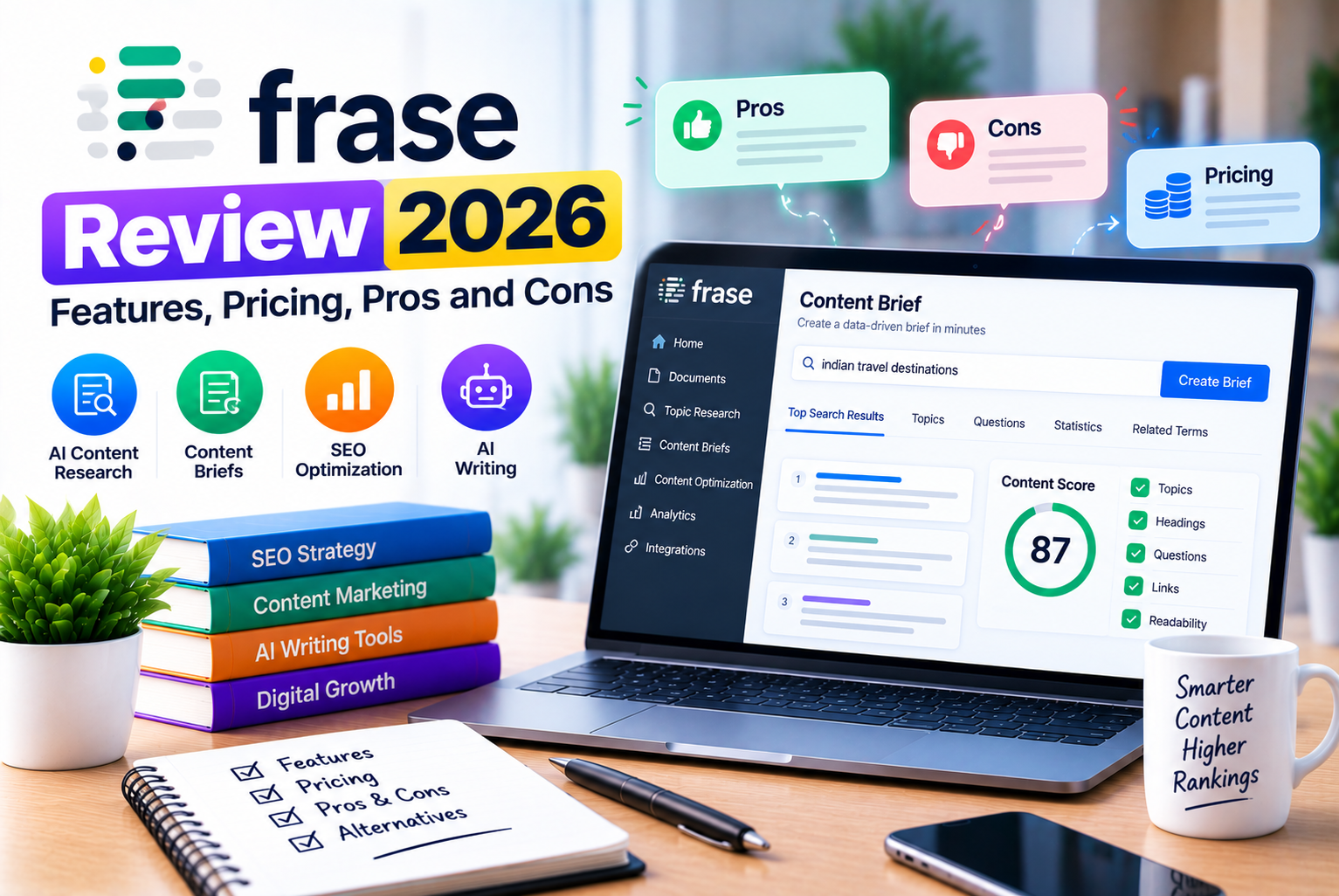
Frase Review 2026: Features, Pricing, Pros and Cons
Creating content that ranks well in search engines requires more than writing informative articles and adding a few keywords. Website owners must understand search intent, analyze competing pages, identify missing topics, organize content effectively, and continually improve published articles.
For bloggers, affiliate marketers, and SEO professionals, managing these tasks manually can consume significant time. This is where SEO content optimization tools can help.
Frase is an AI-powered SEO and content platform designed to help users research topics, prepare content briefs, write and optimize articles, and monitor their website’s search performance. Its current platform also includes AI search visibility features, website auditing, publishing capabilities, and tools for maintaining existing content.
But is Frase worth paying for in 2026? Does it genuinely make content optimization easier? How much does Frase cost, and what limitations should you consider before purchasing a subscription?
In this comprehensive Frase review, we will explore its major features, pricing plans, advantages, disadvantages, practical applications, and suitability for different types of users.
We will also examine how Frase fits into an SEO content workflow, compare its capabilities with alternative approaches, and explain what to consider before investing in the platform.
By the end of this guide, you should have a clearer understanding of whether Frase is the right SEO tool for your content strategy.
What Is Frase?
Frase is an AI-powered content research and SEO optimization platform that helps users move from a search query to a researched, written, and optimized webpage.
Rather than requiring users to manage every stage of content creation separately, Frase brings several activities into one workflow.
These activities include researching search engine results pages, identifying topics covered by competing articles, creating content briefs, generating AI-assisted drafts, optimizing content, and publishing articles through supported content management systems.
Frase has also expanded beyond traditional content optimization. Its current platform includes generative engine optimization (GEO), which focuses on preparing content for AI-powered search experiences, alongside tools for auditing websites and tracking visibility in supported AI search engines.
You can explore the platform directly through the official Frase website.
How Does Frase Work?
Frase follows a workflow that connects content research, writing, optimization, and ongoing improvement.
| Stage | What You Do | How Frase Helps |
| Topic research | Select a subject and target keyword | Analyzes relevant search results and identifies topics to cover |
| Content planning | Decide the article structure | Helps generate outlines and content briefs |
| Content creation | Write the article | Provides AI-assisted drafting and writing support |
| SEO optimization | Improve relevance and completeness | Scores content and suggests potential improvements |
| AI search optimization | Prepare content for AI-powered discovery | Provides GEO scoring and supported AI visibility features |
| Publishing | Move the article to your website | Supports publishing through compatible platforms |
| Content maintenance | Review existing pages | Offers auditing and monitoring features to identify improvement opportunities |
The precise features available depend on the subscription plan.
The main advantage is that Frase can reduce the need to move repeatedly between separate research, writing, and optimization tools.
However, it does not eliminate the need for keyword research, fact-checking, editorial judgment, or performance analysis. Those activities remain important parts of an effective SEO strategy.
Frase Review 2026: Quick Verdict
Before exploring individual features, here is a quick overview of what to consider when evaluating Frase.
| Evaluation Factor | Assessment |
| Primary purpose | SEO content research, creation, and optimization |
| AI writing | Available |
| SERP analysis | Available |
| Content brief generation | Available |
| Content optimization scoring | Available |
| Existing content optimization | Supported |
| AI search optimization | GEO scoring and related features |
| Website auditing | Available |
| Content publishing | Supported through compatible platforms |
| Suitable for | Bloggers, freelancers, SEO specialists, and content teams |
| Main advantage | Combines several content workflow tasks in one platform |
| Main limitation | Subscription costs, usage limits, and the need for human review |
| Pricing structure | Monthly or annual billing, with features and limits varying by plan |
| Free trial | Seven days, according to the official pricing page |
Our initial verdict: Frase is worth considering if you regularly produce SEO-focused content and want to streamline research, drafting, optimization, and publishing. Whether it offers sufficient value depends on your publishing volume, existing tools, budget, and need for its additional SEO and AI visibility features.
A tool’s feature list alone cannot establish its return on investment. You should evaluate the time it saves and the improvements it helps you make to your actual content.
Key Features of Frase in 2026
Understanding Frase’s features is essential before deciding whether to purchase a subscription.
The platform has evolved beyond its original focus on SERP research and content briefs. Its current offering combines several capabilities related to content creation, search optimization, publishing, and monitoring.
Let’s examine the most important features individually.
1. SERP Analysis and Content Research
Search engine results page analysis is one of the central functions of an SEO content workflow.
Before writing an article, you need to understand what users expect to find when they search for a particular keyword. You also need to examine the pages competing for that query and identify opportunities to provide more useful information.
Frase helps automate parts of this research process.
After entering a topic or search query, the platform can analyze relevant search results and surface information about the topics, subtopics, headings, and questions covered by competing pages.
This gives writers a starting point for understanding the subject and preparing an article outline.
For example, imagine you want to write an article targeting the keyword best web hosting for small businesses.
Your research might identify topics such as:
- Types of business hosting.
- Website performance and uptime.
- Security and backup features.
- Pricing and renewal costs.
- Customer support.
- Scalability.
- Hosting limitations.
- Frequently asked questions.
Instead of manually opening every competing article and recording its structure, you can use Frase to organize parts of this research.
However, competitor analysis should be treated as a starting point rather than a formula for ranking.
If every competing article discusses the same topics, simply repeating those topics will not automatically make your content better. You should also consider original insights, practical examples, audience needs, and information that competing pages may overlook.
Best use case: Writers and SEO specialists who want to accelerate topic research and build more comprehensive content briefs.
2. AI Content Brief Generation
A content brief provides a structured plan for an article before the writing process begins.
It helps define the article’s purpose, target audience, primary keyword, supporting topics, heading structure, and questions that need to be answered.
Frase can turn its research findings into a structured content brief that writers can use to begin drafting.
This can be particularly useful for agencies and websites producing multiple articles every month.
Consider the following example.
| Content Brief Element | Example |
| Article topic | Best Email Marketing Software for Small Businesses |
| Primary keyword | Best Email Marketing Software |
| Search intent | Commercial investigation |
| Target audience | Small business owners and marketers |
| Main sections | Features, pricing, integrations, advantages, disadvantages |
| Comparison requirements | Pricing, automation, subscriber limits, reporting |
| Supporting topics | Email segmentation, campaign automation, deliverability |
| Reader objective | Compare platforms and choose a suitable solution |
A structured brief makes it easier for writers to understand what an article should accomplish.
It can also help editors maintain consistency across multiple contributors.
Nevertheless, an AI-generated content brief should not replace editorial planning. Search results can contain outdated recommendations, irrelevant headings, or information that does not match your audience’s needs.
Review the outline before writing and remove sections that do not contribute to the article’s purpose.
3. AI Writing Assistant
Frase includes AI-assisted writing capabilities designed to help users draft and develop content.
Depending on the workflow, writers can use the platform to generate outlines, draft sections, expand ideas, and develop content based on their research.
This can help reduce the time required to create an initial draft.
For example, a blogger writing a product comparison could use AI assistance to develop a preliminary structure covering features, pricing, use cases, and limitations.
The writer would then verify product details, add practical analysis, refine the language, and ensure the final article accurately reflects the product.
AI writing is most useful when it supports a well-defined editorial process.
It is less reliable when users expect it to produce a complete, publication-ready article without supervision.
What Are the Benefits of Frase’s AI Writer?
The main potential benefits include:
- Faster creation of initial drafts.
- Help organizing complex subjects.
- Assistance expanding short outlines into complete sections.
- Reduced time spent on repetitive writing tasks.
- A more consistent starting point for teams.
- Integration with research and optimization workflows.
However, AI-generated content can contain unsupported claims, generic explanations, repetitive passages, and outdated product information.
This is especially important for affiliate marketing articles, where readers rely on accurate specifications, pricing, feature descriptions, and purchasing advice.
Our recommendation: Use Frase’s AI writer to accelerate the drafting process, but review every important claim before publication. Add original analysis, verify current information, and make sure the article answers the reader’s question rather than merely filling space.
4. Real-Time SEO Content Optimization
SEO content optimization involves improving a webpage’s relevance and usefulness for a specific search query.
Frase provides an optimization score and suggestions based on its analysis of the content and relevant competing pages.
According to its official SEO content optimization documentation, the platform can highlight topics and questions that may need additional coverage as you write.
This can help identify gaps that writers might otherwise overlook.
For example, an article about email marketing software might discuss campaign creation but omit subscriber segmentation, automation workflows, analytics, or deliverability.
An optimization tool can help identify these omissions and prompt the writer to consider whether they belong in the article.
How Does Frase Content Optimization Work?
A typical workflow involves the following steps:
- Enter the target topic or keyword.
- Review the relevant search results and research suggestions.
- Create or import the article.
- Examine the optimization score and suggested improvements.
- Identify missing topics or insufficiently developed sections.
- Revise the article where those changes improve its usefulness.
- Review the complete article before publishing.
The important distinction is that a higher optimization score does not guarantee higher Google rankings.
A content score is a diagnostic indicator based on the tool’s methodology. Google rankings depend on many factors, including relevance, content quality, competition, website reputation, technical accessibility, and other signals.
You should not add irrelevant keywords or repetitive sentences merely to increase a score.
The objective is to improve the article, not simply satisfy a tool’s scoring system.
5. Content Optimization for Existing Articles
Publishing new articles is only one part of an effective SEO strategy.
Existing content may lose visibility because competitors publish better resources, search intent changes, information becomes outdated, or the article no longer answers important questions.
Frase supports the optimization of existing content by allowing users to import a live URL and assess the page against current search results.
This can help identify sections that need updating.
For example, consider an article titled Best AI Writing Tools in 2025.
If the article still contains outdated pricing, discontinued features, and old product comparisons, updating those details may be more useful than publishing another article covering the same subject.
A content refresh might involve:
- Updating prices and product features.
- Replacing outdated examples.
- Adding new tools where relevant.
- Improving weak explanations.
- Revising headings to better match search intent.
- Adding relevant internal links.
- Removing redundant sections.
- Improving the introduction and conclusion.
- Verifying existing external references.
Frase can help identify potential content gaps, but the final update should be based on factual accuracy, reader needs, and actual performance data.
For a broader approach, you can also develop a content refresh process using your analytics and search performance information.
6. AI Search Optimization and GEO Scoring
Search behavior is expanding beyond traditional search engine results pages.
Users increasingly ask conversational questions through AI-powered search experiences and assistants. Depending on the platform, these systems may summarize information from multiple sources and cite selected webpages.
This has created interest in Generative Engine Optimization (GEO), a term used to describe efforts to improve the likelihood that content is understood, retrieved, referenced, or cited by generative AI systems.
Frase now includes GEO-related content scoring alongside traditional SEO optimization.
This can help content teams evaluate their articles from more than one perspective.
| Traditional SEO | Generative Engine Optimization |
| Focuses on organic search visibility | Focuses on visibility in generative AI experiences |
| Examines relevance to search queries | Examines whether content can address questions in AI-assisted discovery |
| Uses keyword research and search intent | Also considers conversational questions and clearly expressed answers |
| Optimizes page structure and content coverage | Emphasizes understandable, well-organized information and useful supporting details |
| Measures search rankings and organic traffic | May measure AI mentions, citations, or visibility where reliable tracking is available |
These approaches overlap considerably. GEO is not a replacement for SEO, and the two should not be treated as completely separate disciplines.
Clear explanations, accurate information, useful examples, and well-organized pages can benefit both traditional search users and people interacting with AI assistants.
However, an AI optimization score cannot guarantee that ChatGPT, Google AI, Perplexity, or another system will cite a particular page.
Actual citations depend on the retrieval methods, source selection, query, and other factors used by each system.
7. AI Visibility Tracking
Optimizing content for AI search is different from measuring whether a brand or website actually appears in AI-generated answers.
Frase’s AI Visibility feature is designed to help users monitor supported AI search experiences and understand how their content or brand appears in those environments.
The available platforms and tracking limits vary by subscription plan.
According to Frase’s published pricing information, the entry-level plan includes tracking for ChatGPT and Google AI, while higher plans add additional platforms.
This feature may be useful for businesses that want to evaluate their visibility beyond traditional organic search results.
For example, a software company could monitor questions such as:
- What are the best SEO tools for small businesses?
- Which AI writing platforms support content optimization?
- What tools help bloggers improve organic traffic?
- Which platforms combine content research and AI writing?
Tracking relevant prompts can help reveal whether a brand appears in the answers generated for those questions.
However, AI visibility metrics should be interpreted carefully.
AI responses can change between queries, and visibility measurements do not necessarily represent a complete view of all users or conversations.
Use AI visibility tracking alongside organic traffic, search performance, conversions, and other relevant business metrics.
8. Website Auditing and Content Monitoring
Frase also offers website auditing and content monitoring capabilities.
These features extend its usefulness beyond individual articles by helping users identify pages that may require attention.
Website auditing can help organize potential problems and improvement opportunities across a website. Content monitoring can help identify published pages whose search performance may be declining.
For a website with dozens or hundreds of articles, this can provide a more organized approach to content maintenance.
For example, a content team could prioritize:
- Articles that have lost meaningful organic traffic.
- Important pages that no longer satisfy their target search intent.
- Content with outdated product information.
- Pages with missing or incomplete sections.
- Articles that could benefit from internal links.
- Pages that deserve a full refresh rather than a minor edit.
The availability and scope of individual monitoring features depend on the plan.
It is also important to distinguish content monitoring from a complete technical SEO solution. Depending on your requirements, you may still need separate tools for detailed crawling, backlink analysis, keyword research, log-file analysis, or other specialist tasks.
9. Content Publishing and CMS Integration
Content production often involves several separate stages.
Writers research topics, draft articles, optimize them, transfer the content to a content management system, format the page, and prepare it for publication.
Moving content between multiple tools can create unnecessary work.
Frase supports publishing through compatible platforms, including WordPress, Webflow, Sanity, and Wix, according to its official website.
This can help teams streamline the transition from content creation to publication.
For example, a WordPress-based blog could use a compatible publishing workflow to move approved content into its website without manually recreating the entire article.
Before relying on this feature, confirm that your intended publishing workflow supports the fields and formatting your website requires.
You should also review the final page before publishing to check:
- Heading hierarchy.
- Paragraph formatting.
- Tables and lists.
- Internal links.
- External links.
- Featured images.
- Meta titles and descriptions.
- Image alternative text.
- Schema markup, where appropriate.
- Mobile presentation.
Publishing automation can save time, but it does not eliminate the need for a final editorial and technical review.
10. Content Planning and Internal Linking
A successful content strategy requires more than publishing individual articles.
Related pages should work together to build topical coverage and help readers discover additional information.
For example, a website publishing SEO software reviews might organize its content into several groups:
| Content Group | Example Article | Purpose |
| Product reviews | Frase Review 2026 | Evaluate one tool in detail |
| Pricing guides | Frase Pricing Plans Compared | Help readers understand costs |
| Comparisons | Frase vs Surfer SEO | Help readers choose between products |
| Alternatives | Best Frase Alternatives in 2026 | Help readers evaluate other solutions |
| Tutorials | How to Use Frase for SEO Content Optimization | Explain how to use the product |
This structure creates opportunities for relevant internal links.
Frase’s Professional plan also lists internal linking suggestions among its features. These suggestions can help identify potential links, although the editorial team should still decide which connections are useful.
Frase Pricing in 2026: How Much Does Frase Cost?
Pricing is one of the most important considerations when evaluating any paid SEO tool.
Frase currently lists three main self-service plans: Starter, Professional, and Scale. Enterprise pricing is available for organizations requiring a customized arrangement.
The official pricing page lists lower monthly-equivalent prices for annual billing than for month-to-month subscriptions.
Frase Pricing Plans Compared
The following table reflects the published prices and core limits shown on Frase’s official pricing page at the time of research.
| Feature | Starter | Professional | Scale |
| Monthly price with annual billing | $39 | $103 | $239 |
| Month-to-month price | $49 | $129 | $299 |
| User seats included | 1 | 3 | 5 |
| Sites or domains | 1 | 5 | Up to 10 |
| Articles per month | 10 | 40 | 100 |
| Audit pages per month | 50 | 250 | 1,000 |
| AI Visibility platforms listed | ChatGPT and Google AI | Adds Perplexity | Adds Claude and Gemini |
| Content Guard monitoring | 10 pages | 75 pages | 300 pages |
| Best suited for | Individual creators | Small content teams | Agencies and multi-site operations |
Important pricing notes:
- Annual billing is charged upfront, even though the advertised price is displayed per month.
- The monthly-equivalent price is not the same as a month-to-month subscription price.
- Additional seats and usage options may increase the total cost.
- Feature availability and limits can change.
- Enterprise pricing is customized.
Before buying, check the latest details on the official Frase pricing page.
1. Frase Starter Plan
The Starter plan is designed for individual users and small operations working on a single website.
At the published annual-billing rate of $39 per month, it includes one seat, one site, 10 articles, and 50 audit pages per month.
It also includes SEO and GEO scoring, AI Visibility for the supported entry-level platforms, and access to publishing capabilities.
This plan may suit:
- Individual bloggers.
- Freelance SEO writers.
- Affiliate marketers managing one website.
- Small businesses with modest content requirements.
- Users who want to evaluate Frase before expanding their workflow.
However, the 10-article monthly allowance is an important consideration.
If you regularly publish a high volume of articles, refresh older content, or manage several websites, you should assess whether the plan’s limits fit your actual workflow.
Who should choose Starter?
Choose Starter if you primarily work independently, manage one site, and want a centralized platform for content research and optimization without paying for team-oriented capacity you do not need.
2. Frase Professional Plan
The Professional plan is designed for teams that need more content capacity and collaboration features.
The published annual-billing price is $103 per month, compared with $129 per month for month-to-month billing.
It includes three seats, five sites, 40 articles, and 250 audit pages per month.
The plan also includes additional capabilities, such as a content calendar, internal linking suggestions, and expanded AI Visibility coverage.
It may be suitable for:
- Small SEO agencies.
- In-house marketing departments.
- Content teams managing several websites.
- Businesses publishing multiple articles each week.
- Teams coordinating research, writing, and optimization.
The higher price can make sense when multiple people regularly use the platform.
However, if you only need to publish a few articles every month, the additional capacity may not justify the expense.
Who should choose Professional?
Consider Professional if your team needs multiple seats, manages several websites, and can make practical use of the expanded content and auditing limits.
3. Frase Scale Plan
The Scale plan is designed for agencies and organizations handling larger content operations.
At the published annual-billing rate of $239 per month, it includes five seats, up to 10 domains, 100 articles, and 1,000 audit pages per month.
It also expands supported AI Visibility coverage to include additional platforms listed in Frase’s pricing information.
This plan may be relevant to:
- SEO agencies managing multiple clients.
- Content marketing companies.
- Businesses operating several websites.
- Organizations with substantial content production requirements.
- Teams that need broader monitoring and auditing capacity.
However, a higher-tier plan is not automatically a better investment.
The decision should depend on how much of the included capacity you will actually use and whether the additional capabilities support your business goals.
Who should choose Scale?
Choose Scale only if the increased content capacity, site limits, team access, and additional features justify the cost of the subscription.
Is Frase Expensive?
Whether Frase is expensive depends on your publishing volume, team size, and existing software expenses.
A freelancer publishing a handful of articles each month may find the Starter plan sufficient.
An agency producing dozens of articles across several websites may benefit from Professional or Scale.
The important question is not simply how much Frase costs. It is whether the platform saves enough time or improves your workflow enough to justify the subscription.
For example, suppose a content team spends several hours researching and optimizing every article. If Frase meaningfully reduces that time while maintaining editorial quality, it may offer practical value.
However, if you already have effective research, writing, and optimization tools, Frase may duplicate some of your existing capabilities.
Before purchasing, compare the cost of Frase with your current workflow and identify the specific tasks it would replace or improve.
Frase Pros and Cons: Is It Worth Using?
Every SEO platform has strengths and limitations.
Frase’s main appeal is its combination of research, writing, optimization, and publishing capabilities. However, its usefulness depends on how well those capabilities fit your requirements.
Advantages of Frase
- Combines several content tasks
Frase brings research, content creation, optimization, and related publishing workflows together, potentially reducing the need to switch between tools.
- Helps create structured content briefs
Its research capabilities can help writers understand what competing pages cover and identify topics that deserve attention.
- Supports AI-assisted writing
The AI writing functionality can accelerate drafting and help develop initial outlines or sections.
- Provides optimization suggestions
Content scoring and topic suggestions can help writers identify areas that may need additional coverage.
- Supports existing content improvements
Users can evaluate published pages and identify potential opportunities to refresh outdated or incomplete articles.
- Includes AI search-related features
GEO scoring and AI Visibility capabilities make Frase relevant to content teams interested in both traditional SEO and AI-powered discovery.
- Offers publishing integrations
Supported CMS publishing workflows can reduce repetitive work when transferring approved content to a website.
- Scales across different team sizes
The available plans provide different limits and collaboration options for individuals, smaller teams, and larger content operations.
Disadvantages of Frase
- Paid subscription required for the main workflow
Users who need regular access to the platform’s core research and optimization capabilities must account for subscription costs.
- Monthly usage limits
Article and auditing limits can constrain users with high content production requirements.
- AI writing still requires editorial review
Generated content may be repetitive, generic, incomplete, or factually inaccurate.
- Optimization scores are not ranking guarantees
A high score does not prove that an article will outperform competing pages.
- May not replace every specialist SEO tool
Users with advanced keyword research, backlink analysis, technical SEO, or analytics requirements may still need other platforms.
- Higher plans can be costly for smaller users
Professional and Scale may offer more capacity than a solo blogger or small website actually needs.
- AI visibility metrics require careful interpretation
Tracking supported AI platforms can provide useful observations, but the results should not be treated as a complete measure of brand visibility or business performance.
Frase Pros and Cons at a Glance
| Pros | Cons |
| Combines research and content optimization | Subscription costs |
| Supports AI-assisted writing | Human editing remains necessary |
| Helps identify content gaps | Scores do not guarantee rankings |
| Supports existing content refreshes | Usage limits vary by plan |
| Includes GEO-related capabilities | AI visibility measurements have limitations |
| Supports compatible CMS publishing | May require additional specialist tools |
| Offers options for individuals and teams | Higher tiers may not suit small websites |
Overall assessment: Frase is most compelling when its combined workflow replaces repetitive tasks that would otherwise require several separate tools. Its value is less certain when users need only one isolated capability or already have an effective content production system.
How to Use Frase for SEO Content Optimization
Understanding a product’s features is useful, but knowing how to apply them to an actual article is even more important.
The following workflow explains how bloggers and SEO professionals can incorporate Frase into their content production process.
Step 1: Choose a Relevant Topic and Primary Keyword
Start by identifying the topic you want to cover and the audience you want to reach.
Your primary keyword should reflect the article’s purpose and the search intent you want to address.
For example:
- Primary keyword: Frase Review.
- Supporting keyword: Frase pricing.
- Supporting keyword: Frase features.
- Supporting keyword: Frase pros and cons.
- Supporting keyword: Is Frase worth it?
Before writing, examine the existing content on your website to determine whether another page already targets the same search intent.
This helps reduce unnecessary duplication.
Step 2: Research the Search Results
Use Frase’s research capabilities to examine the pages competing for your target query.
Look for common topics, important subheadings, questions, and areas where existing articles provide incomplete explanations.
Do not assume that every topic appearing in a competing article belongs in yours.
Instead, determine which subjects are essential for your readers and which would distract from the article’s purpose.
Step 3: Prepare a Detailed Content Brief
Create an outline that covers the reader’s main questions in a logical order.
For a software review, the outline might include:
- Product overview.
- Main features.
- Pricing plans.
- Advantages and disadvantages.
- Practical use cases.
- Alternatives.
- Frequently asked questions.
- Final recommendation.
The final outline should reflect the product and the search intent rather than following the same structure for every article.
Step 4: Draft the Article
Write the first draft using your content brief and research.
You can use Frase’s AI writing capabilities to accelerate this stage, but ensure the content reflects your intended audience and editorial standards.
Include specific examples, accurate product details, useful comparisons, and clear explanations.
For affiliate articles, distinguish verified facts from opinions and recommendations.
Step 5: Optimize the Content
Review Frase’s optimization suggestions and identify meaningful gaps.
Check whether the article addresses the primary search intent, includes relevant supporting topics, and explains important concepts adequately.
Add sections only when they improve the article.
Avoid inserting keywords into every heading or repeating the primary keyword unnaturally.
Step 6: Add Relevant Internal and External Links
Internal links help readers discover related content on your website.
External links can support factual claims and direct readers to official documentation or other authoritative resources.
For a Frase review, relevant internal links could point to a Frase pricing guide, a Frase versus Surfer SEO comparison, and an article about Frase alternatives.
External links should direct readers to reliable sources, especially when discussing current prices and product capabilities.
Step 7: Review and Publish
Before publishing, check the article’s accuracy, formatting, and completeness.
Confirm that:
- Product features are described accurately.
- Pricing reflects the latest available information.
- The introduction clearly explains what readers will learn.
- Headings follow a logical hierarchy.
- Tables are easy to understand.
- Internal links point to the correct pages.
- External links work correctly.
- FAQs answer genuine reader questions.
- The CTA is relevant to the article.
- The content is readable on mobile devices.
Only publish once the article is ready for readers.
Step 8: Monitor Performance and Improve the Article
After publication, review performance using the analytics and search performance tools available to you.
Useful metrics include:
- Organic clicks.
- Search impressions.
- Average search position.
- Click-through rate.
- Engagement.
- Affiliate link clicks.
- Conversions.
- Revenue generated by the article.
If a page attracts impressions but receives few clicks, you may need to review the title and description.
If it attracts visitors but produces few affiliate clicks, consider whether the product recommendation, comparison, or CTA addresses the reader’s needs.
If rankings decline, investigate the cause before making changes.
Frase can support the optimization workflow, but performance decisions should be based on actual evidence rather than content scores alone.
Frase vs Manual SEO Content Optimization
Not every blogger needs a paid content optimization platform.
Some users can achieve good results with a structured research process, spreadsheet-based planning, analytics, and careful editing.
The choice depends on the scale of your work and the complexity of your workflow.
| Factor | Frase-Assisted Workflow | Manual Workflow |
| Initial research | Automates parts of SERP research | Requires manual review |
| Content brief | Can generate a structured brief | Created by the writer or editor |
| Drafting | Includes AI writing assistance | Written manually or with separate AI tools |
| Optimization | Provides scoring and suggestions | Depends on editorial analysis and other tools |
| Content refresh | Helps identify potential improvements | Requires manual audits and analysis |
| Publishing | Supports compatible publishing integrations | Depends on your CMS workflow |
| Direct software cost | Requires an appropriate paid plan for regular use | Can be low if existing tools are sufficient |
| Control over the process | Guided by tool suggestions and user decisions | Determined by the writer or team |
| Best suited for | Teams seeking a more centralized workflow | Users comfortable managing each stage separately |
A manual workflow can work well for bloggers with limited publishing requirements.
Frase becomes more attractive when research and optimization tasks are repeated frequently across many articles.
The best approach is the one that produces accurate, useful content efficiently without adding unnecessary costs.
Frase vs Other SEO Content Optimization Tools
Frase is not the only platform available for SEO content research and optimization.
Depending on your requirements, you may also want to consider Surfer SEO, Semrush, Ahrefs, or other content and SEO tools.
These products do not all serve exactly the same purpose, so comparisons should focus on the tasks you actually need to perform.
Frase vs Surfer SEO
Surfer SEO is a relevant alternative for users who want to optimize content around search intent, topic coverage, and on-page SEO recommendations.
Frase combines content research, AI-assisted writing, optimization, publishing, and newer AI search-related features in its current platform.
Surfer SEO’s exact capabilities and pricing should be checked against its current official documentation before making a direct purchasing decision.
For NextBloggers, we will examine this comparison in more detail in the dedicated article:
Related article to create: Frase vs Surfer SEO: Features, Pricing and Content Optimization Compared
Planned URL slug: frase-vs-surfer-seo
Frase vs Semrush
Semrush is a broader SEO and digital marketing platform with capabilities covering areas such as keyword research, competitor analysis, rank tracking, and site auditing.
Frase is particularly relevant when the primary objective is to streamline the research, creation, and optimization of content.
| Requirement | Frase | Semrush |
| SEO content research | Core capability | Available through relevant tools and workflows |
| AI-assisted content creation | Available | AI-related content capabilities are available in relevant products |
| Content optimization | Core capability | Available through relevant content tools |
| Keyword research | Assess the specific research data and depth you require | Broad keyword research capabilities |
| Competitor analysis | Focused on content research and related SEO workflows | Broader SEO competitor research capabilities |
| Technical SEO | Website auditing capabilities available | Site auditing capabilities available |
| AI search-related features | GEO scoring and AI Visibility features | Capabilities depend on the current product and plan |
| Best fit | Content-focused workflows | Broader SEO and digital marketing workflows |
This is a high-level comparison, not a claim that one platform is universally better.
Choose based on your required features, the depth of data you need, and the total cost of the tools involved.
Frase vs Ahrefs
Ahrefs is widely used for SEO research, particularly keyword research, backlink analysis, competitor research, and understanding organic search performance.
Frase is more focused on connecting content research with writing and optimization workflows.
If your primary objective is to research backlinks or investigate competitors’ link profiles, a specialist SEO research platform may be more appropriate.
If you mainly want to prepare briefs, develop articles, and improve content coverage, Frase may be worth evaluating.
Some users may benefit from combining a content optimization tool with a broader SEO research platform rather than expecting one product to cover every requirement.
Who Should Use Frase?
Frase can serve different types of users, but its suitability depends on their publishing needs and workflow.
1. Bloggers
Bloggers who regularly publish informational articles can use Frase to research topics, prepare outlines, and identify content gaps.
It may be particularly helpful when managing a growing collection of articles that need consistent optimization.
However, bloggers who publish infrequently may not need a paid subscription.
2. Affiliate Marketers
Affiliate marketers often produce product reviews, comparisons, alternatives articles, and buying guides.
These formats require detailed research, structured comparisons, and accurate product information.
Frase can help organize the content workflow and identify topics that need additional coverage.
However, affiliate marketers should not rely on AI-generated product claims without verification.
Pricing, product limitations, commissions, and feature availability must be checked carefully.
3. SEO Professionals
SEO professionals can use Frase to streamline research and content optimization across multiple projects.
The platform may be particularly useful for preparing content briefs and maintaining consistency across articles.
Those who require extensive keyword databases, backlink intelligence, or advanced technical analysis may still need other SEO tools.
4. Content Marketing Agencies
Agencies that manage multiple clients may benefit from standardized research and optimization workflows.
The Professional and Scale plans offer more seats, sites, and content capacity than Starter.
However, agencies should evaluate actual client requirements and monthly production volume before selecting a plan.
5. Small Businesses
Small businesses that publish educational resources or support articles may find Frase useful for improving their content production process.
The tool is most relevant when content plays an important role in attracting organic visitors and supporting customer acquisition.
Businesses with only a few pages and minimal publishing requirements may find a manual workflow sufficient.
6. Beginners Learning SEO
Beginners can use Frase to understand how search results inform content planning and how to identify topics that deserve coverage.
Nevertheless, the platform should be treated as a learning aid rather than a substitute for understanding SEO fundamentals.
Learning about search intent, internal linking, keyword research, technical SEO, and content quality remains important.
Who Should Avoid Frase?
Frase may not be the right investment for everyone.
Consider alternatives or a manual workflow if any of the following situations apply.
You publish very little content. If you write only one or two articles occasionally, the subscription may not justify its cost.
You need extensive backlink analysis. A specialist SEO platform may be more suitable if backlink research is your primary requirement.
You already have overlapping tools. If your existing software already covers research, drafting, optimization, and publishing effectively, Frase may offer limited additional value.
You expect AI to produce publication-ready articles automatically. AI-generated content still requires verification, editing, and editorial oversight.
Your budget is extremely limited. You may be able to handle research and optimization manually while your website grows.
You expect guaranteed rankings. No content optimization platform can guarantee specific Google rankings or AI citations.
The best purchasing decision is based on the tasks you need to accomplish, not the number of features advertised.
Is Frase Good for Affiliate Marketing?
Frase can be useful for affiliate marketers because affiliate websites often rely on several repeatable content formats.
These include product reviews, pricing guides, software comparisons, alternatives articles, and educational content that helps readers make purchasing decisions.
A structured content workflow can help affiliate marketers produce these articles more efficiently.
For example, an affiliate marketer reviewing an email marketing platform might need to cover:
- Core features.
- Subscription plans.
- Usage limits.
- Integrations.
- Advantages and disadvantages.
- Best use cases.
- Limitations.
- Alternatives.
- Questions potential buyers ask before purchasing.
Frase can help research the topic and organize these sections into a brief.
However, an effective affiliate article needs more than keyword coverage.
Readers need honest recommendations, accurate pricing, clear explanations of product limitations, and practical guidance about which solution suits their requirements.
Where possible, include firsthand experience, original screenshots, practical tests, or other evidence that distinguishes your review from generic product descriptions.
How Affiliate Marketers Can Evaluate Frase’s Value
Consider the following example.
Suppose a content team publishes 20 articles per month and spends substantial time researching and optimizing each one.
If Frase helps reduce the time required for those tasks, the time savings may contribute to its value.
However, the result depends on actual usage.
A useful evaluation should consider:
| Metric | What to Measure |
| Research time | Time spent researching each article before and after using Frase |
| Drafting time | Time needed to prepare the first draft |
| Editing time | Time needed to correct and improve the content |
| Publishing time | Time required to format and publish an article |
| Content quality | Accuracy, depth, originality, and usefulness |
| Organic performance | Impressions, clicks, rankings, and relevant conversions |
| Affiliate performance | Outbound clicks, conversion rate, and commission revenue |
| Total cost | Subscription fees and any additional software expenses |
Do not assume that producing articles faster will automatically generate more affiliate revenue.
The real objective is to improve the efficiency and quality of your content operation while maintaining reader trust.
How to Get the Most Value From Frase
If you decide to use Frase, a few practices can help you make better use of the platform.
Start With Clear Content Goals
Before creating an article, decide what the page should accomplish.
Is it intended to explain a concept, compare products, help readers solve a problem, or support a purchase decision?
A clear objective makes it easier to determine which research findings and optimization suggestions are relevant.
Use Primary and Supporting Keywords Strategically
Choose one primary keyword that reflects the main search intent.
Then identify supporting keywords that represent related questions, subtopics, and long-tail searches.
Use these terms naturally in the article.
Do not repeat the primary keyword unnecessarily or force every supporting keyword into a heading.
Prioritize Reader Needs Over Scores
An optimization score can highlight possible improvements, but it should not determine every editorial decision.
If a suggested section does not help the reader, you do not need to include it simply to raise the score.
Likewise, if your article needs a detailed explanation that competitors omit, include it even if the tool does not explicitly recommend it.
Verify Product Information
Software reviews and affiliate articles require particularly careful fact-checking.
Check official documentation for:
- Current pricing.
- Included features.
- Subscription limits.
- Integrations.
- Free trial conditions.
- Cancellation terms.
- Supported platforms.
Do not rely on old reviews for information that may have changed.
Refresh Existing Content Regularly
Review your important articles periodically to identify outdated information and declining performance.
Prioritize pages based on business importance, search performance, and the potential value of improvements.
Not every article requires a complete rewrite. Sometimes updating a few inaccurate details or adding a missing explanation is sufficient.
Measure Business Results
Evaluate Frase based on how it affects your actual workflow.
If it saves time but reduces content quality, the trade-off may not be worthwhile.
If it helps your team produce better-researched articles more efficiently, it may provide value even before you observe changes in organic rankings.
Use a consistent evaluation period and compare results with your previous process.
Frequently Asked Questions About Frase
1. What Is Frase Used For?
Frase is an AI-powered SEO and content optimization platform used for researching topics, preparing content briefs, drafting articles, optimizing content, and supporting publishing workflows. Its current platform also includes website auditing and AI search visibility capabilities.
It is particularly relevant to bloggers, content writers, affiliate marketers, SEO professionals, and agencies that produce content regularly.
2. Is Frase Worth It in 2026?
Frase can be worth it in 2026 if you regularly create SEO-focused content and need help with research, writing, optimization, or content maintenance.
Its value depends on your publishing volume, budget, existing tools, and the time it saves.
Before purchasing, compare the subscription cost with the benefits you expect to receive.
3. How Much Does Frase Cost?
Frase’s published self-service pricing starts at $39 per month with annual billing for Starter, compared with $49 per month when billed month to month.
Professional is listed at $103 per month with annual billing, while Scale is listed at $239 per month with annual billing.
Prices, features, and usage limits may change. Check the official Frase pricing page before purchasing.
4. Does Frase Have a Free Trial?
Yes. Frase advertises a seven-day free trial without requiring a credit card on its official website.
Check the current terms before registering, as trial availability and conditions can change.
5. Is Frase an AI Writing Tool?
Yes. Frase includes AI-assisted writing capabilities, but its functionality extends beyond text generation.
It also supports content research, brief creation, SEO optimization, and other content workflow tasks.
This makes it relevant to users who want to combine AI writing with research and optimization rather than use a standalone writing assistant.
6. Can Frase Help Improve Google Rankings?
Frase can help improve aspects of content quality and optimization by identifying missing topics and suggesting potential improvements.
However, it cannot guarantee higher rankings.
Google rankings depend on many factors, including relevance, content quality, competition, website performance, and other signals.
Use Frase to support sound SEO practices rather than treating its optimization score as a ranking guarantee.
7. Does Frase Support AI Search Optimization?
Yes. Frase offers GEO scoring and AI Visibility features intended to help users prepare content for AI-powered search experiences and monitor visibility on supported platforms.
The exact tracking capabilities depend on the subscription plan.
These features can support an AI search strategy, but they cannot guarantee citations or mentions in AI-generated answers.
8. Can Frase Optimize Existing Blog Posts?
Yes. Frase supports workflows for evaluating existing pages and identifying potential content improvements.
This can be useful when refreshing outdated articles, improving incomplete sections, and updating content to better match current search intent.
The effectiveness of a refresh depends on the changes made and the page’s circumstances.
9. Is Frase Suitable for Affiliate Marketing Websites?
Frase can be useful for affiliate websites that publish product reviews, comparisons, alternatives guides, and buying advice.
It can help organize research and improve content coverage.
However, affiliate marketers should independently verify product features, pricing, and limitations. They should also include honest recommendations and comply with applicable affiliate disclosure requirements.
10. Is Frase Better Than Surfer SEO?
Neither tool is automatically better for every user.
Frase combines content research, AI-assisted writing, optimization, and related publishing workflows.
Surfer SEO is another option for users focused on content optimization and related SEO workflows.
The better choice depends on the specific features you need, your budget, and the tools you already use.
11. Can Frase Replace Semrush or Ahrefs?
Frase may reduce the need for certain overlapping content tools, but it should not automatically be considered a complete replacement for broader SEO research platforms.
Semrush and Ahrefs offer capabilities for tasks such as keyword research, competitor analysis, and backlink research.
If those functions are important to your workflow, compare the specific features and data available before cancelling an existing subscription.
12. Does Frase Support WordPress?
Yes. Frase lists WordPress among its supported publishing platforms.
It also lists Webflow, Sanity, and Wix.
Confirm that the current publishing integration supports your intended workflow and review the final article before making it live.
13. Is Frase Good for Beginners?
Frase can help beginners organize content research and understand how competing pages cover a topic.
However, beginners should also learn SEO fundamentals, including search intent, keyword research, content quality, internal linking, and technical accessibility.
The platform is most useful when its suggestions are understood and evaluated rather than followed blindly.
14. What Are the Main Disadvantages of Frase?
The main considerations include subscription costs, usage limits, the need for human editing, and the fact that optimization scores cannot guarantee rankings.
Users who need extensive backlink analysis or specialized technical SEO data may also require additional tools.
Whether these limitations matter depends on the user’s workflow and requirements.
15. Is Frase Suitable for SEO Agencies?
Frase can suit SEO agencies that manage multiple websites and produce content regularly.
Its higher-tier plans provide additional seats, sites, articles, and auditing capacity.
Agencies should evaluate the available limits and calculate whether the platform’s features justify the subscription cost across their client projects.
16. Can Frase Generate a Complete Blog Post?
Frase provides AI-assisted content creation capabilities that can help users develop article drafts and sections.
However, a generated article should be reviewed for accuracy, relevance, originality, completeness, and usefulness before publication.
For product reviews and affiliate content, verify all material claims against current official sources.
17. Does a High Frase Content Score Guarantee SEO Success?
No. A high Frase content score does not guarantee improved rankings, organic traffic, or conversions.
The score is a tool-specific indicator that helps users evaluate aspects of content optimization.
Search performance depends on a broader set of factors, and a useful article should prioritize reader needs over achieving an arbitrary score.
18. How Should I Choose the Right Frase Plan?
Start by estimating how many articles you create monthly, how many websites you manage, how many people need access, and how much auditing or AI visibility tracking you require.
Compare those needs with the limits of Starter, Professional, and Scale.
Choose the least expensive plan that adequately supports your workflow, and upgrade only when the additional capacity or features provide a clear benefit.
19. Is Frase Useful for Updating Old Content?
Yes. Frase can support content refresh workflows by helping identify areas where an existing article may need improvement.
Useful updates can include correcting outdated information, expanding incomplete explanations, revising headings, and adding relevant internal links.
Prioritize updates using actual performance data and the importance of the page rather than refreshing every article indiscriminately.
20. Should I Buy Frase or Use Free SEO Tools?
The answer depends on how frequently you publish and how much time you spend researching and optimizing content.
Free tools and manual research may be sufficient for a small website with limited publishing needs.
Frase becomes more attractive when you regularly produce content and want to combine research, writing, optimization, and publishing tasks in one workflow.
Compare the cost with the time saved and the quality of the results before making a decision.
Final Verdict: Should You Buy Frase in 2026?
Frase is a content-focused SEO platform that combines research, AI-assisted writing, content optimization, publishing, and related monitoring capabilities.
Its greatest potential advantage is workflow consolidation. Instead of handling every content task independently, users can organize much of the process within one platform.
For bloggers and affiliate marketers, this can make it easier to research product reviews, prepare structured outlines, identify missing topics, and improve existing articles.
For SEO agencies and content teams, the higher-tier plans provide additional capacity and collaboration options.
However, Frase is not essential for every website.
If you publish infrequently, already have effective tools, or mainly need advanced backlink and keyword research, another approach may be more suitable.
It is also important to remember that no SEO tool can guarantee Google rankings or citations from AI search engines. Content quality, factual accuracy, search intent, and ongoing performance analysis remain essential.
Our Recommendation
| User Type | Recommendation |
| Individual blogger | Consider Starter if you publish regularly |
| Affiliate marketer | Consider Frase if research and optimization are recurring tasks |
| Freelance SEO writer | Evaluate whether the time savings justify the subscription |
| Small content team | Compare Professional with your publishing volume and team needs |
| SEO agency | Evaluate Professional or Scale against client requirements |
| Website with very little content | Start with manual research or existing tools |
| User needing advanced backlink research | Consider a specialist SEO research platform alongside or instead of Frase |
The bottom line: Frase is worth evaluating if you want to streamline SEO content production and improve how you research, create, and maintain articles. Before committing to a paid plan, test it with a real article and assess whether it improves your workflow enough to justify the cost.
Ready to Explore Frase?
If you want to see how Frase can fit into your SEO content workflow, explore its official website, review the available subscription plans, and evaluate the features against your publishing requirements.
Start with a real topic from your website rather than a hypothetical example. Use it to test the research, drafting, and optimization process, then decide whether the results meet your editorial standards.
Explore Frase’s features and plans: Visit the official Frase website.
Leave a Reply