


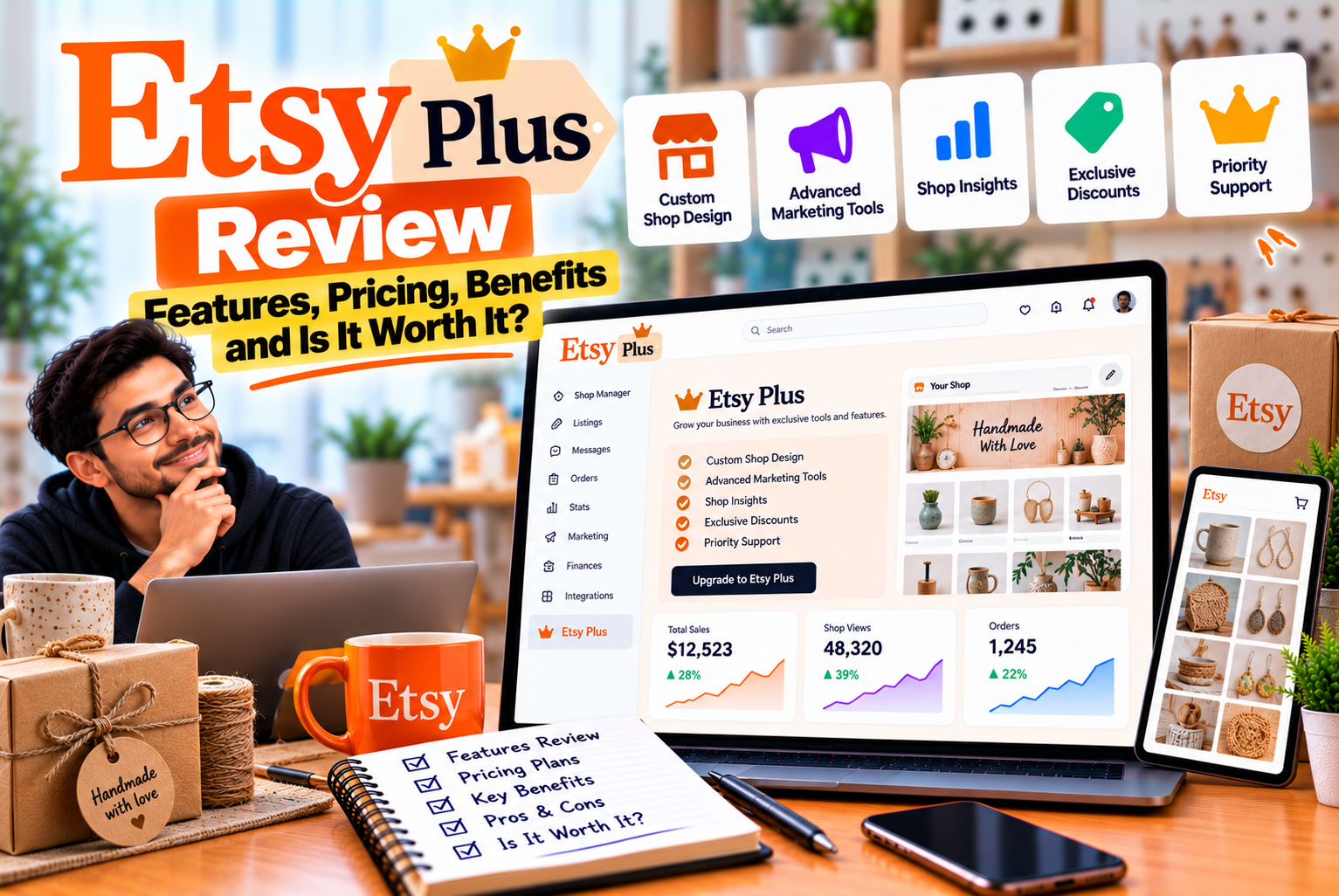
Etsy Plus Review
Running a successful Etsy shop involves much more than uploading product listings. Sellers need to research keywords, create attractive product photographs, manage inventory, maintain competitive pricing, respond to customers, and find ways to increase sales. As a shop grows, managing these responsibilities efficiently becomes increasingly important.
This is where Etsy Plus enters the picture.
Etsy Plus is an optional paid subscription designed for sellers who want additional shop customization options, monthly listing credits, Etsy Ads credits, and tools such as restock requests. It offers features beyond Etsy’s standard seller experience, giving shop owners additional ways to manage their storefront and present their products to potential customers.
However, paying for another monthly subscription does not automatically make a business more profitable. The real question is whether Etsy Plus provides enough practical value to justify its cost.
For some sellers, the subscription may be worthwhile because they regularly publish listings, advertise products, and maintain a recognizable brand. Others may find that Etsy’s standard features are sufficient, particularly when they are just starting out.
In this Etsy Plus review, we will examine the subscription’s pricing, features, advantages, limitations, and potential return on investment. We will also compare Etsy Plus with the standard Etsy seller experience to help you decide whether upgrading makes financial sense for your business.
What Is Etsy Plus?
Etsy Plus is an optional monthly subscription package for eligible Etsy sellers. It provides additional tools and benefits intended to support shop presentation, listing management, and promotional activities.
Unlike a separate e-commerce platform, Etsy Plus does not give sellers an independent online store with complete control over its infrastructure. Instead, it enhances certain aspects of an existing Etsy shop.
The subscription combines several benefits, including:
- Monthly credits for creating or renewing product listings.
- Monthly credits for Etsy Ads.
- Advanced shop customization options.
- Restock requests for sold-out products.
- Additional branding and storefront presentation opportunities.
The exact value of these benefits depends on how a seller operates their business. A shop owner who frequently lists new products and advertises on Etsy may find the included credits useful. Someone with only a few listings and little advertising activity may not benefit as much.
Etsy Plus should therefore be viewed as an optional collection of seller tools rather than a requirement for running an Etsy business.
You can explore the subscription and its terms through Etsy’s official Fees and Payments Policy.
How Much Does Etsy Plus Cost?
According to Etsy’s published Fees and Payments Policy, Etsy Plus costs $10 USD per month. Applicable local taxes may increase the amount charged, and the subscription fee is recorded in the seller’s Etsy payment account.
The subscription renews monthly until canceled.
Etsy also provides recurring credits to subscribers, which can offset some of the subscription cost when used.
Etsy Plus Pricing at a Glance
| Pricing Detail | Current Published Terms |
| Monthly subscription fee | $10 USD |
| Annualized cost at the monthly rate | $120 USD |
| Monthly listing credits | 15 credits |
| Listed value of monthly listing credits | $3 USD |
| Monthly Etsy Ads credits | $5 USD |
| Total face value of included monthly credits | Up to $8 USD |
| Commitment | Monthly subscription |
| Cancellation | Available through Shop Manager settings |
| Unused monthly credits | Expire rather than roll over |
Pricing and benefits are based on Etsy’s published policy reviewed for this article. Check Etsy’s current subscription terms before purchasing, as features, regional availability, and charges can change.
Is Etsy Plus Free?
No. Etsy Plus is a paid subscription.
Etsy sellers can use the standard seller experience without paying the additional $10 monthly Etsy Plus subscription fee. However, standard selling fees still apply when using Etsy to sell products.
Etsy Plus should not be confused with an introductory promotion or free trial. Promotional offers may have eligibility requirements and expiration dates, so sellers should check whether an offer is currently available in their accounts.
Is Etsy Plus Worth $10 Per Month?
The answer depends on how much of the subscription’s value you actually use.
Consider the included credits:
- Fifteen listing credits can offset up to $3 in listing fees at the standard $0.20 listing fee per credit.
- The Etsy Ads credit provides another $5 toward eligible Etsy Ads spending.
If you use both benefits completely, you receive up to $8 in direct monthly credit value.
That leaves $2 of the $10 subscription cost to be justified by other benefits, such as advanced shop customization and restock requests.
However, this calculation assumes that you would have paid for those listings and advertisements anyway. If you would not otherwise spend money on Etsy Ads or create enough listings to use the credits, their full face value does not represent actual savings.
For that reason, it is important to evaluate your shop’s real activity before upgrading.
Etsy Plus Features Explained
Etsy Plus includes several features that can be useful for sellers who want to improve their storefront presentation or manage products more effectively.
Let’s examine the main benefits individually.
1. Monthly Listing Credits
One of the most straightforward Etsy Plus benefits is the inclusion of 15 listing credits per subscription cycle.
Etsy generally charges a $0.20 USD listing fee when a seller publishes a listing. Eligible listing credits can offset the cost of creating or renewing listings.
This can be useful for sellers who regularly introduce new products, refresh their catalog, or maintain a large inventory.
For example, consider a seller who publishes 15 new listings during a month.
Without Etsy Plus, the standard listing fees for those 15 listings would total:
15 × $0.20 = $3.
With Etsy Plus, the included listing credits can cover that amount, subject to the subscription’s applicable terms.
However, the credits do not mean that sellers can list unlimited products for free. Additional listings, renewals, and other applicable fees may still incur charges.
Who benefits most?
Listing credits are particularly useful for:
- Handmade product sellers introducing new designs.
- Jewelry businesses expanding their collections.
- Digital product sellers creating new downloadable products.
- Print-on-demand businesses managing multiple designs.
- Seasonal sellers preparing listings for holidays and special occasions.
Sellers with only a handful of listings and little planned catalog growth may not use all 15 credits.
It is also important to remember that the credits expire at the end of the applicable subscription cycle rather than accumulating indefinitely.
2. Monthly Etsy Ads Credits
Etsy Plus also includes $5 USD in Etsy Ads credits per subscription cycle.
Etsy Ads is Etsy’s on-platform advertising system. It allows sellers to promote eligible listings within Etsy and potentially reach shoppers who are searching for relevant products.
Advertising can help sellers test which products attract attention, but it does not guarantee purchases.
The included $5 credit can reduce the amount a seller pays out of pocket for eligible Etsy Ads activity.
For example, a seller who already budgets $30 per month for Etsy Ads may be able to use the $5 credit toward that spending, subject to Etsy’s credit rules.
This means the credit can help reduce an existing advertising expense rather than requiring the seller to increase their advertising budget simply to use it.
Is the Etsy Ads Credit Enough to Generate Sales?
Not necessarily.
A $5 credit is a relatively small advertising allowance. Its effectiveness depends on several factors, including:
- Product prices.
- Competition for relevant search terms.
- Advertising costs.
- Listing quality.
- Product photographs.
- Conversion rate.
- Customer demand.
- Profit margins.
A low-priced product with a narrow profit margin may struggle to generate sufficient profit from advertising. A higher-priced product with strong demand and healthy margins may have more room to absorb advertising costs.
Sellers should also distinguish between advertising activity and business results.
Impressions and clicks can show that people are seeing or visiting a listing, but they do not establish profitability. Orders, revenue, advertising costs, and contribution margin provide a more meaningful picture.
Best use case: Etsy Plus’s advertising credit is most useful for sellers who already plan to run Etsy Ads and can evaluate whether their campaigns are producing profitable results.
3. Advanced Shop Customization
Another important Etsy Plus feature is access to additional Shop Home customization options.
A shop’s visual presentation can influence how shoppers perceive a business. Clear branding, attractive banners, and well-organized featured products can help a storefront feel more professional and consistent.
Etsy Plus provides additional customization options beyond the standard shop presentation tools.
These can include:
- Additional banner layouts.
- Carousel banners featuring multiple images.
- Collage-style banners.
- Expanded featured-listing presentation options.
- Shop color-theme customization.
The precise options available should be checked in Etsy’s current help documentation.
Carousel Banners
Carousel banners allow sellers to present multiple images in a banner area that shoppers can navigate.
This can be useful when a shop sells several related product categories.
For example, a handmade home décor store could use separate images to highlight wall art, decorative cushions, and personalized gifts.
A jewelry seller might use a carousel to showcase different collections or seasonal designs.
The purpose is to communicate the shop’s product range more effectively without relying on a single banner image.
However, sellers should avoid filling the banner with too much information. The images should be visually consistent, clear, and relevant to the products being sold.
Collage Banners
Collage banners combine multiple images into one banner layout.
This format can work well for sellers who want to showcase different products, materials, colors, or collections in a single visual area.
For example, a handmade pottery business could combine photographs of mugs, bowls, and decorative ceramics.
The most effective collages maintain consistent lighting, image quality, and visual balance. Poorly selected images can make the storefront look cluttered rather than professional.
Featured Listings
Featured listings allow sellers to give selected products or shop sections greater prominence within the shop’s presentation.
This can be helpful when a seller wants to highlight:
- Bestselling products.
- New collections.
- Seasonal products.
- Personalized gifts.
- Higher-value products.
- Items associated with a promotional campaign.
For example, a gift shop preparing for the holiday season could feature products that are particularly relevant to holiday shopping.
The feature is most useful when sellers deliberately select products that match current customer interests.
Shop Color Themes
Etsy Plus also provides additional shop color customization options.
A consistent visual identity can help a business appear more recognizable. Using complementary colors across a shop icon, banner, and product photography can create a more cohesive storefront.
However, sellers should not assume that a particular color theme directly improves Etsy search rankings.
Color customization is primarily a branding and presentation feature. Its potential commercial value comes from helping customers understand and recognize the shop, not from a guaranteed search advantage.
You can review the available options in Etsy’s official Advanced Shop Customization guide.
4. Restock Requests
Restock requests allow shoppers to express interest in an item that is currently sold out.
When an eligible sold-out item becomes available again, interested shoppers can receive an email notification.
This can be useful for businesses that sell physical products with limited inventory.
Consider a handmade candle shop that sells out of a popular fragrance. A shopper who wants that product may be willing to purchase it later but might forget to return to the shop.
A restock request gives the shopper a way to indicate interest and receive a notification when the product becomes available again.
The feature can help sellers understand demand for sold-out products and potentially bring interested shoppers back to a listing.
Who Benefits From Restock Requests?
This feature is particularly relevant to:
- Handmade jewelry businesses.
- Clothing and accessory sellers.
- Home décor shops.
- Handmade candle businesses.
- Small-batch beauty and gift businesses.
- Sellers working with limited materials or production capacity.
It may be less useful for products that never become unavailable.
For example, a seller offering a digital download with effectively unlimited inventory may have little reason to prioritize restock requests.
Restock notifications also do not guarantee that a shopper will return or complete a purchase. They simply provide a convenient way to notify interested customers when an item becomes available.
5. Custom Domain Benefits
A custom domain can make a business easier to identify and remember.
For example, a seller might prefer a branded address rather than relying entirely on a marketplace shop URL.
Historically, Etsy Plus has offered domain-related benefits through a third-party provider. Because domain partnerships, discounts, and eligible extensions can change, sellers should verify the current terms within Etsy before assigning a monetary value to this benefit.
A custom domain can support branding, but it does not automatically create an independent online store or remove the seller’s dependence on Etsy.
If your long-term objective is to build an independent e-commerce website, you should compare the domain benefits of Etsy Plus with the broader control and costs of running a standalone store.
For a comparison of marketplace and independent-store models, see our related guide: Etsy vs Shopify: Which Platform Is Better for Selling Handmade Products?
6. A More Professional Storefront Experience
The individual Etsy Plus features may appear modest, but they can work together to improve how a shop presents itself.
A seller can use custom banners to introduce their brand, featured listings to highlight important products, and restock requests to maintain interest in sold-out items.
These features may be especially helpful when a shop has developed a consistent product range and already attracts relevant visitors.
Nevertheless, customization is only one part of running a successful Etsy business.
A visually appealing shop will still struggle if it has weak product photography, unclear descriptions, uncompetitive pricing, poor customer service, or products that do not match customer demand.
Etsy Plus can support a well-managed business, but it cannot replace the fundamentals of product selection, marketing, and customer experience.
Etsy Plus vs Etsy Standard: What’s the Difference?
The main difference between Etsy Plus and Etsy Standard is that Plus adds a paid package of benefits to the regular Etsy seller experience.
Etsy Standard remains suitable for sellers who want to operate without an additional monthly subscription.
Etsy Plus vs Etsy Standard Comparison
| Feature | Etsy Standard | Etsy Plus |
| Monthly subscription | No Etsy Plus subscription fee | $10 USD per month |
| Standard selling fees | Apply | Continue to apply |
| Listing credits | No Etsy Plus credit allowance | 15 credits per cycle |
| Etsy Ads credits | No Etsy Plus credit allowance | $5 per cycle |
| Advanced banner options | Standard customization options | Additional customization options |
| Featured shop presentation | Standard options | Additional layout options |
| Shop color customization | Standard options | Additional theme customization |
| Restock requests | Not included as an Etsy Plus feature | Available for eligible sold-out listings |
| Guaranteed search-ranking boost | No | No guaranteed boost |
| Guaranteed sales | No | No |
| Independent e-commerce website | No | No |
The standard Etsy selling fees continue to apply when using Etsy Plus. The subscription does not replace listing fees beyond the credits provided, transaction fees, payment-processing fees, or other applicable charges.
Which Plan Is Better for Beginners?
For most beginners, the standard Etsy seller experience is a sensible starting point.
New sellers usually have more important priorities than upgrading their subscription. They need to validate product demand, understand their costs, develop high-quality listings, and learn how shoppers discover and purchase products.
Starting with Etsy Standard allows a new seller to focus on those fundamentals without adding a recurring subscription expense.
Once the shop begins generating consistent activity, the seller can review their listing volume, advertising budget, and demand for additional customization features.
At that point, upgrading may make sense.
Which Plan Is Better for Established Sellers?
Etsy Plus may be more attractive to established sellers who:
- Publish or renew listings regularly.
- Already use Etsy Ads.
- Have a recognizable brand.
- Sell products that frequently go out of stock.
- Want more control over storefront presentation.
- Can identify a practical benefit from the additional tools.
Even for established shops, the subscription should be evaluated periodically. A seller whose listing activity or advertising needs change may no longer receive enough value to justify the monthly cost.
Advantages of Etsy Plus
Etsy Plus has several potential advantages for sellers who use its features regularly.
1. Monthly Credits Reduce Some Expenses
The included listing and advertising credits provide a straightforward benefit when sellers would otherwise pay for eligible listings and advertising.
Using both allowances fully can provide up to $8 in monthly face value.
Although this does not cover the entire subscription cost, it reduces the amount that needs to be justified by the other features.
2. Better Storefront Customization
The additional banner, featured-listing, and color-theme options can help sellers create a more cohesive shop presentation.
This is particularly relevant to brands with several related collections or a consistent visual identity.
3. Useful for Shops With Frequently Sold-Out Products
Restock requests provide a way for interested shoppers to request notifications when an item becomes available again.
For businesses that regularly sell out of popular products, this may help bring interested shoppers back to the shop.
4. Supports Brand Development
As a shop grows, sellers may want to present their products in a way that reflects a more developed brand.
Advanced shop customization can support that objective without requiring the seller to leave Etsy.
5. Flexible Monthly Subscription
Etsy’s published terms allow sellers to cancel through Shop Manager settings. Sellers can therefore review the subscription periodically rather than treating it as a permanent commitment.
Before canceling, however, sellers should check when their access ends and which subscription-only features will be removed.
Disadvantages of Etsy Plus
Despite its benefits, Etsy Plus is not the right choice for every seller.
1. It Adds a Recurring Expense
The subscription costs $120 USD per year at the published $10 monthly rate, before applicable taxes.
For a new or low-volume shop, this can be a meaningful expense.
If the seller does not use the included credits or customization features, much of the subscription’s potential value is wasted.
2. The Included Credits Do Not Cover the Full Subscription
The listing credits are worth up to $3, and the Etsy Ads credits provide another $5.
Together, they offer up to $8 in face value against a $10 monthly subscription.
Sellers must therefore obtain additional value from the other features to justify the remaining cost.
3. Credits Expire
Unused credits do not accumulate indefinitely.
If a seller does not create or renew enough listings or does not use Etsy Ads, some of the included benefits may go unused.
This is especially important for businesses with irregular sales or seasonal activity.
4. It Does Not Guarantee Better Rankings
Etsy Plus should not be purchased solely to improve search visibility.
The subscription does not promise better rankings, additional organic traffic, or more sales.
Sellers should continue to focus on relevant keywords, listing quality, product photography, customer experience, and other factors associated with Etsy search and conversion performance.
5. It Does Not Eliminate Standard Etsy Fees
The subscription is an additional expense, not a replacement for the usual cost of selling on Etsy.
Listing fees beyond the included credits, transaction fees, payment-processing fees, and other applicable charges can continue to affect profitability.
6. Some Features May Have Little Value for Certain Shops
A digital product seller with unlimited inventory may have little use for restock requests.
A seller who already has a simple, effective storefront may not need additional banner layouts.
A shop that does not advertise may struggle to use the Etsy Ads credit effectively.
The value of Etsy Plus depends on the business model, not simply the number of features advertised.
Is Etsy Plus Worth It? A Practical Cost-Benefit Analysis
To determine whether Etsy Plus is worth purchasing, calculate the value of the benefits you will actually use.
Do not assume that every included feature has equal value for every business.
Step 1: Calculate Your Listing Credit Savings
Suppose you publish or renew 15 eligible listings during a subscription cycle.
At $0.20 per listing, the maximum direct value of the 15 credits is $3.
If you only use 5 credits, the value you actually use is $1.
The difference matters because unused credits expire.
Step 2: Calculate Your Etsy Ads Credit Usage
If you already spend money on Etsy Ads and use the full $5 credit, you can count that amount toward the subscription’s value.
If you do not use Etsy Ads, do not count the credit as money saved.
Starting an advertising campaign purely to use the credit can be counterproductive if the campaign does not generate enough profitable orders.
Step 3: Estimate the Value of Other Features
The remaining benefits are more difficult to quantify.
For example, advanced customization might help you present a product collection more clearly. Restock requests might bring interested customers back when inventory returns.
However, you should not assign a large financial value to these features without a reasonable basis.
Consider whether they save you time, help you manage inventory, or contribute to measurable business results.
Step 4: Compare the Total With the Subscription Cost
Use this formula:
Net Etsy Plus value = Actual listing credit savings + Actual advertising credit used + Estimated value of additional features − Subscription fee
For example:
| Item | Example Monthly Value |
| Listing credits used | $3 |
| Etsy Ads credits used | $5 |
| Additional feature value | $4 |
| Total estimated value | $12 |
| Subscription cost | $10 |
| Estimated net value | $2 |
In this hypothetical example, Etsy Plus produces an estimated net value of $2 for the month.
The $4 value assigned to additional features is illustrative, not a guaranteed saving. Your own estimate should reflect actual benefits rather than an arbitrary amount.
If you only use the $3 listing credits and $5 advertising credits, your direct credit value is $8, leaving the subscription $2 short of break-even before considering the other features.
Step 5: Review Your Results Regularly
A subscription that makes sense during a busy season may not be worthwhile during a quieter period.
Review the previous few months of shop activity and ask:
- Did I use all the listing credits?
- Did I use the Etsy Ads credit?
- Did I benefit from the customization options?
- Did restock requests support my inventory strategy?
- Did the subscription contribute to measurable savings or business value?
If the answers are consistently negative, Etsy Standard may be the better option.
Who Should Subscribe to Etsy Plus?
Etsy Plus is most suitable for sellers who already understand their shop’s operations and can identify specific benefits from the subscription.
1. Sellers With Large Product Catalogs
Businesses that frequently add or renew products may use the monthly listing credits more consistently.
However, sellers should still account for listing fees beyond the included allowance.
2. Sellers Who Already Advertise
If you already use Etsy Ads, the monthly advertising credit can reduce some of your advertising costs.
The important distinction is that the credit supports existing marketing activity; it does not guarantee that the advertising itself will be profitable.
3. Established Brands
Sellers with a recognizable visual identity may benefit from additional banner layouts, featured listings, and color customization.
These options are particularly relevant when storefront presentation is an important part of the customer experience.
4. Businesses With Limited Inventory
Sellers whose products regularly sell out may find restock requests useful.
This is especially relevant to handmade businesses with limited production capacity or products made in small batches.
5. Sellers Who Want to Improve Shop Presentation
If your shop already attracts visitors and you want additional ways to present collections or highlight selected products, Etsy Plus may provide useful tools.
Nevertheless, review the performance of individual listings before assuming that storefront customization will increase conversions.
Who Should Avoid Etsy Plus?
Not every Etsy seller needs a paid subscription.
1. Complete Beginners
New sellers should generally prioritize product research, listing quality, pricing, and understanding the marketplace before adding recurring expenses.
2. Sellers With Very Few Listings
If you rarely publish or renew listings, you may not use the included listing credits.
The subscription may therefore provide less direct financial value.
3. Sellers Who Do Not Use Etsy Ads
If you do not advertise on Etsy, the $5 advertising credit may have no practical value to your business.
You should not start spending on ads without a clear reason simply to justify the subscription.
4. Digital Product Sellers With Unlimited Inventory
Digital sellers can still benefit from listing credits and storefront customization, but restock requests may be less relevant to products that do not sell out.
The best choice depends on listing volume and the value of the other features.
5. Sellers Focused on Independent Branding
If your main goal is to build a fully independent online store, Etsy Plus may not provide the control you need.
You may want to compare Etsy with platforms that offer broader control over website design, customer journeys, integrations, and store operations.
Does Etsy Plus Improve SEO or Search Rankings?
One of the most important questions in this Etsy Plus review is whether the subscription improves search rankings.
Etsy Plus does not guarantee higher search rankings or increased organic traffic.
The subscription provides additional seller tools, but it should not be treated as an SEO shortcut.
Sellers should continue to optimize their listings around relevant search terms and shopper intent.
Focus on Relevant Titles
Use titles that clearly describe the product and naturally incorporate the phrases shoppers are likely to use.
Avoid filling titles with repetitive keywords simply to include as many search terms as possible.
A title should help shoppers understand what the product is before they click.
Use All Relevant Tags Strategically
Etsy provides 13 tag slots per listing. Sellers should use relevant, descriptive phrases that reflect different ways customers might search for the product.
For example, a personalized wooden sign might target phrases related to its material, use, recipient, and customization.
Tags should describe the actual product rather than unrelated popular searches.
Complete Relevant Attributes
Accurate product attributes help describe characteristics such as material, color, occasion, and other applicable details.
Select the options that accurately represent the product.
Improve Product Photography
Product images help shoppers understand the item, its size, quality, and appearance.
Use clear photographs that show important details and represent the product accurately.
For handmade goods, additional images can demonstrate materials, texture, customization options, and how the product might be used.
Write Helpful Descriptions
Product descriptions should answer practical questions about dimensions, materials, customization, delivery, and intended use.
Avoid repeating the same keyword unnaturally throughout the description.
The goal is to help shoppers make an informed decision.
Monitor Actual Shop Performance
Use Etsy’s available shop statistics to understand which listings attract visits and which generate orders.
If a listing receives visits but few purchases, investigate factors such as product photography, pricing, shipping costs, and the clarity of the offer.
These improvements can be more valuable than paying for a subscription solely in the hope of receiving better search rankings.
For current guidance, consult the official Etsy Seller Handbook.
Etsy Plus vs Etsy Ads: Are They the Same?
No. Etsy Plus and Etsy Ads are different services.
Etsy Plus is a monthly subscription package that includes several seller benefits.
Etsy Ads is an advertising system that allows sellers to promote listings on Etsy.
Etsy Plus includes an Etsy Ads credit, but the subscription is not itself an advertising campaign.
| Comparison | Etsy Plus | Etsy Ads |
| Main purpose | Additional seller tools and benefits | Promote eligible listings |
| Monthly subscription | $10 USD under published terms | No Etsy Plus subscription required |
| Listing credits | Included with Plus | Not included by itself |
| Advertising credit | $5 included with Plus | Advertising spend is managed separately |
| Shop customization | Additional options included | Not the purpose of the service |
| Restock requests | Included as a Plus feature | Not the purpose of the service |
| Guaranteed sales | No | No |
A seller can use Etsy Ads without subscribing to Etsy Plus, subject to Etsy’s advertising eligibility and policies.
If you already run advertising campaigns, Etsy Plus may offer additional value through its credit. However, you should assess the advertising results independently from the subscription.
Etsy Plus vs Shopify: Which Is Better for Growing a Business?
Etsy Plus and Shopify solve different problems.
Etsy Plus adds features to an Etsy shop. Shopify is an e-commerce platform for building and operating an online store.
A seller choosing between the two should consider their long-term business goals.
Choose Etsy Plus If:
- You already sell on Etsy.
- You want additional storefront customization.
- You regularly create or renew listings.
- You already use Etsy Ads.
- You sell products that may go out of stock.
- You prefer to continue operating within Etsy’s marketplace.
Consider Shopify If:
- You want to build an independent online store.
- You need greater control over your website’s design and customer journey.
- You want to develop a separate brand presence.
- You are prepared to attract traffic through SEO, advertising, social media, email marketing, or other channels.
- You need store functionality beyond what Etsy provides.
Shopify introduces its own subscription, payment-processing, and potentially other operating costs. It also does not guarantee sales or provide automatic access to Etsy’s marketplace audience.
For a detailed comparison of the two platforms, read our related article: Etsy vs Shopify: Which Platform Is Better for Selling Handmade Products?
How to Subscribe to Etsy Plus
If you decide that Etsy Plus is appropriate for your business, you can review the available subscription options through Etsy’s seller interface.
The general process is as follows:
- Sign in to your Etsy seller account.
- Open Shop Manager.
- Navigate to the settings associated with your shop subscription.
- Find the Etsy Plus subscription option.
- Review the current price and included benefits.
- Check any applicable taxes and regional conditions.
- Confirm the subscription if the terms meet your requirements.
The exact interface and available options may change.
Before subscribing, check the current fee, billing date, credit conditions, and feature availability.
You can start with Etsy’s official Fees and Payments Policy and Etsy Plus help section.
How to Cancel Etsy Plus
Etsy’s published terms allow sellers to cancel Etsy Plus through the subscription settings in Shop Manager.
Before canceling, review the date on which your access will end and which features depend on an active subscription.
Etsy states that subscription-only customization may be removed when the subscription ends. For example, advanced banner and shop color options can revert to standard presentation options.
To cancel:
- Sign in to your Etsy seller account.
- Open Shop Manager.
- Navigate to Settings and locate the subscription section.
- Open your Etsy Plus subscription details.
- Follow the cancellation instructions displayed by Etsy.
- Confirm the cancellation and check the final access date.
Do not assume that canceling immediately removes all benefits or immediately refunds the current month’s charge. Check the terms displayed in your account.
If you later decide to subscribe again, review the current features and pricing rather than assuming that every previous customization will be retained.
Tips for Getting the Most Value From Etsy Plus
If you subscribe, use the features deliberately.
1. Plan Your Listings Ahead of Time
Prepare product photographs, titles, descriptions, and tags before publishing new products.
This helps you use listing credits for products that are ready to sell rather than rushing to publish incomplete listings.
2. Use Advertising Credits on Relevant Products
Choose products with clear photographs, competitive pricing, strong descriptions, and healthy margins.
Do not advertise an item simply because the credit is available.
3. Create a Consistent Visual Identity
Use banner layouts and shop colors that complement your product photography.
Consistency can help customers recognize your business and understand what your shop offers.
4. Feature Products Strategically
Highlight products that are relevant to current demand, seasonal shopping, or your main collections.
Review your selection periodically instead of featuring the same products indefinitely.
5. Monitor Sold-Out Products
If restock requests are relevant to your inventory, pay attention to which items attract interest.
Use that information alongside your production capacity, materials, sales history, and profit margins when planning inventory.
6. Track Your Subscription’s Value
Maintain a simple monthly record of:
- Listing credits used.
- Advertising credits used.
- Subscription cost.
- Advertising results.
- Restock-request activity.
- Any measurable benefit from customization.
This allows you to assess the subscription using evidence rather than assumptions.
7. Reassess Your Plan
A growing shop may benefit from Etsy Plus today but not need it during a quieter period.
Review your actual usage regularly and cancel if the subscription no longer supports your business goals.
Final Verdict: Is Etsy Plus Worth It?
Etsy Plus can be worth it for active sellers who use the included credits and benefit from its additional shop-management and customization features. However, it is not essential for every Etsy business.
At the published price of $10 per month, the subscription provides up to $8 in direct monthly listing and advertising credit value when both allowances are fully used.
The remaining value must come from other benefits, such as advanced shop customization and restock requests.
For established shops with regular listing activity, existing advertising budgets, and a need for additional storefront tools, Etsy Plus may be a reasonable investment.
For new sellers, low-volume businesses, or shops that do not use Etsy Ads, the standard Etsy seller experience may be the better choice.
Most importantly, Etsy Plus does not guarantee higher search rankings, increased traffic, or additional sales. Strong product selection, keyword relevance, compelling photography, competitive pricing, and reliable customer service remain essential.
Before subscribing, review your recent shop activity and calculate how much of the package you will genuinely use.
Our recommendation: Start with Etsy Standard if you are new to selling. Consider Etsy Plus once your shop has established consistent activity and you can demonstrate that its benefits justify the recurring cost.
Frequently Asked Questions About Etsy Plus
1. What is Etsy Plus?
Etsy Plus is an optional paid subscription for eligible Etsy sellers. It offers additional listing and advertising credits, advanced shop customization, and restock requests.
2. How much does Etsy Plus cost per month?
Etsy’s published Fees and Payments Policy lists the subscription at $10 USD per month. Applicable taxes and regional billing conditions may affect the final charge.
3. Is Etsy Plus worth it for beginners?
It may not be necessary for beginners. New sellers often benefit more from improving their products, listing quality, pricing, and understanding of Etsy search before adding a recurring subscription expense.
4. Does Etsy Plus increase sales?
Etsy Plus does not guarantee sales. Its features may support shop presentation and advertising activity, but actual results depend on demand, product quality, pricing, marketing, and customer experience.
5. Does Etsy Plus improve Etsy SEO?
Etsy Plus is not a guaranteed search-ranking boost. Sellers should continue optimizing relevant titles, tags, attributes, photographs, descriptions, and the overall shopping experience.
6. How many listing credits does Etsy Plus include?
Etsy’s published terms provide 15 listing credits per subscription cycle, with a stated value of $3 USD.
7. How much Etsy Ads credit comes with Etsy Plus?
The published subscription terms include $5 USD in Etsy Ads credits per subscription cycle.
8. Do Etsy Plus credits roll over?
No. Under Etsy’s published terms, unused listing and advertising credits expire at the end of the applicable subscription cycle.
9. Can I sell on Etsy without Etsy Plus?
Yes. Etsy Plus is optional. Sellers can use the standard Etsy seller experience without paying the additional Plus subscription fee, although standard selling fees still apply.
10. Does Etsy Plus remove listing fees?
No. Etsy Plus provides a limited number of listing credits. Listing fees beyond the included credits can still apply.
11. Does Etsy Plus eliminate transaction fees?
No. The subscription does not eliminate Etsy’s standard transaction fees or other applicable selling costs.
12. What is advanced shop customization?
Advanced shop customization gives eligible Etsy Plus subscribers additional options for presenting their storefront, including certain banner layouts, featured-listing layouts, and color themes.
13. What are Etsy Plus restock requests?
Restock requests allow shoppers to request an email notification when an eligible sold-out product becomes available again.
14. Is Etsy Plus useful for digital product sellers?
It can be useful if a digital seller regularly creates listings, uses Etsy Ads, or values advanced shop customization. Restock requests may be less relevant for digital products that do not run out of inventory.
15. Can I use Etsy Ads without Etsy Plus?
Yes. Etsy Ads is separate from the Etsy Plus subscription. Eligible sellers can use Etsy Ads without subscribing to Etsy Plus.
16. Can I cancel Etsy Plus at any time?
Etsy’s published terms allow sellers to cancel through their Shop Manager subscription settings. Check the displayed billing and access dates before canceling.
17. What happens when I cancel Etsy Plus?
Your shop returns to the standard seller experience after the subscription ends. Subscription-only features may be removed, and advanced customization may revert to standard options.
18. Does Etsy Plus include a custom domain?
Etsy Plus has offered domain-related benefits through a third-party provider. Available offers and terms can change, so check Etsy’s current subscription information before purchasing a domain.
19. Is Etsy Plus better than Shopify?
They serve different purposes. Etsy Plus enhances an existing Etsy shop, while Shopify provides a platform for operating an independent online store. The right option depends on your branding, traffic, control, and budget requirements.
20. Does Etsy Plus provide unlimited free listings?
No. Etsy Plus provides a limited monthly listing-credit allowance. Sellers may still incur listing fees for additional listings and renewals.
21. Can Etsy Plus help improve my shop’s branding?
Yes. Additional banner layouts, featured-listing presentation, and color customization can help sellers create a more consistent storefront. These features do not guarantee higher conversions.
22. Is Etsy Plus a good investment for high-volume sellers?
It may be useful for high-volume sellers who regularly use the listing and advertising credits and benefit from the additional features. They should still calculate the subscription’s actual value against its cost.
23. Can Etsy Plus help me bring back customers?
Restock requests can notify interested shoppers when eligible sold-out products become available again. This may help bring shoppers back, but it does not guarantee a purchase.
24. Should I subscribe to Etsy Plus just for the $5 Ads credit?
Not necessarily. The $5 credit alone does not cover the $10 subscription cost. Consider the listing credits and other features, and do not start unprofitable advertising solely to use the credit.
25. How can I decide whether Etsy Plus is right for my shop?
Review your listing activity, advertising spending, inventory needs, and interest in advanced customization. Calculate the benefits you will actually use and compare their value with the $10 monthly subscription fee.
Official References
Consult these official resources when checking the article’s current facts and preparing it for publication.
- Etsy Fees and Payments Policy — Subscription pricing, listing fees, and monthly credit terms.
- Etsy Plus Help Section — Official help resources covering Etsy Plus features.
- Etsy Plus: Advanced Shop Customization — Banner and storefront customization information.
- Etsy Seller Handbook — Guidance on shop management, search, and selling practices.
- Etsy Help Center — Additional seller support and account guidance.
Leave a Reply