


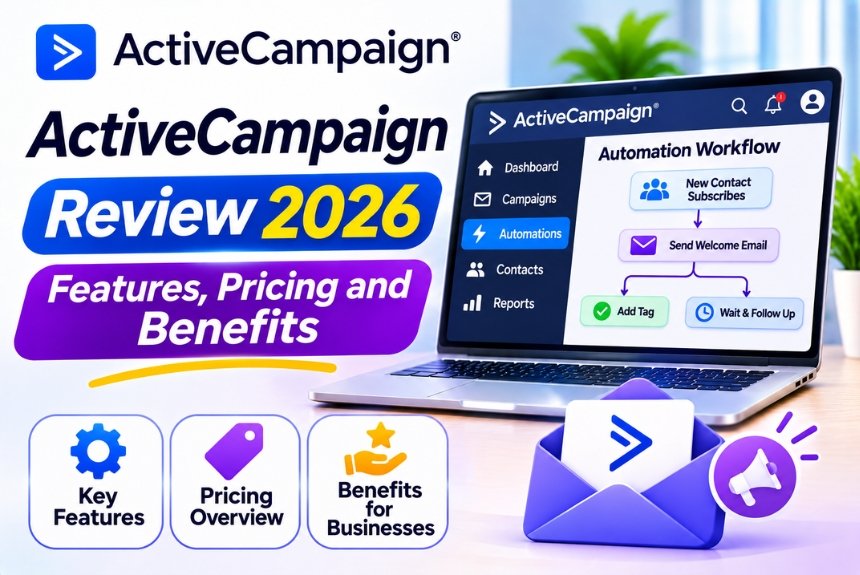
ActiveCampaign Review 2026 – Features, Pricing and Benefits
Choosing the right email marketing software can significantly impact how businesses attract leads, nurture subscribers, and convert prospects into customers. While many platforms focus on newsletters and promotional campaigns, modern businesses increasingly need advanced automation, personalized communication, and customer relationship management.
ActiveCampaign is one such platform that combines email marketing, marketing automation, customer segmentation, and CRM capabilities to help businesses manage their marketing activities more efficiently.
But is ActiveCampaign worth the investment in 2026? Does it offer enough features for small businesses, marketers, and growing companies? And how does it compare with other email marketing platforms?
In this comprehensive ActiveCampaign review, we will explore its features, pricing, advantages, disadvantages, integrations, automation capabilities, and real-world use cases to help you decide whether it is the right solution for your business.
What Is ActiveCampaign?
ActiveCampaign is a customer experience automation platform designed to help businesses create personalized marketing campaigns, automate customer communication, manage contacts, and improve sales processes.
The platform combines several important marketing capabilities into one ecosystem, including:
- Email marketing and newsletter campaigns
- Marketing automation workflows
- Contact management and segmentation
- Customer relationship management
- Landing pages and forms
- Sales pipeline management through CRM options
- Behavioral tracking and reporting
- AI-assisted marketing capabilities
- Multichannel communication through supported integrations and add-ons
ActiveCampaign is particularly popular among businesses that require more advanced automation than traditional newsletter platforms provide.
Official website: https://www.activecampaign.com/
ActiveCampaign Review: Quick Overview
Before exploring the platform in detail, here is a quick overview of ActiveCampaign.
| Category | Details |
| Software Type | Email Marketing and Marketing Automation |
| Best For | Businesses requiring advanced automation and personalization |
| Email Campaigns | Yes |
| Marketing Automation | Yes |
| Contact Segmentation | Yes |
| CRM Functionality | Available through eligible plans and add-ons |
| Landing Pages | Available on eligible plans |
| AI Capabilities | Yes, availability varies by plan |
| Integrations | Extensive third-party integrations |
| Free Plan | No permanent free plan |
| Free Trial | 14-day trial |
| Starting Price | Approximately $15/month for 1,000 contacts on annual billing |
| Learning Curve | Moderate to advanced |
| Overall Verdict | Strong option for automation-focused businesses |
Features, subscription options, and pricing can change. Always verify the latest information on the official website before purchasing.
ActiveCampaign Features Review
ActiveCampaign offers a broad collection of marketing and automation features. Let’s examine the most important capabilities.
1. Email Marketing Campaigns
Email marketing is one of ActiveCampaign’s core functionalities.
The platform allows businesses to create, customize, and send email campaigns using a visual email designer.
Key Features
- Drag-and-drop email editor
- Pre-designed email templates
- Newsletter creation
- Promotional email campaigns
- Personalized email content
- Subject line testing
- Email scheduling
- Campaign reporting
- Responsive email layouts
How It Works
You can create a campaign by selecting your audience, choosing a template, customizing the content, and configuring the sending settings.
The email designer allows you to add text, images, buttons, and other content elements without requiring advanced coding knowledge.
Businesses can also use custom HTML when they need more control over email design.
Our verdict: ActiveCampaign provides a flexible email creation experience suitable for businesses that want more than basic newsletter functionality.
2. Marketing Automation
Marketing automation is where ActiveCampaign distinguishes itself from many traditional email marketing platforms.
Its visual automation builder allows businesses to create workflows that respond to subscriber actions and customer behavior.
Key Automation Features
| Feature | Purpose |
| Automation Triggers | Start workflows based on contact activity |
| Automated Emails | Send emails without manual intervention |
| If/Else Conditions | Create different paths based on contact behavior |
| Wait Actions | Control the timing of communication |
| Tag Management | Organize contacts automatically |
| Contact Updates | Update subscriber information |
| Lead Nurturing | Deliver educational content over time |
| Sales Automation | Support sales processes through eligible CRM features |
Example
A business can create a welcome automation:
New subscriber → Welcome email → Wait 2 days → Educational email → Wait 3 days → Product introduction.
This workflow runs automatically for contacts who meet the trigger conditions.
Our verdict: ActiveCampaign is particularly strong for businesses that want to build complex and personalized customer journeys.
3. Contact Management and Segmentation
ActiveCampaign allows businesses to organize subscribers using lists, tags, custom fields, and dynamic segments.
Instead of sending identical emails to every subscriber, marketers can target contacts based on relevant characteristics and interactions.
Segmentation Options
- Contact information
- Location
- Custom field values
- Email engagement
- Tags
- Purchase history through supported integrations
- Website behavior
- Subscription status
- Customer lifecycle stage
Example
Suppose your business publishes content about SEO, email marketing, and web hosting.
You can create segments such as:
| Segment | Audience |
| SEO Subscribers | Contacts interested in SEO |
| Email Marketing Audience | Contacts interested in email campaigns |
| Hosting Subscribers | Contacts interested in web hosting |
| Active Subscribers | Contacts who recently engaged |
| Inactive Subscribers | Contacts who have not engaged recently |
This helps businesses create more relevant campaigns.
Our verdict: Contact segmentation is a major advantage for marketers who want to personalize campaigns and improve engagement.
4. ActiveCampaign CRM
ActiveCampaign also offers CRM functionality through eligible subscriptions and enhanced CRM add-ons.
These capabilities help businesses connect marketing activities with their sales processes.
CRM Features
- Contact and lead management
- Deal management
- Sales pipeline tracking
- Deal stages
- Task management
- Sales follow-ups
- Lead scoring
- Sales reporting
- CRM automation
Sales Pipeline Example
| Stage | Description |
| New Lead | Prospect enters the pipeline |
| Contacted | Sales team initiates communication |
| Qualified | Prospect meets the required criteria |
| Proposal Sent | Offer or proposal is shared |
| Negotiation | Commercial discussions continue |
| Won | Prospect becomes a customer |
| Lost | Opportunity does not convert |
Businesses can customize these stages according to their sales processes.
Our verdict: ActiveCampaign CRM can be useful for businesses that want marketing and sales activities connected. However, companies requiring a comprehensive enterprise CRM may need to evaluate specialized alternatives.
5. Landing Pages and Forms
ActiveCampaign provides landing page and form-building capabilities on eligible plans.
These tools allow businesses to collect subscriber information, generate leads, and promote products or services.
Landing Page Features
- Drag-and-drop page builder
- Customizable templates
- Lead generation forms
- CTA buttons
- Campaign-specific landing pages
- Integration with automation workflows
Common Use Cases
| Use Case | Purpose |
| Newsletter Signup | Grow your subscriber list |
| Ebook Download | Generate leads |
| Webinar Registration | Collect event registrations |
| Product Promotion | Promote a product or service |
| Consultation Booking | Generate sales opportunities |
| Free Trial Registration | Acquire potential customers |
Our verdict: Landing pages and forms provide additional convenience, particularly for businesses that want to connect lead generation directly with email automation.
6. AI-Powered Marketing Features
ActiveCampaign has expanded its AI capabilities to support campaign creation, personalization, and automation.
Depending on your plan and available features, AI tools can assist with:
- Generating email content
- Creating campaign ideas
- Improving subject lines
- Building automation workflows
- Developing marketing messages
- Personalizing communication
- Supporting campaign optimization
The platform’s AI capabilities are evolving, and availability may vary by subscription.
Our verdict: AI features can help marketers save time, but campaign quality still depends on human review, audience understanding, and strategic planning.
7. Multichannel Marketing
ActiveCampaign supports marketing beyond email through available channel features and integrations.
Supported Marketing Channels
| Channel | Use Case |
| Newsletters and promotional campaigns | |
| SMS | Text-based marketing communication |
| Messaging and customer engagement | |
| Website Messages | Website-based communication |
| Landing Pages | Lead generation and promotions |
| Digital Advertising | Audience-related advertising integrations |
Some channels, including SMS and WhatsApp functionality, may require additional subscriptions, add-ons, or integrations.
Our verdict: Multichannel marketing is valuable for businesses that want to coordinate customer communication across different touchpoints.
8. Analytics and Reporting
ActiveCampaign provides reporting tools to help marketers measure campaign effectiveness.
Important Metrics
| Metric | What It Measures |
| Open Rate | Estimated email opens |
| Click-Through Rate | Email link engagement |
| Bounce Rate | Undelivered emails |
| Unsubscribe Rate | Subscriber opt-outs |
| Conversion Rate | Desired customer actions |
| Campaign Performance | Overall campaign engagement |
| Revenue Attribution | Revenue associated with marketing activity |
| Automation Reporting | Workflow performance and outcomes |
Higher-tier subscriptions offer more advanced reporting and attribution capabilities.
Our verdict: ActiveCampaign provides useful reporting for campaign optimization, although businesses with complex analytical requirements should examine the reporting capabilities available in their specific plan.
ActiveCampaign Pricing 2026
ActiveCampaign uses contact-based pricing, meaning subscription costs generally increase as your contact database grows.
Its main email marketing plans include Starter, Plus, Professional, and Enterprise.
The following table provides a general overview of the plans.
| Plan | Best For | Key Features |
| Starter | Individuals and small businesses | Email campaigns, essential automation, templates, contact management |
| Plus | Growing businesses | Advanced automation options, segmentation, landing pages, AI features |
| Professional | Marketing teams | Advanced segmentation, reporting, predictive features, and enhanced automation |
| Enterprise | Larger organizations | Enterprise security, SSO, premium reporting, and dedicated support |
ActiveCampaign Starting Price
ActiveCampaign’s Starter plan begins at approximately $15 per month for 1,000 contacts with annual billing.
Actual pricing depends on your contact count, billing frequency, selected plan, and available offers.
Additional features such as enhanced CRM, SMS, custom reporting, and transactional email may involve separate charges.
What Should You Consider Before Purchasing?
- Number of contacts in your database
- Monthly email sending requirements
- Automation complexity
- Number of team members
- CRM functionality
- Reporting requirements
- Integrations
- Additional channel requirements
Check the latest pricing: https://www.activecampaign.com/pricing
ActiveCampaign Pros and Cons
Every marketing platform has advantages and limitations. Here is a balanced overview of ActiveCampaign.
Advantages of ActiveCampaign
- Advanced Marketing Automation
The visual automation builder supports complex workflows, conditional logic, and personalized customer journeys.
- Powerful Segmentation
Businesses can create targeted campaigns using contact attributes, tags, and behavioral information.
- Personalized Communication
Custom fields and behavioral data help businesses deliver more relevant messages.
- Marketing and Sales Integration
CRM capabilities help connect marketing activities with lead management and sales processes.
- Extensive Integrations
ActiveCampaign integrates with numerous third-party tools, making it easier to connect marketing workflows with business applications.
- Useful Reporting
Campaign analytics help businesses evaluate performance and improve their email marketing strategy.
Disadvantages of ActiveCampaign
- Learning Curve
Beginners may need time to understand the automation builder and advanced features.
- No Permanent Free Plan
Businesses looking for a free email marketing platform may need to consider alternatives.
- Contact-Based Pricing
Costs increase as subscriber lists grow, which can become expensive for businesses with large databases.
- Advanced Features Require Higher Plans
Some automation, segmentation, reporting, and multichannel features are restricted to higher-tier subscriptions.
- CRM May Require Additional Costs
Enhanced CRM capabilities can require add-ons depending on the selected plan.
- Interface Complexity
Users who only need simple newsletters may find the platform more complicated than necessary.
ActiveCampaign User Reviews and Ratings
User feedback can help you understand how a platform performs in practical business situations.
According to G2, ActiveCampaign has a rating of approximately 4.4 out of 5, based on more than 14,000 product reviews.
On Capterra, the platform has a rating of approximately 4.6 out of 5, based on more than 2,500 reviews. Its reported ease-of-use rating is around 4.2 out of 5.
What Users Commonly Appreciate
- Advanced automation capabilities
- Flexible email marketing workflows
- Contact segmentation
- Personalized campaigns
- Integration options
- Customer support and educational resources
Common Concerns
- Learning how to use advanced features
- Understanding complex workflows
- Subscription costs as contact lists grow
- Navigating multiple marketing features
- Additional charges for certain capabilities
Overall, user feedback suggests that ActiveCampaign is particularly valuable for businesses that actively use its automation and personalization capabilities.
Who Should Use ActiveCampaign?
ActiveCampaign is not necessarily the ideal solution for every business. Its value depends on your marketing objectives and the complexity of your customer communication.
1. Small Businesses
Small businesses can use ActiveCampaign to automate welcome emails, follow-ups, and lead nurturing.
However, businesses with limited budgets should carefully evaluate contact-based pricing.
2. Digital Marketing Agencies
Agencies can use ActiveCampaign to manage client campaigns, automate lead nurturing, and build customer journeys.
Its segmentation and automation capabilities make it useful for businesses managing multiple marketing activities.
3. SaaS Companies
SaaS businesses can create onboarding sequences, product education emails, trial follow-ups, and customer retention campaigns.
4. Ecommerce Businesses
Ecommerce companies can use supported integrations to automate cart reminders, purchase-related communication, and customer lifecycle marketing.
5. B2B Companies
B2B businesses can use automation to educate prospects, qualify leads, and connect marketing engagement with sales follow-ups.
Who Should Avoid ActiveCampaign?
ActiveCampaign may not be the best choice for businesses with simple email marketing requirements.
Businesses That Only Need Newsletters
If your primary goal is sending occasional newsletters, a simpler platform may be easier to manage.
Beginners With Limited Budgets
Users who are just starting email marketing may prefer a platform with a permanent free plan or fewer advanced features.
Businesses Requiring Enterprise CRM
Organizations that need highly specialized CRM functionality, extensive sales management, or advanced enterprise workflows should compare ActiveCampaign with dedicated CRM platforms.
ActiveCampaign vs. Other Email Marketing Platforms
Choosing between email marketing platforms depends on your budget, marketing complexity, and automation requirements.
| Feature | ActiveCampaign | Mailchimp | GetResponse |
| Email Campaigns | Yes | Yes | Yes |
| Marketing Automation | Advanced | Available | Available |
| Behavioral Automation | Strong | Available | Available |
| Segmentation | Advanced | Available | Available |
| CRM Capabilities | Available through plans/add-ons | Basic marketing contact tools | Marketing-focused capabilities |
| Landing Pages | Available on eligible plans | Available | Available |
| Ease of Use | Moderate learning curve | Beginner-friendly | Moderate |
| Best For | Advanced automation | Simple campaigns and marketing | Marketing campaigns and automation |
ActiveCampaign vs. Mailchimp
ActiveCampaign is a strong choice for businesses that need complex automations, behavior-based segmentation, and customer journey personalization.
Mailchimp may be more suitable for businesses that prioritize simplicity and straightforward email marketing.
ActiveCampaign vs. GetResponse
Both platforms provide email marketing and automation capabilities.
ActiveCampaign is particularly attractive for businesses requiring advanced workflow logic and CRM-connected marketing, while GetResponse offers a broader marketing toolkit that may appeal to businesses seeking multiple marketing functions in one platform.
The right choice depends on your requirements, plan features, and budget.
ActiveCampaign Integrations
Integrations help businesses connect ActiveCampaign with their existing software ecosystem.
Common Integration Categories
| Category | Examples of Use |
| Ecommerce | Customer and purchase synchronization |
| Website Platforms | Lead capture and form submissions |
| CRM | Contact and sales data synchronization |
| Analytics | Marketing performance measurement |
| Webinar Platforms | Registration and follow-up |
| Lead Generation | Form and landing page connections |
| Payment Platforms | Purchase-triggered automation |
| Productivity Tools | Workflow coordination |
ActiveCampaign supports a large integration ecosystem, with connections available through native integrations and third-party tools.
Before selecting a subscription, confirm that your essential integrations are supported and that the required features are included in your plan.
How to Get the Most Out of ActiveCampaign
If you decide to use ActiveCampaign, follow these practices to maximize its value.
1. Start With Simple Automations
Begin with a welcome sequence, lead nurturing workflow, or onboarding automation.
Avoid building complicated workflows before understanding the platform.
2. Organize Your Contacts
Use consistent tags, custom fields, and segmentation rules to keep your database organized.
3. Focus on Relevant Communication
Send emails based on subscriber interests, preferences, and behavior rather than sending every campaign to your entire list.
4. Test Campaigns Before Sending
Preview your emails, verify personalization fields, test links, and review your automation logic before activating workflows.
5. Monitor Performance
Review clicks, conversions, unsubscribes, and other meaningful campaign metrics.
6. Maintain Email Deliverability
Use permission-based lists, authenticate your sending domain, and regularly review engagement and bounce rates.
7. Review Your Subscription
As your business grows, periodically evaluate your contact volume, sending requirements, and plan features to ensure you are not paying for unnecessary capabilities.
Frequently Asked Questions About ActiveCampaign
1. Is ActiveCampaign worth it in 2026?
Yes, ActiveCampaign can be worth it for businesses that need advanced email marketing automation, segmentation, personalization, and CRM-connected workflows. It may be less suitable for users who only need basic newsletters.
2. Is ActiveCampaign free?
ActiveCampaign does not offer a permanent free plan. It provides a 14-day free trial that allows users to explore its functionality before purchasing a subscription.
3. How much does ActiveCampaign cost?
The Starter plan begins at approximately $15 per month for 1,000 contacts with annual billing. Pricing increases based on contact volume, subscription level, and billing terms. Check the official pricing page for current rates.
4. Is ActiveCampaign suitable for beginners?
Yes, beginners can use ActiveCampaign for basic email campaigns and simple automation workflows. However, advanced features may require additional learning and practice.
5. Does ActiveCampaign offer CRM functionality?
Yes. ActiveCampaign offers CRM capabilities through eligible subscriptions and enhanced CRM add-ons. These features support lead management, sales pipelines, and deal tracking.
6. Can ActiveCampaign integrate with WordPress?
Yes. ActiveCampaign supports WordPress integration through available plugins and connection methods. Businesses can use these integrations to collect leads and connect website activity with marketing workflows.
7. Does ActiveCampaign support ecommerce automation?
Yes. Supported ecommerce integrations can enable purchase-related automation, abandoned cart workflows, customer onboarding, and personalized campaigns.
8. Is ActiveCampaign better than Mailchimp?
ActiveCampaign is generally more suitable for advanced marketing automation and behavior-based customer journeys. Mailchimp may be a better fit for businesses that prioritize simplicity and basic email marketing.
9. Can ActiveCampaign send SMS campaigns?
Yes. SMS marketing is available through eligible subscriptions and add-ons. Availability, usage, and costs depend on your plan and configuration.
10. What is the biggest advantage of ActiveCampaign?
Its biggest advantage is its marketing automation functionality. The platform allows businesses to create personalized workflows based on customer behavior, contact information, and marketing interactions.
Final Verdict: Is ActiveCampaign Worth It?
ActiveCampaign is a powerful email marketing and marketing automation platform for businesses that want to move beyond basic newsletters and develop more personalized customer communication.
Its advanced automation builder, contact segmentation, behavioral targeting, CRM capabilities, and integration ecosystem make it a strong option for growing businesses, SaaS companies, agencies, and ecommerce brands.
However, its learning curve and contact-based pricing may not suit every user. Businesses with simple email marketing needs may find more affordable and easier-to-use alternatives.
Our recommendation: Choose ActiveCampaign if marketing automation is a central part of your business strategy. If you only need occasional newsletters, compare simpler email marketing platforms before committing to a subscription.
Leave a Reply