


What Is Query Fan-Out in AI Search and How Does It Affect SEO?
Search is changing from a system where users enter a query and receive a list of webpages into an experience where AI can investigate a question, explore related topics, and combine information from multiple sources before presenting an answer.
One of the concepts behind this change is query fan-out.
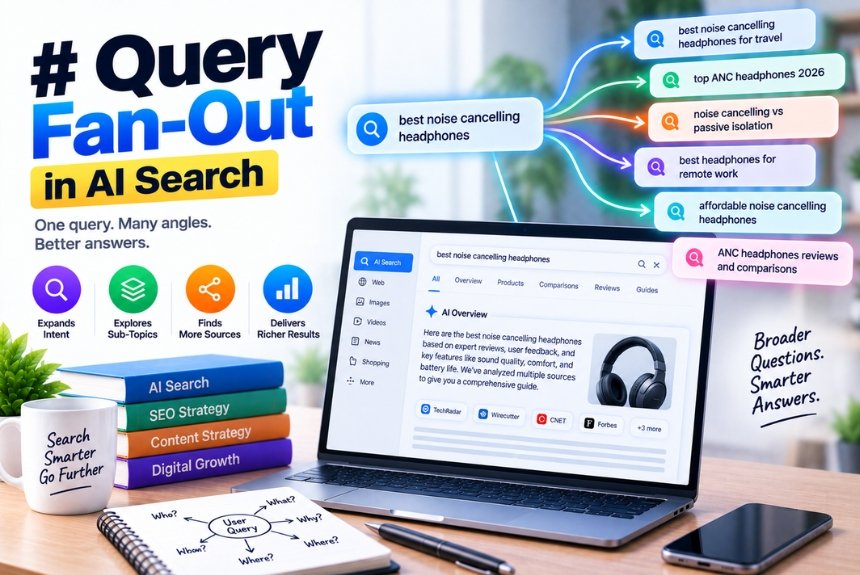
Query fan-out describes a process in which an AI-powered search system takes a user’s question and expands it into multiple related searches or subtopics. Those searches can explore different aspects of the original question, retrieve information from different sources, and help the system build a more comprehensive response.
Google has publicly documented query fan-out as a technique that AI Overviews and AI Mode may use, describing it as issuing multiple related searches across subtopics and data sources to develop a response.
For SEO professionals, this changes an important question.
Instead of asking only, “How do I rank for this keyword?”, businesses increasingly need to consider:
“Does my content provide useful information for the different questions an AI search system may explore around this topic?”
That does not mean traditional SEO is obsolete. Search rankings, crawling, indexing, relevance, links, technical accessibility, content quality, and other established SEO fundamentals remain important.
However, AI search introduces another layer of complexity: a single user question can lead to multiple retrieval paths before the final answer is generated.
What Is Query Fan-Out?
Query fan-out is the process of expanding one user search query into multiple related searches or sub-queries to gather information from different angles.
Imagine someone searches:
“What is the best hosting for a high-traffic ecommerce website?”
A traditional search experience might primarily evaluate pages relevant to the query itself.
An AI search system may need to investigate several underlying questions, such as:
- What hosting types handle high traffic?
- What makes hosting suitable for ecommerce?
- How does server performance affect an online store?
- What is the difference between cloud hosting and dedicated hosting?
- How important is scalability?
- What security features should an ecommerce website have?
- How does hosting affect website speed?
- What happens when traffic suddenly increases?
- What hosting features support databases and ecommerce applications?
- What should businesses consider when comparing hosting providers?
These additional searches represent different aspects of the original information need.
The system can then use the retrieved information to construct a response.
The exact number and nature of searches can vary. There is no single publicly established number of fan-out queries that applies to every AI search, and businesses should be cautious about treating third-party estimates as a universal rule.
The important concept is not the number.
It is the expansion of one information need into multiple retrieval paths.
How Does Query Fan-Out Work?
The exact internal architecture of AI search systems varies by platform and is not completely public. Therefore, it is more accurate to describe query fan-out as a general retrieval concept rather than assume every AI engine follows the same process.
A simplified workflow looks like this:
User query → Query expansion → Related searches → Information retrieval → Evaluation → Answer synthesis
Let’s examine each stage.
1. A User Enters a Complex Question
The process begins with a question, prompt, or search request.
For example:
“How can I improve the SEO of my Shopify store?”
This looks like one query, but it contains multiple potential areas of investigation.
The search system needs to understand what the user is actually trying to accomplish.
Possible underlying areas include:
- technical SEO
- product page optimization
- collection page optimization
- site architecture
- internal linking
- page speed
- structured data
- duplicate content
- canonical URLs
- keyword targeting
- content marketing
- backlinks
The original query therefore becomes a starting point rather than the entire retrieval task.
2. The Query Can Be Expanded Into Related Searches
The AI search system can explore related subtopics.
For the Shopify SEO example, these could include searches related to:
Shopify technical SEO
Shopify product page SEO
Shopify site speed
Shopify structured data
Shopify duplicate content
Shopify internal linking
The user did not necessarily type any of these phrases.
They are potential components of the broader question.
This is where query fan-out becomes particularly relevant to SEO.
3. Multiple Sources Can Be Retrieved
The resulting searches can retrieve information from different webpages and sources.
A complex answer may require information from:
- official documentation
- specialist publications
- research
- industry websites
- product pages
- comparison resources
- expert articles
- business websites
Google explains that its AI search features can use query fan-out across subtopics and data sources to develop responses.
4. Relevant Information Is Evaluated
The retrieved information then needs to be assessed for relevance to the question.
Not every page discovered through a related search will necessarily become part of the final answer.
The system has to determine which information is useful for the particular response being generated.
This is one reason why simply inserting hundreds of keywords into an article is not an effective response to AI search.
A page can contain many keywords and still fail to provide useful, specific information.
5. The Answer Is Synthesized
Finally, the system can combine relevant information into an AI-generated response.
This can result in a search experience where the user receives a synthesized answer rather than simply a traditional list of ten blue links.
Google describes AI Mode as particularly useful for nuanced questions, exploration, reasoning, and complex comparisons, while its AI features can provide links to supporting websites.
Query Fan-Out vs Traditional Search
The easiest way to understand query fan-out is to compare it with the traditional search model.
| Traditional Search | AI Search With Query Fan-Out |
|---|---|
| User enters a query | User enters a question or prompt |
| Search focuses on the query | System can explore related subtopics |
| Results are presented as webpages | Information can be synthesized into an answer |
| User often performs follow-up searches | AI can investigate related questions during retrieval |
| Keyword relevance is important | Topic, context, relevance and supporting information can matter across multiple searches |
| User compares several results | AI may combine information from multiple sources |
This does not mean traditional search has disappeared.
Instead, AI search adds another layer to how information can be discovered and presented.
For SEO professionals, this means that optimizing a webpage around one isolated keyword may not fully capture the information needs surrounding a topic.
Why Does Query Fan-Out Matter for SEO?
Query fan-out matters because it can broaden the range of information an AI search system considers when responding to a user’s question.
Traditional SEO has often been organized around keywords.
For example:
Primary keyword:
“email marketing software”
Then a content team might create a page specifically targeting that phrase.
With AI search, the information need can be broader.
Someone asking:
“What is the best email marketing software for a small ecommerce business?”
may require information about:
- pricing
- automation
- ecommerce integrations
- subscriber limits
- templates
- segmentation
- analytics
- deliverability
- abandoned-cart emails
- ease of use
- scalability
A page that only defines email marketing software may not address enough of these underlying questions.
A well-developed resource, however, can provide useful information across several relevant dimensions.
This is why topic coverage and depth are becoming increasingly important components of an AI search content strategy.
Does Query Fan-Out Mean Keywords No Longer Matter?
No.
This is an important distinction.
Query fan-out does not mean that keywords are irrelevant.
Search engines still need to understand what a webpage is about. Keywords, entities, headings, page structure, internal links, structured data, and surrounding contextual signals can all help search systems interpret content.
The change is that SEO should not stop at exact keyword matching.
Consider two approaches.
Approach 1: Keyword-focused content
A page repeatedly uses:
“best web hosting”
but provides very little useful information.
Approach 2: Topic-focused content
A page discusses:
- hosting types
- performance
- scalability
- uptime
- security
- backups
- server resources
- CDN integration
- pricing
- support
- migration
- ecommerce requirements
The second approach provides a much richer representation of the topic.
The goal should therefore be relevant topical coverage, not simply maximum keyword repetition.
How Query Fan-Out Changes Keyword Research
Traditional keyword research often starts with a primary keyword and expands into related terms.
Query fan-out encourages SEO teams to think beyond keyword variations and investigate underlying questions and sub-intents.
For example, consider the topic:
“Website speed optimization.”
A conventional keyword list might include:
- website speed optimization
- improve website speed
- website speed test
- website performance
- increase website loading speed
A broader content analysis could identify questions such as:
- What causes a website to load slowly?
- How does image compression improve performance?
- What is browser caching?
- Does a CDN improve website speed?
- How does hosting affect page speed?
- How do JavaScript files affect performance?
- What is Core Web Vitals?
- How can mobile website performance be improved?
- How should website speed be measured?
These are not merely keyword variations.
They represent different information needs.
That distinction is valuable when developing content for both traditional search and AI-powered search.
Query Fan-Out and Topical Authority
One of the biggest implications for content strategy is the importance of building comprehensive coverage around a subject.
Suppose your website sells web hosting.
Instead of publishing one article titled:
“Best Web Hosting”
you could build a structured content ecosystem covering:
Hosting Fundamentals
- What Is Web Hosting?
- How Does Web Hosting Work?
- Shared Hosting Explained
- VPS Hosting Explained
- Dedicated Hosting Explained
- Cloud Hosting Explained
Performance
- How Hosting Affects Website Speed
- How to Reduce Server Response Time
- What Is a CDN?
- How to Handle Traffic Spikes
Security
- Website Hosting Security
- SSL Certificates
- Server Backups
- Malware Protection
Ecommerce
- Hosting for Ecommerce Websites
- Hosting for WooCommerce
- Hosting for High-Traffic Stores
- Hosting Scalability
Technical Resources
- Server Resources Explained
- PHP Versions
- Database Performance
- DNS and Hosting
This creates a much stronger topical ecosystem.
However, there is an important warning:
Do not create separate pages simply because an AI system could theoretically generate separate sub-queries.
If several questions can be answered clearly on one comprehensive page, combining them may be more useful.
The goal is not to produce hundreds of thin pages.
The goal is to create the most useful information architecture for your audience.
How to Optimize Content for Query Fan-Out
There is no publicly documented formula that guarantees inclusion in an AI-generated answer.
Therefore, SEO teams should focus on principles that improve the usefulness, relevance, accessibility, and clarity of their content.
1. Start With the Main User Question
Every article should have a clear purpose.
Before writing, ask:
What problem is the reader trying to solve?
For example:
Instead of targeting only:
“AI SEO”
you might address:
“How can businesses optimize their websites for AI-powered search?”
The second question gives you a clearer content direction.
2. Identify Related Sub-Questions
After identifying the main question, list the questions a reader is likely to ask next.
For example:
Main question:
What is query fan-out?
Potential follow-up questions:
- How does query fan-out work?
- Why does it matter for SEO?
- Does Google use query fan-out?
- Does query fan-out replace traditional search?
- How does query fan-out affect keyword research?
- How should content creators respond?
- Does every page need to cover multiple topics?
- How can businesses measure AI search visibility?
These questions can become your content framework.
3. Answer Important Questions Directly
AI-generated answers need information that can be understood and extracted from webpages.
Instead of burying an answer inside a long introduction, make important information clear.
For example:
What Is Query Fan-Out?
Query fan-out is a search technique in which an AI system expands a user’s question into multiple related searches or subtopics to retrieve information before developing a response.
Then explain the concept in greater depth.
This structure benefits readers because they can quickly find the definition while still having access to detailed information.
4. Build Content Around Concepts, Not Just Keywords
Use relevant terminology naturally.
For an article about query fan-out, that could include:
- AI search
- AI Overviews
- AI Mode
- search intent
- sub-queries
- information retrieval
- content relevance
- semantic relationships
- AI search visibility
- generative search
- SEO
- content strategy
But these terms should appear because they are relevant to the subject.
Do not force them into paragraphs simply to increase keyword density.
5. Use Clear Heading Structures
A strong heading hierarchy helps readers navigate long-form content.
For example:
H1:
What Is Query Fan-Out in AI Search?
H2:
What Is Query Fan-Out?
H2:
How Does Query Fan-Out Work?
H3:
The Initial User Query
H3:
Query Expansion
H3:
Information Retrieval
H3:
Answer Synthesis
H2:
Why Does Query Fan-Out Matter for SEO?
H2:
How to Optimize Content for Query Fan-Out
This makes the relationship between topics easier to understand.
6. Include Evidence and Sources
AI search makes trustworthy information particularly important.
When making factual claims, especially about technologies, algorithms, products, regulations, statistics, or industry developments, use credible sources.
For Google’s own AI search behavior, Google’s Search Central documentation is the appropriate primary reference. Google explicitly states that AI Overviews and AI Mode may use query fan-out.
That wording matters.
It means marketers should avoid claiming that every AI search always uses a specific number of sub-queries or follows an identical retrieval process.
7. Strengthen Internal Linking
Query fan-out also provides a useful way to think about internal linking.
Suppose you have a main guide about:
“How to Start an Online Store.”
You could internally link to detailed resources covering:
- ecommerce hosting
- payment gateways
- product SEO
- website security
- conversion optimization
- email marketing
- website analytics
This creates connections between related topics.
Internal links also help users move from broad information to deeper resources.
8. Create Comprehensive Content Without Creating Bloated Content
Comprehensive does not mean unnecessarily long.
A 5,000-word article is not automatically better than a 2,000-word article.
The right question is:
Does the content adequately answer the user’s information need?
If a question can be answered in 150 useful words, there is no SEO benefit in turning it into 1,000 words of repetition.
AI search optimization should therefore focus on information quality and coverage rather than word count alone.
9. Make Important Information Easy to Extract
Use formats that communicate information clearly.
Useful formats include:
- definitions
- bullet points
- numbered steps
- comparison tables
- concise explanations
- FAQs
- examples
- pros and cons
- processes
- statistics with sources
For example, instead of writing one large paragraph comparing hosting types, use a table.
| Hosting Type | Suitable For | Scalability | Management |
|---|---|---|---|
| Shared Hosting | Small websites | Limited | Easy |
| VPS Hosting | Growing websites | Moderate | Moderate |
| Cloud Hosting | Variable traffic | High | Varies |
| Dedicated Hosting | Resource-intensive websites | High | More technical |
Clear formatting helps readers understand information quickly.
Query Fan-Out Does Not Mean You Should Create Content for Every Possible Query
This is one of the most important strategic points.
If an AI system generates many related searches, it can be tempting to create a separate article for every possible variation.
That can lead to:
- duplicate content
- thin pages
- overlapping articles
- keyword cannibalization
- poor site architecture
- unnecessary maintenance
Instead, group related questions according to search intent.
For example:
One comprehensive article
What Is Website Hosting?
could answer:
- What is hosting?
- How does hosting work?
- Why do websites need hosting?
- What does a hosting server do?
But another article might be appropriate for:
Shared Hosting vs VPS Hosting
because that represents a more specific comparison intent.
The goal is intent-based content architecture, not unlimited content production.
Does Ranking #1 Guarantee AI Search Visibility?
No.
A high traditional search ranking does not automatically guarantee that a webpage will be included or cited in every AI-generated answer.
AI search can retrieve and evaluate information through different processes and may consider multiple related searches and sources.
This is one reason SEO teams should distinguish between:
Traditional search visibility
and
AI search visibility.
They overlap, but they are not necessarily identical.
A page can perform well for a particular traditional search query while another source may be selected for a specific AI-generated response.
Conversely, a highly useful page addressing a specific subtopic may become relevant to an AI response even if it is not the traditional top-ranking result for the user’s exact wording.
The exact selection process varies by search system and query.
Query Fan-Out and Generative Engine Optimization
Query fan-out is closely connected to the broader discussion around Generative Engine Optimization (GEO) and AI search optimization.
Traditional SEO generally focuses on improving visibility within search engines.
GEO is often used to describe efforts aimed at improving how brands, websites, and information are represented in AI-generated answers.
Query fan-out provides one explanation for why content breadth can matter.
If an AI system explores several related aspects of a topic, then a brand’s visibility may depend on whether its content is relevant to those different information needs.
However, GEO should not be treated as a replacement for SEO.
Many foundational SEO practices remain relevant:
- crawlability
- indexability
- useful content
- site architecture
- internal linking
- technical performance
- structured information
- authority
- relevant external references
- clear page structure
AI search adds another discovery and retrieval layer rather than eliminating the fundamentals of search optimization.
A Practical Query Fan-Out Content Workflow
Businesses can incorporate this concept into their existing SEO process.
Step 1: Select a Core Topic
Choose a topic that is directly relevant to your audience and business.
Example:
Website Security
Step 2: Define the Main User Intent
Determine what the reader actually wants.
Example:
“How can I secure my business website?”
Step 3: Identify Supporting Questions
Research questions related to:
- SSL
- passwords
- malware
- backups
- software updates
- hosting security
- firewalls
- access controls
Step 4: Group the Questions
Separate them into logical content clusters.
Step 5: Decide What Belongs on the Main Page
Questions that naturally support the primary intent can be answered on the main article.
Step 6: Identify Supporting Articles
More specialized questions can become separate resources.
Step 7: Connect the Content
Use contextual internal links between the main guide and supporting resources.
Step 8: Update the Content
Search behavior, products, technologies, and user questions change.
Review important content regularly and update outdated information.
How to Find Potential Fan-Out Topics Without Knowing the Actual AI Queries
One challenge is that marketers generally cannot see every internal retrieval operation performed by an AI search system.
Therefore, do not pretend that a keyword tool has revealed the exact hidden queries used by every AI engine.
Instead, use multiple sources of evidence.
Use Search Suggestions
Look at autocomplete suggestions and related searches.
Use People Also Ask
These can reveal common follow-up questions around a topic.
Analyze Existing Search Queries
Search Console data can reveal queries that already lead users to your website.
Study Competitor Content
Look at the questions and subtopics competing pages address.
Analyze Customer Questions
Sales calls, support tickets, FAQs, reviews, and community discussions can reveal real information needs.
Use AI Tools for Ideation
AI can help generate potential subtopics, but those suggestions should be validated against actual audience needs and reliable sources.
The objective is not to perfectly predict an AI engine’s hidden retrieval process.
It is to understand the broader information landscape surrounding your topic.
Common Query Fan-Out SEO Mistakes
Mistake 1: Creating Hundreds of Thin Articles
More URLs do not automatically mean more visibility.
Create a new page when there is a genuine information need that deserves its own resource.
Mistake 2: Stuffing Related Keywords
Adding every imaginable keyword can make content unnatural and less useful.
Use terminology naturally.
Mistake 3: Assuming One AI Engine Works Like Another
Google AI Mode, AI Overviews, ChatGPT, Perplexity, and other AI-powered search experiences can use different systems and retrieval processes.
Avoid treating one platform’s behavior as universal.
Mistake 4: Chasing a Specific Fan-Out Count
There is no universally established number of searches that every AI system performs for every question.
Focus on the quality of information coverage rather than an arbitrary number.
Mistake 5: Ignoring Traditional SEO
AI search does not make crawlability, indexing, useful content, technical SEO, and website architecture irrelevant.
These remain important foundations.
Mistake 6: Writing for Machines Instead of People
The ultimate purpose of your content should remain helping people solve problems.
Content that is clear, accurate, useful, and easy to navigate has a stronger foundation than content created purely around algorithm speculation.
How to Measure the Impact of an AI Search Content Strategy
Query fan-out can influence how you think about content, but measurement still requires care.
Businesses can monitor several indicators.
Traditional Organic Performance
Track:
- organic clicks
- impressions
- rankings
- organic traffic
- conversions
- indexed pages
Topic-Level Visibility
Instead of monitoring only one keyword, track groups of related queries.
This provides a broader view of whether your website is gaining visibility around a topic.
Brand Mentions in AI Search
Where appropriate, manually or through suitable monitoring tools, examine whether AI search experiences mention your:
- company
- products
- services
- authors
- resources
- brand associations
Referral Traffic
Track referral traffic from AI platforms when identifiable in your analytics data.
Conversions
Ultimately, visibility should connect to business outcomes.
Monitor:
- leads
- sales
- sign-ups
- enquiries
- downloads
- purchases
A rise in AI visibility is useful, but the business impact matters too.
What Does Query Fan-Out Mean for Content Writers?
For content creators, the biggest change is the shift from writing around a keyword to answering an information need.
Instead of asking:
“How many times should I use my target keyword?”
ask:
- What does the reader need to understand?
- What questions will they have next?
- What evidence supports the answer?
- What related concepts are important?
- Which information can be combined into this article?
- Which topics deserve their own resources?
- Can the answer be understood without unnecessary jargon?
This produces content that is more useful to humans while also providing search systems with richer contextual information.
The Future of SEO Is More Contextual
Query fan-out represents a broader shift in how search can understand information.
Search is becoming increasingly capable of interpreting questions in context rather than relying only on a literal keyword match.
That means SEO strategies should increasingly consider:
Topic → Intent → Context → Supporting questions → Evidence → Useful answer
rather than:
Keyword → Page → Ranking
The second model is not disappearing, but it is no longer the entire picture.
For businesses, this creates an opportunity to build websites that genuinely answer the questions their audiences have—not just pages designed to capture individual search terms.
Frequently Asked Questions About Query Fan-Out
1. What is query fan-out in AI search?
Query fan-out is a technique in which an AI-powered search system expands a user’s question into multiple related searches or subtopics. The retrieved information can then be used to develop a broader response. Google says AI Overviews and AI Mode may use query fan-out across subtopics and data sources.
2. Does Google use query fan-out?
Yes. Google Search Central states that both AI Overviews and AI Mode may use a query fan-out technique, issuing multiple related searches across subtopics and data sources to develop a response.
3. Does query fan-out replace traditional SEO?
No. Query fan-out changes how AI-powered search can retrieve and synthesize information, but traditional SEO fundamentals such as crawlability, indexing, relevant content, site architecture, and technical accessibility remain important.
4. Does query fan-out mean I need to target hundreds of keywords?
No. The objective is not to target as many keywords as possible. Instead, identify the important questions and subtopics associated with a user’s information need and cover them naturally and comprehensively.
5. How does query fan-out affect content strategy?
It encourages businesses to create content that addresses broader topics and related user questions rather than focusing exclusively on one keyword. It can also encourage stronger topic clusters, internal linking, and more comprehensive resources.
6. Can I see the exact queries an AI search engine uses?
Not necessarily. The internal retrieval process of AI search systems is not fully exposed to website owners, and the amount of observable information varies by platform. Third-party tools may provide estimates or reconstructed query paths, but those should not automatically be treated as official data.
7. Is query fan-out the same as keyword expansion?
Not exactly. Keyword expansion generally refers to finding related keywords and search terms. Query fan-out refers to an AI search system expanding an information need into related searches or subtopics during retrieval.
8. Should every blog cover multiple search intents?
No. A single article should have a clear primary purpose. Supporting questions that naturally belong to that purpose can be included, while substantially different search intents may deserve separate pages.
Final Takeaway
Query fan-out is an important concept in the evolution of AI-powered search. It describes how a system can take one user question and explore multiple related searches, subtopics, and data sources before producing a response.
For SEO professionals, the practical lesson is not to chase hypothetical algorithms or create content for every possible AI-generated query.
Instead, build content around real user needs.
Start with a clear question. Identify the important subtopics. Answer relevant follow-up questions. Support factual claims with trustworthy sources. Create logical internal links. Keep your website technically accessible. And organize related content into a structure that makes sense for both users and search systems.
Traditional SEO is not disappearing. But as AI-powered search becomes more capable of understanding complex questions, depth, context, relevance, and comprehensive topic coverage are becoming increasingly important parts of a modern SEO strategy.
The businesses that adapt successfully will not simply ask how to rank for a keyword.
They will ask a broader question:
“How can we become the most useful source of information across the entire topic our audience is trying to understand?”
Leave a Reply