


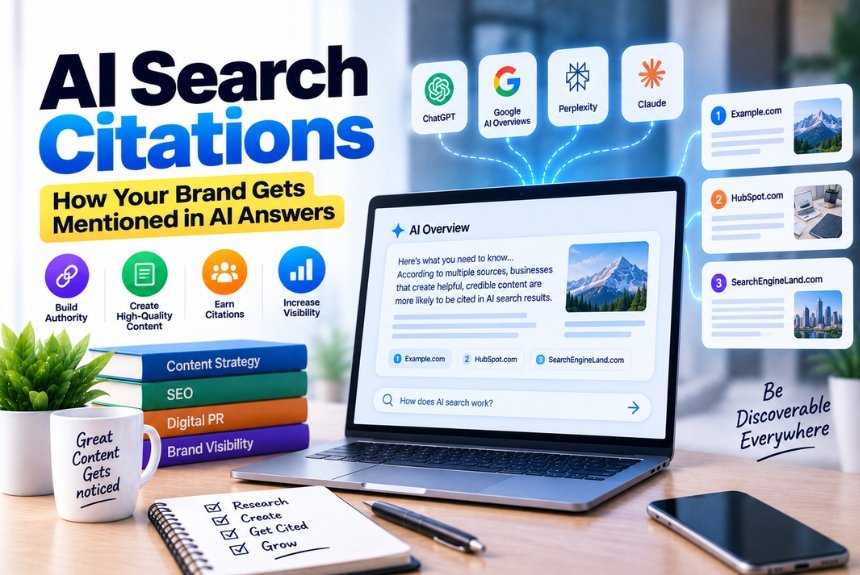
AI Search Citations: How Do AI Engines Choose Which Websites to Reference?
Search engines have traditionally helped users discover webpages by presenting ranked results.
AI-powered search changes the experience.
Instead of simply showing a list of links, an AI search system can retrieve information from multiple sources and use that information to generate a response. Depending on the platform and search experience, the answer may also include links or citations to webpages that support the information.
This has created a new question for website owners and SEO professionals:
How do AI engines decide which websites to reference?
The answer is more complicated than simply being ranked number one on Google.
AI search systems can use retrieval systems, relevance signals, content understanding, source information, and other mechanisms to identify information that may be useful for a particular question. The exact systems differ between platforms and are not completely disclosed.
Google, for example, has publicly explained that its AI search experiences can use query fan-out, where a complex question is broken into multiple related searches across subtopics and data sources before developing a response.
This means that a website may become relevant to an AI-generated answer because it provides particularly useful information about one part of a broader question.
For SEO, that creates an important shift.
The objective is no longer simply to create pages that rank for individual keywords.
Businesses should also create content that is:
- relevant
- useful
- specific
- trustworthy
- well-structured
- accessible to search systems
- supported by evidence
- aligned with real user questions
There is no publicly documented formula that guarantees a website will receive an AI citation.
However, understanding how retrieval and source selection work can help businesses develop a stronger AI search optimization strategy.
What Are AI Search Citations?
An AI search citation is a reference or link to a source used in or associated with an AI-generated search response.
For example, a user could ask:
“What is edge computing?”
An AI search system might provide an explanation and reference several webpages supporting different parts of the answer.
Those references are citations.
Depending on the platform, citations may appear as:
- inline links
- numbered sources
- linked text
- source cards
- footnotes
- website previews
- expandable references
The exact presentation varies.
A citation therefore provides a connection between the AI-generated response and an external information source.
Mention vs Citation: What Is the Difference?
These terms are often used interchangeably, but they represent different things.
Brand Mention
An AI system may mention:
“Company A provides cloud hosting services.”
The company is visible, but its website may not be referenced.
Citation
The system may instead provide a link to:
Company A’s cloud hosting page
as the source associated with the information.
This distinction matters for SEO.
A brand can have strong AI visibility through mentions while receiving relatively few website citations.
Conversely, a specific webpage can receive citations for informational queries even when the brand itself is not prominently discussed.
That is why AI search measurement should track mentions and citations separately.
Why Do AI Engines Cite Websites?
The fundamental purpose of a citation is to connect generated information with a source.
A source can be useful because it contains information relevant to the user’s question.
Consider a question such as:
“What documents are required to apply for a particular government service?”
A government website may be particularly useful because it provides first-party information.
Now consider:
“How does a particular software feature work?”
The software company’s official documentation may be highly relevant.
For:
“What are the latest statistics about a particular industry?”
A current research report or authoritative dataset may provide stronger evidence.
This demonstrates an important principle:
The most appropriate source depends on the information need.
There is no single type of website that is automatically the preferred citation for every AI search.
How AI Search Retrieval Can Work
The internal systems differ by AI platform, but a simplified model looks like this:
User question
↓
Intent and query understanding
↓
Search or retrieval
↓
Related searches / query expansion
↓
Candidate sources
↓
Relevance and quality assessment
↓
Answer generation
↓
Citations or source links
This process should be treated as a conceptual model rather than a universal technical description of every AI engine.
Different systems can use different retrieval architectures.
1. Relevance Is a Fundamental Signal
The first consideration is whether your content actually answers the question.
Imagine someone searches:
“How does email segmentation work?”
A page titled:
“The Complete Guide to Email Marketing”
might contain a section about segmentation.
Another page might be dedicated specifically to:
“Email Segmentation: A Complete Guide.”
The second page may provide more directly relevant information for the particular question.
This illustrates why content should address specific information needs.
Better approach
Instead of writing broadly about everything your company does, create useful resources that clearly answer important questions.
For example:
What Is Zero-Party Data?
How Does Email Segmentation Work?
What Is Query Fan-Out?
How Does Cloud Hosting Scale?
Clear topical focus makes the purpose of a page easier to understand.
2. Semantic Relevance Matters Beyond Exact Keywords
AI search systems are designed to understand language and concepts.
That means a webpage does not necessarily need to repeat the exact wording of a user’s question to be relevant.
For example, a user might ask:
“How can I make my website load faster?”
A useful source may discuss:
- page performance
- server response time
- image optimization
- caching
- content delivery networks
- JavaScript optimization
- Core Web Vitals
The page may rarely use the exact phrase “make my website load faster.”
Yet it can still be highly relevant.
This is why modern content optimization should focus on conceptual coverage and meaning, rather than exact-match keyword repetition.
3. Content Depth Can Help Answer Complex Questions
Complex questions often involve multiple subtopics.
Consider:
“How should a small business choose an ecommerce hosting provider?”
A useful source could cover:
- server performance
- uptime
- scalability
- security
- backups
- ecommerce compatibility
- support
- pricing
- traffic handling
A page containing only a generic definition of web hosting would provide limited value.
However, depth should not be confused with word count.
A longer article is not automatically a better source.
The objective is to provide complete information for the specific user intent.
4. Source Authority Can Matter
AI search systems need to distinguish between useful information and unreliable information.
Source authority can therefore be relevant.
Consider a medical, financial, legal, technical, or government-related question.
Depending on the subject, users may benefit more from information originating from:
- government agencies
- universities
- recognized organizations
- official documentation
- established publications
- subject-matter experts
- primary research
- reputable companies
For commercial claims, first-party sources can be especially important.
For example, if someone asks:
“What features does Product X have?”
the manufacturer’s official documentation is a natural source for product specifications.
This does not mean official websites automatically receive citations.
They still need to provide information that is relevant and accessible.
5. First-Party Information Can Be Particularly Valuable
A first-party source is information published by the organization directly involved with the subject.
Examples include:
- product documentation
- company policies
- official specifications
- original research
- pricing pages
- government regulations
- official announcements
Suppose a company launches a new feature.
Third-party websites may discuss it, but the company’s official documentation may contain the most precise information about:
- functionality
- limitations
- requirements
- pricing
- availability
Businesses should therefore ensure that important first-party information is published clearly on their websites.
6. Freshness Matters for Time-Sensitive Information
Some information changes quickly.
Examples include:
- pricing
- product specifications
- software features
- regulations
- company policies
- market data
- event information
- technology developments
For these subjects, an outdated article may be less useful than a current source.
Consider:
“What is the current price of Product X?”
An article from three years ago may contain an accurate historical price but be inappropriate for a current answer.
This is why content maintenance matters.
Review pages that contain information likely to change and update them when necessary.
7. Original Information Can Strengthen Content Value
One way to make your content more useful is to publish information that cannot easily be copied from dozens of other websites.
Examples include:
- original research
- surveys
- case studies
- proprietary data
- first-party experiments
- industry analysis
- original photographs
- detailed testing
- real-world experience
For example, instead of publishing another generic article titled:
“How to Improve Website Speed”
a hosting company could conduct a controlled test comparing different configurations and publish the results.
That creates a potentially valuable source of information.
Originality does not guarantee an AI citation.
But it can give your content a stronger reason to exist.
8. Clear Content Structure Helps
AI systems need to process information from webpages.
Clear structure can make the content easier to understand.
Use:
- descriptive headings
- short paragraphs
- lists
- tables
- definitions
- examples
- step-by-step instructions
- clearly labeled sections
For example:
What Is Edge Computing?
Give the definition immediately.
How Does Edge Computing Work?
Explain the process.
What Are the Benefits?
List the relevant benefits.
When Does a Website Need Edge Computing?
Explain the use cases.
This structure is useful for humans first, while also making relationships between concepts clearer.
9. Specific Answers Are Often More Useful Than Generic Statements
Compare these two explanations.
Generic
“Website performance is important for businesses.”
Specific
“Server response time can affect how quickly a webpage begins loading. Businesses with high traffic should evaluate server resources, caching, CDN configuration, and application performance when investigating slow response times.”
The second provides substantially more information.
When creating content for AI search visibility, prioritize specific, explanatory information over vague marketing statements.
10. Supporting Evidence Matters
If you make a factual claim, support it when appropriate.
For example:
“Our platform processes millions of transactions every year.”
If that is an important claim, explain its source or provide supporting evidence.
Useful evidence can include:
- official data
- research
- documented statistics
- methodology
- references
- case studies
- technical documentation
This improves credibility for readers and creates clearer source context.
How Query Fan-Out Affects AI Citations
Query fan-out makes citation selection particularly interesting.
Suppose a user asks:
“How can I build an AI-ready ecommerce website?”
The system may need information about:
- website infrastructure
- hosting
- structured data
- content
- product information
- technical SEO
- APIs
- performance
- AI integrations
A single website may not have the best resource for every part.
The final response can therefore draw information from multiple sources.
One website might provide the best technical documentation.
Another might provide original research.
Another might explain ecommerce implementation.
This means a business does not necessarily need one page that answers every possible question.
Instead, it can build a connected library of high-quality resources covering the important aspects of its expertise.
What Makes a Website More Citation-Worthy?
There is no guaranteed checklist that causes an AI engine to cite a webpage.
However, several practical characteristics can make content more useful as a source.
1. Clear topical relevance
The page directly addresses the question.
2. Accurate information
Claims are factually sound.
3. Useful detail
The content goes beyond generic statements.
4. Good organization
Important information is easy to find.
5. Appropriate freshness
Time-sensitive information is maintained.
6. Credible sourcing
Claims are supported where appropriate.
7. Original value
The page contributes something beyond recycled information.
8. Technical accessibility
Search systems can access and process the page.
9. Clear authorship and context
Readers can understand who created the content and why they should trust the information.
10. Strong topical relationships
The page fits logically within the broader website.
None of these guarantees an AI citation.
Together, however, they form a sensible foundation for AI-search-ready content.
Technical SEO Still Matters
AI search does not eliminate technical SEO.
Your content still needs to be accessible to search systems.
Important fundamentals include:
- crawlability
- indexability
- valid status codes
- sensible internal linking
- mobile usability
- page performance
- canonicalization
- appropriate redirects
- structured data where relevant
- accessible content
If a search engine cannot effectively access or process your page, the quality of the writing becomes less useful from a search-discovery perspective.
Google’s guidance for AI features continues to point website owners toward established Search fundamentals rather than requiring a separate special AI markup system.
This is an important point.
You do not need to create a mysterious “AI SEO tag” simply because your goal is to appear in AI search.
Is There a Special Schema Markup for AI Citations?
There is no universal schema markup that guarantees an AI engine will cite your page.
Structured data can help search engines understand certain types of content when implemented correctly, but it should not be treated as a direct citation-control mechanism.
For example, relevant structured data can describe:
- products
- organizations
- articles
- events
- local businesses
- FAQs where applicable
Use structured data according to the appropriate search-engine guidelines.
Do not add irrelevant schema simply because you want AI visibility.
Does Being Number One on Google Guarantee an AI Citation?
No.
Traditional search ranking and AI citation are related but distinct concepts.
A page can rank highly for a particular query without being referenced in a specific AI response.
Likewise, a source may become useful for a particular subtopic within an AI-generated response without being the traditional top result for the user’s exact wording.
AI search can retrieve information through different pathways.
Therefore:
Google ranking ≠ guaranteed AI citation
This is one of the most important misconceptions businesses should avoid.
Does Having a Lot of Backlinks Guarantee AI Citations?
No.
Backlinks can be an important part of traditional SEO and authority-building, but there is no publicly established rule saying that a specific number of backlinks guarantees citation in an AI answer.
A page can have thousands of links and still be irrelevant to a particular question.
Meanwhile, a highly specific authoritative resource may be useful for a narrow information need.
Focus on building genuine authority and useful resources rather than chasing a particular backlink count for AI visibility.
Does Keyword Density Affect AI Citations?
There is no established ideal keyword density for AI citations.
Repeating a keyword excessively can make content unnatural.
Instead, use relevant terms naturally while covering the concepts readers need.
For example, an article about AI search citations can naturally discuss:
- AI search
- source selection
- citations
- retrieval
- relevance
- authority
- content quality
- query expansion
- search intent
The terminology should follow the subject matter.
How to Create Content That Can Become a Useful AI Source
A practical process can help.
Step 1: Choose a Real Information Need
Start with a question your audience genuinely has.
Step 2: Understand the Search Intent
Determine whether the user wants:
- information
- instructions
- comparison
- research
- product information
- troubleshooting
- recommendations
Step 3: Map Supporting Questions
Identify the important questions surrounding the main topic.
Step 4: Research the Subject
Use authoritative and primary sources wherever appropriate.
Step 5: Add Original Value
Include:
- examples
- experience
- data
- analysis
- testing
- case studies
Step 6: Structure the Page
Use descriptive headings and logical sections.
Step 7: Support Important Claims
Provide sources where factual claims require evidence.
Step 8: Improve Technical Accessibility
Make sure important content can be crawled and indexed.
Step 9: Connect Related Content
Use internal links to supporting resources.
Step 10: Maintain the Page
Update information when the subject changes.
Build a Citation-Focused Content Cluster
Instead of thinking about one article in isolation, consider your entire content ecosystem.
Suppose you operate a web hosting website.
Your core topic might be:
Web Hosting
Supporting resources could include:
Hosting Basics
- What Is Web Hosting?
- How Does Web Hosting Work?
- Shared Hosting Explained
- VPS Hosting Explained
Performance
- How Hosting Affects Website Speed
- What Is Server Response Time?
- What Is a CDN?
Security
- What Is an SSL Certificate?
- How Do Website Backups Work?
- Website Hosting Security
Ecommerce
- Best Hosting Features for Ecommerce
- Hosting for High-Traffic Websites
- WooCommerce Hosting Requirements
Each article answers a different information need.
Internal links connect these resources.
The result is a website with a deeper information architecture rather than a collection of unrelated blog posts.
Why Internal Linking Matters
Internal linking helps establish relationships between pages.
Suppose your article explains:
“Cloud hosting can scale resources according to demand.”
You can link to a detailed article explaining:
“What Is Cloud Hosting?”
Then connect that page to:
“Cloud Hosting vs VPS Hosting.”
This creates a logical pathway.
For users, it provides additional context.
For search engines, it provides information about how pages relate to each other.
Create Pages for People, Not Hypothetical AI Queries
One of the biggest mistakes in AI SEO is attempting to reverse-engineer every possible prompt.
Imagine trying to create a separate article for:
- best hosting for startups
- affordable hosting for startups
- cheap hosting for startups
- startup website hosting
- hosting options for new businesses
- hosting for small startup websites
If the underlying intent is essentially the same, creating six thin articles may make the website worse.
Instead, create one genuinely useful resource that addresses the shared information need.
Then create separate pages only when the intent is meaningfully different.
AI Citations and Brand Authority
AI citation strategy should also be connected with broader brand authority.
Imagine someone asks:
“Which companies are known for enterprise ecommerce hosting?”
The AI system needs information that helps it understand which companies belong to that category.
That information may exist across:
- company websites
- documentation
- industry publications
- reviews
- research
- case studies
- third-party references
This means brand positioning should be consistent.
Your website should clearly communicate:
- what you do
- who you serve
- where you operate
- your areas of expertise
- products and services
- evidence supporting important claims
A vague website makes it harder for any information system to understand your business.
The Importance of Entity Clarity
AI systems increasingly need to understand entities and relationships.
For example:
Brand → Product → Category → Audience → Use Case
A SaaS company might have:
Company X → CRM platform → Customer relationship management → Small businesses → Sales teams
Your website should communicate these relationships clearly.
This can be done through:
- organization information
- product pages
- service pages
- author pages
- about pages
- documentation
- internal linking
- structured data where appropriate
The goal is to make your business understandable, not to manipulate an algorithm.
What About AI-Generated Content?
AI-generated content is not automatically unsuitable for search.
The more important question is whether the resulting content is:
- accurate
- useful
- original
- relevant
- well researched
- properly edited
Using AI to generate hundreds of generic pages simply to capture search traffic is a very different approach from using AI as a research, drafting, or editing assistant while maintaining human oversight and adding genuine value.
For AI citation visibility, generic content provides little differentiation.
The strongest strategy remains creating information worth referencing.
How to Improve Existing Pages for AI Search
You do not necessarily need to publish new content.
Start by auditing existing pages.
Check the Introduction
Can the reader understand the topic immediately?
Check the Main Answer
Is the primary question answered clearly?
Check Headings
Do they reflect real user questions?
Check Supporting Information
Does the page address important related questions?
Check Sources
Are factual claims properly supported?
Check Freshness
Are outdated facts, statistics, screenshots, or product details still accurate?
Check Internal Links
Does the page connect to relevant supporting resources?
Check Author Information
Is it clear who created the content?
Check Originality
Does the page provide something beyond what dozens of competing pages already say?
This can turn an existing article into a substantially more useful resource.
A Practical AI Citation Audit
You can create a monthly or quarterly citation audit.
Track:
| Metric | What to Record |
|---|---|
| Prompt | Exact question tested |
| Platform | AI search system |
| Brand Mention | Yes/No |
| Website Citation | Yes/No |
| Cited URL | Specific webpage |
| Competitors | Other brands mentioned |
| Topic | Topic category |
| Answer Context | How your brand/content was used |
| Accuracy | Accurate/Needs Review |
| Date | When the response was checked |
Over time, this creates a historical record.
You can then identify patterns.
For example:
Your product pages receive many citations, but your educational content receives very few.
That might suggest a content opportunity.
Or:
Your website is frequently cited for technical questions but rarely for comparison questions.
That can inform your content strategy.
Common AI Citation SEO Mistakes
Mistake 1: Assuming There Is a Citation Formula
There is no publicly confirmed universal formula.
Avoid claims such as:
“Do X and AI will cite you.”
Search systems are more complex than that.
Mistake 2: Optimizing Only for Keywords
AI search involves context and information needs, not just exact phrases.
Mistake 3: Publishing Generic AI Content
If ten competitors say the same thing, another generic version provides little additional value.
Mistake 4: Ignoring Sources
Unsupported factual claims can weaken content credibility.
Mistake 5: Neglecting Existing Content
Some of your strongest citation opportunities may already exist on your website.
Mistake 6: Creating Excessive Content
More pages do not automatically create more authority.
Mistake 7: Ignoring Technical SEO
Excellent content still needs to be accessible to search systems.
Mistake 8: Treating One AI Platform as Universal
Different AI search systems can retrieve and present information differently.
How to Think About AI Citations as an SEO Professional
The traditional SEO question has often been:
“How do I rank this page?”
The AI-search question becomes:
“How can this page become a useful source for an information need?”
That leads to better questions:
- Does this page directly answer something people want to know?
- Is the information accurate?
- Is it sufficiently detailed?
- Is the source credible?
- Is it current?
- Does it contain original value?
- Is the content clearly structured?
- Can search systems access it?
- Does the website demonstrate expertise around the subject?
These are much more sustainable questions than attempting to guess an undocumented ranking formula.
AI Citation Strategy: A Practical Checklist
Before publishing an important page, ask:
Topic
- Does the page address a genuine information need?
- Is the primary intent clear?
Content
- Is the main question answered directly?
- Are important supporting questions addressed?
- Is the information accurate?
- Is the content sufficiently detailed?
- Does it provide original value?
Trust
- Are important claims supported?
- Is authorship clear?
- Are first-party facts presented accurately?
- Are outdated claims removed?
Structure
- Is the H1 descriptive?
- Are H2s and H3s logical?
- Are lists and tables used where useful?
- Can readers quickly locate important information?
Technical SEO
- Can the page be crawled?
- Can it be indexed?
- Are canonical signals correct?
- Are important internal links present?
- Is the page usable on mobile?
Measurement
- Is the topic included in your AI prompt set?
- Are brand mentions being tracked?
- Are citations being tracked?
- Are cited URLs being recorded?
- Are competitors being monitored?
Frequently Asked Questions
1. What are AI search citations?
AI search citations are references or links to webpages or other sources associated with information used in an AI-generated search response. Their appearance and implementation vary between AI search platforms.
2. How do AI engines choose websites to cite?
The exact selection process varies by platform and is not fully public. In general, AI search systems can retrieve information based on the relevance of sources to a user’s question and other signals associated with information quality, accessibility, and context. There is no universal public formula guaranteeing a citation.
3. Does Google use citations in AI search?
Google’s AI search experiences can provide links to supporting webpages. Google also documents that AI Overviews and AI Mode may use query fan-out to search across related subtopics and data sources.
4. Does ranking number one guarantee an AI citation?
No. Traditional search rankings and AI citations are different signals. A high-ranking page is not guaranteed to be cited in every AI-generated response.
5. How can I increase my chances of being cited by AI search?
Focus on creating relevant, accurate, useful, well-structured and accessible content. Answer real user questions, support important claims, maintain current information, demonstrate subject expertise, and provide original value where possible.
6. Is there special schema markup for AI citations?
There is no universal schema markup that guarantees an AI citation. Use structured data where it genuinely describes the content on your page and follows the relevant search-engine guidelines.
7. Are backlinks important for AI search citations?
Backlinks can contribute to broader search authority, but there is no established backlink threshold that guarantees AI citations. Relevance and usefulness to the specific information need remain important considerations.
8. Should I create separate pages for every AI search query?
No. Create separate pages when there are meaningful differences in user intent or information needs. Otherwise, consolidate closely related questions into comprehensive, useful resources.
9. How can I monitor AI citations?
Create a consistent set of relevant prompts and test them across the AI platforms important to your audience. Record brand mentions, citations, cited URLs, competitors, topics and changes over time. Dedicated AI visibility tools can automate portions of this process.
Final Takeaway
AI search citations are becoming an important part of modern search visibility, but there is no guaranteed formula for earning them.
AI systems can retrieve information from multiple sources, interpret complex questions, and synthesize information into responses. Google’s documentation, for example, confirms that its AI search features may use query fan-out to explore multiple related searches across subtopics and data sources.
For website owners, the practical response is not to search for a secret AI-ranking trick.
Build content that is genuinely worth referencing.
That means creating pages that:
Answer real questions.
Provide accurate information.
Use clear structure.
Support important claims.
Stay current.
Offer original value.
Demonstrate relevant expertise.
Remain technically accessible.
And importantly, connect individual resources into a coherent website rather than publishing disconnected articles for every imaginable keyword variation.
AI citation visibility should therefore be viewed as an extension of a broader SEO and content strategy.
The fundamental objective remains the same:
Create useful information that helps people make better decisions—and make that information easy for search systems to discover, understand, and reference.
Leave a Reply