


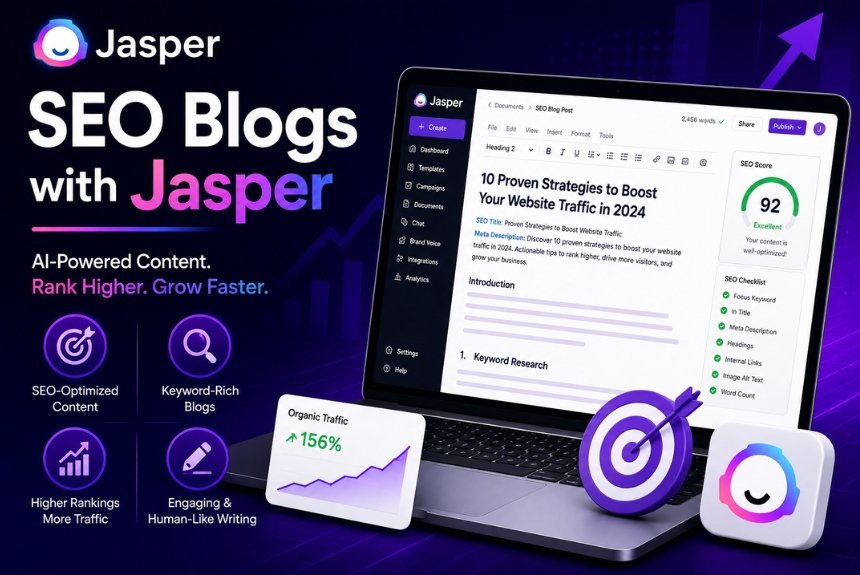
Search engine optimization (SEO) is one of the most effective ways to drive long-term organic traffic to a website. However, creating high-quality, optimized content consistently can be time-consuming. Writers must research keywords, structure articles, optimize headings, maintain readability, and ensure content satisfies user intent.
Artificial intelligence has simplified this process, and Jasper AI is one of the most popular platforms for AI-assisted content creation. Designed for marketers, bloggers, agencies, and businesses, Jasper helps users produce SEO-friendly blog posts more efficiently while maintaining quality and consistency.
Although Jasper can generate content in minutes, achieving strong search engine rankings still requires strategic planning. Successful SEO blogging involves proper keyword research, content organization, optimization, editing, and publishing—not simply generating text with AI.
This comprehensive guide explains how to write SEO blogs with Jasper from start to finish. You’ll learn how to set up your workspace, identify the right keywords, create optimized outlines, generate engaging content, refine it for search engines, and publish articles that have a better chance of ranking on Google.
Setup
Before creating your first SEO blog, it’s important to configure Jasper AI correctly. A well-prepared workspace ensures consistent content quality and helps the AI understand your goals, audience, and writing style.
Create Your Jasper Workspace
Start by organizing your content projects inside Jasper. Keeping articles, campaigns, and drafts in separate folders makes long-term content management much easier.
A structured workspace allows you to:
- Organize blog projects
- Manage multiple websites
- Store drafts
- Reuse templates
- Collaborate with team members
- Track publishing progress
This organization becomes increasingly valuable as your content library grows.
Configure Brand Voice
One of Jasper AI’s most powerful features is Brand Voice. By defining your preferred writing style, tone, vocabulary, and messaging, Jasper can generate content that remains consistent across every blog post.
Consider defining:
- Brand personality
- Target audience
- Preferred tone
- Writing style
- Formatting preferences
- Common terminology
This helps maintain a recognizable voice throughout your website.
Choose the Right Template
Jasper offers several templates designed for content creation. Selecting the appropriate template before writing saves time and provides a structured workflow.
Common options include:
- Blog Post
- Long-Form Article
- SEO Blog
- Marketing Copy
- Product Review
- How-To Guide
Each template guides the AI toward producing content suited to your objective.
Define Your Content Goal
Before generating any text, clarify the purpose of your article.
Ask yourself:
- Who is the target audience?
- What problem will the article solve?
- Which keyword will you target?
- What action should readers take after reading?
Clear objectives help Jasper generate more relevant and useful content.
Setup Checklist
| Task | Status |
| Create Workspace | ✔ |
| Configure Brand Voice | ✔ |
| Select Blog Template | ✔ |
| Define Target Audience | ✔ |
| Choose Primary Keyword | ✔ |
| Set Writing Goals | ✔ |
Table 1. Essential setup checklist before writing SEO blogs with Jasper.
Expert Analysis
Proper setup is the foundation of successful AI-assisted blogging. By organizing projects, configuring Brand Voice, selecting the appropriate template, and defining clear content objectives, users can significantly improve the relevance and consistency of Jasper-generated content. Investing a few minutes in setup reduces editing time later and creates a smoother workflow for long-term content production.
Keyword Research
Keyword research is the foundation of every successful SEO blog. No matter how well-written an article is, it is unlikely to rank if it targets the wrong keywords or fails to satisfy search intent. Before using Jasper AI to generate content, you should identify keywords that your target audience is actively searching for.
Jasper AI helps transform keyword ideas into high-quality content, but it does not replace the need for proper keyword research. Combining Jasper with reliable SEO research ensures your articles are both valuable to readers and optimized for search engines.
Understand Search Intent
Before selecting a keyword, determine why people are searching for it. Google ranks content that best matches user intent, so understanding the purpose behind a search query is essential.
The four primary types of search intent are:
Informational
Users want to learn about a topic.
Examples:
- What is Jasper AI?
- How to write SEO blogs
- AI writing tools explained
Navigational
Users are looking for a specific website or product.
Examples:
- Jasper AI login
- Jasper pricing
- Jasper documentation
Commercial Investigation
Users are comparing products before making a decision.
Examples:
- Jasper AI vs ChatGPT
- Best AI writing software
- Jasper AI review
Transactional
Users are ready to purchase or subscribe.
Examples:
- Buy Jasper AI
- Jasper subscription
- Jasper pricing plans
Choosing the correct search intent ensures your content aligns with what users expect to find.
Find Your Primary Keyword
Every SEO article should focus on one primary keyword.
A strong primary keyword should:
- Match user intent
- Have reasonable search volume
- Be relevant to your niche
- Have manageable competition
- Fit naturally throughout the article
For this guide, the focus keyword is:
Write SEO Blogs with Jasper
This keyword clearly communicates the topic and aligns with informational search intent.
Identify Secondary Keywords
Supporting keywords help search engines better understand the overall topic while increasing the chances of ranking for multiple related searches.
Examples include:
- Jasper SEO writing
- AI blog writing
- SEO content creation
- Jasper AI blogging
- AI content marketing
- Keyword optimization
- Long-form SEO writing
- Content optimization
- Search engine optimization
Use these naturally throughout the article instead of repeating the focus keyword excessively.
Use Long-Tail Keywords
Long-tail keywords are longer and more specific search phrases. Although they generally have lower search volume, they often attract users with clearer intent and higher engagement.
Examples:
- How to write SEO blogs using Jasper AI
- Best way to optimize blog posts with Jasper
- Jasper AI guide for beginners
- AI-powered SEO content writing
- Jasper blog writing workflow
Including long-tail keywords allows your content to target a broader range of search queries.
Analyze Keyword Difficulty
Not every keyword is worth targeting.
When evaluating keywords, consider:
- Search volume
- Competition level
- Ranking difficulty
- User intent
- Existing competitors
- Content quality of ranking pages
For newer websites, focusing on low- to medium-competition keywords often provides better ranking opportunities.
Organize Keywords Before Writing
Before opening Jasper AI, prepare a keyword list that will guide the writing process.
A simple keyword plan may include:
| Keyword Type | Example |
| Primary Keyword | Write SEO Blogs with Jasper |
| Secondary Keyword | Jasper SEO Writing |
| Long-Tail Keyword | How to Write SEO Blogs Using Jasper AI |
| Related Keyword | AI Content Marketing |
| Semantic Keyword | SEO Content Creation |
Table 2. Example keyword planning sheet for an SEO blog.
Avoid Keyword Stuffing
One of the most common SEO mistakes is overusing keywords.
Instead of repeating the same phrase unnaturally, focus on writing naturally while incorporating:
- Related terms
- Synonyms
- Semantic keywords
- Contextual phrases
This improves readability and aligns with modern search engine algorithms.
Prepare Keywords for Jasper
Once your research is complete, provide Jasper with:
- Primary keyword
- Secondary keywords
- Target audience
- Search intent
- Article objective
- Desired tone
Giving Jasper detailed instructions produces more accurate and SEO-friendly content from the beginning.
Keyword Research Checklist
Before generating your article, confirm that you have:
- ✔ Identified the primary keyword
- ✔ Collected secondary keywords
- ✔ Found long-tail keyword opportunities
- ✔ Understood search intent
- ✔ Reviewed keyword competition
- ✔ Planned keyword placement
Table 3. Keyword research checklist before writing with Jasper.
Best Practices for Keyword Research
To maximize SEO performance:
- Focus on one primary keyword per article.
- Include secondary and semantic keywords naturally.
- Prioritize search intent over keyword volume.
- Target long-tail keywords for easier rankings.
- Review competing pages before writing.
- Keep your keyword list organized for future updates.
Following these practices ensures that Jasper generates content aligned with both user expectations and search engine requirements.
Expert Analysis
Effective keyword research is the starting point of every successful SEO strategy. Jasper AI can produce well-structured, keyword-rich content, but the quality of the output depends on the quality of the input. By selecting the right primary keyword, supporting it with secondary and long-tail keywords, and understanding user search intent, you provide Jasper with the context it needs to create content that is both relevant and optimized. Combining solid keyword research with Jasper’s AI capabilities enables marketers and bloggers to create articles that have a stronger potential to rank, attract organic traffic, and satisfy reader intent.
Outline
A well-structured outline is the backbone of every successful SEO blog. Before generating full-length content, it’s important to organize your ideas into a logical framework that satisfies both readers and search engines. A clear outline improves readability, ensures comprehensive topic coverage, and prevents important information from being overlooked.
Jasper AI can quickly generate article outlines, but the best results come when users provide clear instructions, target keywords, and search intent. Instead of relying entirely on AI, use Jasper as a collaborative writing assistant to build an outline that aligns with your SEO strategy.
Why an Outline Matters
Many writers make the mistake of jumping directly into content creation. Without an outline, articles often become repetitive, disorganized, or fail to answer the reader’s questions.
A well-planned outline helps you:
- Maintain a logical flow of information.
- Cover all important subtopics.
- Improve readability.
- Reduce editing time.
- Keep the article focused on the target keyword.
- Increase the chances of ranking for multiple related search terms.
An organized structure also makes it easier for search engines to understand your content.
Define the Main Topic
Before creating headings, clearly identify the central topic of your article.
For example:
Main Topic: Write SEO Blogs with Jasper
Every section of the blog should contribute to explaining this topic without drifting into unrelated subjects.
Create SEO-Friendly Headings
Headings improve both user experience and SEO. Jasper AI can suggest headings, but reviewing and refining them ensures they accurately match search intent.
A typical SEO blog structure includes:
- H1 – Article Title
- H2 – Main Sections
- H3 – Supporting Information
- H4 – Additional Details (when required)
Proper heading hierarchy helps readers scan content quickly while allowing search engines to understand the relationship between different sections.
Organize Content Logically
Arrange sections in a sequence that answers readers’ questions naturally.
For example, a guide on writing SEO blogs with Jasper could follow this flow:
- Introduction
- Setup
- Keyword Research
- Outline
- Writing
- Optimization
- Editing
- Publishing
- Common Mistakes
- FAQs
- Conclusion
This progression takes readers from preparation to publication in a step-by-step manner.
Use Jasper to Generate an Outline
After selecting your primary keyword and defining the article objective, you can prompt Jasper to create a detailed outline.
Include information such as:
- Primary keyword
- Search intent
- Target audience
- Desired article length
- Number of headings
- Writing style
Review the generated outline carefully and adjust headings where necessary to ensure complete topic coverage.
Include Questions Readers Ask
Adding question-based headings increases the likelihood of appearing in featured snippets and aligns content with user intent.
Examples include:
- What is Jasper AI?
- How do you write SEO blogs with Jasper?
- Is AI-generated content good for SEO?
- How can you optimize AI-written articles?
- What mistakes should you avoid?
These questions also improve engagement by directly addressing common reader concerns.
Plan Internal Linking Opportunities
While outlining your article, identify areas where you can naturally link to other relevant pages on your website.
Examples include:
- Related blog posts
- Product pages
- Case studies
- Beginner guides
- Comparison articles
Internal links improve navigation and help distribute authority across your website.
Outline Template Example
| Heading Level | Content |
| H1 | Write SEO Blogs with Jasper |
| H2 | Setup |
| H2 | Keyword Research |
| H2 | Outline |
| H2 | Writing |
| H2 | Optimization |
| H2 | Editing |
| H2 | Publishing |
| H2 | Mistakes |
| H2 | FAQs |
| H2 | Final Recommendation |
Table 4. Example SEO blog outline for a Jasper AI article.
Outline Checklist
Before moving to the writing stage, ensure your outline includes:
- ✔ A keyword-focused title
- ✔ Clear H2 and H3 headings
- ✔ Logical content flow
- ✔ Sections that address user intent
- ✔ Opportunities for internal linking
- ✔ FAQ section
- ✔ Clear conclusion or call to action
A complete outline reduces revisions and keeps the writing process efficient.
Best Practices for Creating Outlines
To create effective SEO blog outlines:
- Keep headings descriptive and concise.
- Avoid duplicate or overlapping sections.
- Ensure each heading addresses a specific topic.
- Use keywords naturally in headings where appropriate.
- Organize information from general concepts to specific details.
- Review competitor articles to identify important topics you may have missed.
These practices help create comprehensive, reader-friendly content that performs well in search results.
Writing
Once the outline is complete, the next step is generating the actual blog content. This is where Jasper AI helps transform ideas, keywords, and headings into well-structured articles within minutes. However, simply generating text is not enough to create content that ranks on search engines. The best SEO blogs combine AI-generated drafts with human expertise, strategic optimization, and thorough editing.
Jasper AI should be viewed as a writing assistant rather than a replacement for human creativity. By providing clear instructions and refining the generated output, users can produce engaging, informative, and SEO-friendly articles that deliver value to readers.
Start with a Strong Prompt
The quality of Jasper’s output depends largely on the quality of the prompt. A detailed prompt provides context and helps the AI generate more relevant content.
A good prompt should include:
- Primary keyword
- Target audience
- Search intent
- Desired tone
- Word count
- Writing style
- Key points to cover
The more specific your instructions, the better Jasper can tailor the content to your objectives.
Write Section by Section
Instead of asking Jasper to generate an entire article in one request, create the blog one section at a time.
For example:
- Generate the introduction.
- Write the first H2 section.
- Continue with each remaining section.
- Generate the conclusion.
- Create FAQs.
- Write the meta title and description.
This approach allows you to review and improve each section before moving forward, resulting in more accurate and cohesive content.
Focus on Readability
SEO content should be easy to read and understand. Readers are more likely to stay on a page that presents information clearly.
While generating content with Jasper, aim to:
- Keep paragraphs short.
- Use descriptive headings.
- Include bullet points where appropriate.
- Break complex ideas into smaller sections.
- Use simple and direct language.
- Maintain a logical flow between topics.
Improved readability enhances user experience and can contribute to better engagement metrics.
Maintain a Consistent Tone
Consistency is important for building trust with readers and reinforcing your brand identity.
Jasper’s Brand Voice feature can help maintain a consistent tone across multiple articles. Whether your preferred style is professional, conversational, educational, or persuasive, ensure the same tone is used throughout the blog.
Avoid switching between formal and informal language unless it suits your audience.
Expand Content Naturally
Jasper can generate concise responses, but high-ranking SEO articles often require more comprehensive explanations.
To improve content quality:
- Add practical examples.
- Explain technical terms.
- Include step-by-step instructions.
- Compare different approaches.
- Answer related questions.
- Support key points with relevant insights.
Comprehensive content increases topical authority and provides greater value to readers.
Follow EEAT Principles
Google emphasizes Experience, Expertise, Authoritativeness, and Trustworthiness (EEAT) when evaluating content quality.
After Jasper generates a draft:
- Include real-world examples where possible.
- Add expert opinions or insights.
- Verify facts and statistics.
- Use credible sources to support important claims.
- Ensure the content answers the reader’s question completely.
These improvements make AI-generated content more reliable and trustworthy.
Avoid Over-Reliance on AI
Although Jasper significantly speeds up content creation, AI-generated drafts should always be reviewed before publication.
Check for:
- Repetitive wording
- Generic statements
- Factual inaccuracies
- Missing information
- Inconsistent tone
- Unnecessary repetition
Adding your own expertise and unique perspective helps differentiate your content from competing articles.
Optimize During Writing
Rather than waiting until the editing stage, apply basic SEO practices while writing.
This includes:
- Using the primary keyword naturally.
- Including secondary keywords where relevant.
- Writing descriptive headings.
- Answering user intent clearly.
- Maintaining logical paragraph structure.
- Adding transition sentences between sections.
Early optimization reduces the amount of revision required later.
Writing Workflow Example
| Step | Action |
| 1 | Enter a detailed prompt in Jasper |
| 2 | Generate the introduction |
| 3 | Write one heading at a time |
| 4 | Review and refine each section |
| 5 | Add examples and supporting details |
| 6 | Check keyword placement |
| 7 | Complete the conclusion and FAQs |
Table 5. Recommended workflow for writing SEO blogs with Jasper.
Writing Best Practices
To maximize the quality of AI-generated content:
- Write for readers first and search engines second.
- Use clear and descriptive headings.
- Support claims with examples or evidence.
- Avoid unnecessary repetition.
- Keep sentences concise and engaging.
- Review every AI-generated section before continuing.
- Add original insights to make the content unique.
Following these practices helps create articles that are informative, engaging, and optimized for search performance.
Expert Analysis
Jasper AI can dramatically reduce the time required to draft high-quality blog posts, but its effectiveness depends on how it is used. Breaking the article into smaller sections, providing detailed prompts, and refining each output produces significantly better results than generating an entire article at once. While Jasper excels at creating well-structured drafts, human review remains essential to ensure accuracy, originality, and alignment with SEO best practices. The most successful content creators treat AI as a productivity tool that enhances their expertise rather than replacing it.
Optimization
Writing an article is only half the SEO process. To improve visibility on search engines, the content must be optimized before publication. Optimization ensures that search engines can understand the topic while providing readers with a better experience.
Jasper AI helps generate SEO-friendly content, but achieving higher rankings requires additional optimization steps such as refining keyword placement, improving readability, adding internal links, optimizing metadata, and enhancing overall content quality.
This section explains how to optimize AI-generated blog posts for better search performance without sacrificing readability.
Optimize Keyword Placement
Keywords help search engines understand the primary topic of your article. However, they should be incorporated naturally to avoid keyword stuffing.
Include your primary keyword in strategic locations such as:
- SEO Title
- URL Slug
- Introduction
- One or more H2 headings
- First 100 words
- Conclusion
- Meta Title
- Meta Description
Secondary and semantic keywords should appear naturally throughout the article where they enhance the context.
Avoid forcing keywords into every paragraph, as this can negatively affect readability and search performance.
Improve Heading Structure
A clear heading hierarchy makes articles easier to navigate for both readers and search engines.
A well-optimized blog should include:
- One H1 heading
- Multiple H2 headings
- Supporting H3 headings
- H4 headings only when necessary
Each heading should clearly describe the content that follows and include relevant keywords where appropriate.
Example:
H1: Write SEO Blogs with Jasper
H2: Keyword Research
H3: Choose the Right Primary Keyword
H3: Understand Search Intent
This logical structure improves both user experience and crawlability.
Optimize Meta Tags
Meta tags influence how your article appears in search engine results pages (SERPs). A compelling title and description can improve click-through rates.
Meta Title
Keep the title concise and include the primary keyword near the beginning.
Example:
Write SEO Blogs with Jasper: Step-by-Step SEO Guide (2026)
Meta Description
Write a summary of approximately 150–160 characters that highlights the value of the article and encourages users to click.
Example:
Learn how to write SEO blogs with Jasper using keyword research, optimization, editing, and publishing best practices to improve Google rankings.
Add Internal Links
Internal linking connects related pages within your website, helping users discover more content while improving SEO.
Consider linking to:
- Related blog posts
- Product or service pages
- Beginner guides
- Case studies
- Comparison articles
- Resource pages
Internal links help distribute page authority and encourage visitors to spend more time on your website.
Use External References
Linking to credible external resources can improve trustworthiness and provide additional value to readers.
When appropriate, reference:
- Industry research
- Official documentation
- Government websites
- Academic publications
- Reputable industry blogs
Always ensure external links are relevant and come from authoritative sources.
Optimize Images
Images improve engagement, but they should also be optimized for SEO.
Best practices include:
- Use descriptive file names.
- Compress images for faster loading.
- Add keyword-relevant alt text.
- Choose high-quality visuals.
- Use captions when necessary.
Optimized images improve accessibility and contribute to better page performance.
Improve Readability
Search engines increasingly prioritize content that provides a positive user experience.
To improve readability:
- Keep paragraphs short.
- Use bullet points for lists.
- Highlight important information with headings.
- Avoid unnecessary jargon.
- Use transition words to improve flow.
- Break long sections into smaller blocks.
Easy-to-read content encourages users to stay on the page longer.
Optimize for Featured Snippets
Featured snippets appear at the top of many search results and can significantly increase visibility.
Increase your chances by:
- Answering questions directly.
- Using numbered or bulleted lists.
- Including concise definitions.
- Adding FAQ sections.
- Writing step-by-step instructions.
Jasper AI can generate these formats quickly, but review them to ensure clarity and accuracy.
Review Content Before Publishing
Before publishing, perform a final quality check.
Verify:
- Keyword placement
- Heading structure
- Grammar and spelling
- Readability
- Internal links
- External links
- Meta tags
- Image optimization
- Overall content flow
A thorough review helps eliminate errors and improves the overall quality of the article.
SEO Optimization Checklist
| Task | Completed |
| Primary keyword optimized | ✔ |
| Secondary keywords included | ✔ |
| SEO title created | ✔ |
| Meta description written | ✔ |
| Heading hierarchy reviewed | ✔ |
| Internal links added | ✔ |
| External references included | ✔ |
| Images optimized | ✔ |
| Readability improved | ✔ |
| Final proofreading completed | ✔ |
Table 6. SEO optimization checklist before publishing a Jasper-generated blog.
Best Practices for Optimization
To maximize the performance of AI-generated content:
- Prioritize user experience over keyword density.
- Write naturally and avoid keyword stuffing.
- Use descriptive headings.
- Add internal and external links strategically.
- Optimize images for speed and accessibility.
- Keep metadata concise and compelling.
- Regularly update older articles with new information.
Consistently following these practices can improve search rankings and enhance the overall quality of your website.
Expert Analysis
Optimization is the stage where an AI-generated draft is transformed into a search-engine-ready article. Jasper AI provides an excellent starting point by producing structured and relevant content, but long-term SEO success depends on thoughtful refinement. Proper keyword placement, strong heading hierarchy, internal linking, optimized metadata, and improved readability all contribute to better search visibility and user engagement. Rather than relying solely on AI, successful content creators combine Jasper’s efficiency with human review to produce content that is informative, trustworthy, and aligned with modern SEO best practices.
Editing
After Jasper AI generates your blog post, the next step is editing. While AI can create well-structured drafts quickly, human review is essential to ensure the content is accurate, engaging, and aligned with your brand. Editing improves readability, removes repetition, and enhances the overall quality of the article.
Proofread the Content
Carefully review the entire article for:
- Grammar and spelling errors
- Punctuation mistakes
- Inconsistent formatting
- Awkward sentence structure
Although Jasper produces high-quality text, proofreading ensures the final content appears professional.
Fact-Check Information
Always verify:
- Statistics
- Dates
- Product information
- Technical details
- Industry-specific claims
Accurate information builds trust with readers and improves content credibility.
Improve Readability
Make the article easier to read by:
- Shortening lengthy paragraphs
- Removing repetitive phrases
- Using simple language
- Adding bullet points where appropriate
- Improving transitions between sections
These changes create a smoother reading experience and increase user engagement.
Check Originality
Before publishing, review the article to ensure it contains original insights and reflects your expertise. Add examples, case studies, or personal observations where possible to differentiate your content from other AI-generated articles.
Editing Checklist
| Task | Status |
| Grammar reviewed | ✔ |
| Facts verified | ✔ |
| Readability improved | ✔ |
| Original insights added | ✔ |
| Final proofreading completed | ✔ |
Table 7. Final editing checklist before publishing.
Expert Analysis
Editing is the final quality-control step in the content creation process. Jasper AI can significantly reduce writing time, but careful human review ensures the article is accurate, engaging, and trustworthy. A polished article not only improves user experience but also strengthens long-term SEO performance.
Publishing
Once editing is complete, publish your article using SEO best practices.
Before clicking Publish, confirm that you have:
- Optimized the SEO title and meta description.
- Added internal and external links.
- Optimized images with descriptive alt text.
- Checked formatting on desktop and mobile devices.
- Included a clear call to action.
After publishing, monitor the article’s performance using analytics and SEO tools. Regularly updating content helps maintain rankings and keeps information relevant.
Common Mistakes to Avoid
Avoid these common mistakes when writing SEO blogs with Jasper:
- Relying entirely on AI without human editing.
- Choosing keywords without considering search intent.
- Overusing keywords (keyword stuffing).
- Publishing content without fact-checking.
- Ignoring internal linking opportunities.
- Using generic AI-generated introductions and conclusions.
- Neglecting regular content updates.
By avoiding these mistakes, you can create higher-quality content that performs better in search results and provides greater value to readers.
Frequently Asked Questions (FAQs)
1. Can Jasper AI write SEO-friendly blog posts?
Yes. Jasper AI can generate well-structured, SEO-friendly blog posts using your target keywords and prompts. However, for the best results, users should combine AI-generated content with proper keyword research, human editing, and on-page SEO optimization before publishing.
2. Does Jasper AI replace keyword research?
No. Jasper AI assists with content creation but does not replace keyword research. You should identify the right primary and secondary keywords using SEO research tools before generating content to ensure your article targets relevant search queries.
3. How long should an SEO blog written with Jasper be?
The ideal length depends on the topic and search intent. Informational guides generally perform well between 1,500 and 3,000 words, while highly competitive topics may require more comprehensive coverage. Focus on fully answering the reader’s query rather than meeting a specific word count.
4. Is AI-generated content good for SEO?
AI-generated content can perform well in search engines if it is original, accurate, valuable, and optimized for user intent. Google prioritizes helpful, high-quality content regardless of whether it is written by humans or AI. Human review and fact-checking remain essential before publication.
5. What is the biggest mistake when using Jasper for SEO blogging?
The most common mistake is publishing AI-generated content without reviewing it. Always edit the article, verify facts, improve readability, add original insights, and optimize on-page SEO elements before making the content live.
Final Recommendation
Jasper AI is an excellent writing assistant for bloggers, marketers, agencies, and businesses looking to streamline their SEO content creation process. From generating outlines and drafting articles to maintaining a consistent brand voice, the platform helps reduce the time and effort required to produce high-quality blog posts.
However, successful SEO blogging involves much more than AI-generated text. Keyword research, strategic content planning, optimization, editing, and regular updates all contribute to long-term search engine success. By combining Jasper AI with sound SEO practices and human expertise, users can create informative, engaging, and search-engine-friendly content that delivers lasting value to readers.
Start Creating SEO Blogs with Jasper
If you want to scale content creation while maintaining quality, Jasper AI can streamline your workflow. Combine keyword research, strategic editing, and SEO optimization to publish high-quality blogs that drive organic traffic and improve search rankings.
Leave a Reply