


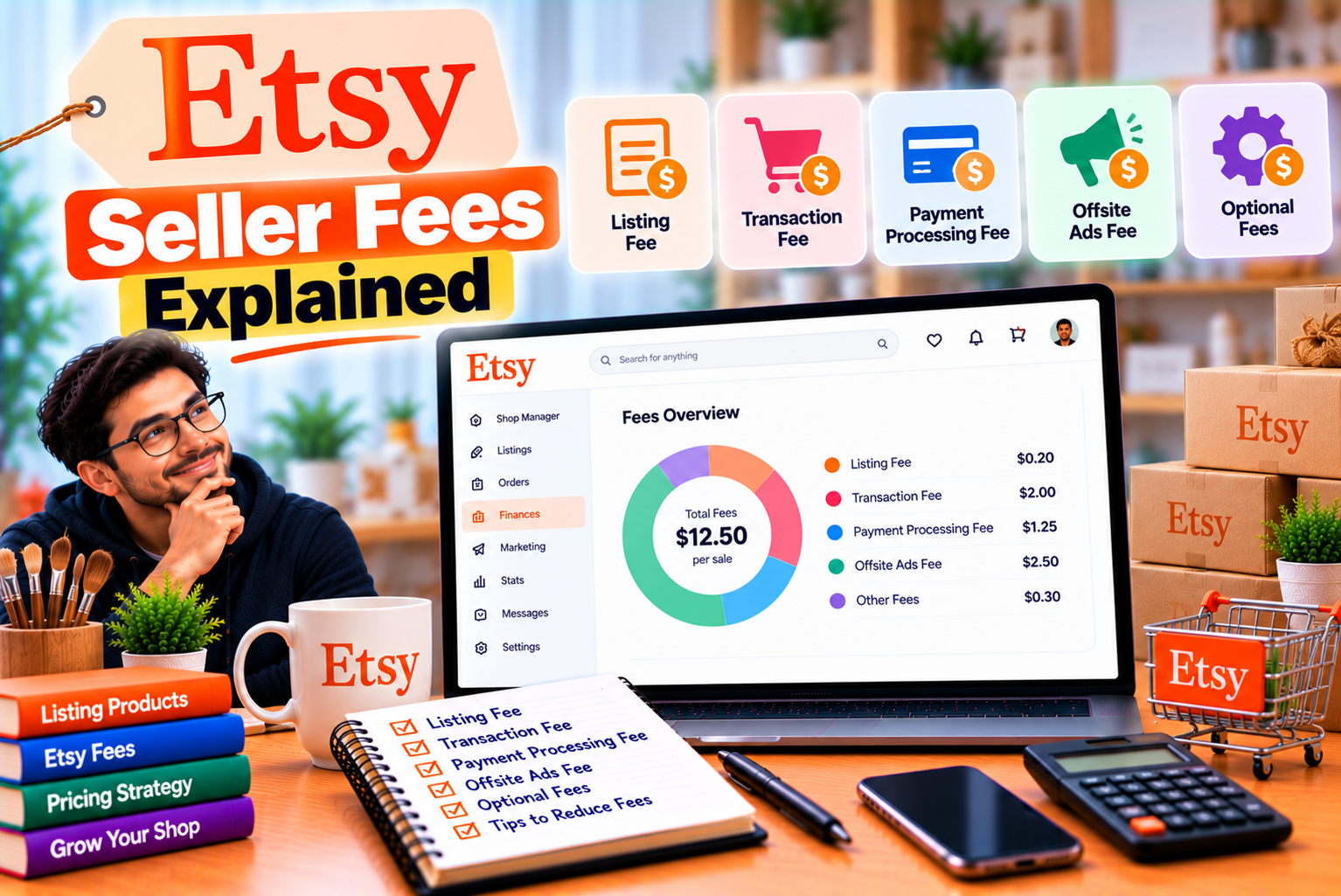
Etsy Seller Fees Explained
Etsy provides independent sellers with access to an established online marketplace where they can sell handmade products, original designs, vintage items, craft supplies, and digital downloads. However, opening an Etsy shop does not mean every sale translates directly into profit.
Like other e-commerce marketplaces, Etsy charges sellers for several services. These costs can include listing products, processing payments, completing sales, advertising products, and converting currencies. Depending on your location and selling activity, you may also encounter regulatory operating fees, taxes on seller fees, and additional payment or withdrawal charges.
Understanding these costs before launching a shop is essential. A product that appears profitable at first may generate much less income after marketplace fees, production expenses, shipping, packaging, advertising, and other business costs are deducted.
For example, a seller might price a handmade product at $30 and assume that the entire amount, minus production costs, represents profit. In reality, the seller may need to account for a listing fee, Etsy’s transaction fee, payment processing, advertising charges on qualifying orders, and other applicable costs.
In this guide, we explain Etsy seller fees in detail, including how the major charges work, which fees apply before or after a sale, how to calculate your net revenue, and how sellers can price products more accurately.
We also cover Etsy’s fee structure for sellers in India, where payment processing, regulatory operating fees, and Payoneer-related charges require particular attention.
Quick takeaway: Etsy’s standard listing fee is $0.20 per listing, and its transaction fee is 6.5% of the applicable order amount. Payment processing fees vary by country. Additional charges may apply depending on advertising, currency conversion, seller location, and other services used. Always check Etsy’s current official fee schedule for your country before calculating profitability.
What Are Etsy Seller Fees?
Etsy seller fees are charges associated with using the platform to list products, process customer payments, complete sales, and access optional services.
Some fees apply even when a product does not sell, while others are deducted only when a qualifying transaction occurs.
For example, Etsy generally charges a listing fee when you publish a product. By contrast, the transaction fee is charged when a sale occurs.
This distinction matters because sellers must budget for both operating expenses and sales-related expenses.
The Main Types of Etsy Seller Fees
| Fee Type | What It Covers | When It Applies |
| Shop setup fee | Initial shop-opening process | When Etsy requires a setup fee |
| Listing fee | Publishing a product listing | When a listing is created or renewed |
| Transaction fee | Etsy’s marketplace selling service | When an applicable sale occurs |
| Payment processing fee | Processing a customer’s payment | When a transaction uses Etsy Payments |
| Regulatory operating fee | Certain location-specific operating costs | On qualifying transactions in applicable countries |
| Offsite Ads fee | Sales attributed to Etsy’s external advertising | When a qualifying attributed sale occurs |
| Etsy Ads cost | Promoting listings within Etsy | When advertising charges accrue |
| Currency conversion fee | Converting sales funds between currencies | When the relevant currency conversion applies |
| Shipping label cost | Purchasing eligible shipping labels through Etsy | When a seller purchases a label |
| Etsy Plus subscription | Optional enhanced shop features | While the subscription is active |
| Taxes on seller fees | Applicable taxes charged on Etsy’s services | Where required by law |
Not every seller pays every fee. Your total depends on your country, payment setup, sales volume, advertising participation, currency settings, and use of optional services.
Etsy also updates its policies periodically, so treat the official fee schedule as the final reference when opening or operating a shop.
1. Etsy Listing Fees Explained
A listing fee is the charge Etsy applies when you publish a product for sale on its marketplace.
According to Etsy’s published fee policy, the standard listing fee is $0.20 USD per listing.
This fee generally applies whether or not the product sells.
For a new seller, listing fees are among the easiest Etsy expenses to overlook because they occur before revenue is generated.
How Much Does Etsy Charge Per Listing?
The standard fee structure works as follows:
| Listing Activity | Standard Listing Fee |
| Publish one listing | $0.20 |
| Publish 10 listings | $2.00 |
| Publish 50 listings | $10.00 |
| Publish 100 listings | $20.00 |
| Publish 250 listings | $50.00 |
| Publish 500 listings | $100.00 |
These calculations represent the basic listing fees only. They exclude applicable taxes, currency conversion effects, and other selling costs.
Do You Pay Etsy Listing Fees Even If Your Product Does Not Sell?
Yes. The standard listing fee is generally charged when you publish a listing, regardless of whether the product attracts a buyer.
For example, suppose you publish 50 products at $0.20 each.
Your initial listing expense would be:
50 × $0.20 = $10.00
If none of those products sells, you would still have incurred the $10 listing expense.
This is why sellers should evaluate product demand before investing heavily in listings.
How Long Does an Etsy Listing Remain Active?
Etsy listings generally expire after four months.
When automatic renewal is enabled, an eligible listing may renew automatically at the end of its listing period, triggering another $0.20 fee.
Sellers can generally manage automatic renewal settings through their Listings Manager.
This is useful for products that remain available over time, but it also means an inactive listing can continue generating fees if it is automatically renewed.
Example: You publish 100 listings and allow all of them to renew once after four months.
The initial listing expense is $20. If all 100 listings renew, another $20 is charged, bringing the combined listing expense to $40, before any applicable taxes or other costs.
What Happens When a Listing Sells?
If you sell an item from a listing, Etsy’s listing-fee rules may result in another $0.20 charge when the listing renews for the next available quantity.
For listings containing multiple quantities, an additional listing fee may apply to each extra item sold beyond the quantity already covered by the original listing fee.
For example, if a buyer purchases three units from a multi-quantity listing, the applicable listing charges may include the original $0.20 listing fee plus $0.20 for each additional quantity sold.
The precise fee treatment depends on how the listing is configured and how the order is processed.
How to Reduce Unnecessary Listing Fees
You cannot eliminate the standard listing fee for ordinary paid listings, but you can avoid unnecessary spending.
Consider these practices:
- Research product demand before publishing large numbers of listings.
- Improve existing listings instead of repeatedly creating duplicates.
- Monitor automatic renewal settings.
- Remove or deactivate products you no longer intend to sell.
- Track listing expenses separately from sales-related fees.
- Evaluate listing performance before expanding your catalog.
These steps can help you control costs without sacrificing product quality or search visibility.
2. Etsy Transaction Fees Explained
Etsy charges a transaction fee when a qualifying sale occurs through its marketplace.
The standard transaction fee is 6.5% of the applicable order amount.
This fee is separate from the listing fee and payment processing fee.
Under Etsy’s published policy, the transaction fee generally applies to the product price and amounts charged for shipping and gift wrapping. Optional personalization charges included in the displayed price can also form part of the fee calculation.
For sellers outside the United States, the applicable transaction-fee calculation can include certain taxes that the seller is responsible for, according to Etsy’s policy.
How Does the 6.5% Transaction Fee Work?
Suppose you sell a handmade product for $40 and charge $5 for shipping.
The applicable transaction-fee base is:
$40 + $5 = $45
The transaction fee is:
$45 × 6.5% = $2.925
Rounded for illustration, the fee is approximately $2.93.
This example excludes payment processing, listing fees, advertising, taxes on Etsy’s services, and other potential charges.
Is the Transaction Fee Charged on Shipping?
Yes. Etsy’s transaction fee generally applies to the shipping amount you charge the buyer.
For example, if your product costs $25 and you charge $8 for shipping, the transaction fee is generally calculated on the combined applicable amount rather than only the $25 product price.
This matters when setting shipping prices.
A seller who treats shipping as a separate, fee-free expense may underestimate the actual cost of fulfilling an order.
Is the Transaction Fee Different From the Payment Processing Fee?
Yes. These are two separate charges.
The transaction fee covers Etsy’s marketplace selling service, while the payment processing fee relates to processing the buyer’s payment through Etsy Payments.
Both may apply to the same order.
For instance, if a seller’s payment processing fee is 3% plus a fixed amount, the seller must account for that charge in addition to Etsy’s 6.5% transaction fee.
The exact payment processing rate depends on the seller’s country.
Transaction Fee Calculation Examples
| Applicable Order Amount | Transaction Fee at 6.5% |
| $10 | $0.65 |
| $20 | $1.30 |
| $30 | $1.95 |
| $50 | $3.25 |
| $75 | $4.88 |
| $100 | $6.50 |
| $250 | $16.25 |
| $500 | $32.50 |
These figures illustrate the standard percentage calculation and exclude other charges.
How Can Sellers Account for Transaction Fees?
The easiest approach is to include marketplace fees in your product pricing model.
Before publishing a product, estimate:
- The selling price.
- The amount charged for shipping.
- The transaction fee.
- The payment processing fee.
- The listing fee.
- Any applicable regulatory operating fee.
- Advertising charges where relevant.
- Production and fulfillment expenses.
- Taxes and other business costs.
This gives you a more realistic estimate of the amount remaining after a sale.
3. Etsy Payment Processing Fees
Payment processing fees are charged for transactions processed through Etsy Payments.
Unlike the standard listing fee, payment processing charges generally include a percentage of the transaction amount plus a fixed fee.
The rate varies by the country associated with the seller’s payment account.
This means sellers should not automatically use the US payment processing rate when calculating fees for shops registered in India, the United Kingdom, Canada, Australia, or another market.
How Do Etsy Payment Processing Fees Work?
The payment processing fee is generally calculated on the total payment amount covered by Etsy’s policy, including applicable shipping charges and taxes.
The fee is deducted through the seller’s Etsy Payment account.
Consider an illustrative US-based transaction with a payment processing rate of 3% plus $0.25.
If the applicable transaction amount is $50:
Percentage charge:
$50 × 3% = $1.50
Fixed charge:
$0.25
Total payment processing fee:
$1.50 + $0.25 = $1.75
The actual rate must be checked for the seller’s country and current payment setup.
Payment Processing Fees by Country
Payment processing rates are not universal.
For example, Etsy’s published guidance lists the following rates for selected markets. These are reference examples and should be rechecked before publication or use in a business forecast.
| Seller Location | Published Payment Processing Rate |
| United States | 3% + $0.25 USD |
| United Kingdom | 4% + £0.20 GBP |
| India | 5% + ₹25 INR |
| Canada | Varies by applicable domestic or international transaction conditions and the published Canadian rate |
| Australia | Check Etsy’s current country-specific fee schedule |
Rates and transaction conditions can change. Always consult Etsy’s official payment processing fee table for the applicable country.
Why Payment Processing Fees Matter
Payment processing can have a noticeable impact on low-priced products because the fixed component represents a larger percentage of the sale.
Consider two orders using the illustrative US rate of 3% plus $0.25.
Order A: $10 sale
- Percentage charge: $0.30
- Fixed charge: $0.25
- Total: $0.55
Processing cost as a percentage of the sale: 5.5%.
Order B: $100 sale
- Percentage charge: $3.00
- Fixed charge: $0.25
- Total: $3.25
Processing cost as a percentage of the sale: 3.25%.
The fixed fee has a greater relative impact on the smaller order.
This is one reason sellers should consider production costs, order values, and packaging expenses when pricing low-cost products.
4. Etsy Shop Setup Fees
Etsy may charge a one-time shop setup fee when a seller opens a new shop.
The amount can vary by location and the onboarding process. If Etsy requires this payment, the amount is displayed during shop setup before the seller completes the relevant steps.
The setup fee is separate from listing fees and ongoing transaction costs.
Because it is not a universal fixed amount for every seller, do not assume that opening an Etsy shop will always cost the same amount.
What Should New Sellers Budget For?
Before opening a shop, consider these initial expenses:
- Any setup fee displayed during onboarding.
- Initial listing fees.
- Product photography.
- Sample products and materials.
- Packaging.
- Branding and design.
- Tools or equipment required for production.
- Any required business registration or compliance expenses.
The Etsy setup fee is only one part of the startup budget.
If you plan to sell physical products, production and shipping preparations may require significantly more investment than the platform’s basic listing fees.
5. Etsy Offsite Ads Fees
Etsy Offsite Ads is an advertising program through which Etsy promotes eligible sellers’ products on external platforms and websites.
When an order is attributed to an Offsite Ads placement, the seller may be charged an advertising fee under Etsy’s rules.
The fee is different from the ordinary transaction fee and from Etsy Ads, which promotes products within Etsy.
How Much Does Etsy Charge for Offsite Ads?
Etsy’s standard Offsite Ads fee structure is:
- 15% for qualifying sellers whose shop has not crossed the applicable $10,000 USD sales threshold during the relevant 365-day period.
- 12% for qualifying sellers whose shop has reached or exceeded the applicable $10,000 USD threshold during the relevant 365-day period.
A maximum fee of $100 USD per attributed order applies under the program’s standard rules.
Eligibility, participation requirements, attribution rules, and the threshold calculation are governed by Etsy’s current advertising policy.
For shops below the threshold, participation may be optional. Shops that reach the applicable threshold are generally required to participate, subject to Etsy’s policy.
Confirm your shop’s current status and obligations before calculating the fee.
Example of a 15% Offsite Ads Fee
Suppose a qualifying order has an applicable advertising-fee base of $100.
At a 15% rate:
$100 × 15% = $15
The Offsite Ads charge would be $15 before accounting for other applicable fees and expenses.
Example of a 12% Offsite Ads Fee
Suppose a qualifying order has an applicable advertising-fee base of $100.
At a 12% rate:
$100 × 12% = $12
The Offsite Ads charge would be $12 before accounting for other fees and costs.
These examples illustrate the percentage calculation. The actual fee base and attribution conditions must be checked against Etsy’s current policy.
Do Offsite Ads Fees Apply to Every Sale?
No. An Offsite Ads fee generally applies to a qualifying order attributed to Etsy’s external advertising program.
If an order does not meet the program’s attribution conditions, the Offsite Ads fee may not apply.
However, sellers should understand the attribution rules before assuming a sale is exempt.
Are Offsite Ads Worth It?
Offsite Ads can help sellers reach customers beyond Etsy’s marketplace.
They may be useful for products with strong margins and demand, particularly when external exposure introduces new customers to the shop.
However, a 12% or 15% advertising fee can reduce profit substantially.
Before evaluating performance, calculate the remaining contribution after:
- Product cost.
- Transaction fees.
- Payment processing.
- Listing fees.
- Offsite Ads charges.
- Shipping and packaging.
- Other applicable costs.
An advertising-driven sale is only valuable when the resulting contribution supports the business’s financial goals.
6. Etsy Ads Costs
Etsy Ads allows sellers to promote their products within Etsy’s marketplace.
Unlike Offsite Ads, which involves Etsy promoting products externally, Etsy Ads is managed through the seller’s advertising settings and budget.
Advertising costs vary according to the campaign and the clicks or other billable activity covered by the program.
Sellers should review their current campaign settings and the charges shown in their Payment account.
How Much Should You Spend on Etsy Ads?
There is no universal advertising budget that works for every shop.
A seller offering low-margin products may have little room for advertising expenses. A seller with higher margins may be able to invest more in product promotion.
Before running ads, estimate how much contribution each order can generate.
For example, if your product generates $15 in contribution before advertising, spending $10 to acquire an order leaves $5 before other business overheads.
If advertising costs exceed the contribution available from a sale, the campaign may lose money even if it generates revenue.
How to Monitor Etsy Advertising Costs
Review:
- Daily advertising spend.
- Clicks and impressions.
- Orders attributed to advertising.
- Revenue from advertised listings.
- Cost per order.
- Conversion rate.
- Contribution after product and marketplace costs.
Do not evaluate campaigns using revenue alone. A campaign that generates substantial sales may still be unprofitable if its costs are too high.
7. Etsy Regulatory Operating Fees
Etsy charges regulatory operating fees to sellers in certain countries.
These fees are additional to the platform’s standard selling fees and apply according to seller location and the relevant country-specific rules.
Etsy’s published guidance lists a regulatory operating fee of 0.05% for sellers in India.
Other countries have different rates.
For applicable transactions, the fee generally applies to the item price and shipping costs, including gift wrapping and personalization where relevant, subject to Etsy’s detailed policy.
Example of the Indian Regulatory Operating Fee
Suppose an eligible Indian shop has an applicable fee base of ₹10,000.
At 0.05%:
₹10,000 × 0.0005 = ₹5
The illustrative regulatory operating fee would be ₹5 before considering any applicable tax on that fee.
The actual fee base must be checked against Etsy’s policy and the details of the transaction.
Why Does Etsy Charge This Fee?
Etsy explains that regulatory operating fees help cover increased operating costs associated with regulations in certain countries.
The fee is charged in addition to other applicable selling costs.
Sellers should include it in their pricing calculations rather than treating it as an unexpected deduction.
8. Etsy Currency Conversion Fees
Currency conversion can create additional costs when the currency used for your listings differs from the currency of your Etsy Payment account.
Etsy’s published policy specifies a 2.5% currency conversion fee when the relevant conversion applies.
This charge is separate from the ordinary transaction and payment processing fees.
How Does Currency Conversion Work?
Suppose your shop lists products in one currency, but your Payment account operates in another.
Etsy may need to convert the relevant sales amount into the payment account currency.
When the policy’s currency conversion fee applies, the fee is calculated at 2.5% of the relevant sale amount.
For example, on an eligible $200 equivalent amount:
$200 × 2.5% = $5
The illustrative conversion fee would be $5, before other costs.
Actual currency conversion rates and the final amount credited to your account may vary.
How Can Sellers Avoid Unnecessary Conversion Costs?
Etsy recommends using the same currency for listings and the Payment account to avoid the relevant foreign-exchange charge.
Before choosing a shop currency, consider:
- The currency in which your costs are paid.
- The currency of your payment account.
- Your target customer markets.
- The currencies displayed to buyers.
- Any currency conversion fees.
- Exchange-rate movements.
- The currency in which your business tracks profit.
A suitable currency setup can simplify accounting and reduce avoidable conversion costs.
9. Etsy Fees for Sellers in India
Indian sellers need to consider the standard Etsy fees alongside India-specific payment processing, regulatory operating, and payment withdrawal arrangements.
Etsy’s published guidance states that Indian sellers enrolled in Etsy Payments use a Payoneer Payment Account to receive their sales funds.
The same guidance states that sellers must have a valid and regular GSTIN on file to enroll in Etsy Payments.
Etsy also states that Indian shops enrolled in Etsy Payments cannot currently accept domestic sales through Etsy.
These requirements are particularly important for sellers who plan to operate a shop from India.
Main Etsy Fees for Indian Sellers
| Fee Type | Published Amount or Rule |
| Listing fee | $0.20 USD per listing |
| Transaction fee | 6.5% of the applicable order amount |
| Payment processing fee | 5% + ₹25 INR |
| Regulatory operating fee | 0.05% on the applicable fee base |
| Currency conversion | 2.5% when the relevant conversion applies |
| Shop setup fee | Varies; shown during onboarding if required |
| Offsite Ads | Applicable program rate when a qualifying sale is attributed |
| Etsy Ads | Depends on advertising activity |
| Payoneer charges | Additional fees may apply, depending on withdrawal and conversion arrangements |
| Taxes on Etsy fees | May apply according to applicable rules |
The figures above reflect Etsy’s published guidance reviewed for this article. Verify the latest fee schedule and eligibility requirements before opening a shop or changing your pricing.
How Indian Sellers Receive Etsy Payments
Etsy’s published India-specific payment guidance describes the following arrangement:
- Enroll in Etsy Payments if eligible.
- Provide a valid GSTIN as required.
- Connect or create an eligible Payoneer Payment Account.
- Receive sales funds through the supported payment arrangement.
- Review the currency conversion and withdrawal costs that may apply when funds are transferred to your bank account.
Etsy states that it deposits funds to Indian sellers’ Payoneer accounts in USD under its specified payout schedule. Payoneer may then convert and transfer funds to the seller’s bank account, with applicable fees.
Because payment schedules and requirements can change, check the latest official instructions before relying on a particular payout time.
Example: Calculating Fees for an Indian Etsy Seller
Suppose an eligible Indian seller completes an order with the following illustrative values:
- Product price: ₹3,000
- Shipping charged to the buyer: ₹500
- Applicable transaction-fee base: ₹3,500
Transaction fee
₹3,500 × 6.5% = ₹227.50
Payment processing fee
Assuming the applicable processing base is ₹3,500:
₹3,500 × 5% + ₹25 = ₹200
Regulatory operating fee
Assuming the applicable fee base is ₹3,500:
₹3,500 × 0.05% = ₹1.75
Listing fee
The standard listing fee is $0.20 USD, converted as applicable for the seller’s Payment account.
The three percentage or payment-processing calculations above total:
₹227.50 + ₹200 + ₹1.75 = ₹429.25
This is not the final total cost of the order. It excludes the listing fee, possible taxes on Etsy’s fees, production costs, packaging, actual shipping expenses, any applicable advertising fees, and Payoneer conversion or withdrawal charges.
The payment processing calculation is illustrative. Etsy’s precise processing base and fee treatment should be verified against the current policy and actual order statement.
Important Considerations for Indian Sellers
Before opening an Etsy shop from India:
- Confirm current seller eligibility and onboarding requirements.
- Verify GSTIN requirements.
- Check Etsy Payments availability for your account.
- Review Payoneer setup and withdrawal conditions.
- Understand the limitations concerning domestic sales.
- Calculate the impact of USD-to-INR conversion.
- Include shipping and international fulfillment costs.
- Confirm your tax and business compliance obligations.
For sellers in India, the combination of marketplace fees, international logistics, payment processing, and currency conversion can materially affect profitability.
10. Etsy Plus Subscription Fees
Etsy Plus is an optional subscription that offers additional shop-management and promotional features.
It is not required to use Etsy’s standard marketplace.
Etsy has published Etsy Plus pricing at $10 USD per month, but subscription pricing, availability, included benefits, and any applicable taxes should be checked against the current subscription information before subscribing.
Etsy Plus may be useful for sellers who can make practical use of its included benefits. However, it does not eliminate standard listing, transaction, or payment processing fees.
Should You Pay for Etsy Plus?
The subscription makes the most sense when the additional features provide enough value to justify the monthly cost.
Before subscribing, consider:
- Whether you need the included customization tools.
- Whether the promotional credits are useful to your shop.
- Whether you can use the included listing credits.
- Whether the subscription supports your sales strategy.
- Whether the cost fits your current budget.
New sellers with limited demand may benefit more from improving product photography, descriptions, pricing, and customer service before adding another recurring expense.
11. Other Etsy Selling Costs You Should Know
The main marketplace fees are only part of the total cost of running an Etsy shop.
Depending on your business, additional expenses can include:
Shipping Labels
Etsy offers shipping-label purchasing in certain locations.
The price depends on the carrier, package dimensions, weight, origin, destination, and any additional services.
Shipping-label charges are separate from the transaction fee on shipping amounts charged to buyers.
Packaging Materials
Physical products may require boxes, mailers, protective materials, labels, and branded packaging.
These expenses should be allocated to each order when calculating profitability.
Production Costs
Handmade products require materials, labor, equipment, and potentially production space.
Digital products may have software, design, licensing, and development costs.
Taxes on Etsy Fees
Etsy’s published policy states that applicable VAT or similar taxes may be charged on seller fees, depending on the circumstances.
Sellers should check the taxes reflected in their Payment account and understand their local tax obligations.
Payoneer Fees
For eligible Indian sellers, Payoneer is part of the payment arrangement described by Etsy.
Payoneer may apply currency conversion, withdrawal, or other fees depending on the account and transaction.
Review the relevant Payoneer terms rather than assuming all received sales funds can be withdrawn without additional costs.
Refunds and Order Adjustments
Returns, refunds, cancellations, and other adjustments can affect the final financial outcome of an order.
Review Etsy’s fee policies to understand how individual fees are handled when an order is refunded or otherwise adjusted.
Business Overheads
Other costs may include:
- Photography equipment.
- Design software.
- Product samples.
- Marketing tools.
- Accounting software.
- Business registration.
- Insurance.
- Workspace expenses.
- Equipment maintenance.
These expenses may not appear in Etsy’s Payment account, but they still matter when calculating business profit.
12. Etsy Seller Fees Example: Calculate Your Total Cost
Understanding individual fees is useful, but sellers ultimately need to know how much money remains after an order.
Let’s work through an illustrative example.
Suppose a seller lists a product for $50 and charges $8 for shipping.
Assume the seller uses the illustrative US payment processing rate of 3% plus $0.25.
The order is not attributed to Offsite Ads, and no additional country-specific operating fee or currency conversion fee applies.
Order Details
| Item | Amount |
| Product price | $50.00 |
| Shipping charged to buyer | $8.00 |
| Total order amount used in this example | $58.00 |
Step 1: Calculate the Transaction Fee
$58 × 6.5% = $3.77
Transaction fee: $3.77
Step 2: Calculate Payment Processing
$58 × 3% = $1.74
Add the fixed fee of $0.25:
$1.74 + $0.25 = $1.99
Payment processing fee: $1.99
Step 3: Add the Listing Fee
Listing fee: $0.20
Step 4: Calculate Total Marketplace Fees
$3.77 + $1.99 + $0.20 = $5.96
Total of the three illustrated fees: $5.96
Step 5: Calculate the Amount Remaining Before Other Expenses
$58 − $5.96 = $52.04
The seller has $52.04 remaining before subtracting the actual shipping cost, production costs, packaging, applicable taxes, advertising, and other business expenses.
If the seller’s actual shipping cost is $8, then:
$52.04 − $8 = $44.04
This leaves $44.04 before product production costs and other expenses.
Important: This is a simplified example, not a universal Etsy fee calculation. Actual fee bases, rounding, applicable taxes, country-specific processing rates, and additional charges depend on the transaction and seller location.
13. Etsy Seller Fees Calculator: A Simple Formula
You do not need a complicated financial model to estimate your basic Etsy selling costs.
You can start with a simple calculation.
Basic Marketplace Fee Formula
Estimated basic fees = Listing fee + Transaction fee + Payment processing fee
For sellers subject to other charges, extend the formula:
Estimated total selling fees = Basic fees + Regulatory operating fee + Applicable advertising fees + Currency conversion fee + Taxes on seller fees + Other applicable charges
This estimates marketplace and payment-related fees, not total business expenses.
Calculate Your Estimated Profit
A more useful formula is:
Estimated profit = Product revenue + Shipping revenue − Etsy fees − Actual shipping cost − Product cost − Packaging cost − Advertising cost − Other business expenses
This formula helps you distinguish revenue from profit.
For accurate results, use the actual fee bases and charges recorded in your Etsy Payment account.
Example of a Basic Fee Calculator
Consider a seller using the illustrative US payment processing rate of 3% plus $0.25.
| Input | Example Value |
| Product price | $40.00 |
| Shipping charged to buyer | $5.00 |
| Applicable order amount | $45.00 |
| Transaction fee rate | 6.5% |
| Payment processing rate | 3% + $0.25 |
| Listing fee | $0.20 |
| Transaction fee | $2.925 |
| Payment processing fee | $1.60 |
| Listing fee | $0.20 |
| Total of these three fees | $4.725 |
Rounded to the nearest cent, the three fees total approximately $4.73.
This calculation excludes production expenses, shipping costs, applicable taxes, advertising, currency conversion, and any other relevant charges.
14. How to Price Products After Etsy Fees
Pricing products correctly is one of the most important steps in building a sustainable Etsy business.
A price that covers only materials may leave you with little or no profit once selling fees and labor are included.
Include All Relevant Costs
Before setting a product price, estimate:
- Materials.
- Labor.
- Packaging.
- Shipping subsidy, if any.
- Listing fees.
- Transaction fees.
- Payment processing fees.
- Regulatory operating fees, where applicable.
- Advertising costs, where applicable.
- Taxes and other business expenses.
- Desired profit.
The final selling price should reflect the value of the product and the cost of delivering it profitably.
Example: Pricing a Handmade Product
Suppose your product has the following costs:
| Cost Component | Amount |
| Materials | $8.00 |
| Labor | $10.00 |
| Packaging | $2.00 |
| Allocated shipping expense | $5.00 |
| Total before marketplace fees | $25.00 |
If you sell the product for $40, your initial contribution before marketplace fees is:
$40 − $25 = $15
That $15 must still cover Etsy fees and any other costs not already included.
If your marketplace and payment fees total $4.50, the remaining contribution is:
$15 − $4.50 = $10.50
The seller’s actual profit may be lower after accounting for overheads and taxes.
This example illustrates why product pricing should be based on total cost rather than material cost alone.
Should You Increase Prices to Cover Etsy Fees?
Possibly, but price increases should reflect your overall business strategy.
Compare similar products, assess the value you provide, and determine whether customers are willing to pay the proposed price.
You should also consider the effects of higher prices on conversion rates and order volume.
The goal is not simply to charge more. It is to set a price that supports your costs, communicates the product’s value, and remains competitive in your market.
15. Seven Ways to Reduce Unnecessary Etsy Selling Costs
You cannot avoid every standard Etsy fee, but you can improve the financial efficiency of your shop.
1. Use the Correct Shop Currency
Where practical, aligning your listing currency with your Payment account currency can help avoid the relevant currency conversion fee.
Review the implications before changing your shop settings.
2. Monitor Automatic Listing Renewals
Check your listings regularly and review automatic renewal settings.
Remove products you no longer intend to sell and avoid allowing inactive listings to renew unnecessarily.
3. Evaluate Advertising Performance
Monitor the contribution generated by Etsy Ads and Offsite Ads rather than looking only at sales revenue.
Understand the program’s participation and attribution rules before calculating advertising profitability.
4. Price Shipping Carefully
Include packaging, carrier charges, and applicable transaction fees when deciding how much to charge for delivery.
Do not assume shipping revenue is exempt from marketplace fees.
5. Calculate Product-Level Profit
Different products can have very different margins.
A low-priced item may be profitable at scale but less attractive after fixed payment processing charges and fulfillment expenses.
Calculate margins separately for each important product category.
6. Review Your Payment Account
Use Etsy’s Payment account to monitor fee deductions, sales proceeds, and any outstanding amounts.
Regular reviews make it easier to identify unexpected charges and maintain accurate records.
7. Avoid Unnecessary Subscriptions
Optional tools and subscriptions should support a clear business need.
Before paying for Etsy Plus or other services, estimate whether the benefits justify the additional cost.
16. Is Etsy Worth Selling On After Fees?
Etsy can be a worthwhile marketplace for businesses that sell products aligned with its customer base.
However, the answer depends on product margins, order values, shipping costs, competition, and the seller’s ability to attract customers.
Etsy May Be Worth It If:
- Your products have sufficient margins.
- Your target audience shops for handmade or distinctive goods.
- Your products can be priced to cover materials and labor.
- You can manage shipping and customer service efficiently.
- You understand the marketplace’s fee structure.
- Your sales volume supports your operating costs.
Etsy May Be Less Attractive If:
- Your margins are extremely low.
- Your products are difficult to ship profitably.
- Your business relies heavily on paid advertising without sufficient contribution per order.
- You frequently incur currency conversion charges.
- Your product category faces intense price competition.
- Your operational costs exceed the revenue available from each order.
Etsy Fees Compared With Selling Through Your Own Website
Selling on Etsy and operating your own website involve different cost structures.
On Etsy, you pay marketplace-related fees and gain access to a platform where customers can discover products from multiple sellers.
With your own website, you may have greater control over the shopping experience and brand presentation, but you must account for website hosting, payment processing, marketing, maintenance, and customer acquisition.
The correct comparison is not simply Etsy fees versus website fees.
It is the total cost of acquiring customers and fulfilling orders through each channel.
A seller may benefit from Etsy’s marketplace exposure while gradually developing an independent website for long-term brand growth.
Etsy Seller Fees: Final Verdict
Etsy’s fee structure is manageable when sellers understand the costs and incorporate them into their pricing strategy.
The standard $0.20 listing fee makes it relatively straightforward to begin listing products, while the 6.5% transaction fee and country-specific payment processing fees create recurring costs as sales increase.
Additional charges can make a meaningful difference. Offsite Ads may apply to qualifying attributed orders, regulatory operating fees affect sellers in certain countries, and currency conversion can add expenses when the relevant currencies differ.
For Indian sellers, the published payment processing rate, GSTIN requirement, Payoneer payment arrangement, and domestic-sales limitations deserve particular attention.
Our Recommendation
Before launching an Etsy shop, create a spreadsheet that calculates the total cost and expected contribution for each product.
Include the selling price, shipping charged to the buyer, actual shipping expense, listing fee, transaction fee, payment processing fee, applicable regulatory fee, advertising costs, currency conversion, production expenses, and other relevant business costs.
Review the results regularly using your actual Etsy Payment account records.
Final verdict: Etsy can be a useful marketplace for creative businesses, but profitability depends on more than sales volume. Sellers who understand the fee structure, price products accurately, and monitor their expenses are better positioned to build a sustainable shop.
Frequently Asked Questions About Etsy Seller Fees
1. How much does Etsy charge sellers?
Etsy’s standard published fees include a $0.20 listing fee per listing and a 6.5% transaction fee on the applicable order amount. Payment processing fees vary by country, and additional fees may apply depending on advertising, currency conversion, location, and other services.
2. Is Etsy free to sell on?
No. Etsy generally charges listing fees and transaction fees, along with payment processing fees when applicable. A one-time shop setup fee may also be required during onboarding. Sellers may incur additional costs for advertising, currency conversion, taxes, and optional services.
3. How much is Etsy’s listing fee?
The standard listing fee is $0.20 USD per listing. It generally applies when a listing is created or renewed, even if the item does not sell.
4. Does Etsy charge listing fees for unsold products?
Yes. The standard listing fee is generally charged when a product is listed, regardless of whether it sells. Automatic renewals can also trigger additional listing fees.
5. How long does an Etsy listing last?
Etsy listings generally expire after four months. If automatic renewal is enabled, the listing may renew automatically and incur another listing fee.
6. What is Etsy’s transaction fee?
Etsy’s standard transaction fee is 6.5% of the applicable order amount. It generally applies to the product price and amounts charged for shipping and gift wrapping, subject to Etsy’s detailed policy.
7. Does Etsy charge transaction fees on shipping?
Yes. Etsy’s transaction fee generally applies to the shipping amount charged to the buyer. Sellers should account for this when setting delivery prices.
8. Are transaction fees and payment processing fees the same?
No. The transaction fee covers Etsy’s marketplace selling service, while the payment processing fee covers payment processing through Etsy Payments. Both may apply to the same order.
9. How much are Etsy payment processing fees?
Payment processing fees generally consist of a percentage of the applicable payment amount plus a fixed charge. The rate varies by country and should be verified using Etsy’s current official fee schedule.
10. What are Etsy seller fees in India?
Published fees for Indian sellers include the standard $0.20 listing fee, 6.5% transaction fee, payment processing at 5% plus ₹25 INR, and a 0.05% regulatory operating fee on the applicable fee base. Other charges may apply, including advertising, currency conversion, taxes, and Payoneer-related fees.
11. Do Indian sellers need GSTIN to sell on Etsy?
Etsy’s published guidance states that Indian sellers must have a valid and regular GSTIN on file to enroll in Etsy Payments. Sellers should verify the current onboarding requirements before opening a shop.
12. Can Indian Etsy sellers sell to domestic customers?
Etsy’s published India-specific payment guidance states that Indian shops enrolled in Etsy Payments cannot currently accept domestic sales through Etsy. Check Etsy’s latest country-specific guidance before planning your sales strategy.
13. Does Etsy charge a shop setup fee?
Etsy may charge a one-time setup fee when a seller opens a shop. The amount varies by location and is displayed during onboarding if required.
14. What is Etsy’s Offsite Ads fee?
Etsy’s standard Offsite Ads structure generally charges 15% for qualifying sellers below the applicable $10,000 USD sales threshold over the relevant 365-day period and 12% for qualifying sellers who have reached or exceeded that threshold. Program rules and a $100 USD maximum fee per attributed order apply under the standard structure.
15. Do Etsy Offsite Ads fees apply to every order?
No. The fee generally applies to qualifying orders attributed to Etsy’s external advertising program. Whether a fee applies depends on Etsy’s attribution rules and the seller’s participation requirements.
16. What is the difference between Etsy Ads and Offsite Ads?
Etsy Ads allows sellers to promote listings within Etsy’s marketplace. Offsite Ads involves Etsy promoting eligible products on external platforms and websites. Their billing methods and fee structures differ.
17. Does Etsy charge a currency conversion fee?
Etsy’s published policy specifies a 2.5% currency conversion fee when the relevant conversion applies because the listing currency differs from the Payment account currency. Sellers should check their current currency settings and policy.
18. What is Etsy’s regulatory operating fee?
It is an additional fee charged to sellers in certain countries. The rate depends on seller location. Etsy’s published guidance lists a 0.05% regulatory operating fee for India on the applicable fee base.
19. Does Etsy Plus eliminate standard seller fees?
No. Etsy Plus is an optional subscription that provides additional shop features. Standard listing, transaction, and applicable payment processing fees still apply.
20. How can I calculate my Etsy selling fees?
Start by adding the listing fee, transaction fee, and payment processing fee. Then include any applicable regulatory operating fee, advertising costs, currency conversion charges, and taxes on seller fees. Use your actual Payment account records for the most accurate calculation.
21. Does Etsy charge fees if I do not make any sales?
You may still incur listing fees and other charges associated with services you use, such as certain subscriptions or advertising activity. Transaction and payment processing fees generally depend on qualifying transactions.
22. How can I reduce Etsy fees?
You cannot avoid every standard fee, but you can monitor listing renewals, choose an appropriate shop currency, evaluate advertising performance, price shipping carefully, and avoid unnecessary subscriptions. You should also calculate profit at the product level.
23. Does Etsy charge tax on seller fees?
Applicable VAT or similar taxes may be charged on seller fees depending on your location and circumstances. Review the taxes shown in your Payment account and consult a qualified tax professional when necessary.
24. Does Etsy refund seller fees when an order is cancelled?
The treatment of fees depends on the type of fee, the transaction, and Etsy’s current policies. Review the applicable refund and cancellation rules rather than assuming every charge will be refunded.
25. Is selling on Etsy profitable after fees?
It can be profitable if product pricing covers production, marketplace fees, payment processing, shipping, packaging, advertising, taxes, and other expenses. Sellers should calculate contribution and profit rather than relying on gross sales alone.
Leave a Reply