

How to Write High-Converting Marketing Copy with Copymatic AI
Marketing copy is more than just words on a webpage—it is the bridge between a business and its customers. Whether you’re promoting a product, launching a new service, running paid advertisements, or sending an email campaign, the quality of your copy directly impacts engagement, click-through rates, lead generation, and sales.
In today’s competitive digital landscape, businesses have only a few seconds to capture attention. A compelling headline can encourage a visitor to keep reading, while a persuasive call-to-action (CTA) can turn that visitor into a paying customer. This is why effective copywriting remains one of the most valuable skills in digital marketing.
However, writing persuasive marketing copy consistently is not easy. Marketers often struggle with writer’s block, time constraints, and producing fresh ideas across multiple campaigns. This is where Copymatic AI Copywriting becomes a powerful assistant.
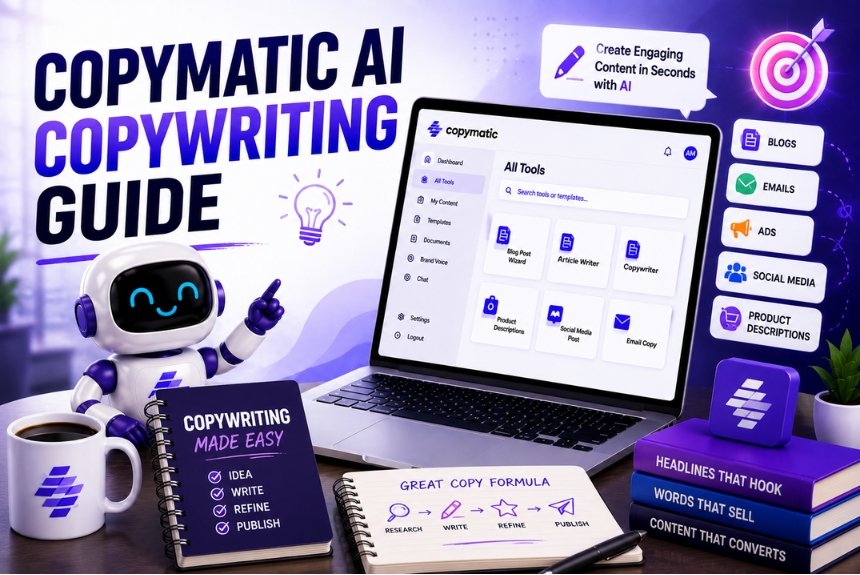
Copymatic AI uses artificial intelligence to help generate marketing content quickly, including headlines, product descriptions, advertisements, landing page copy, social media posts, and email campaigns. Rather than replacing experienced copywriters, it helps accelerate the brainstorming and drafting process, allowing marketers to spend more time refining strategy and improving conversions.
In this comprehensive guide, you’ll learn how to use Copymatic AI to create compelling marketing copy, understand proven copywriting frameworks, optimize content for conversions, and avoid common mistakes that reduce campaign performance.
Whether you’re a freelancer, business owner, digital marketer, ecommerce seller, or agency professional, this step-by-step tutorial will help you create persuasive copy that connects with your audience and drives measurable results.

What Is Copymatic AI Copywriting?
Copymatic AI Copywriting refers to using Copymatic’s artificial intelligence tools to generate persuasive marketing content for digital channels. Instead of manually writing every sentence, marketers provide prompts, keywords, and goals, and the AI produces structured drafts that can be refined for accuracy, tone, and brand consistency.
The platform supports multiple copywriting formats, including:
- Blog Articles
- Website Copy
- Product Descriptions
- Landing Pages
- Google Ads
- Facebook Ads
- Instagram Captions
- Email Campaigns
- Sales Pages
- Headlines
- Call-to-Action Buttons
- Press Releases
- Video Scripts
This versatility makes Copymatic a valuable productivity tool for marketers who create content across multiple platforms.
Why Marketing Copy Matters
Good marketing copy doesn’t just describe a product—it persuades people to take action.
Whether your goal is to generate leads, increase sales, encourage sign-ups, or build brand awareness, persuasive copy can make a significant difference in campaign performance.
Effective marketing copy helps businesses:
- Capture attention quickly.
- Build trust with potential customers.
- Clearly communicate value.
- Address customer pain points.
- Increase click-through rates (CTR).
- Improve conversion rates.
- Strengthen brand messaging.
- Support SEO and content marketing efforts.
- Drive measurable business results.
In competitive markets, even small improvements in messaging can lead to meaningful increases in engagement and revenue.

What Makes Great Marketing Copy?
High-converting copy is built on understanding people—not just products. Successful marketers focus on customer needs, motivations, and emotions before writing a single sentence.
Below are the core principles of effective marketing copy.
1. Understand Your Audience
Before writing, ask:
- Who is my ideal customer?
- What problem are they trying to solve?
- What motivates them?
- What objections might they have?
- What outcome are they hoping to achieve?
The better you understand your audience, the more relevant and persuasive your messaging becomes.
2. Focus on Benefits, Not Just Features
Many businesses make the mistake of listing technical features without explaining why they matter.
Feature
“AI generates blog posts in minutes.”
Benefit
“Save hours of writing time and publish more content without sacrificing quality.”
Customers care less about what a product does and more about how it improves their lives or businesses.
3. Build Trust
Persuasive copy should reduce uncertainty and build confidence.
Ways to establish trust include:
- Customer testimonials
- Case studies
- Industry expertise
- Performance data
- Transparent messaging
- Clear guarantees (where applicable)
Trust is often the deciding factor between a visitor leaving your website and becoming a customer.
4. Keep It Clear and Simple
Avoid unnecessary jargon or overly complex language.
Instead:
- Use short paragraphs.
- Write conversationally.
- Break information into bullet points.
- Highlight key benefits.
- Guide readers logically toward the next step.
Clear writing improves readability and helps readers make decisions faster.
Understanding Customer Psychology
Great copywriting is rooted in psychology. People buy based on emotion and justify their decisions with logic.
Successful copy addresses emotions such as:
- Saving time
- Increasing income
- Reducing stress
- Improving efficiency
- Achieving success
- Feeling confident
- Solving a frustrating problem
By speaking directly to these motivations, your copy becomes more relatable and persuasive.

Features vs. Benefits: A Critical Difference
One of the most common beginner mistakes is focusing only on product features.
Here’s the difference:
| Feature | Benefit |
| AI-powered writing | Create quality content faster and reduce manual effort. |
| SEO optimization | Improve the chances of ranking higher in search results. |
| Multiple templates | Generate content for blogs, ads, emails, and websites from one platform. |
| Long-form editor | Produce comprehensive articles more efficiently. |
| Readability analysis | Make your content easier for readers to understand. |
Whenever possible, translate every feature into a customer-focused benefit.
Proven Copywriting Frameworks
Professional copywriters rarely write without a structure. Frameworks help organize ideas, maintain flow, and guide readers toward action.
The AIDA Framework
AIDA stands for:
Attention
Capture interest with a compelling headline.
Example:
“Struggling to Write Marketing Copy That Converts?”
Interest
Explain the problem and introduce your solution.
Example:
“Discover how AI can help you create persuasive marketing content in a fraction of the time.”
Desire
Show the benefits and outcomes.
Example:
“Generate engaging headlines, compelling emails, and high-converting landing pages without starting from scratch.”
Action
Encourage readers to take the next step.
Example:
“Start creating better marketing copy today.”
The PAS Framework
Another highly effective structure is PAS:
Problem
Identify the reader’s challenge.
Example:
“Writing marketing copy takes too much time.”
Agitate
Highlight the consequences.
Example:
“Without strong messaging, campaigns struggle to attract clicks, leads, and conversions.”
Solution
Present your offer.
Example:
“Copymatic AI helps generate persuasive marketing copy faster, allowing you to focus on strategy and optimization.”
Before–After–Bridge (BAB)
This framework paints a clear picture of transformation.
Before
Your current situation.
“You’re spending hours writing every campaign.”
After
The desired outcome.
“Imagine creating polished marketing copy in minutes.”
Bridge
How to get there.
“Use Copymatic AI to accelerate drafting while refining the final copy with your expertise.”
Writing High-Converting Headlines
Your headline is often the first—and sometimes only—chance to capture attention.
A strong headline should:
- Spark curiosity.
- Clearly communicate value.
- Address a pain point.
- Include your target keyword when appropriate.
- Encourage readers to continue.
Examples
- How to Write High-Converting Marketing Copy with Copymatic AI
- 10 Copywriting Tips That Increase Conversions
- Create Better Ads Faster Using AI Copywriting
- The Beginner’s Guide to AI Marketing Copy
- Write Landing Pages That Convert More Visitors into Customers
Writing High-Converting Product Descriptions with Copymatic AI
A product description is far more than a list of features—it serves as a sales conversation between your business and potential customers. Whether you’re selling physical products, digital downloads, SaaS subscriptions, or professional services, a compelling product description can influence purchasing decisions and improve conversion rates.
Many ecommerce businesses make the mistake of writing generic descriptions copied from manufacturers. These descriptions often fail to communicate value or address customer pain points.
With Copymatic AI Copywriting, marketers can generate structured product descriptions in minutes, then refine them with brand-specific messaging, customer benefits, and SEO optimization.

Why Product Descriptions Matter
An effective product description should answer three key questions:
- What is this product?
- Why should someone buy it?
- How will it improve the customer’s life?
Instead of simply listing specifications, focus on communicating outcomes and solving problems.
Weak Example
AI Writing Software with multiple templates.
Strong Example
Create professional blogs, advertisements, emails, and website copy in minutes with AI-powered writing tools that save time and improve productivity.
Notice how the second example focuses on the benefit rather than simply describing features.
Structure of a High-Converting Product Description
Professional copywriters often follow this structure:
1. Attention-Grabbing Opening
Immediately explain what makes the product valuable.
2. Problem Statement
Highlight the challenge customers face.
3. Solution
Explain how the product solves that challenge.
4. Benefits
Focus on outcomes rather than technical details.
5. Features
Present specifications that support the benefits.
6. Call-to-Action
Encourage readers to take the next step.
Example AI Prompt
Instead of writing:
Write a product description.
Try:
Write a persuasive product description for an AI copywriting software designed for bloggers and digital marketers. Highlight productivity, SEO optimization, multiple writing templates, and ease of use using a professional yet conversational tone.
Specific prompts almost always produce stronger first drafts.
Writing Facebook Ad Copy with Copymatic AI
Facebook advertising is highly competitive. Users scroll through hundreds of posts daily, giving advertisers only a few seconds to capture attention.
A successful Facebook ad typically consists of:
- Primary Text
- Headline
- Description
- Call-to-Action
Copymatic can help generate multiple variations that marketers can test and refine.
Facebook Copywriting Formula
Hook
Capture attention immediately.
Example:
Still spending hours writing marketing content?
Problem
Highlight the challenge.
Example:
Creating blogs, ads, and emails manually takes valuable time away from growing your business.
Solution
Introduce your offer.
Example:
Use AI-powered copywriting to generate high-quality marketing content in minutes.
CTA
Encourage action.
Example:
Start creating smarter marketing campaigns today.
Best Practices for Facebook Ads
- Keep the opening sentence concise.
- Focus on customer benefits.
- Use conversational language.
- Avoid excessive promotional wording.
- Test multiple headlines and CTAs.
- Include a clear value proposition.
Writing Google Ads Copy
Google Ads differ from social media because users are actively searching for solutions.
Your copy should match their intent.
A Google Search Ad usually includes:
- Headlines
- Descriptions
- Display URL
- Call-to-Action
Example Headlines
- AI Copywriting Software
- Write Better Marketing Copy
- SEO Content in Minutes
- Boost Your Content Workflow
- AI Marketing Assistant
Example Description
Generate blogs, ads, emails, and website copy faster with AI-powered writing tools designed to improve productivity and support your marketing goals.
Tips for Google Ads
- Include the target keyword naturally.
- Highlight unique value.
- Focus on user intent.
- Keep messaging clear and concise.
- Align landing pages with ad copy.
Consistency between ads and landing pages improves user experience and can contribute to stronger campaign performance.
Creating Effective Email Marketing Copy
Email marketing remains one of the highest-return digital marketing channels when campaigns are relevant and well-targeted.
Instead of sending generic messages, successful marketers personalize communication and focus on customer value.
Copymatic can assist in generating drafts for:
- Welcome Emails
- Product Launches
- Promotional Campaigns
- Abandoned Cart Emails
- Re-engagement Campaigns
- Newsletters
- Seasonal Offers
Anatomy of a High-Converting Email
Subject Line
Capture attention.
Example:
Ready to Create Better Marketing Copy Faster?
Opening
Personalize the message.
Example:
Hi Sarah,
Creating compelling marketing copy shouldn’t consume your entire day.
Body
Explain benefits.
- Save time
- Improve productivity
- Generate multiple copy variations
- Simplify campaign creation
CTA
Guide readers toward one action.
Example:
Explore AI-powered copywriting today.
Email Copywriting Tips
- Write naturally.
- Keep paragraphs short.
- Focus on one objective.
- Avoid excessive promotional language.
- End with one clear CTA.
Writing Landing Page Copy
Landing pages exist for one purpose—to encourage visitors to take a specific action.
Unlike blog articles, landing pages should remain focused and avoid unnecessary distractions.
Essential Landing Page Sections
Hero Section
Communicate value immediately.
Example:
Write Better Marketing Copy Faster with AI
Supporting Text:
Generate blogs, ads, landing pages, emails, and social media content from one intuitive platform.
CTA:
Start Writing Today
Benefits Section
Instead of listing features, explain outcomes.
Examples:
- Save hours every week.
- Create consistent marketing campaigns.
- Improve productivity.
- Generate content ideas faster.
- Scale your marketing workflow.
Social Proof
Build trust using:
- Testimonials
- Reviews
- Success Stories
- Customer Numbers
- Industry Recognition
Frequently Asked Questions
Reduce uncertainty by answering common objections before asking visitors to convert.

Writing High-Converting CTAs
The Call-to-Action (CTA) is often the deciding factor between a visitor leaving your page and taking the next step.
Weak CTAs:
- Submit
- Click Here
- Learn More
Stronger CTAs:
- Start Writing Smarter
- Generate Your First Draft
- Boost Your Marketing Today
- Explore AI Copywriting
- Create Better Content Now
- Improve Your Campaigns
- Try AI-Powered Copywriting
Good CTAs are:
- Action-oriented
- Benefit-driven
- Clear
- Specific
Editing AI Output
AI-generated copy is only the beginning.
Professional marketers spend significant time refining content before publication.
Step 1: Verify Accuracy
Check:
- Product information
- Statistics
- Pricing
- Technical claims
Never assume AI-generated information is completely accurate.
Step 2: Match Brand Voice
Every business has its own personality.
Ask:
Does this sound like our brand?
Adjust wording to maintain consistency.
Step 3: Remove Repetition
AI occasionally repeats:
- Keywords
- Benefits
- Ideas
- Sentences
Combine similar sections and eliminate unnecessary repetition.
Step 4: Improve Readability
Use:
- Short paragraphs
- Bullet lists
- Tables
- Clear headings
- Logical transitions
Formatting enhances user experience and keeps readers engaged.
Step 5: Strengthen Persuasion
Ask yourself:
- Have I explained the customer’s problem?
- Did I focus on benefits?
- Is the value proposition clear?
- Does the CTA motivate action?
If not, revise before publishing.
AI Prompt Templates for Better Marketing Copy
The quality of AI output depends heavily on the prompt you provide. Detailed prompts produce more focused and persuasive results.
Product Description Prompt
Write a persuasive product description for an AI copywriting platform aimed at digital marketers. Highlight productivity, SEO support, ease of use, and multiple content templates in a professional and engaging tone.
Facebook Ad Prompt
Create three Facebook ad variations promoting AI-powered copywriting software for small businesses. Each version should include a strong hook, customer benefit, and compelling CTA.
Google Ads Prompt
Write five Google Search ad headlines and four descriptions targeting the keyword “AI copywriting software.” Keep the messaging concise, benefit-focused, and aligned with search intent.
Email Prompt
Draft a welcome email introducing new users to an AI copywriting platform. Emphasize time savings, content quality, and encourage them to generate their first piece of content.
Landing Page Prompt
Write persuasive landing page copy for an AI marketing tool. Include a hero section, benefits, social proof, FAQs, and a strong call-to-action aimed at increasing free trial sign-ups.
Comparison: Traditional Copywriting vs AI-Assisted Copywriting
| Task | Traditional Workflow | AI-Assisted Workflow with Copymatic |
| Brainstorming Ideas | Manual research and ideation | AI generates multiple concepts quickly |
| Headline Creation | Several iterations | Multiple headline options in minutes |
| Product Descriptions | Written from scratch | AI creates a structured first draft |
| Email Campaigns | Manual drafting | AI provides customizable templates |
| Landing Page Copy | Time-intensive writing | Faster initial draft with human refinement |
| Editing | Manual review | Human review remains essential |
| Publishing Speed | Slower | Faster while maintaining quality control |
Common Copywriting Mistakes to Avoid
Even with the help of AI, writing high-converting marketing copy requires strategy and careful editing. Many beginners make mistakes that reduce engagement, lower conversion rates, and weaken the overall effectiveness of their campaigns.
Below are the most common copywriting mistakes and how to avoid them.
1. Focusing Only on Features
Many marketers spend too much time describing product features instead of explaining customer benefits.
Poor Example
“Our AI software includes 50+ writing templates.”
Better Example
“Create blogs, ads, emails, and landing pages faster with 50+ AI-powered templates designed to save time and improve productivity.”
Remember:
People don’t buy features. They buy outcomes.
2. Weak Headlines
Your headline determines whether people continue reading.
Avoid:
- Generic titles
- Clickbait
- Confusing wording
- Headlines without value
Instead:
- Highlight benefits
- Address pain points
- Spark curiosity
- Include your target keyword naturally
3. Ignoring the Target Audience
One message cannot effectively speak to everyone.
Before writing, ask:
- Who am I writing for?
- What problem are they facing?
- What outcome do they want?
- What language do they use?
Customer-focused messaging consistently performs better than company-focused messaging.
4. Publishing AI Content Without Editing
AI accelerates drafting but should not replace human review.
Always:
- Verify facts
- Improve readability
- Match your brand voice
- Remove repetitive wording
- Add original examples and insights
5. Writing Long, Dense Paragraphs
Online readers scan before they read.
Improve readability by using:
- Short paragraphs
- Bullet points
- Tables
- Clear headings
- Visual spacing
This makes content easier to consume and encourages visitors to stay on the page.
6. Weak Calls-to-Action
Every marketing asset should guide the reader toward one clear next step.
Avoid vague CTAs like:
- Submit
- Click Here
- Continue
Instead, use action-oriented phrases such as:
- Start Writing Smarter
- Generate Your First Draft
- Create Better Marketing Copy
- Boost Your Content Today
- Explore AI Copywriting
7. Overusing Keywords
Keyword stuffing can harm readability and create a poor user experience.
Use your primary keyword naturally while incorporating semantic and supporting keywords throughout the article.
Focus on writing for people first and search engines second.
Frequently Asked Questions (FAQs)
1. What is Copymatic AI Copywriting?
Copymatic AI Copywriting refers to using Copymatic’s artificial intelligence tools to generate marketing content such as blog posts, product descriptions, landing pages, advertisements, email campaigns, and social media copy.
2. Can Copymatic write high-converting marketing copy?
Copymatic can generate persuasive first drafts based on detailed prompts. However, the best-performing marketing copy is achieved by combining AI-generated content with human editing, customer research, and conversion optimization.
3. Is Copymatic suitable for beginners?
Yes. Its intuitive interface and ready-made templates make it accessible for beginners while also providing advanced capabilities for experienced marketers and agencies.
4. Can Copymatic create Facebook and Google Ads?
Yes. It can generate headlines, descriptions, promotional copy, and multiple ad variations that marketers can refine and test for performance.
5. Does Copymatic support email marketing?
Yes. Users can create welcome emails, promotional campaigns, newsletters, abandoned cart reminders, and lead nurturing sequences.
6. Can Copymatic write landing page copy?
Yes. It assists with drafting hero sections, benefit-focused messaging, FAQs, and calls-to-action that can be customized to align with your brand and campaign goals.
7. Should AI-generated copy be edited?
Absolutely. Human review is essential for verifying facts, improving clarity, refining tone, and ensuring the content accurately represents your brand.
8. What copywriting framework works best?
There is no single best framework. Popular options include:
- AIDA
- PAS
- Before–After–Bridge (BAB)
The most effective choice depends on your audience, offer, and marketing objective.
9. Can Copymatic improve conversion rates?
AI itself does not guarantee higher conversions. Better results come from combining AI-generated drafts with persuasive messaging, audience research, compelling offers, strong design, and ongoing A/B testing.
10. Is Copymatic useful for ecommerce businesses?
Yes. Ecommerce businesses can use it to create product descriptions, promotional emails, landing pages, advertisements, and social media content.
11. What is the biggest mistake beginners make?
The most common mistake is publishing AI-generated content without editing or tailoring it to the target audience. Human review is essential for quality and effectiveness.
12. Is AI replacing copywriters?
No. AI is best viewed as a productivity tool that supports copywriters by speeding up brainstorming and drafting. Human creativity, strategy, and editing remain essential.
Final Marketing Copy Checklist
Before publishing any marketing copy, review the following checklist.
Audience
- Have I identified the target audience?
- Does the copy address a real problem?
- Is the messaging customer-focused?
Copy Quality
- Strong headline
- Clear value proposition
- Benefits emphasized over features
- Logical structure
- Conversational tone
- Consistent brand voice
SEO
- Primary keyword included naturally
- Supporting keywords used appropriately
- Meta title optimized
- Meta description completed
- Internal links added
- Image ALT text included
Conversion Optimization
- Clear CTA
- Trust-building elements
- Social proof where appropriate
- Objections addressed
- Easy-to-read formatting
Final Review
- Grammar checked
- Facts verified
- Repetition removed
- Readability improved
- Mobile-friendly formatting
Expert Verdict
Copymatic AI is a valuable productivity tool for marketers who want to streamline the copywriting process without sacrificing quality. It excels at generating structured first drafts for blogs, advertisements, product descriptions, landing pages, and email campaigns.
The platform is especially useful for:
- Digital Marketing Agencies
- Freelancers
- Ecommerce Businesses
- SaaS Companies
- Content Marketing Teams
- Small Business Owners
However, successful marketing copy requires more than AI-generated text. The highest-converting campaigns are built through a combination of audience research, persuasive messaging, strategic editing, and continuous optimization.
Overall Expert Rating: ⭐⭐⭐⭐☆ (4.8/5)
Ready to improve your marketing copy?
Start by identifying your audience, defining your campaign goals, and using Copymatic AI to generate structured first drafts. Refine the output with your own expertise, optimize it for search engines, and test different versions to discover what resonates most with your audience. Consistent experimentation and thoughtful editing will help you create persuasive marketing content that supports long-term business growth.
Conclusion
Writing persuasive marketing copy is both an art and a science. While creativity, audience understanding, and strategic messaging remain the foundation of successful campaigns, AI tools like Copymatic can significantly improve productivity by accelerating brainstorming and first-draft creation.
Throughout this guide, we’ve explored how to craft compelling headlines, persuasive product descriptions, effective ad copy, engaging emails, optimized landing pages, and high-converting calls-to-action. We’ve also covered proven copywriting frameworks, common mistakes, and practical editing techniques that help transform AI-generated drafts into polished marketing assets.
The key takeaway is simple: use AI to enhance your workflow—not replace thoughtful marketing strategy. By combining Copymatic AI with human creativity, audience insights, and continuous testing, you can produce marketing copy that is engaging, trustworthy, and conversion-focused.
Leave a Reply