


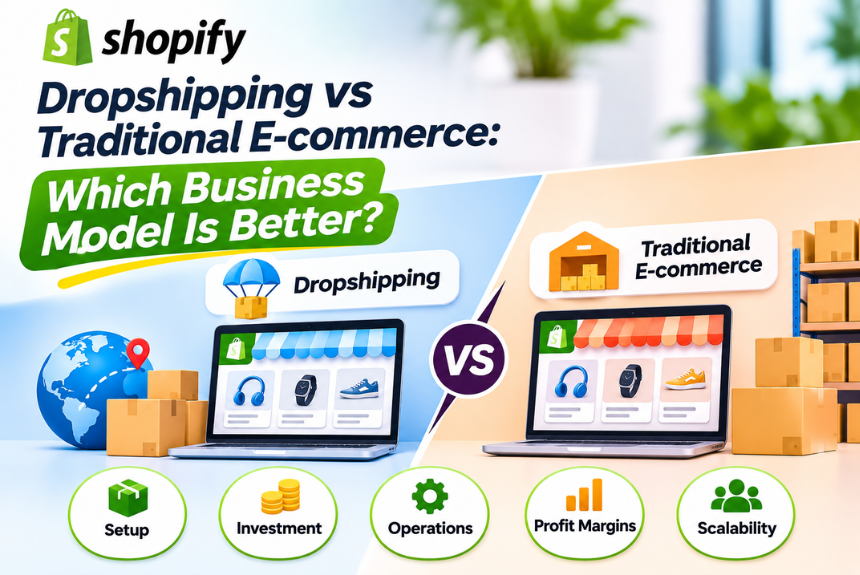
Dropshipping vs Traditional E-commerce: Which Business Model Is Better?
Starting an online business has become easier than ever, thanks to modern ecommerce platforms, digital payment systems, and online marketing tools. However, before launching an online store, one important decision can significantly influence your business operations, investment, and long-term growth: choosing the right ecommerce business model.
When comparing dropshipping vs traditional ecommerce, entrepreneurs often face a common question: Should you sell products without maintaining inventory, or should you purchase and manage your own stock?
Both business models offer opportunities to build a profitable online business, but they differ in how products are sourced, stored, shipped, and delivered to customers.
Dropshipping allows you to sell products without physically holding inventory, while traditional ecommerce generally involves purchasing, storing, and managing products before selling them online.
In this guide, we will compare dropshipping and traditional ecommerce in detail, including startup costs, profit margins, inventory management, customer experience, scalability, risks, and operational requirements.
By the end, you will understand which business model is better suited to your budget, experience, and business goals.
What Is Dropshipping?
Dropshipping is an ecommerce business model in which a store sells products without purchasing or storing inventory in advance.
When a customer places an order, the store owner forwards the order details to a supplier, manufacturer, or fulfillment partner. That supplier then prepares and ships the product directly to the customer.
The store owner manages the website, product listings, marketing, pricing, and customer communication, while the supplier handles inventory storage and order fulfillment.
How Does Dropshipping Work?
The process typically follows these steps:
- You create an online store using an ecommerce platform.
- You select products from a dropshipping supplier.
- You list those products on your website.
- A customer places an order through your store.
- You receive the customer’s payment.
- You purchase the product from your supplier.
- The supplier packages and ships the product.
- You manage customer communication and support.
Example of a Dropshipping Business
Suppose you sell a fitness accessory through your online store.
| Business Activity | Example |
| Supplier’s Product Cost | ₹500 |
| Your Selling Price | ₹900 |
| Customer Payment | ₹900 |
| Supplier Payment | ₹500 |
| Gross Difference | ₹400 |
The ₹400 difference is not your final profit. You must still account for advertising, payment processing, platform expenses, refunds, and other operating costs.
Popular Dropshipping Product Categories
Some common dropshipping categories include:
- Fashion accessories
- Home decor
- Fitness accessories
- Beauty and personal care products
- Phone accessories
- Pet products
- Travel accessories
- Kitchen and lifestyle products
Best suited for: Entrepreneurs who want to test products, start with limited inventory investment, and focus primarily on marketing and store management.
What Is Traditional E-commerce?
Traditional ecommerce is an online business model in which a retailer purchases or produces products, maintains inventory, and sells them directly to customers through an online store.
The business owner generally manages product sourcing, inventory storage, packaging, order fulfillment, and shipping, either independently or through third-party service providers.
Unlike dropshipping, traditional ecommerce gives you greater control over the products you sell and how orders are fulfilled.
How Does Traditional E-commerce Work?
The process typically involves:
- Researching and selecting products.
- Finding manufacturers, wholesalers, or suppliers.
- Purchasing inventory or producing products.
- Storing products in a warehouse or suitable location.
- Creating an online store and listing products.
- Receiving customer orders.
- Picking, packing, and preparing products.
- Shipping orders to customers.
- Managing returns, exchanges, and customer support.
Example of a Traditional E-commerce Business
Suppose you purchase 100 fitness accessories from a manufacturer.
| Business Activity | Example |
| Purchase Cost per Product | ₹500 |
| Total Inventory | 100 Units |
| Initial Inventory Investment | ₹50,000 |
| Selling Price per Product | ₹900 |
| Revenue if All Units Sell | ₹90,000 |
| Gross Difference | ₹40,000 |
The gross difference is calculated before packaging, storage, shipping, marketing, payment fees, taxes, returns, and other operating expenses.
Best suited for: Entrepreneurs who want greater control over product quality, inventory, packaging, fulfillment, and brand experience.
Dropshipping vs Traditional E-commerce: Key Differences
The most significant difference between dropshipping and traditional ecommerce is how inventory and fulfillment are managed.
| Comparison Factor | Dropshipping | Traditional E-commerce |
| Inventory Ownership | Generally not required | Usually required |
| Initial Investment | Lower | Higher |
| Product Storage | Supplier manages storage | Business manages storage |
| Order Fulfillment | Supplier ships products | Business or fulfillment partner ships |
| Product Quality Control | Limited direct control | Greater direct control |
| Packaging | Usually supplier-managed | Greater customization |
| Shipping Control | Dependent on supplier | More control over shipping |
| Profit Margins | Often lower | Potentially higher |
| Product Testing | Easier with limited investment | Requires inventory investment |
| Business Risk | Lower inventory risk | Higher inventory risk |
| Customer Experience | Supplier-dependent | Greater control |
| Branding Opportunities | May be limited | More flexibility |
| Scalability | Depends on supplier reliability | Depends on operations and inventory |
| Returns Management | Supplier policies may affect returns | Greater operational control |
| Best For | Beginners and product testing | Established brands and inventory-led businesses |
Both business models can be successful. The better choice depends on your financial resources, operational capabilities, and business objectives.
Startup Costs and Initial Investment
Startup costs are one of the biggest differences between dropshipping and traditional ecommerce.
Dropshipping Startup Costs
Dropshipping typically requires less upfront investment because you do not need to purchase large quantities of products before generating sales.
Common expenses include:
- Ecommerce platform subscription
- Domain name
- Store design and branding
- Product research tools
- Marketing and advertising
- Payment processing fees
- Supplier-related expenses
- Customer support tools
You can often test products without committing significant money to inventory.
However, low inventory investment does not mean dropshipping is completely free. Marketing, website setup, and business operations still require resources.
Traditional E-commerce Startup Costs
Traditional ecommerce generally requires a larger initial investment because products must be purchased or manufactured before they are sold.
Common expenses include:
- Initial product inventory
- Ecommerce platform subscription
- Domain name
- Website design
- Packaging materials
- Warehouse or storage
- Shipping and fulfillment
- Product photography
- Marketing and advertising
- Business registration and compliance
The total investment depends on your product category, supplier terms, inventory quantity, and business scale.
Startup Cost Comparison
| Expense | Dropshipping | Traditional E-commerce |
| Website Setup | Required | Required |
| Domain | Required | Required |
| Initial Inventory | Usually not required | Usually required |
| Storage | Usually not required | May be required |
| Packaging | Often supplier-managed | Business-managed |
| Product Photography | May use supplier assets or custom photography | Usually arranged by business |
| Marketing | Required | Required |
| Fulfillment | Supplier-managed | Business or third-party fulfillment |
| Initial Financial Risk | Generally lower | Generally higher |
Which Model Is More Affordable?
Dropshipping is generally more affordable to start because it reduces inventory and storage expenses.
Traditional ecommerce requires more upfront capital but can offer greater control over products, operations, and customer experience.
Key takeaway: If your budget is limited and you want to validate demand before investing in inventory, dropshipping may be a practical starting point.
Profit Margins and Revenue Potential
Revenue and profitability are not the same thing.
A business can generate substantial sales but still struggle to make a profit if its expenses are too high.
Dropshipping Profit Margins
Dropshipping businesses typically purchase products individually from suppliers after receiving customer orders.
Because suppliers manage storage and fulfillment, product costs may be higher than bulk wholesale purchasing.
Your profit depends on factors such as:
- Supplier product prices
- Selling price
- Advertising expenses
- Payment processing fees
- Platform costs
- Shipping charges
- Refunds and returns
- Customer acquisition costs
Example
| Metric | Amount |
| Product Selling Price | ₹1,500 |
| Supplier Product Cost | ₹800 |
| Gross Difference | ₹700 |
| Advertising Cost per Sale | ₹250 |
| Payment Processing | ₹45 |
| Other Allocated Expenses | ₹100 |
| Estimated Contribution | ₹305 |
This example is illustrative. Actual results depend on your business expenses, supplier agreements, and customer acquisition performance.
Traditional E-commerce Profit Margins
Traditional ecommerce businesses may purchase products in bulk at lower per-unit prices.
This can improve gross margins, particularly when the business negotiates favorable supplier terms or manufactures its own products.
However, bulk purchasing also creates inventory risks.
Example
| Metric | Amount |
| Product Selling Price | ₹1,500 |
| Bulk Purchase Cost | ₹600 |
| Gross Difference | ₹900 |
| Packaging and Fulfillment | ₹120 |
| Advertising Cost per Sale | ₹250 |
| Payment Processing | ₹45 |
| Other Allocated Expenses | ₹100 |
| Estimated Contribution | ₹385 |
Again, these numbers are illustrative, not guaranteed margins.
Which Model Offers Better Profitability?
Traditional ecommerce may provide better margins when products are purchased in bulk at competitive prices.
Dropshipping may provide lower margins per sale, but it can reduce inventory investment and make it easier to test products.
Important: Higher gross margins do not automatically mean higher overall profits. Unsold inventory, storage expenses, and cash tied up in products can reduce the profitability of a traditional ecommerce business.
Inventory Management and Fulfillment
Inventory management affects cash flow, operational efficiency, and the ability to fulfill customer orders.
Inventory Management in Dropshipping
Dropshipping reduces the need to manage physical inventory directly.
Your supplier generally handles:
- Product storage
- Inventory availability
- Order processing
- Packaging
- Shipment preparation
- Dispatch
This makes operations simpler for the store owner.
However, you depend on your supplier’s inventory accuracy.
If a product becomes unavailable after a customer purchases it, you may need to cancel the order, offer an alternative, or manage a delay.
Dropshipping Inventory Challenges
- Supplier stock may change unexpectedly.
- Product availability may not update in real time.
- Multiple suppliers may create separate shipments.
- Supplier errors can affect customer satisfaction.
- Inventory synchronization may require integrations.
Inventory Management in Traditional E-commerce
Traditional ecommerce businesses maintain inventory themselves or use third-party fulfillment services.
This provides greater control over stock levels and order preparation.
You can track:
- Available inventory
- Reserved stock
- Incoming stock
- Product variants
- Warehouse locations
- Reorder levels
- Stock movement
- Returns and damaged products
Traditional Inventory Challenges
- Unsold products can tie up capital.
- Storage costs may increase.
- Inventory forecasting requires attention.
- Products can become outdated.
- Overstocking and stockouts can affect profitability.
Which Model Is Better for Inventory Management?
Dropshipping is generally easier because the supplier handles inventory storage.
Traditional ecommerce offers more control but requires more operational responsibility.
Product Quality and Customer Experience
Customer experience plays a major role in ecommerce success.
Customers expect accurate product descriptions, quality products, reliable delivery, easy communication, and straightforward returns.
Customer Experience in Dropshipping
Dropshipping businesses depend heavily on suppliers for product quality and fulfillment.
Potential challenges include:
- Inconsistent product quality
- Generic packaging
- Limited customization
- Longer delivery times
- Supplier communication issues
- Difficulty handling defective products
To improve customer experience, carefully evaluate suppliers before listing their products.
Order samples, inspect product quality, test shipping times, and establish clear communication procedures.
Customer Experience in Traditional E-commerce
Traditional ecommerce businesses generally have more direct control over product quality and order preparation.
You can:
- Inspect products before shipping.
- Create branded packaging.
- Include personalized inserts.
- Improve product presentation.
- Manage quality checks.
- Offer customized products.
- Maintain more consistent fulfillment standards.
Which Model Offers Better Customer Experience?
Traditional ecommerce generally provides greater control over customer experience.
However, dropshipping businesses can also deliver excellent customer service if they work with reliable suppliers and communicate shipping and return policies clearly.
Shipping and Delivery
Shipping speed and reliability directly influence customer satisfaction.
Dropshipping Shipping
In dropshipping, suppliers generally handle shipping.
Delivery times depend on factors such as:
- Supplier location
- Product availability
- Shipping method
- Warehouse location
- Customs procedures
- Logistics partner
- Order processing time
If your supplier operates internationally, delivery may take longer than customers expect.
You should communicate realistic shipping estimates and avoid promising delivery dates you cannot control.
Traditional E-commerce Shipping
Traditional ecommerce businesses can manage shipping directly or use third-party logistics providers.
They may have greater flexibility to:
- Choose shipping partners
- Negotiate shipping rates
- Maintain local inventory
- Offer faster delivery
- Provide express shipping
- Improve packaging
- Track fulfillment performance
Shipping Comparison
| Factor | Dropshipping | Traditional E-commerce |
| Shipping Responsibility | Supplier | Business or fulfillment partner |
| Delivery Control | Limited | Greater |
| Packaging Control | Often limited | Greater |
| Shipping Speed | Supplier-dependent | More flexibility |
| Shipping Costs | Supplier-dependent | May benefit from negotiated rates |
| Order Tracking | Depends on supplier integration | Easier to manage directly |
| Customer Experience | Depends on fulfillment partner | Greater operational control |
Key takeaway: Traditional ecommerce is often better for businesses that prioritize fast, predictable, and branded delivery.
Business Risks and Challenges
Every business model comes with risks. Understanding them before launching can help you make better decisions.
Dropshipping Risks
1. Supplier Dependency
Your business depends on suppliers for product availability, quality, and shipping.
A supplier’s operational problems can directly affect your business.
2. Limited Quality Control
You may not inspect every product before it reaches the customer.
This makes supplier evaluation and product sampling important.
3. High Competition
Many dropshipping businesses sell similar products from common suppliers.
Differentiation through branding, customer service, product selection, and content marketing becomes essential.
4. Lower Margins
Supplier prices, shipping costs, and advertising expenses can reduce your margins.
5. Shipping Problems
Delays, tracking issues, and fulfillment errors can affect customer satisfaction.
6. Limited Branding
Some suppliers offer limited customization or branded packaging options.
Traditional E-commerce Risks
1. Unsold Inventory
Purchasing products in bulk creates the risk of unsold stock.
2. Higher Initial Investment
Inventory, storage, packaging, and fulfillment can require significant capital.
3. Storage Expenses
Depending on the product category and business size, storage can become an ongoing expense.
4. Inventory Forecasting
Incorrect demand forecasting may lead to overstocking or stockouts.
5. Product Obsolescence
Some products lose value over time due to changing trends, technology, or customer preferences.
6. Operational Complexity
Managing products, warehouses, orders, returns, and shipping requires effective processes.
Risk Comparison
| Risk Factor | Dropshipping | Traditional E-commerce |
| Unsold Inventory | Low | High |
| Supplier Dependency | High | Moderate to high |
| Upfront Capital Risk | Lower | Higher |
| Quality Control Risk | Higher | Lower with direct inspection |
| Storage Risk | Low | Higher |
| Fulfillment Risk | Supplier-dependent | Business-controlled or outsourced |
| Cash Flow Pressure | Marketing and operating costs | Inventory and operating costs |
Neither business model is risk-free. The difference is the type of risk you are taking.
Marketing and Customer Acquisition
Marketing is essential for both dropshipping and traditional ecommerce.
Even if you have excellent products, customers need to discover your store before they can make purchases.
Marketing a Dropshipping Business
Dropshipping entrepreneurs often focus heavily on digital marketing.
Common strategies include:
- Social media marketing
- Paid advertising
- Influencer collaborations
- Search engine optimization
- Content marketing
- Email marketing
- Product demonstrations
- Short-form video content
Because dropshipping allows you to test products without purchasing inventory in bulk, you can experiment with different product categories and marketing campaigns.
However, paid advertising expenses can become significant if campaigns do not generate profitable sales.
Marketing a Traditional E-commerce Business
Traditional ecommerce businesses can use the same digital marketing channels.
They may also benefit from:
- Branded product photography
- Original product demonstrations
- Customer-generated content
- Product packaging experiences
- Repeat purchase campaigns
- Loyalty programs
- Exclusive product launches
- Wholesale partnerships
Owning inventory can make it easier to create consistent branded content and showcase products in detail.
Which Model Is Better for Marketing?
Both models can succeed through digital marketing.
Dropshipping is often suited to product testing and performance-driven advertising.
Traditional ecommerce may provide greater opportunities for brand building, customer loyalty, and repeat purchases.
Scalability and Business Growth
Scalability refers to the ability of a business to increase sales and operations without creating disproportionate costs or complexity.
Scaling a Dropshipping Business
Dropshipping can make it easier to test and introduce additional products without purchasing inventory in advance.
Potential growth opportunities include:
- Expanding product categories
- Testing new markets
- Working with multiple suppliers
- Automating order processing
- Integrating marketing tools
- Improving customer support
- Building a recognizable brand
However, growth depends heavily on supplier reliability.
As order volumes increase, supplier capacity, stock availability, shipping quality, and communication become increasingly important.
Scaling a Traditional E-commerce Business
Traditional ecommerce businesses can scale by:
- Increasing inventory purchases
- Negotiating better wholesale rates
- Expanding warehouse capacity
- Working with fulfillment partners
- Introducing new product lines
- Expanding geographically
- Building customer loyalty
- Developing private-label products
Scaling requires careful inventory planning and cash flow management.
Which Model Is Easier to Scale?
Dropshipping can make product expansion easier because inventory investment is lower.
Traditional ecommerce may provide greater control over operations and customer experience as the business grows.
The better option depends on whether your main growth strategy involves testing products quickly or building a controlled, inventory-led brand.
Dropshipping vs Traditional E-commerce: Pros and Cons
Dropshipping Advantages
- Lower initial inventory investment
- No need for personal warehouse space
- Easier product testing
- Reduced risk of unsold stock
- Lower inventory management requirements
- Potential to operate with a smaller team
- Flexible product selection
Dropshipping Disadvantages
- Supplier dependency
- Limited control over product quality
- Potentially lower profit margins
- Shipping delays and fulfillment challenges
- Limited packaging customization
- High competition
- More difficult brand differentiation
Traditional E-commerce Advantages
- Greater control over inventory
- Better product quality inspection
- Potentially higher gross margins
- Greater packaging flexibility
- More control over fulfillment
- Better opportunities for branding
- Greater control over customer experience
Traditional E-commerce Disadvantages
- Higher startup investment
- Inventory storage requirements
- Risk of unsold products
- More complex inventory management
- Greater operational responsibility
- Potential cash flow pressure
- Additional fulfillment expenses
Which Business Model Is Better for Beginners?
The best business model for beginners depends on available capital, product knowledge, operational capabilities, and risk tolerance.
Dropshipping May Be Better If:
- You have limited startup capital.
- You want to learn ecommerce before investing heavily.
- You want to test multiple products.
- You prefer not to manage physical inventory.
- You want to focus on marketing and customer acquisition.
- You are comfortable working with suppliers.
- You want to validate market demand before purchasing stock.
Traditional E-commerce May Be Better If:
- You have sufficient startup capital.
- You have reliable product suppliers.
- You want greater control over product quality.
- You want to build a distinctive brand.
- You want to manage packaging and fulfillment.
- You understand inventory management.
- You have a long-term product strategy.
Beginner Decision Matrix
| Your Situation | Recommended Model |
| Limited capital | Dropshipping |
| No inventory storage | Dropshipping |
| Testing product demand | Dropshipping |
| Strong supplier relationships | Either model |
| Greater product control | Traditional ecommerce |
| Custom packaging | Traditional ecommerce |
| Higher bulk purchasing capacity | Traditional ecommerce |
| Building a private-label brand | Traditional ecommerce |
| Want to validate a niche first | Dropshipping |
| Want complete fulfillment control | Traditional ecommerce |
Recommendation: If you are completely new to ecommerce, dropshipping can be a practical way to understand product research, online marketing, customer acquisition, and store management before investing in inventory.
However, if you already have a validated product and reliable sourcing, traditional ecommerce may provide a stronger foundation for long-term brand development.
How to Choose the Right Business Model
Before making your decision, evaluate your business using the following framework.
1. Evaluate Your Budget
Calculate how much capital you can invest without creating unnecessary financial pressure.
Consider inventory, website setup, marketing, fulfillment, and operating expenses.
2. Understand Your Products
Some products are easier to dropship than others.
Fragile, customized, regulated, or quality-sensitive products may require greater control over sourcing and fulfillment.
3. Research Your Suppliers
A reliable supplier is essential for dropshipping.
For traditional ecommerce, compare manufacturers and wholesalers based on product quality, pricing, minimum order quantities, and reliability.
4. Calculate Profitability
Estimate your total costs rather than focusing only on the difference between selling price and product cost.
Consider customer acquisition costs, returns, shipping, payment fees, and operating expenses.
5. Consider Customer Expectations
If customers expect customized packaging, premium quality checks, or rapid delivery, traditional ecommerce may be more suitable.
If your product category allows flexible fulfillment and you have reliable suppliers, dropshipping may work well.
6. Assess Your Operational Capabilities
Determine whether you can manage inventory, storage, packaging, shipping, and returns.
If you do not want to manage these activities directly, dropshipping or third-party fulfillment may be more appropriate.
7. Think About Long-Term Goals
Are you trying to build a flexible online business, test different products, or establish a recognizable brand with repeat customers?
Your long-term objectives should influence your business model.
Can You Combine Dropshipping and Traditional E-commerce?
Yes. You do not have to choose only one business model.
Many ecommerce businesses use a hybrid approach that combines dropshipping with inventory-based selling.
This strategy allows you to test products through dropshipping and invest in inventory for products that demonstrate consistent demand.
How a Hybrid Ecommerce Model Works
Stage 1: Test Products Through Dropshipping
Introduce selected products without purchasing large quantities of inventory.
Monitor customer interest, conversion rates, and sales performance.
Stage 2: Identify Best-Selling Products
Analyze which products consistently attract customers and generate profitable sales.
Stage 3: Purchase Inventory for Proven Products
Purchase selected products in bulk to improve availability, potentially negotiate better pricing, and gain greater control over fulfillment.
Stage 4: Improve Customer Experience
Introduce branded packaging, product quality checks, faster shipping, and better customer support.
Stage 5: Expand Strategically
Continue testing new products through dropshipping while maintaining inventory for established bestsellers.
Benefits of a Hybrid Model
- Reduces the risk of investing in untested products
- Allows flexible product expansion
- Improves control over popular products
- Creates opportunities for better margins
- Supports more consistent fulfillment
- Helps develop a stronger brand
A hybrid approach can be useful for businesses that want flexibility during their early stages while gradually building a more controlled ecommerce operation.
Frequently Asked Questions
1. What is the difference between dropshipping and traditional ecommerce?
Dropshipping allows you to sell products without maintaining inventory. Suppliers generally store and ship products directly to customers. Traditional ecommerce usually involves purchasing or manufacturing inventory and managing fulfillment directly or through a third-party logistics provider.
2. Is dropshipping better than traditional ecommerce for beginners?
Dropshipping may be easier for beginners with limited capital because it reduces inventory investment and storage requirements. Traditional ecommerce may be better for beginners who already have reliable suppliers, sufficient capital, and a clear product strategy.
3. Which business model requires less investment?
Dropshipping generally requires less initial investment because you do not need to purchase products in bulk or maintain a warehouse. However, website development, marketing, payment processing, and operating expenses still apply.
4. Is traditional ecommerce more profitable than dropshipping?
Traditional ecommerce can offer higher gross margins through bulk purchasing and better control over fulfillment. However, profitability depends on sales volume, inventory management, operating expenses, and customer acquisition costs.
5. Can dropshipping be profitable?
Yes, dropshipping can be profitable when you select suitable products, work with reliable suppliers, price products effectively, and manage marketing and operational expenses.
6. Do dropshipping businesses need inventory?
No. In the typical dropshipping model, suppliers maintain inventory and fulfill orders. The store owner manages product listings, marketing, customer communication, and order coordination.
7. Is traditional ecommerce more difficult to manage?
Traditional ecommerce can involve more operational responsibilities, including inventory purchasing, storage, packaging, order fulfillment, and stock management. However, these activities can be outsourced to third-party service providers.
8. Which model offers better control over product quality?
Traditional ecommerce generally offers greater control because business owners can inspect inventory, verify product quality, and manage packaging before shipping orders.
9. Can I switch from dropshipping to traditional ecommerce?
Yes. Many businesses start with dropshipping to test product demand and later purchase inventory for popular products. This transition can help reduce the risk of investing in unproven products.
10. Which business model is better for building a brand?
Traditional ecommerce generally offers greater flexibility for branded packaging, product customization, quality control, and fulfillment. However, dropshipping businesses can also build strong brands by offering distinctive products and excellent customer service.
11. Is dropshipping legal?
Dropshipping is a legitimate ecommerce fulfillment model in many countries. However, businesses must comply with applicable laws, consumer protection requirements, taxes, product regulations, and marketplace policies.
12. Can I use Shopify for both dropshipping and traditional ecommerce?
Yes. Shopify supports both business models. You can sell products maintained by suppliers through dropshipping integrations or manage your own inventory and fulfillment.
13. Can I combine dropshipping with inventory-based ecommerce?
Yes. A hybrid model allows you to dropship selected products while maintaining inventory for bestsellers. This approach provides flexibility and can help you gradually expand your operations.
14. Which model is better for international selling?
Both models can support international ecommerce. Dropshipping may simplify inventory management, while traditional ecommerce may provide more control over fulfillment if you maintain inventory in suitable locations. Shipping costs, customs, taxes, and delivery times must be considered.
15. What should I consider before choosing an ecommerce business model?
Evaluate your budget, product demand, supplier reliability, profit margins, inventory requirements, shipping costs, customer expectations, operational capabilities, and long-term business objectives.
Conclusion
Choosing between dropshipping and traditional ecommerce depends on your business goals, available resources, and willingness to manage operational responsibilities.
Dropshipping is generally suitable for beginners who want to start with lower inventory investment, test products, and focus on marketing.
Traditional ecommerce is generally suitable for businesses that want greater control over product quality, inventory, packaging, fulfillment, and brand development.
Neither model guarantees success. Both require product research, customer understanding, effective marketing, reliable operations, and consistent improvement.
If you are starting from scratch, consider testing your business idea with a manageable investment. Once you understand customer demand and identify products that perform well, you can expand your operations and explore a hybrid ecommerce model.
The most effective business model is the one that aligns with your resources, serves your customers well, and supports sustainable growth.
Ready to Start Your Ecommerce Journey?
Explore more ecommerce guides, platform comparisons, and practical tutorials on NextBloggers to learn how to build, manage, and grow your online business.
Start with a clear strategy, choose the right business model, and focus on creating a valuable shopping experience for your customers.
Leave a Reply