


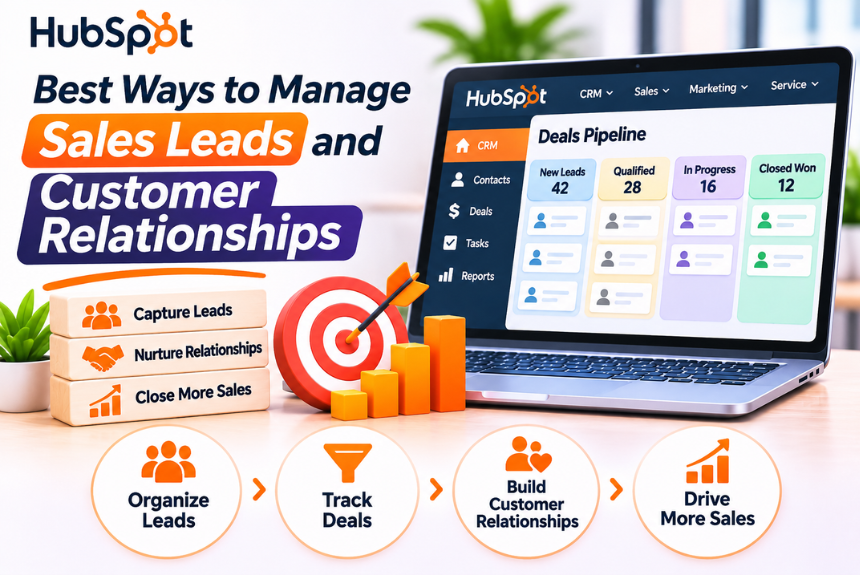
Best Ways to Manage Sales Leads and Customer Relationships
Managing sales leads and customer relationships is essential for businesses that want to increase revenue, improve customer satisfaction, and build long-term growth. Generating leads is only the first step in the sales process. Businesses must also organize prospects, understand their requirements, maintain consistent communication, and guide them toward making purchasing decisions.
Without an effective lead management strategy, potential customers can easily get lost in the sales pipeline. Sales teams may miss follow-ups, overlook promising opportunities, or struggle to maintain meaningful relationships with existing customers.
This is where sales lead management and customer relationship management (CRM) become important. By combining structured sales processes, customer data, personalized communication, and automation, businesses can improve their ability to convert prospects into customers while strengthening relationships over time.
In this guide, we will explore the best ways to manage sales leads and customer relationships, practical strategies for improving sales performance, and how businesses can use CRM software to build an efficient and scalable sales process.
What Is Sales Lead Management?
Sales lead management is the process of identifying, collecting, organizing, tracking, qualifying, and nurturing potential customers throughout their journey from initial interest to conversion.
A sales lead may come from several sources, including website forms, social media campaigns, email marketing, advertisements, referrals, webinars, or direct inquiries.
Effective sales lead management helps businesses understand where each prospect is in the buying journey and determine the most appropriate action to move them forward.
Key Stages of Sales Lead Management
| Stage | Description |
| Lead Generation | Attract potential customers through marketing and sales activities. |
| Lead Capture | Collect contact information and relevant prospect details. |
| Lead Qualification | Evaluate whether the prospect is a suitable potential customer. |
| Lead Distribution | Assign leads to the appropriate sales representatives. |
| Lead Nurturing | Build relationships through relevant communication and engagement. |
| Sales Conversion | Guide qualified prospects toward purchasing. |
| Lead Analysis | Measure performance and identify opportunities for improvement. |
A structured process ensures that every lead receives appropriate attention and that sales teams can focus their efforts on the most promising opportunities.
What Is Customer Relationship Management?
Customer relationship management (CRM) refers to the strategies, processes, and technologies businesses use to manage interactions with prospects and existing customers.
A CRM system stores customer information, tracks communication history, manages sales opportunities, and helps businesses maintain consistent relationships across different touchpoints.
Rather than relying on scattered spreadsheets, emails, or manual notes, businesses can use CRM software to centralize customer information and make it accessible to relevant team members.
Benefits of Customer Relationship Management
- Centralized Customer Information: Maintain contact details, communication history, preferences, and purchase information in one place.
- Improved Communication: Ensure consistent and timely communication throughout the customer journey.
- Better Sales Visibility: Monitor opportunities, sales activities, and pipeline progress.
- Personalized Customer Experiences: Use customer data to deliver relevant offers and recommendations.
- Increased Customer Retention: Strengthen relationships through proactive support and engagement.
- Improved Team Collaboration: Help sales, marketing, and customer support teams work with shared information.
Sales lead management focuses primarily on converting prospects, while customer relationship management extends beyond conversion to customer satisfaction, loyalty, and retention.
Why Managing Sales Leads and Customer Relationships Matters
Businesses that manage leads and customer relationships effectively can create more predictable sales processes and improve the overall customer experience.
1. Improve Lead Conversion Rates
Not every lead is ready to purchase immediately. By tracking prospect behavior, requirements, and engagement, sales teams can identify when a lead is ready for a sales conversation.
A systematic follow-up process prevents promising opportunities from being overlooked.
2. Reduce Lost Sales Opportunities
Many businesses lose potential customers because they fail to follow up at the right time.
Lead management systems help sales representatives track pending conversations, schedule reminders, and monitor opportunities that require attention.
3. Build Long-Term Customer Relationships
Customer relationships should not end after a purchase.
Regular communication, personalized support, product updates, and customer feedback help businesses maintain engagement and encourage repeat purchases.
4. Increase Sales Team Productivity
A well-organized sales process reduces manual administrative work.
Sales representatives can spend less time searching for customer information and more time engaging with prospects, understanding their requirements, and closing deals.
5. Improve Customer Satisfaction
Customers expect businesses to understand their needs and provide relevant solutions.
Maintaining accurate customer records enables businesses to offer more personalized experiences and respond to customer concerns efficiently.
6. Make Data-Driven Sales Decisions
Tracking sales activities and customer interactions provides valuable insights into sales performance.
Businesses can identify which lead sources generate the most qualified prospects, which sales activities produce better results, and where opportunities are being lost.
Best Ways to Manage Sales Leads and Customer Relationships
Building an effective sales management process requires more than collecting contact information. Businesses need a combination of organized data, clear workflows, consistent communication, and customer-focused strategies.
1. Centralize All Sales Leads and Customer Information
One of the most effective ways to manage sales leads is to maintain a centralized database of prospect and customer information.
When contact details are scattered across spreadsheets, email inboxes, messaging applications, and individual sales representatives’ records, it becomes difficult to maintain consistency.
A centralized CRM database allows businesses to store:
- Customer names and contact details
- Company names and industry information
- Lead sources and acquisition channels
- Customer requirements and interests
- Previous conversations and interactions
- Purchase history and transaction details
- Sales opportunity status
- Follow-up dates and assigned representatives
- Customer preferences and feedback
Why Centralization Matters
Centralized information ensures that sales representatives have the context they need before contacting a prospect.
For example, if a prospect previously discussed pricing with another representative, the assigned salesperson can review that conversation instead of asking the customer to repeat the same information.
This creates a smoother and more professional customer experience.
Recommended approach: Use a CRM system as the primary source of customer information and establish clear rules for updating records.
2. Segment Sales Leads Based on Their Characteristics
Not every lead has the same requirements, purchasing capacity, or level of interest.
Lead segmentation allows businesses to group prospects based on meaningful characteristics and create more relevant communication strategies.
Common Lead Segmentation Criteria
| Segmentation Type | Examples |
| Industry | Healthcare, education, retail, manufacturing |
| Company Size | Small businesses, mid-sized companies, enterprises |
| Geographic Location | Country, region, city, or service area |
| Buying Intent | Researching, comparing, ready to purchase |
| Lead Source | Organic search, paid ads, referrals, social media |
| Product Interest | Specific products, services, or solutions |
| Budget | Low, medium, or high purchasing capacity |
| Engagement | Website visits, email clicks, demo requests |
Example of Lead Segmentation
A digital marketing agency may receive inquiries from local businesses, e-commerce brands, startups, and established enterprises.
Instead of sending the same sales message to every lead, the agency can segment prospects by business type and service requirements.
An e-commerce business interested in improving organic traffic may receive information about SEO and conversion optimization, while a local business may receive recommendations about local SEO and Google Business Profile optimization.
This approach makes communication more relevant and increases the likelihood of engagement.
3. Establish a Clear Lead Qualification Process
Lead qualification helps sales teams identify which prospects are most likely to become customers.
Without qualification, sales representatives may spend excessive time on leads that lack purchasing intent, budget, authority, or a genuine business requirement.
Popular Lead Qualification Frameworks
BANT Framework
BANT stands for:
- Budget: Does the prospect have the financial resources to purchase?
- Authority: Is the prospect responsible for making or influencing the purchasing decision?
- Need: Does the prospect have a problem that your product or service can solve?
- Timeline: When does the prospect intend to make a purchasing decision?
CHAMP Framework
CHAMP focuses on:
- Challenges: What problems is the prospect trying to solve?
- Authority: Who is involved in the purchasing decision?
- Money: Is the solution financially feasible?
- Prioritization: How important is solving the problem right now?
How to Qualify Leads Effectively
- Understand the prospect’s business requirements.
- Identify the challenges they are experiencing.
- Determine whether your product or service addresses those challenges.
- Evaluate purchasing authority and decision-making processes.
- Understand budget expectations and timelines.
- Assign an appropriate qualification status.
Qualification should be a discovery process rather than an aggressive interrogation. Sales representatives should focus on understanding customer needs and identifying opportunities to provide value.
4. Build and Maintain a Structured Sales Pipeline
A sales pipeline provides a visual representation of where prospects are in the sales process.
It helps sales teams understand which opportunities require attention, which deals are progressing, and which prospects may be approaching conversion.
Example of a Sales Pipeline
| Pipeline Stage | Description | Recommended Action |
| New Lead | Prospect has entered the system. | Initiate contact. |
| Contacted | Initial communication has been made. | Understand requirements. |
| Qualified | Prospect meets qualification criteria. | Schedule a discovery meeting. |
| Meeting or Demo | Product or service has been presented. | Address questions and objections. |
| Proposal Sent | Pricing or proposal has been shared. | Follow up and clarify terms. |
| Negotiation | Commercial discussions are underway. | Resolve objections and finalize details. |
| Closed Won | Prospect has become a customer. | Begin onboarding and relationship management. |
| Closed Lost | Opportunity did not convert. | Record the reason and evaluate future opportunities. |
Best Practices for Sales Pipeline Management
- Define clear criteria for every pipeline stage.
- Avoid keeping leads in the same stage indefinitely.
- Assign responsibility for every opportunity.
- Review pipeline progress regularly.
- Track expected deal value and closing dates.
- Identify stalled opportunities and take appropriate action.
- Record the reasons for won and lost deals.
A well-maintained pipeline improves sales forecasting and helps managers identify bottlenecks before they affect revenue.
5. Follow Up Consistently Without Being Intrusive
Consistent follow-up is one of the most important aspects of sales lead management.
Many prospects do not convert after their first interaction. They may need additional information, internal approvals, budget discussions, or time to evaluate alternatives.
However, excessive follow-up can damage relationships and create a negative impression.
Create a Follow-Up Schedule
A practical follow-up sequence might look like this:
| Time | Follow-Up Activity |
| Day 1 | Send an introductory message or acknowledgment. |
| Day 2–3 | Follow up with relevant information. |
| Day 5–7 | Share a useful resource, case study, or solution. |
| Day 10–14 | Check whether the prospect has additional questions. |
| Later | Move the prospect into a suitable nurturing sequence if they are not ready. |
The timing should depend on the industry, customer expectations, and sales cycle.
Follow-Up Best Practices
- Personalize messages using previous conversations.
- Provide useful information instead of repeatedly asking for a response.
- Respect the prospect’s preferred communication channel.
- Maintain accurate follow-up records.
- Stop or adjust communication when a prospect requests it.
- Use reminders to prevent missed follow-ups.
The goal is to remain helpful and relevant, not to pressure prospects into purchasing.
6. Personalize Communication at Every Stage
Personalized communication helps businesses build stronger relationships with leads and existing customers.
Generic messages often fail because they do not address the prospect’s actual requirements or challenges.
Ways to Personalize Sales Communication
Use the prospect’s business context: Reference their industry, company size, business model, or specific challenges.
Address individual requirements: Explain how your product or service can solve the problems discussed during previous conversations.
Customize product recommendations: Recommend solutions based on customer needs rather than promoting every available offering.
Reference previous interactions: Continue conversations naturally by acknowledging questions, discussions, or commitments made earlier.
Provide relevant resources: Share case studies, guides, demonstrations, and examples that align with the prospect’s interests.
Example
Instead of sending:
“Hello, we provide digital marketing services. Let us know if you are interested.”
A personalized message could say:
“Thank you for sharing your website requirements. Based on your goal of improving organic traffic and increasing qualified inquiries, we recommend starting with a technical SEO audit and targeted content strategy.”
Personalization demonstrates that the business understands the prospect’s requirements and is interested in providing an appropriate solution.
7. Use CRM Software to Manage Leads and Relationships
CRM software is one of the most effective tools for managing sales leads and customer relationships.
It helps businesses organize customer data, monitor sales activities, automate repetitive tasks, and maintain communication records.
Essential CRM Features
| CRM Feature | Purpose |
| Contact Management | Store and organize customer information. |
| Lead Tracking | Monitor prospects throughout the sales journey. |
| Sales Pipeline | Visualize sales opportunities and stages. |
| Task Management | Schedule calls, meetings, and follow-ups. |
| Workflow Automation | Automate repetitive sales processes. |
| Email Integration | Track and manage customer communication. |
| Reporting and Analytics | Evaluate sales performance and trends. |
| Lead Scoring | Prioritize prospects based on predefined criteria. |
| Customer Support Management | Track customer issues and service requests. |
| Integration Capabilities | Connect CRM with marketing, sales, and business applications. |
Popular CRM Software for Businesses
HubSpot CRM
HubSpot offers contact management, deal tracking, sales pipeline visibility, and automation capabilities. It can be useful for businesses looking to connect marketing, sales, and customer service activities.
Zoho CRM
Zoho CRM provides lead management, workflow automation, sales forecasting, and customer communication tools. It is suitable for businesses looking for customizable CRM workflows.
Salesforce
Salesforce offers extensive CRM capabilities for sales, marketing, customer service, analytics, and business process automation. It is commonly considered by organizations with complex requirements.
Pipedrive
Pipedrive focuses on sales pipeline management, activity tracking, deal progression, and sales productivity.
Freshsales
Freshsales provides contact management, lead scoring, sales automation, and communication features for sales teams.
Choosing the right CRM depends on your business size, sales process, budget, integrations, and automation requirements. Businesses should evaluate their actual needs before selecting a platform.
8. Automate Repetitive Sales and Customer Management Tasks
Sales automation helps businesses reduce manual work and maintain consistency across the sales process.
Instead of manually updating records, assigning leads, scheduling reminders, and sending routine messages, businesses can automate many of these activities through CRM workflows.
Sales Tasks That Can Be Automated
| Task | Automation Example |
| Lead Capture | Automatically add website inquiries to CRM. |
| Lead Assignment | Assign incoming leads based on region, industry, or availability. |
| Follow-Up Reminders | Create tasks when a prospect needs another interaction. |
| Email Sequences | Send relevant emails based on lead behavior. |
| Lead Scoring | Update scores when prospects perform specific actions. |
| Pipeline Updates | Move leads to appropriate stages based on defined conditions. |
| Meeting Scheduling | Send booking links and meeting confirmations. |
| Customer Onboarding | Trigger onboarding emails after a successful purchase. |
| Renewal Reminders | Notify teams about upcoming contract or subscription renewals. |
Example of an Automated Sales Workflow
- A prospect submits a contact form on the website.
- The CRM automatically creates a new lead record.
- The lead is assigned to the appropriate sales representative.
- The prospect receives an acknowledgment email.
- The sales representative receives a notification.
- A follow-up task is created.
- The prospect is categorized based on the information submitted.
- The sales team tracks the opportunity until conversion or closure.
Automation should support meaningful customer interactions rather than replace human communication where personal attention is required.
9. Implement Lead Scoring to Prioritize Prospects
Lead scoring assigns numerical values to prospects based on their characteristics, behavior, and engagement.
This allows sales teams to prioritize leads that demonstrate stronger purchasing intent.
Common Lead Scoring Factors
| Factor | Example |
| Website Activity | Visiting pricing or service pages. |
| Email Engagement | Clicking relevant emails or resources. |
| Form Submission | Requesting a consultation or product demo. |
| Business Fit | Matching the ideal customer profile. |
| Purchase Intent | Asking about pricing, implementation, or timelines. |
| Content Engagement | Downloading relevant guides or case studies. |
| Interaction Frequency | Engaging consistently with sales communication. |
Example of a Lead Scoring Model
| Activity | Score |
| Visits the website | +5 |
| Visits pricing page | +10 |
| Downloads a relevant guide | +10 |
| Submits a demo request | +25 |
| Attends a product demonstration | +20 |
| Matches ideal customer profile | +15 |
| Unsubscribes from marketing emails | -20 |
| Has no engagement for an extended period | -10 |
Businesses can define thresholds based on their sales process.
For example:
- 0–20 points: Early-stage prospect
- 21–50 points: Engaged lead
- 51–75 points: Marketing-qualified lead
- 76+ points: High-priority sales opportunity
These thresholds are illustrative. Actual scoring should be tested and refined using historical conversion data.
10. Develop an Effective Lead Nurturing Strategy
Lead nurturing involves maintaining relationships with prospects who are not yet ready to purchase.
Instead of allowing these leads to become inactive, businesses can provide useful information that helps prospects understand their challenges and evaluate possible solutions.
Lead Nurturing Methods
Educational Email Campaigns: Share relevant information, industry insights, and practical advice.
Case Studies: Demonstrate how similar businesses solved problems using your product or service.
Webinars and Demonstrations: Help prospects understand product capabilities and applications.
Product Guides: Explain features, implementation processes, and use cases.
Retargeting Campaigns: Re-engage interested prospects through appropriate advertising channels.
Personalized Sales Outreach: Contact qualified prospects when their engagement or requirements indicate stronger interest.
Example Lead Nurturing Sequence
| Purpose | Content | |
| Email 1 | Introduction | Welcome message and relevant information. |
| Email 2 | Education | Helpful guide addressing a common challenge. |
| Email 3 | Problem Awareness | Explain common mistakes and potential solutions. |
| Email 4 | Social Proof | Share a relevant customer success story. |
| Email 5 | Product Education | Explain how your offering addresses specific needs. |
| Email 6 | Conversion | Invite the prospect to book a consultation or demonstration. |
The sequence should be adapted to the prospect’s engagement, preferences, and buying stage.
11. Maintain Strong Relationships After the Sale
Customer relationship management does not stop when a lead becomes a customer.
Existing customers can generate repeat purchases, referrals, testimonials, and valuable feedback. Maintaining relationships after conversion is therefore essential for long-term business growth.
Customer Relationship Management Strategies
Provide a Smooth Onboarding Experience
Help new customers understand how to use your product or service.
Provide onboarding documentation, training sessions, welcome emails, and clear communication about next steps.
Offer Proactive Customer Support
Do not wait until customers encounter major problems.
Provide accessible support channels and respond to customer concerns within reasonable timeframes.
Maintain Regular Communication
Share relevant updates, product improvements, educational resources, and important announcements.
Avoid sending unnecessary promotional messages that do not provide value.
Collect Customer Feedback
Use surveys, interviews, feedback forms, and customer conversations to understand satisfaction and identify improvement opportunities.
Recognize Customer Loyalty
Reward repeat purchases, referrals, long-term partnerships, and customer engagement through suitable loyalty programs or personalized benefits.
Monitor Customer Health
For subscription-based businesses, monitor product usage, engagement, support requests, renewal dates, and other indicators that may suggest satisfaction or potential churn.
12. Create a Customer Communication Strategy
Effective customer communication requires consistency, clarity, and an understanding of customer preferences.
Businesses should define how and when sales representatives communicate with prospects and customers.
Choose the Right Communication Channels
| Communication Channel | Best Use |
| Detailed information, proposals, updates, and nurturing. | |
| Phone Calls | Discovery, urgent discussions, and personalized conversations. |
| Quick updates and communication when customers have consented to this channel. | |
| Video Meetings | Demonstrations, consultations, and complex discussions. |
| Social Media | Brand engagement, relationship building, and public interactions. |
| Customer Portals | Support requests, account information, and service updates. |
Establish Communication Guidelines
- Define response-time expectations.
- Maintain consistent messaging across departments.
- Record important customer interactions.
- Respect customer communication preferences.
- Avoid excessive or irrelevant outreach.
- Use appropriate language and tone for different customer segments.
A well-defined communication strategy helps businesses maintain professional relationships and deliver a consistent customer experience.
13. Align Sales, Marketing, and Customer Support Teams
Sales lead management becomes more effective when different departments work together.
Marketing generates and nurtures leads, sales teams qualify and convert prospects, and customer support helps maintain satisfaction after conversion.
When these departments operate independently, important customer information can become fragmented.
Ways to Improve Team Alignment
Define Lead Qualification Criteria: Agree on what constitutes a marketing-qualified lead and a sales-qualified lead.
Establish a Lead Handoff Process: Define when marketing transfers a lead to sales and what information must accompany the transfer.
Share Customer Information: Use a common CRM system to maintain visibility into interactions and customer requirements.
Create Feedback Loops: Sales should communicate lead quality and customer objections to marketing.
Track Shared Metrics: Evaluate lead quality, conversion rates, customer satisfaction, and revenue rather than focusing exclusively on departmental activity.
MQL vs. SQL
| Lead Type | Definition |
| Marketing-Qualified Lead (MQL) | A prospect who demonstrates engagement and meets marketing-defined qualification criteria. |
| Sales-Qualified Lead (SQL) | A prospect assessed by sales as having a suitable requirement and potential to move forward with a sales opportunity. |
Clear definitions reduce confusion and help teams prioritize leads more effectively.
14. Track Sales and Customer Relationship KPIs
Businesses should measure sales lead management and customer relationship performance to understand whether their strategies are delivering results.
Important Sales Lead Management Metrics
| Metric | What It Measures |
| Lead Conversion Rate | Percentage of leads that become customers. |
| Lead Response Time | Time taken to respond to incoming inquiries. |
| Cost per Lead | Cost associated with acquiring a lead. |
| Sales Cycle Length | Time required to convert a prospect into a customer. |
| Pipeline Value | Total estimated value of active opportunities. |
| Win Rate | Percentage of sales opportunities successfully closed. |
| Lead Source Performance | Quality and conversion of leads from different channels. |
| Follow-Up Completion Rate | Percentage of planned follow-ups completed. |
Important Customer Relationship Metrics
| Metric | What It Measures |
| Customer Retention Rate | Percentage of customers retained over a specific period. |
| Customer Churn Rate | Percentage of customers lost during a period. |
| Customer Lifetime Value (CLV) | Estimated revenue or value generated throughout a customer relationship. |
| Customer Satisfaction Score (CSAT) | Customer satisfaction with a product, service, or interaction. |
| Net Promoter Score (NPS) | Customer willingness to recommend a business. |
| Repeat Purchase Rate | Percentage of customers who purchase more than once. |
| Customer Engagement | Level of interaction with products, services, or communication. |
How to Use These Metrics
Review metrics regularly to identify trends and opportunities.
For example, if leads from organic search have a higher conversion rate than leads from paid advertising, businesses may evaluate whether their marketing investment should be adjusted.
If customer churn increases, investigate potential causes such as product issues, pricing concerns, poor onboarding, or inadequate support.
Metrics should guide decisions rather than simply populate dashboards.
15. Use Customer Data to Improve Personalization
Customer data can help businesses understand individual requirements and deliver more relevant experiences.
However, collecting data without a clear purpose does not improve customer relationships.
Useful Customer Data
- Contact and demographic information relevant to the business
- Purchase history and transaction details
- Product preferences
- Customer communication preferences
- Website and product engagement
- Previous support interactions
- Feedback and satisfaction information
- Renewal and contract details
How Businesses Can Use Customer Data
Personalized Recommendations: Suggest products or services based on previous purchases or interests.
Relevant Offers: Share promotions that align with customer needs.
Improved Customer Support: Give support representatives access to relevant interaction history.
Customer Segmentation: Create communication groups based on meaningful customer characteristics.
Retention Campaigns: Identify customers who may benefit from additional support or engagement.
Businesses should collect and use customer data responsibly, maintain appropriate security controls, and respect privacy requirements and consent.
16. Identify and Re-Engage Inactive Leads
Not every prospect converts during the initial sales cycle.
Some leads may stop responding because their priorities change, budgets are delayed, or they are no longer actively evaluating solutions.
Instead of permanently abandoning these opportunities, businesses can develop a structured re-engagement strategy.
Ways to Re-Engage Inactive Leads
- Review the prospect’s previous interactions and requirements.
- Identify why the lead became inactive, if that information is available.
- Share a relevant update, resource, or new solution.
- Ask whether their requirements or priorities have changed.
- Offer a consultation when appropriate.
- Update the CRM based on the prospect’s response.
- Respect requests to stop receiving communication.
Example Re-Engagement Message
“Hello, we connected earlier regarding your business requirements. I wanted to check whether this is still a priority for your team. If your objectives have changed, we would be happy to explore an updated approach that better aligns with your current needs.”
The purpose of re-engagement is to restart a relevant conversation, not to pressure an inactive prospect.
17. Establish a Standardized Sales Process
A standardized sales process helps businesses maintain consistency as their sales teams grow.
Without defined processes, individual representatives may handle leads differently, resulting in inconsistent customer experiences and unreliable reporting.
Elements of a Standardized Sales Process
- Defined lead capture and qualification procedures
- Clear sales pipeline stages
- Standardized discovery questions
- Follow-up guidelines and response-time expectations
- Proposal and quotation procedures
- CRM data entry standards
- Lead assignment rules
- Sales handoff procedures
- Customer onboarding processes
- Sales performance review guidelines
Standardization does not mean every customer receives identical treatment.
It provides a consistent foundation while allowing sales representatives to personalize interactions according to individual requirements.
18. Train Sales Teams in Relationship Management
CRM software alone cannot guarantee successful customer relationships.
Sales representatives need communication, listening, negotiation, problem-solving, and relationship-building skills to use customer information effectively.
Essential Sales Skills
Active Listening: Understand customer concerns and requirements before recommending solutions.
Product Knowledge: Explain product features, benefits, limitations, and use cases accurately.
Consultative Selling: Focus on solving customer problems rather than simply promoting products.
Negotiation: Address objections, pricing discussions, and commercial concerns professionally.
Communication: Maintain clear, relevant, and respectful conversations.
Time Management: Prioritize high-value activities and maintain follow-up commitments.
CRM Proficiency: Use CRM tools to track leads, record interactions, and manage opportunities.
Regular training, sales coaching, role-playing, and performance reviews can help teams continuously improve.
19. Protect Customer Data and Maintain Trust
Trust is a fundamental part of customer relationship management.
Customers expect businesses to handle their personal and business information responsibly.
Data Management Best Practices
- Collect only information necessary for legitimate business purposes.
- Obtain appropriate consent for marketing communication.
- Restrict access to customer data based on job responsibilities.
- Use secure systems to store customer information.
- Review access permissions regularly.
- Maintain appropriate data retention policies.
- Provide mechanisms for customers to update their information.
- Respect unsubscribe requests and communication preferences.
- Evaluate CRM vendors for security and privacy capabilities.
Responsible data management protects customers and strengthens business credibility.
20. Continuously Improve Your Sales Management Strategy
Sales lead management and customer relationship strategies should evolve as customer expectations, markets, and business processes change.
Businesses should regularly review their sales performance, identify operational challenges, and test improvements.
Sales Process Optimization Checklist
| Area | Questions to Evaluate |
| Lead Generation | Are we attracting relevant prospects? |
| Lead Qualification | Are qualification criteria producing good opportunities? |
| Lead Response | Are incoming inquiries receiving timely responses? |
| Sales Pipeline | Are opportunities progressing efficiently? |
| Follow-Up | Are sales representatives completing planned activities? |
| CRM Adoption | Is the team consistently maintaining accurate records? |
| Automation | Are repetitive processes being automated effectively? |
| Customer Experience | Are customers receiving relevant and helpful communication? |
| Retention | Are existing customers satisfied and engaged? |
| Reporting | Are sales and customer metrics supporting decisions? |
Continuous improvement helps businesses refine their processes and achieve more predictable sales outcomes.
Sales Lead Management vs. Customer Relationship Management
Although sales lead management and customer relationship management are closely connected, they serve different purposes.
| Comparison | Sales Lead Management | Customer Relationship Management |
| Primary Focus | Managing and converting prospects | Managing prospects and existing customers |
| Main Objective | Increase lead conversion and sales | Improve relationships, satisfaction, and retention |
| Starting Point | Lead generation and acquisition | Initial interaction through the entire customer lifecycle |
| Key Activities | Qualification, nurturing, follow-up, pipeline management | Communication, customer service, retention, loyalty |
| Important Metrics | Lead conversion rate, win rate, sales cycle | Retention rate, churn, CSAT, customer lifetime value |
| Technology | Lead management tools and CRM systems | CRM platforms and customer service applications |
| Outcome | More qualified opportunities and conversions | Stronger relationships and long-term business value |
An effective business strategy combines both processes rather than treating them as separate activities.
Practical Example: Managing Sales Leads and Customers Using CRM
Consider a digital marketing agency that receives inquiries from businesses interested in SEO, website development, and paid advertising.
Without a structured system, the agency may receive inquiries through multiple channels and struggle to track conversations, assign leads, and manage follow-ups.
A CRM-based workflow can simplify the entire process.
Step 1: Capture Leads
Website forms, social media campaigns, referrals, and advertisements automatically send inquiries to the CRM.
Step 2: Organize Lead Information
Each lead record includes contact information, company details, service requirements, lead source, and inquiry date.
Step 3: Qualify Prospects
The sales team evaluates business requirements, budget, timeline, and decision-making authority.
Step 4: Assign Leads
Qualified leads are assigned to sales representatives based on service expertise or workload.
Step 5: Schedule Follow-Ups
The CRM creates reminders for discovery calls, proposals, and subsequent discussions.
Step 6: Track Opportunities
Sales representatives update the pipeline as prospects move through meetings, proposals, and negotiations.
Step 7: Convert Leads
When a prospect purchases a service, the opportunity is marked as won and the customer onboarding process begins.
Step 8: Maintain Customer Relationships
The agency maintains regular communication, tracks project progress, gathers feedback, and identifies opportunities for future services.
This workflow provides a consistent approach to managing sales leads while ensuring that customer relationships continue beyond the initial purchase.
Common Mistakes to Avoid in Sales Lead and Customer Relationship Management
Even businesses with CRM systems can struggle if their sales processes are poorly designed.
1. Failing to Follow Up
Leads may lose interest when businesses take too long to respond or fail to maintain consistent communication.
Solution: Establish response-time expectations and automated reminders.
2. Collecting Incomplete Customer Data
Missing contact details, requirements, or interaction history make it difficult to manage prospects effectively.
Solution: Create standardized CRM fields and data entry guidelines.
3. Treating Every Lead the Same Way
Different prospects have different needs, budgets, and buying timelines.
Solution: Segment leads and personalize communication.
4. Over-Automating Customer Communication
Excessive automation can make communication feel impersonal and irrelevant.
Solution: Automate routine tasks while preserving human interaction for important conversations.
5. Ignoring Existing Customers
Businesses that focus exclusively on new leads may overlook repeat purchases and customer retention.
Solution: Develop a structured customer engagement and retention strategy.
6. Failing to Track Sales Performance
Without measurable indicators, businesses cannot accurately evaluate the effectiveness of their sales processes.
Solution: Monitor relevant sales and customer relationship KPIs.
7. Using CRM Without Team Adoption
A CRM system provides limited value when sales representatives do not consistently update records.
Solution: Train employees, simplify workflows, and establish clear CRM usage guidelines.
Frequently Asked Questions (FAQs)
1. What is the best way to manage sales leads?
The best way to manage sales leads is to use a structured process that includes centralized lead collection, segmentation, qualification, pipeline tracking, consistent follow-ups, and CRM-based reporting. This helps businesses organize prospects and improve conversion rates.
2. How can businesses improve customer relationship management?
Businesses can improve customer relationship management by maintaining accurate customer data, personalizing communication, providing proactive support, collecting feedback, and using CRM software to manage interactions throughout the customer lifecycle.
3. Why is CRM software important for managing sales leads?
CRM software centralizes customer information, tracks sales opportunities, automates follow-ups, and provides visibility into the sales pipeline. It helps businesses reduce manual work and maintain consistent communication.
4. What are the best CRM tools for sales lead management?
Popular CRM tools include HubSpot CRM, Zoho CRM, Salesforce, Pipedrive, and Freshsales. The best choice depends on business requirements, team size, budget, automation needs, and integrations.
5. How often should sales representatives follow up with leads?
Follow-up frequency depends on the sales cycle, customer preferences, and level of engagement. Businesses should establish a consistent schedule while avoiding excessive communication and respecting requests to stop outreach.
6. What is lead nurturing in sales?
Lead nurturing is the process of building relationships with prospects through relevant communication, educational content, personalized outreach, and follow-ups until they are ready to make a purchasing decision.
7. What is lead scoring, and why is it important?
Lead scoring assigns numerical values to prospects based on their characteristics and engagement. It helps sales teams prioritize leads that demonstrate stronger purchasing intent or better alignment with the ideal customer profile.
8. How can businesses retain existing customers?
Businesses can improve customer retention through proactive support, effective onboarding, personalized communication, loyalty programs, regular feedback collection, and continuous improvement of products and services.
9. What is the difference between an MQL and an SQL?
An MQL is a marketing-qualified lead that meets predefined engagement and qualification criteria. An SQL is a sales-qualified lead that has been evaluated by the sales team and is considered ready for further sales engagement.
10. Can small businesses benefit from CRM software?
Yes. CRM software helps small businesses organize customer information, track sales opportunities, schedule follow-ups, and maintain customer relationships. Many CRM platforms offer scalable plans and features suitable for smaller teams.
11. How can sales automation improve lead management?
Sales automation reduces manual tasks such as lead assignment, follow-up reminders, data entry, email sequences, and pipeline updates. It helps sales teams work more efficiently and maintain consistency.
12. What metrics should businesses track for sales lead management?
Important metrics include lead conversion rate, lead response time, cost per lead, sales cycle length, pipeline value, win rate, and lead source performance.
13. How can businesses manage inactive sales leads?
Businesses can re-engage inactive leads by reviewing previous interactions, sharing relevant information, asking about changing requirements, and offering appropriate solutions. Communication should remain respectful and permission-based.
14. How does customer relationship management improve customer satisfaction?
CRM systems provide access to customer information and interaction history, enabling businesses to deliver personalized communication, respond efficiently to concerns, and maintain consistent service experiences.
15. What is the role of sales and marketing alignment in lead management?
Sales and marketing alignment ensures that both teams agree on lead qualification criteria, share customer information, coordinate lead handoffs, and work toward common revenue and customer acquisition goals.
Conclusion
Managing sales leads and customer relationships effectively requires a combination of structured processes, customer-focused communication, accurate data, and appropriate technology.
Businesses should focus on centralizing lead information, qualifying prospects, maintaining an organized sales pipeline, following up consistently, and personalizing customer interactions. CRM software and sales automation can support these activities by improving visibility, reducing manual work, and helping teams maintain stronger relationships.
However, successful customer relationship management goes beyond software implementation. Businesses must also develop clear sales processes, train their teams, respect customer preferences, and continuously improve the customer experience.
By combining effective sales lead management with long-term customer relationship strategies, businesses can improve conversion rates, strengthen customer loyalty, and build a more sustainable sales operation.
Ready to Improve Your Sales and Customer Relationships?
A structured sales process and the right CRM strategy can help your business manage leads more effectively, improve customer engagement, and create more opportunities for growth.
Explore more practical guides on sales management, CRM software, marketing automation, and business growth at NextBloggers to discover tools and strategies that can help you build a more efficient business.
Leave a Reply