

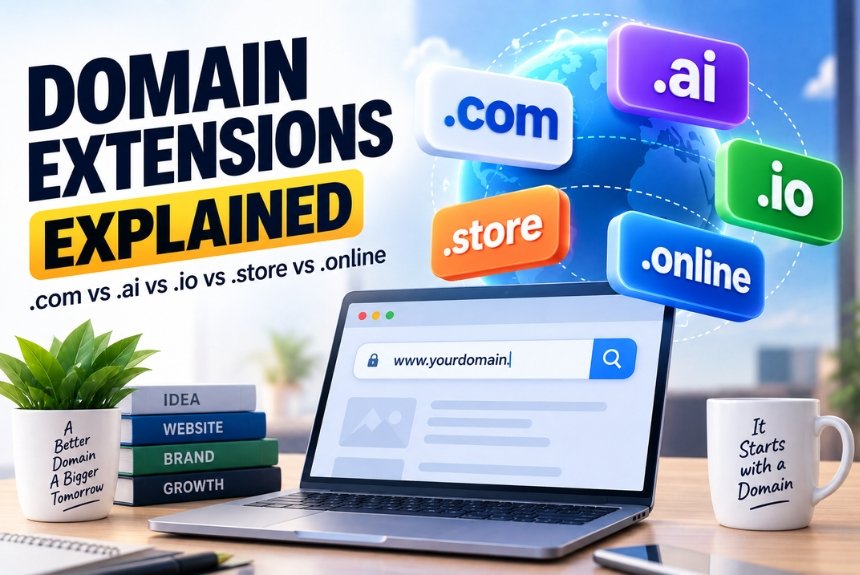
Domain Extensions Explained: .com vs .ai vs .io vs .store vs .online
Introduction
Choosing a domain name is one of the first decisions you make when launching a website.
You might already have the perfect brand name in mind, only to discover that the .com version is unavailable. Then you see alternatives such as .ai, .io, .store, or .online.
This raises several questions:
Which domain extension should you choose?
Does the extension affect SEO?
Is .com still important?
Should an AI startup use .ai?
Is .store better for ecommerce?
The answer depends on your brand, audience, business model, availability, and long-term plans.
A domain extension is technically known as a top-level domain (TLD). Examples include .com, .org, .net, and country-code extensions such as .in and .uk.
Today, there are hundreds of generic top-level domains (gTLDs), giving businesses far more choices than the traditional .com, .net, and .org options.
However, more choice doesn’t necessarily make the decision easier.
Your domain should be memorable, easy to communicate, appropriate for your business, and practical for long-term use.
This guide explains the differences between .com, .ai, .io, .store, and .online, how they can affect branding and SEO, and how to choose a domain extension based on your actual requirements.
What Is a Domain Extension?
A domain extension is the part of a domain name that appears after the final dot.
For example:
example.com
Here:
- example = second-level domain
- .com = top-level domain or TLD
Another example:
startup.ai
Here:
- startup = second-level domain
- .ai = top-level domain
The TLD is part of the website’s complete domain name.
Common examples include:
- .com
- .org
- .net
- .ai
- .io
- .store
- .online
- .tech
- .co
- .in
- .uk
Some extensions communicate an obvious purpose, while others are more closely associated with particular industries or communities.
What Is a TLD?
TLD stands for Top-Level Domain.
It is the highest level in the hierarchical domain-name system.
TLDs are commonly divided into several categories.
Generic Top-Level Domains
These include:
- .com
- .org
- .net
They are generally not tied to one country.
Country-Code Top-Level Domains
These are associated with countries or territories.
Examples include:
- .in — India
- .uk — United Kingdom
- .de — Germany
- .jp — Japan
- .au — Australia
New Generic TLDs
There are also many newer extensions such as:
- .ai
- .store
- .online
- .tech
- .app
- .dev
The available rules and registration requirements can differ between extensions.
Why Are There So Many Domain Extensions?
Originally, domain choices were relatively limited.
Businesses commonly used:
- .com
- .org
- .net
- Country-code extensions
As the domain-name system expanded, many additional TLDs became available.
This created opportunities for businesses to select domain names that align more closely with:
- Industry
- Product
- Location
- Community
- Brand
- Business model
For example:
brand.store
immediately suggests an online shopping business.
Similarly:
company.ai
may communicate an association with artificial intelligence.
But the extension alone doesn’t define the business.
A .ai domain doesn’t automatically mean that the company builds AI products.
.com: The Traditional Choice
.com is one of the most recognized domain extensions on the internet.
It originally stood for commercial, although today it is used by businesses, organizations, individuals, and many other types of websites.
For many businesses, .com remains attractive because it is:
- Familiar
- Easy to recognize
- Widely used
- Simple to communicate
- Strongly associated with commercial websites
If your preferred .com is available and fits your brand, it can be a straightforward choice.
But availability is a major challenge.
Many short and common .com domains have already been registered.
Advantages of a .com Domain
Familiarity
People are accustomed to seeing .com.
Easy to Remember
Users often instinctively associate businesses with .com.
Brand Recognition
A .com can fit almost any industry.
Broad Positioning
You’re not tied to a specific industry or business model.
Long-Term Flexibility
If your business changes direction, the domain can continue to work.
For example, a business that starts by selling one product could eventually expand into services, software, consulting, or other areas without its domain extension becoming restrictive.
Potential Disadvantage of .com
The biggest problem is availability.
You may discover that:
yourbrand.com
is already registered.
The alternative may be:
yourbrandhq.com
getyourbrand.com
or another variation.
This creates a branding decision.
Sometimes a distinctive non-.com domain can be cleaner than a complicated .com variation.
For example:
brand.store
may be easier to remember than:
brand-online-shop-2026.com
The quality of the complete domain matters more than simply forcing a .com into the name.
What Is a .ai Domain?
.ai is the country-code top-level domain associated with Anguilla.
However, it has become strongly associated with artificial intelligence because of the letters “AI.”
This has made .ai particularly popular among:
- AI startups
- AI software companies
- Machine-learning products
- Automation platforms
- AI developer tools
- Technology companies
A domain such as:
company.ai
can communicate an AI-related brand identity immediately.
Advantages of .ai
Strong AI Association
The extension is immediately recognizable as an AI reference.
Modern Technology Branding
It can fit companies building AI products or services.
Availability
Some desirable names that are unavailable as .com may be available under .ai.
Short Branding
A concise .ai domain can create a memorable brand.
Potential Disadvantages of .ai
Higher Registration Costs
.ai pricing can differ significantly from traditional extensions, depending on the registrar and renewal terms.
Always check both:
First-year price
and
Renewal price
before purchasing.
Industry Association
.ai strongly suggests artificial intelligence.
If your company later moves away from AI, the extension could become less aligned with the brand.
Consumer Familiarity
.com remains more familiar to many general internet users.
Therefore, if your audience is highly general rather than technology-focused, test how easily people remember and communicate the domain.
What Is a .io Domain?
.io is the country-code top-level domain assigned to the British Indian Ocean Territory.
Despite its geographic origin, .io has become strongly associated with technology and startups.
The extension is especially common among:
- SaaS companies
- Developer tools
- Software startups
- Technology platforms
- APIs
- Developer communities
The popularity is partly influenced by the fact that “IO” is commonly associated with input/output in computing.
Advantages of .io
Technology Association
.io has developed a strong connection with software and technology.
Startup Branding
Many technology companies use .io, making it familiar within startup and developer communities.
Short Extension
It’s concise and easy to include in a brand name.
Alternative to .com
It can provide a useful alternative when a suitable .com isn’t available.
Potential Disadvantages of .io
Less Familiar to General Audiences
People unfamiliar with technology may not automatically recognize .io as a domain extension.
Brand Expectations
The extension can make a company appear technology-focused.
Long-Term Considerations
Because .io is technically a country-code TLD, businesses should consider the long-term implications of using it and review current registrar and registry policies before making it a permanent brand decision.
What Is a .store Domain?
.store is a generic top-level domain designed to communicate an ecommerce or retail context.
For example:
brand.store
immediately suggests that the website is a store.
This makes it particularly relevant for:
- Ecommerce businesses
- Online retailers
- Product brands
- Fashion stores
- Digital product stores
- Marketplace businesses
Advantages of .store
Clear Commercial Meaning
Visitors can immediately understand that the domain is associated with shopping.
Strong Ecommerce Branding
It can work well for businesses whose primary purpose is selling products.
Availability
You may find a shorter brand name available under .store than under .com.
Marketing Flexibility
A domain such as:
fashion.store
can function almost like part of the brand.
Potential Disadvantages of .store
Less Universal
If your business expands beyond ecommerce, .store may become less representative.
Consumer Familiarity
.com is generally more familiar to a broader audience.
Potentially Higher Cost
Registration and renewal prices vary, so compare the full ownership cost before choosing.
What Is a .online Domain?
.online is a generic top-level domain that communicates an internet-based presence.
It can work across many industries.
Examples include:
- Businesses
- Portfolios
- Services
- Communities
- Ecommerce
- Personal brands
- Digital platforms
Unlike .ai or .store, it isn’t strongly restricted to one particular industry.
Advantages of .online
Broad Usage
Almost any internet-based project can potentially use it.
Descriptive
The word “online” immediately communicates a digital presence.
Availability
It can provide alternatives when common .com names aren’t available.
Flexible Branding
It doesn’t lock your business into one narrow industry.
Potential Disadvantages of .online
Longer Extension
.online is longer than .com, .ai, or .io.
Less Familiar
Some users may still instinctively expect .com.
Branding Consideration
The entire domain should be evaluated to make sure it remains easy to say, spell, and remember.
.com vs .ai vs .io vs .store vs .online
Here’s a quick comparison.
| Extension | Common Association | Suitable For | Main Branding Benefit |
| .com | Commercial/business | Almost any business | Familiarity |
| .ai | Artificial intelligence | AI and technology companies | AI positioning |
| .io | Technology/startups | SaaS and developer products | Tech positioning |
| .store | Ecommerce | Online stores | Clear shopping intent |
| .online | Internet/digital | Broad online businesses | Flexible positioning |
These are branding associations rather than technical restrictions.
A company can use a TLD outside the category people commonly associate with it.
Does Your Domain Extension Affect SEO?
This is one of the most important questions.
A domain extension does not provide a simple ranking advantage simply because it is .com, .ai, .io, .store, or .online.
Google’s Search documentation has stated that new generic top-level domains are treated like other generic TLDs in search. Google has also explained that keywords in a TLD do not provide a ranking advantage. (developers.google.com)
For example:
example.com
doesn’t automatically outrank:
example.store
just because .com is more familiar.
Likewise:
example.ai
doesn’t automatically receive an SEO boost because it contains “AI.”
Does .com Rank Better Than .ai?
There is no general rule that says .com domains automatically rank higher than .ai domains.
Search engines evaluate many factors, including:
- Relevance
- Content quality
- Links
- Page experience
- Technical accessibility
- Search intent
- Site architecture
- Reputation
- Other signals
The TLD alone isn’t a shortcut to better rankings.
However, domain choice can influence human behavior.
A familiar domain may be easier for people to remember and trust.
That can affect branding, direct traffic, sharing, and user behavior.
So the distinction is:
Direct TLD ranking advantage: not something you should assume.
Branding and user perception: potentially significant.
Does a Keyword in the Domain Extension Help SEO?
Suppose you create:
bestshoes.store
It might seem like the word “store” provides an SEO advantage.
It doesn’t work that way.
Google has explained that the TLD itself isn’t a ranking shortcut.
Your content and overall website relevance still matter.
The domain should therefore be chosen primarily for:
- Branding
- Memorability
- Business fit
- Availability
- Long-term use
rather than trying to manipulate rankings.
Can a .ai Domain Rank in Google?
Yes.
A .ai domain can be indexed and rank in search results.
The same general principle applies to .io, .store, .online, and many other generic or country-code domains, subject to the particular characteristics and policies of the TLD.
The extension doesn’t prevent a website from competing in organic search.
Domain Extension and Trust
Trust is more complicated than simply choosing .com.
Users may recognize .com immediately because they encounter it frequently.
But a relevant alternative extension can also make a domain easier to understand.
Compare:
brandshopping123.com
with:
brand.store
The second may communicate the business more clearly even though it isn’t .com.
Trust can also be influenced by:
- Website design
- HTTPS
- Contact information
- Business transparency
- Reviews
- Brand reputation
- Content quality
- Professional email addresses
- Consistent branding
A domain extension is only one component of the overall experience.
Domain Extension and Email Addresses
Don’t forget email.
If your website is:
company.ai
your professional email could be:
hello@company.ai
That can look highly consistent with the brand.
But consider how easily customers can:
- Spell it
- Remember it
- Type it
- Communicate it verbally
This matters particularly for offline advertising.
If someone hears:
“Email us at hello@company.ai”
they should be able to reproduce it correctly.
Domain Extension and Branding
Your domain is more than a technical address.
It can become part of the brand itself.
Consider:
Notion.so
OpenAI.com
Shopify.com
The brand’s reputation can eventually become more important than the extension.
This demonstrates an important principle:
A strong brand can make a less-common domain extension familiar over time.
Therefore, don’t assume that a non-.com domain is automatically weak branding.
Evaluate the complete name.
Should an AI Startup Use .ai?
.ai can be a natural branding choice for an AI-focused company.
For example:
brand.ai
immediately communicates an AI association.
It may be especially appropriate when:
- AI is central to the product
- The brand is technology-focused
- The audience understands AI terminology
- A strong .com isn’t available
- The business intends to maintain an AI identity
However, a company should consider its long-term positioning.
If the product eventually becomes a broader software platform, a .com domain may provide broader brand flexibility.
There isn’t a universal rule.
Should a SaaS Company Use .io?
.io can work well for software and developer-focused businesses.
It has a strong technology association and is already familiar in startup ecosystems.
It can be particularly suitable when:
- The product is software
- The audience is technical
- The brand is startup-oriented
- A concise .io domain is available
But if the target audience is primarily nontechnical consumers, evaluate whether the extension is intuitive for them.
Should an Ecommerce Business Use .store?
.store can be a logical choice when selling products is the central purpose of the website.
For example:
brand.store
can communicate the business model immediately.
It may also provide a better brand name than a long, awkward .com.
However, consider future expansion.
If the company later becomes:
- A marketplace
- A media company
- A SaaS platform
- A services company
the .store extension may no longer describe the complete business.
Should a Business Use .online?
.online can be useful for businesses that want a broad digital identity.
It doesn’t strongly associate the company with one specific industry.
This can make it useful for:
- Consultants
- Agencies
- Online services
- Communities
- Personal brands
- Digital businesses
The main consideration is memorability.
Because .online is longer than .com, test how the complete domain sounds and looks.
Country-Code Domains vs Generic Domains
Your choice doesn’t have to be limited to .com, .ai, .io, .store, or .online.
Country-code domains can be useful when targeting a specific market.
For example:
brand.in
can clearly communicate an Indian market focus.
Similarly:
brand.uk
can communicate a UK presence.
Google explains that country-code top-level domains can be a strong signal that a website is intended for a particular country. (developers.google.com)
This can be useful for businesses with genuinely localized operations.
Does a Country Domain Improve Local SEO?
A country-code domain can communicate geographic targeting.
For example, a .in domain can make sense for a business primarily serving India.
But it isn’t a substitute for local SEO.
You still need:
- Relevant local content
- Accurate business information
- Local links and references
- Appropriate structured data
- Location pages where genuinely useful
- A strong Google Business Profile where applicable
The domain extension is one signal among many.
Should You Buy Multiple Domain Extensions?
Sometimes.
A business may register:
brand.com
brand.ai
brand.store
and redirect the additional domains to the primary website.
This can help protect the brand.
But don’t buy dozens of domains without a reason.
Consider registering additional extensions when:
- They’re likely to be confused with your primary domain
- They’re important to your brand
- They’re being used for specific campaigns
- They protect a valuable brand identity
Then redirect relevant alternatives to the primary domain where appropriate.
Should You Change Your Existing .com Domain?
Usually, don’t change domains simply because a newer extension is fashionable.
A domain migration can involve:
- Redirects
- Search-engine reprocessing
- Link changes
- Email changes
- Branding changes
- Analytics changes
- Social profile updates
- Customer communication
If your existing domain already has a strong brand and established organic visibility, the cost and risk of changing it may outweigh the branding benefits of a new extension.
Make domain changes for a clear business reason rather than trend chasing.
What Makes a Good Domain Name?
Regardless of the extension, a strong domain is usually:
Short
Shorter names are generally easier to remember.
Easy to Spell
Avoid confusing spelling.
Easy to Pronounce
If you can say it easily, people can remember it more easily.
Brandable
Don’t make the domain unnecessarily generic.
Relevant
It should make sense for your business.
Flexible
Avoid restricting the company to a product it may stop selling.
Easy to Type
Avoid excessive hyphens, numbers, or complicated constructions.
Domain Extension Selection Checklist
Before purchasing, ask:
1. Does the extension fit the business?
AI company?
.ai may fit.
Online store?
.store may fit.
General business?
.com may provide broad flexibility.
2. Is the complete domain easy to remember?
Say it aloud.
Can someone reproduce it correctly?
3. What happens if the business expands?
Think five years ahead.
4. What is the renewal price?
Don’t look only at the introductory price.
5. Are there registration restrictions?
Some TLDs have specific eligibility or registration requirements.
Check the registrar and registry rules.
6. Is the domain legally safe to use?
Check trademarks and potential brand conflicts before investing heavily in a domain.
7. Does the domain look professional?
Imagine it:
- On a business card
- In an advertisement
- In an email address
- On social media
- In a podcast
- In a video
8. Is the domain available consistently?
Check whether the corresponding brand name is already heavily associated with another business.
Domain Extension Cost: What Should You Compare?
Don’t compare only the first-year registration price.
Look at:
| Cost Factor | Why It Matters |
| First-year registration | Initial purchase cost |
| Renewal price | Long-term ownership cost |
| Transfer cost | Cost of moving registrar |
| Premium pricing | Some domains have special pricing |
| Privacy services | May vary by registrar/TLD |
| Redemption fees | Important if a domain expires |
| Multi-year registration | May affect total cost |
A domain advertised for a very low introductory price can become significantly more expensive at renewal.
Always check the regular renewal price before buying.
Domain Name vs Website Hosting
Another important distinction:
Your domain is not your hosting.
A domain is the address people use to reach your website.
Hosting is the infrastructure that stores and serves your website.
For example:
Domain:
example.com
Hosting:
The server or cloud infrastructure running the website.
You can register a domain with one company and host the website with another.
This separation gives you flexibility when changing hosting providers.
Can You Use .ai With WordPress?
Yes.
WordPress doesn’t inherently require a .com domain.
You can run WordPress on many domain extensions, including .ai, .io, .store, .online, and country-code domains, provided the domain is properly registered and configured.
The important technical requirements are things such as:
- DNS configuration
- Hosting
- SSL certificate
- WordPress installation
- Domain connection
The TLD itself doesn’t prevent WordPress from working.
Can You Use .store for Shopify?
Yes.
A .store domain can be connected to an ecommerce platform such as Shopify as long as the domain is registered and its DNS is configured correctly.
The same principle applies to many other domain extensions.
Your ecommerce platform generally cares about the domain configuration rather than requiring .com.
How to Choose Between .com, .ai, .io, .store and .online
Use the following framework.
Choose .com when:
- You want broad recognition
- Your brand isn’t tied to one industry
- The domain is available
- Long-term flexibility matters
Consider .ai when:
- AI is central to the business
- Technology branding is important
- The audience understands the association
- The domain creates a strong brand
Consider .io when:
- You’re building software
- Your audience is technical
- Startup positioning fits the brand
- A concise domain is available
Consider .store when:
- Ecommerce is central
- You want the domain to communicate shopping
- The name works naturally with .store
Consider .online when:
- Your business is broadly digital
- You want a flexible extension
- The complete domain remains easy to remember
A Simple Domain Decision Tree
Ask:
Is your preferred .com available?
↓
Yes
Check whether it is short, memorable, legally safe, and appropriate.
If yes, it can be a straightforward option.
No
Ask:
Does another extension create a better brand?
↓
AI business
Consider .ai.
Technology/SaaS
Consider .io or another technology-oriented extension.
Ecommerce
Consider .store.
Broad digital business
Consider .online.
Then compare:
Brand fit + memorability + cost + flexibility + audience familiarity
rather than choosing based on the extension alone.
Common Domain Extension Mistakes
1. Choosing Based Only on SEO
A TLD isn’t a shortcut to higher rankings.
2. Looking Only at First-Year Pricing
Renewal costs matter.
3. Choosing an Extension That Restricts the Brand
A company may outgrow its domain positioning.
4. Using a Complicated Domain Just to Get .com
A long, difficult .com may be less practical than a clean alternative extension.
5. Ignoring Trademark Issues
Always investigate brand conflicts before committing to a domain.
6. Forgetting Email
Make sure the domain works naturally in professional email addresses.
7. Buying Too Many Domains
Register additional extensions strategically rather than collecting domains without a purpose.
8. Changing a Successful Domain Without a Business Reason
Established domains can carry significant branding and search value. Migration should be planned carefully.
Frequently Asked Questions
1. Is .com better than .ai?
They serve different branding purposes. .com is broadly familiar, while .ai has a strong association with artificial intelligence. Neither should be selected solely because you expect a direct SEO advantage.
2. Does .ai improve SEO?
There is no general SEO ranking advantage simply from using .ai. Google treats new generic TLDs similarly for ranking purposes and does not provide a ranking boost simply because a keyword appears in the TLD. (developers.google.com)
3. Is .io good for startups?
.io is widely associated with technology and startups, making it a possible branding choice for software companies, SaaS products, and developer-focused businesses.
4. Is .store good for ecommerce?
.store can clearly communicate that a website is associated with shopping and can therefore be a useful branding option for ecommerce businesses.
5. Is .online a good domain extension?
.online is a broad extension that can work for many digital businesses. The main consideration is whether the complete domain is memorable and easy to communicate.
6. Can a .ai domain rank on Google?
Yes. A .ai domain can be indexed and appear in Google Search. The domain extension itself does not prevent organic ranking.
7. Can I use .ai if my business isn’t an AI company?
Technically, domain availability and registration rules determine whether you can register it, but from a branding perspective, consider whether the strong AI association could confuse your audience.
8. Should I buy the .com if it is expensive?
It depends on the business and the domain’s value to your brand. Don’t make a major purchase solely because you feel you need .com. Compare the cost against alternative domains and consider trademark and brand implications.
9. Does the domain extension affect website speed?
The extension itself generally isn’t what determines website speed. Performance is primarily influenced by hosting, server response, network delivery, caching, code, images, databases, and other infrastructure factors.
10. Can I change my domain extension later?
Yes, but changing domains requires a carefully planned migration. You may need redirects, updated links, DNS changes, email configuration, analytics updates, and communication with customers.
Conclusion
Choosing between .com, .ai, .io, .store, and .online isn’t simply an SEO decision.
Each extension creates a different branding signal.
.com provides broad familiarity and flexibility.
.ai can communicate an artificial-intelligence focus.
.io has a strong technology and startup association.
.store can clearly communicate ecommerce.
.online provides a broad digital identity.
None of these extensions should be treated as a guaranteed SEO advantage.
Instead, evaluate the complete domain name.
Ask whether it is:
- Memorable
- Easy to spell
- Easy to pronounce
- Relevant
- Brandable
- Legally safe
- Affordable to maintain
- Flexible enough for future growth
Most importantly, don’t choose a domain simply because an extension is currently trendy.
Your domain can become part of your brand for years.
Choose an extension that supports the business you are building today while leaving enough room for the business you may build tomorrow.
Leave a Reply