
 English
 Deutsch
 Italia
Surprising East India
Features
Overview
This itinerary offers a very different experience from the larger-than-life experiences of Rajasthan. On this trip, you get to enjoy great scenery, delve into colonial history, ride the toy train in Darjeeling, visit a Buddhist monastery, relax in a tea estate, and discover cultures that make West Bengal and Sikkim both fascinating and surprising.
Highlights
- Explore the capital of the British Raj
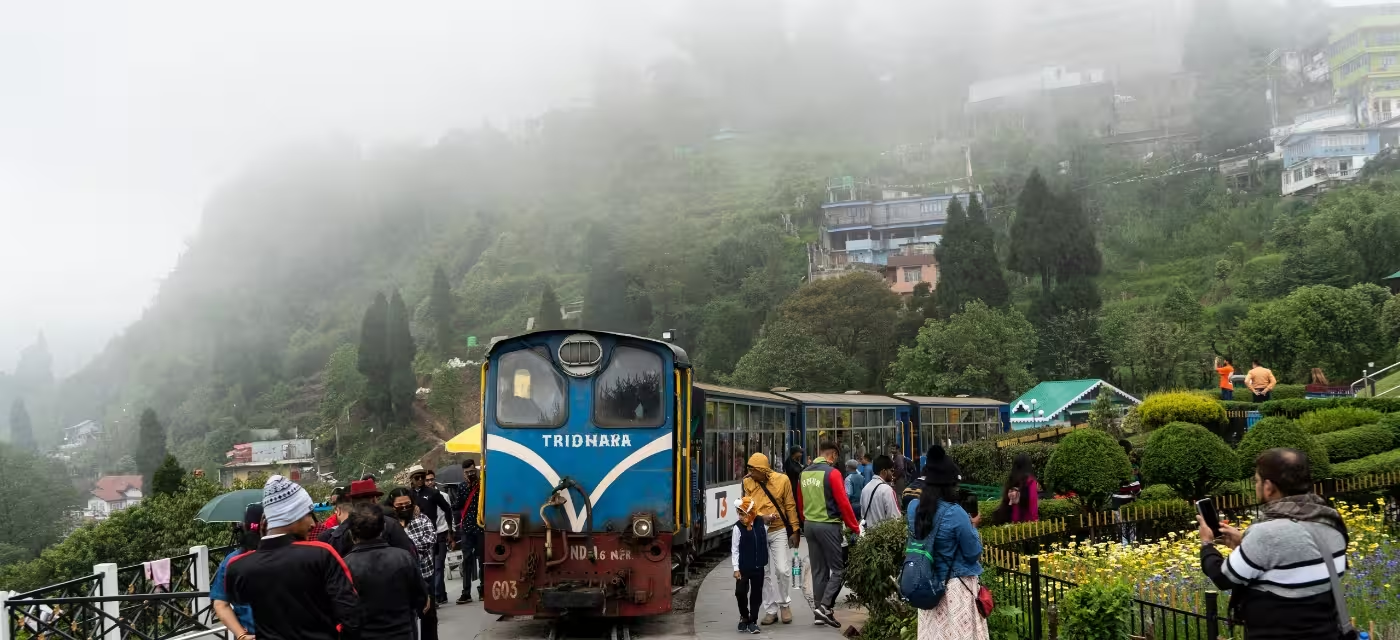
- Ride the Toy Train in Darjeeling
- Stay at a charming operational tea estate
- Soak in the stunning views from Rumtek Buddhist Monastery
- Visit scenic Pelling and Siliguri
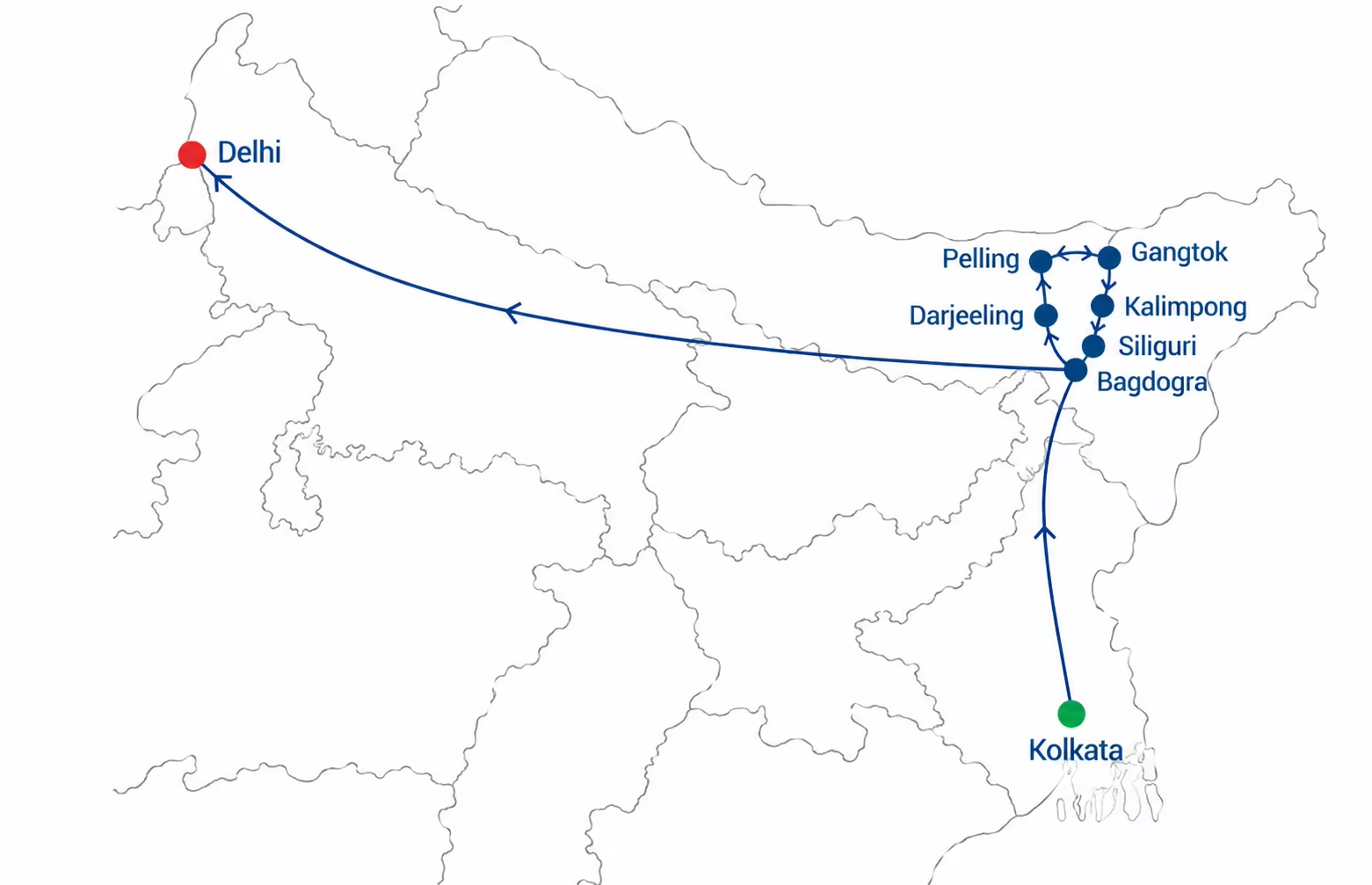
Tour Map
What's Included
 Accommodation
- Entrances
- Guide
- Transport
Itinerary information
Day 1 - Kolkata
Arrive into Calcutta today. Depending on the time of your flight, you might like to explore the markets and near-by cafes which are great for trying some local delicacies. Overnight at hotel.
Day 2 - Kolkata
After breakfast, you set out today to explore the city’s hidden gems. Start at Mother Teresa’s Mission and Mother House. Learn about her and her humanitarian efforts as you explore the grounds. Next, visit the Jain Temple to admire its stunning architecture. A short car ride brings you to the famed University of Calcutta. Here, you walk the grounds as your guide explains the history of the place and names some of the most influential students, like Nobel Prize winning economist Amartya Sen. Post-lunch, visit the Magen David Synagogue, one of the largest Jewish temples open for worship in the Asian Pacific. Enjoy time at Eden Gardens, the hallowed grounds for the nation’s favorite pastime. After checking out what is arguably the most iconic stadium in the country, make a stop at the Victoria Memorial, a museum that’s home to a vast collection of sculptures, manuscripts, paintings and other items from the time of British rule. Finally, make a stop for photos on the Howrah Bridge—the sixth largest cantilever bridge on earth—as you make your way back to your hotel. Overnight at hotel.
Day 3 - Kolkata – Darjeeling
After breakfast, check-out and transfer to the domestic airport. Today you fly to Bagdogra and travel by road to Darjeeling, approx. three hours away. The name ‘Darjeeling’ literally means ‘place of the dorje, or thunderbolt.” Although parts of the area were annexed by Bhutan and Nepal, Darjeeling once belonged to the Rajas of Sikkim. During the period of the East India Company, the British fought and preserved the territory for the Rajas, giving them a “worthless and uninhabited mountain” called Darjeeling. Seeking relief from the heat of the plains, officers of the British Raj escaped to this “worthless hill,” eventually turning it into a popular health resort. Today the area is a favorite summer retreat for Bengalis. The town grew along a crescent-shaped ridge facing the snow-covered Himalayas and many of its hills are thickly covered with coniferous forests and terraced tea gardens. You will stay at the Windermere Hotel, a heritage property full of old fashioned memorabilia and coal fires. This evening you stroll through the city market. Here is one of the best places to get a taste of the town and its people. Overnight at hotel.
Day 4 - Darjeeling
Rising early, you will make the one-hour journey to Tiger Hill to watch sunrise on Kanchenjunga, Mt. Everest, and other sky-touching mountains. In the afternoon take the steam toy train up to and from Ghoom and visit the monastery. It is an important Yiga-Choling Gompa belonging to the Gelugpa sect, headed by the Dalai Lama. This is one of the few monasteries that have an enormous statue of the Maitreya Buddha, or the future Buddha. From Ghoom, if you decide to walk back, the trail passes through some interesting villages and settlements, and you can go off the trail to a Bhotia village down in the valley, though you have to be very sure footed to take this diversion. In the evening walk in the Mall, the most happening place in Darjeeling. The most popular activity for families is to take rides on the “tattoos” as the local underfed horses are called. Glenary’s and Kevs are the most popular hangouts for a hot drink and delicious calorie filled cream pastries. Overnight at hotel.
Day 5 - Darjeeling
After breakfast, you will set out to explore the surrounding area, beginning with the Tibetan Refugee Center, about a half hour amble, with wonderful mountain views on a clear day. Next you can visit the nearby zoo, housing India’s only duet of Siberian Tigers. Just below the zoo, Darjeeling also has a Snow Leopard Breeding Program, one of the few successful programs. As a guidebook notes, snow leopards “are less keen to breed in captivity than the panda (whose disinterest in sex is legendary!).” Right near the zoo, you will also find the Himalayan Mountaineering Institute and Museum. The museum traces the history of the conquest of Everest and contains a collection of mountaineering equipment and samples of Himalayan flora and fauna. Until his death in 1986, Sherpa Tenzing Norgay was the director of the institute. Overnight at hotel.
Day 6 - Darjeeling - Pelling
Start after breakfast on a four drive to Pelling. On the drive you are amply rewarded by wild and untamed scenery. Thickly forested hills, terraced fields of maize or rice, and charming blue and green houses resembling dollhouses make up the scenery. In spring, the flowers are in bloom, and Sikkim is known for its huge range of flora, especially orchids. Deep down in the valley you can see the blue waters of the Ranjeet River. You cross the Teesta River that separates the two states from Jorethang, the border town, it is all uphill, following the Ranjeet river to Pelling, the site of the second oldest monastery in Sikkim – Pemayangste. On a clear day you get stunning views of the Kanchendzonga and adjoining mountains. Today afternoon you visit Pemayangste. This awe-inspiring monastery belonging to the Nyimgmapa sect has an exceptional collection of Buddhist art. The walls and the ceiling of the large Dukhang or prayer hall are covered in numerous thangkas and wall paintings. Of particular note is the exquisite wooden sculpture on the top floor depicting the heavenly palace – the Santhokpalri of Guru Rinpoche that took a monk five years to carve. The palace was revealed to him in a dream. According to tradition, monks for these monasteries are recruited only from pure Tibetan families. Perched on top of a hill, the views are amazing. Early mornings are one of the best times to visit the monasteries for a perfect sunrise in quiet and serene surroundings. Another good time to visit is in the afternoon during the prayer ceremony and daily chanting. You can also visit Randanste, the ruined palace of the 17th to 18th century capital of Sikkim built by the second King of Sikkim. Again there are amazing views all the way to Yuksom and the oldest monastery in Sikkim – Tashideng. Overnight at hotel.
Day 7 - Pelling - Gangtok
This morning after breakfast you drive to Gangtok, six hours away arriving by mid-afternoon. En route you will visit Rumtek Monastry. Sprawling along a ridge, Gangtok is not a particularly attractive town, but has a spectacular setting and marvelous mountain views. The name means “High Hill”, and away from the busy center, there are still quiet back alleys that are interesting to walk through. This afternoon in Gangtok you pay a visit to the most important Buddhist monument here; Dro-Drul Chorten. With a golden top and containing relics of the Buddha and a complete set of holy texts, this monastery is surrounded by 108 prayer wheels that should only be turned clockwise. The unique Research Institute for Tibetology is worth visiting. It was established in 1958 to promote research on Tibet and Mahayana Buddhism that is the main form of Buddhism in this region (both the Nyimgmapa and the Karma Kagupa belong to this stream). Overnight at hotel.
Day 8 - Gangtok- Kalimpong- Silliguri
Depart for Kalimpong after breakfast. The drive is just three hours. Set in beautiful wooded mountain scenery, little visited Kalimpong was once the meeting point of the “Three Closed Lands” on the trade route to Tibet, Nepal and Bhutan. Five kms south of the town center, the Zong Dog Palri Fo-Brang Gompa, was founded in the mid 1970’s by the Dudjom Yeshi Dorje, the former head of the Nyimgmapa sect, and was consecrated by the Dalai Lama. Locally the Gompa is referred to as “Drupin” meaning binoculars referring to the fabulous views from the top. Of particular importance in this monastery is the three-dimensional Mandala, one of only three in the world. The others are in Taiwan and Spiti in Himachal Pradesh. You will also see the large statue of Avalokitesvara, the Buddha of Compassion, with 1000 arms, each of which has an eye in the palm. Time permitting, you may also like to visit Dr Graham’s Home. This stop makes a good break from monasteries. Built on the lower slopes of the Deola Hills, the turn of the century buildings and chapel cover 477 acres. Originally started for the children of tea laborers, it began with just six students. Today they have approximately 1500, though preference is given to children from economically deprived families. It is an interesting place to walk around, and to avoid disruption of classes, you can only visit the Kindergarten section. It is fun to just sit in the sun and watch the kids playing a competitive game of basketball. A climb or drive to summit reveals great views of Kalimpong spread out below. After lunch, continue on to Siliguri which is approximately two and a half hours away. Overnight at hotel.
Day 9 - Siliguri – Delhi, via Bagdogra
This morning, you check out and drive approximately half an hour to Bagdogra airport where you will board your onward flight to Delhi. You are met on arrival and transfer to your hotel. Later, embark on a sightseeing tour of India’s capital city. Begin with exploring the Old City of Delhi, where Mughal art and architecture still survive in the narrow lanes lined with havelis, mosques and food stalls serving authentic Mughlai food, an integral part of Indian cuisine. Old Delhi tourist places include Red Fort, Jama Masjid, Chandni Chowk, Raj Ghat, and Mahatma Gandhi's cremation site. Also visit Humayun’s Tomb, a UNESCO World Heritage Site and the first garden-tomb in India which was the inspiration for the Taj Mahal. Later, discover Imperial New Delhi showcasing spacious, tree-lined boulevards and noteworthy buildings. Notable attractions include Connaught Place (CP), the Presidential Palace and India Gate. Overnight at hotel.
Day 10 - Depart Delhi
Today your India travel comes to an end. A Go India representative will assist with your transfer to the international airport for your onward flight.