 English
 Deutsch
 Italia
August 19, 2026 By admin
Devi The Unvanquished One
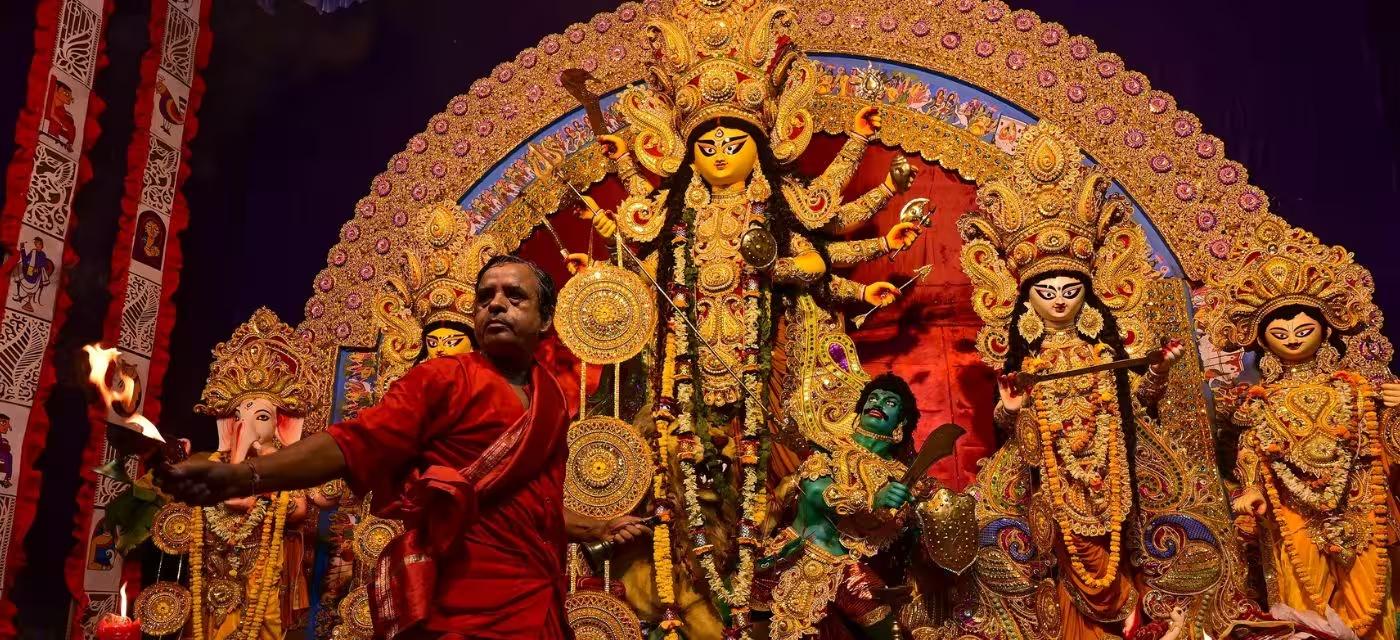
DEVI: The Unvanquished One
“Yaa Devi sarva bhuteshu
Maatri rupena samsthitaa
Yaa Devi sarva bhuteshu
Shakti rupena samsthitaa
Yaa Devi sarva bhutesu
Shanti rupena samsthitaa
Namastasyai Namastasyai Namastasyai Namoh Namah”To that Goddess who in all beings is abiding in the form of Mother;
To that Goddess who in all beings is abiding in the form of power;
To that Goddess who in all beings is abiding in the form of peace;
Salutations to her, Salutations to her, Salutations to her.
— Aparajita Stuti: Yaa Devi Sarva Bhutesu
The nip in the early morning air heralds the arrival of the divine Goddess. Come autumn, and Bengalis across the world prepare to celebrate their biggest, grandest, and most beloved festival—the Durga Puja.
Durga Puja begins with Mahalaya. According to legend, Goddess Durga visits the earth for only four days but begins her descent to earth seven days before the Puja. Hence, the auspicious occasion of Mahalaya, observed seven days before Durga Puja, announces the advent of Durga, who is Shakti (supreme power) personified.
Mahalaya is an invocation of the Mother Goddess, inviting her to descend to earth with the words: “Jaago Tumi Jaago, Jaago Durga…” (“Rise, O Durga…”).
Since the early 1930s, these beautiful words have been brought alive to millions of Bengalis around the world by AIR (All India Radio), when it began the early-morning programme Mahisasura Mardini, or The Annihilation of the Demon, through the sonorous and enchanting voice of the legendary Birendra Krishna Bhadra.
The programme, a beautiful audio montage of recitations from the scriptural verses of the Chandi Kavya, Bengali devotional songs and classical music, continues to run to this day. Much before sunrise, Bhadra’s moving invocation fills the air, marking the beginning of the countdown to Durga Puja.
Bhadra, in his inimitable style, recites the holy verses and tells the story of Durga’s descent to earth. Bhadra has long passed, but his voice remains the heart of Mahalaya. It is the voice every Bengali home waits for—for it means that Durga has finally come home: to be loved, revered and celebrated.
The Goddess Durga
Durga means “one who is difficult to approach”. She is the Mother Goddess (Maa), the one who embodies the primeval source of all power. She personifies love, compassion, beauty, prosperity and all virtues.
She is worshipped in 64 different forms, of which Parvati, the wife of Shiva, is one. In her form as Goddess Durga, she is the beautiful and terrifying warrior with ten arms, each carrying a different lethal weapon given to her by the Gods.
She rides a lion into battle against the evil buffalo demon Mahisasura, finally slaying him with her trident after a fierce combat. Heaven and earth rejoice at her victory.
This is the essence of the festival.
Durga Puja not only marks this great victory but also epitomises the triumph of Good over Evil. Its deeper message is to annihilate all desire and unfold divinity within each one of us.
In Bengal, Durga is worshipped as the destroyer of evil and protector of her devotees.
The first grand worship of Goddess Durga in recorded history is said to have been celebrated in the late 1500s. Apparently, only the wealthiest zamindar (feudal landlord) families would organise the Puja in their homes.
However, during the 18th and 19th centuries and the early 20th century, the growing middle class, particularly in Calcutta, wished to celebrate Puja. They created the community or Sarbojanin Puja (“puja for all”), a tradition that continues to this day.
The Six Important Days
Commemorating the ten-day festival are its six most important days:
- Mahalaya
- Shashthi
- Maha Saptami
- Maha Ashtami
- Maha Nabami
- Vijayadashami
But Durga Puja is not simply about ten days of fasting, feasting, worship, prayers, traditions and religious rituals.
The grand festival is also an occasion for family, friendship, reunion, rejuvenation and the celebration of that precious gift called life.
And no other Indian city celebrates Durga Puja quite like Kolkata.
Bengalis simply call it Pujo.
Kolkata Comes Alive
Charming, laid-back Kolkata springs to life during Pujo.
The air is thick with the fragrance of camphor, incense and flowers. The aroma of elaborate food feasts being prepared wafts out of homes and temples. Shops and malls overflow as frenzied shoppers buy new clothes, sweets and Pujo items.
Meanwhile, across the city and its suburbs, thousands of special Pujo pandals are set up.
These enormous temporary canopies, held together by bamboo frameworks and draped with colourful fabric, house exquisitely sculpted icons of the Goddess and other deities for worship.
The traditional icon of the Goddess worshipped during Durga Puja depicts her astride a lion, her trident piercing Mahisasura as he lies dying, shown in both his half-demon and half-buffalo forms.
Also present on the tableau are her four children—Kartikeya, Ganesha, Saraswati and Lakshmi.
The pratima (traditional clay image of Durga), with all five gods and goddesses beneath one structure, is known as ek-chala, meaning “one cover”.
Kumortuli: Where the Goddess Takes Shape
In Kumortuli, the famous artisans’ quarter in north Kolkata, preparations begin months in advance.
Clay for the sculptures is collected from the banks of the Ganges, and work begins. The entire process of creation, from sculpting to ornamentation, is carried out according to traditional rituals.
Beginning with Goddess Durga, the eyes of the deities are painted on Mahalaya.
Before painting the eyes, the artisans fast for a day and eat only vegetarian food.
The Pandal: A Celebration of Art
The traditional pandal has evolved into a spectacular visual extravaganza.
Pandal decoration is a serious business. Neighbourhoods compete with each other to create stunning and unique pandals, and the one created around the most outstanding theme ultimately takes the honours.
But pandals are not merely places of worship.
They come alive with:
- Art
- Music
- Dance
- Food
- Stalls
- Games
- Fairs
- Cultural programmes
Pujo in Kolkata becomes a giant carnival spilling into the streets.
The streets are jammed and transport virtually comes to a standstill, but enthusiastic and cheerful Bengalis simply walk everywhere.
They walk from neighbourhood to neighbourhood and pandal to pandal. Distance, size, age, class, caste and religion cease to matter—because this is Kolkata going to see its beloved Maa Durga.
Neon lights twinkle and the night skies glow with fireworks. Popular and traditional music pours from loudspeakers, while food stalls serve delicious fare from almost every corner of the city.
Inside the pandals, crowds gather in the mornings to offer pushpanjali (offerings of flowers). Women sound the ululudhvani (ululation), while in the evenings the dhakis (ritual drummers) play the dhak, ceremonial leather-strung drums.
As the beat of the dhak rises to a crescendo, the priest performs the aarati, ceremonial adoration with kindled lamps, accompanied by chants and singing.
As the beautiful face of the Goddess glows in the light of the flame, everyone bows in prayer, invoking her blessings.
Vijayadashami: Farewell to Maa Durga
After nine days of worship and celebration, it is time to bid farewell to Maa Durga.
On Vijaya Dashami—vijaya meaning victory—the tenth and final day of Durga Puja, women holding dhunuchi, earthen lamps filled with burning coconut husks, perform the traditional dhunuchi nritya before the Goddess to the beat of the dhak.
Married women participate in sindoor khela, smearing one another with red vermilion powder.
Then the idols are carried in grand processions from every corner of the city towards various ghats of the Ganga and immersed in the water in a ceremony known as bishorjon.
Accompanied by chants and the beat of the dhak, the immersion symbolises the departure of the Goddess from the earth to be reunited with her consort, Shiva.
Later, families and friends visit one another. Greetings of “Shubho Bijoya” (“auspicious victory”) are exchanged, and sweets are offered.
Till Next Autumn
As the fervour and clamour of the past few days slowly wind down, the people of Kolkata return to their daily lives.
Their hearts, however, remain full of their magnificent Goddess and the love, joy, courage and strength she bestows upon them every year.
Till next autumn.
Related Posts