 English
 Deutsch
 Italia
August 27, 2026 By admin
Golden Triangle India
THE GOLDEN TRIANGLE
Great Experiences at Every Turn
India’s famed Golden Triangle is the route between three cities in the country’s north-west – Delhi, Agra, and Jaipur – which are all connected to each other by good road and rail links. When plotted on the map, they form a roughly equilateral triangle, some 200-250 km along each side. Why ‘golden’? Well, for the extraordinary wealth of cultural, architectural, and historical splendour that each of the three cities has to offer. Starting in the national capital, Delhi, and taking in the states of Uttar Pradesh and Rajasthan, the Golden Triangle is India’s most well-trodden tourist track. The Golden Triangle is the quintessential introduction to India: if you have never been to the subcontinent before, it is a great idea to begin here.
DELHI
…a city as old as time, yet as new as they come
Delhi is the crux of the classic Golden Triangle of Indian tourism. The city is, for an overwhelming number of tourists, their first stop in – and their first taste of – India. Even domestic travellers usually make Delhi their base as they either head out to interesting destinations surrounding the city or prepare for a trek into the Himalayas, in India’s extreme north.
The capital city of India, Delhi was once also the capital of the British Empire in India. Its richly layered history has seen a succession of empires come and go, since the 6th century BCE. It has been captured, ransacked, and rebuilt several times, particularly during the medieval period. But it has, perhaps, received its greatest legacies from the Delhi Sultanate, the Mughals, and the British Empire. Their combined wealth of heritage endures in the city’s splendid monuments, architecture, cuisine, and culture.
Yet, Delhi is a city that constantly renews itself. Its charm lies in its beautiful balance of the ancient and the modern. A true metropolis, Delhi boasts state-of-the-art infrastructure, is a financial and educational hub, has superb museums and art galleries, hosts some of the finest cultural events, festivals, and fairs, and is home to three UNESCO World Heritage Sites and great botanical beauty. A range of excellent hotels and gourmet restaurants complete its attractions.
Most of Delhi’s tourist sites are spread over three broad areas – Central Delhi, the seat of government, bureaucracy, and politics; Old Delhi, which continues to keep its rich, unique heritage alive; and South Delhi, the realm of upmarket residential spaces, markets, designer boutiques, hip cafes and restaurants, and glittering malls.
Built by the Mughal Emperor Shah Jehan in the 17th century, Shahjehanabad or Old Delhi, as we know it now, is where the streets have no names…except mere descriptions of what they hold! But what alluring streets they are! There is the Dariba Kalan, where silversmiths and jewellers line the walls; then Chandni Chowk, the silver square; there is Khari Baoli, where the khara masalas (whole spices) fill the air with their aroma and richness; Chooriwalan, where the bangle-sellers entice you with their colourful and delicate wares; and more…
With its 400 year-old web of alleys held together with great big meshes of electric cables, fascinating spice markets, old world mansions, bustling lanes, loud music, and the flavours of brewing tea and delicious street foods, Old Delhi displays a remarkable and unexpected culture; and an ambience that is a lovely blend of the past and present.
The spectacular heart of the city that is Central Delhi or Lutyens’ Delhi (after Edwin Lutyens, the British colonial architect who designed and developed it), is marked by its grand buildings, ministerial residences, spacious vistas, tree-lined avenues, and Imperial monuments such as India Gate, the Parliament, the Rashtrapati Bhavan (the President’s residence), and the two Secretariat buildings. British-era Connaught Place is Delhi’s famed arcade-style district boasting cinema halls, commercial establishments, retail stores, pavement stalls, bookstores, government emporia, and superb hotels and restaurants.
Experience the Delhi of a bygone time, as you explore iconic landmarks that evoke the city’s rich past – the Red fort, Jama Masjid, Jantar Mantar, Purana Qila (Old Fort), Humayun’s Tomb, Lodhi Gardens, Safdarjung’s Tomb, Qutub Complex, Tughlaqabad Fort, and Hauz Khas Complex. If places of worship interest you, then here are the famous sites to visit: the Jama Masjid, Dargah of Nizamuddin Auliya, Baha’i (Lotus) Temple, Birla Temple, Bangla Sahib Gurudwara; and colonial-era churches such as the St James’ Church, St Thomas Church, and Sacred Heart Cathedral.
Delhi presents a fascinating array of goods for shoppers of every budget and interest. Silver jewellery, ittar (traditional perfume), wedding finery, spices, textiles, traditional Indian sweets, musical instruments, antiques, second-hand books and more define Old Delhi. Central Delhi’s street stalls sell bargain-worthy clothes, accessories, footwear, costume jewellery, books, and even electronic goods; while its old bazaars and shops specialise in interesting Indian handicrafts. South Delhi has a great mix of swanky malls, designer boutiques, bookstores, furniture stores, homeware stores, organic products stores, flea markets, and Asia’s largest IT market that sells all sorts of hardware and software at competitive prices.
AGRA
…a marble mausoleum and astounding Islamic symmetry
Agra, located in the state of Uttar Pradesh, came up on the alluvial plains between the rivers Ganga and Yamuna. Agra had long been a commercial and religious centre but came into its own when the Mughals established their capital here. The enduring legacy of the Mughals can be seen in the city’s monuments, forts, and gardens – all testament to their love of nature, elegance, and the arts.
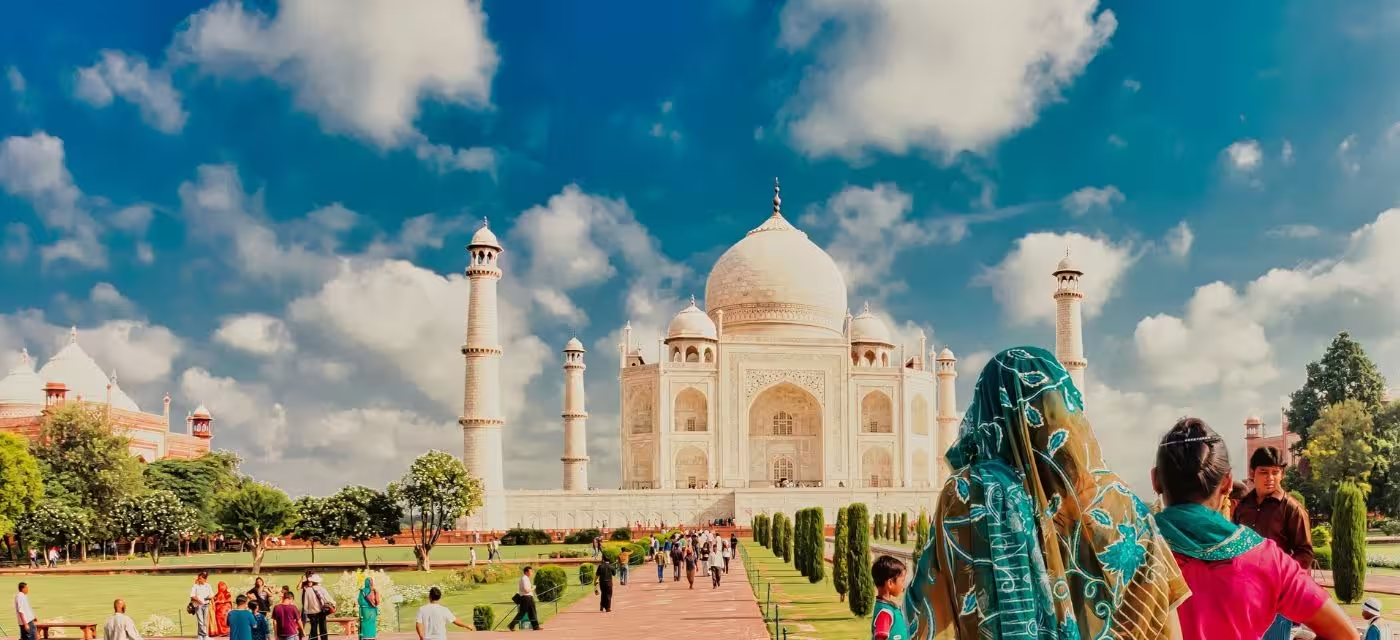
The city’s heat, dust, and chaos may take a toll but, all is forgotten when you see the Taj Mahal, adorning the banks of the River Yamuna. Built in the middle of the 17th century, the ethereal Taj Mahal took nearly 20 years, 20,000 workers, and skilled craftsmen and jewellers from Samarkhand, Constantinople, Kandahar, Baghdad, Bukhara, Syria, Persia, Balochistan, and Southern India, to complete! The white marble mausoleum was built by the Mughal Emperor Shah Jehan in memory of his beloved queen Mumtaz Mahal, who died tragically young.
The Taj Mahal is considered to be the greatest monument to love and is also the ‘Seventh Wonder’ of the modern world. With its beautiful minarets, a mosque, a fountain, water canals, gardens, and exquisite precious stone inlay work, the Taj Mahal is truly deserving of its UNESCO World Heritage Site status.
Built in the 16th century by the Mughal Emperor Akbar, the Agra Fort stands testament to his reputation as one of the greatest and most prolific Mughal builders. The majestic Fort’s ramparts are built in red sandstone and rise up to 70 feet in height. Within the Fort’s complex lie the royal harem, an area where the women shopped, the royal quarters, the royal hall etc.
Located around 37 km from Agra, Fatehpur Sikri (‘Place of Victory’) was the 16th century imperial capital of Mughal Emperor Akbar. Akbar built the city in gratitude and tribute to Salim Chishti, a renowned saint in Sikri. The saint’s grave is in an exquisite marble tomb here, and is now a much revered pilgrimage spot.
Fatehpur Sikri is a magnificent complex of forts, palaces, pavilions, courtyards, domes, balconies, cupolas, tanks, baths, and mosques built in red sandstone, mixing elements of Persian, Timurid, and Indian styles. The city’s remarkably efficient drainage and water-supply system speak for its superb planning and design.
The highlights here are the Jama Masjid, the Buland Darwaza (the highest gate in India), the tomb of Salim Chishti, the palace of Maryam-uz-zamani, and Birbal Bhavan. The first planned city of the Mughals, Fatehpur Sikri is a UNESCO World Heritage Site.
The lovely 17th century Sikandra Tomb, the resting place of Emperor Akbar, is all elegant pavilions and cenotaphs. Beautifully carved red-ochre sandstone, majestic gateways with classic mosaic work, the charbagh garden setting, and the tomb amidst it all, rest on immaculately maintained grounds. The Sikandra Tomb is a five-storied pyramid, with artistic bays, huge piers, and arches.
Agra is famous for its handicrafts – pietra dura or marble inlay work, carpet-weaving, zardozi (gold wire embroidery, usually on silk), and handmade leather works are some of the specialties.
The land that all men desire to see, and having seen once, by even a glimpse, would not give that glimpse for the shows of all the rest of the world combined.
– Mark Twain, More Tramps Abroad, 1897
JAIPUR
…a riot of hues
Fringed by the Aravalli Hills, Jaipur lies in East Rajasthan, on the edge of the Thar Desert. The capital of Rajasthan’s heroic and fearless warrior kings, Jaipur (also known as the ‘Pink City’ for its red-washed buildings) is steeped in centuries of history, culture, and royal tradition.
Behind its pink walls, you will find the original Old City, which dates back to the 18th century. Outside, 21st century Jaipur gives way to multi-storied buildings, gleaming malls, and chaotic traffic. The Old City is flamboyant, fascinating, vibrant, colourful, and chaotic – its narrow lanes are studded with enchanting bazaars that bear their heritage with pride.
Head to Ramganj Bazaar to watch leather shoemakers at work. Tripolia Bazaar is famed for brass and steelware. Johari Bazaar has traditional jewellery shops, as well as bandhani (tie & dye) and block-printed textiles.
To see Rajasthan’s renowned meenakari (the Persian art of colouring the surface of metals by fusing brilliant colours was introduced to India by Persian enamellists during the Mughal era) artisans, gem-cutters, and polishers at their craft, head to Gopalji ka Raasta and Haldiyon ka Raasta lanes. In Manhariyon ka Raasta, watch lac bangle-makers at work. In the tiny Rangwalon ki Gali, bandhani makers skilfully impart bright colours to fabrics. Marble workers, sculptors, and painters are to be found practising their art in Chandpol Bazaar.
Gorgeous Jaipuri quilts, stunning mojaris (a Mughal-era style of handcrafted footwear traditionally made of tanned leather, delicately embroidered and embellished), elegant antiques, and beautiful handicrafts will also vie for your attention in these charming markets.
The Amer (or Amber) Fort is around 10 km north of Jaipur. Amer was the capital of the Kachchawa Rajputs for 700 years (1037-1727). The magnificent Fort rests on a hill high above the city and offers a stunning view from the top.
Constructed in a blend of Mughal and Rajput architectural styles, the resplendent City Palace or royal complex has an excellent collection of miniature paintings, carpets, royal memorabilia, and rare astronomical works in Arabic, Persian, Latin, and Sanskrit. Built by Sawai Pratap Singh in 1799, the Hawa Mahal is Jaipur’s most famous monument. The elegant structure, with its curvilinear roofs, domes, and finials, is unusual because all ornamentation can be seen only in the rear portion of the building, giving the entire palace the ambience of a facade! But this fantastic facade has, in fact, 953 ornate sandstone windows that were designed especially for the women of the royal family – so that they could watch processions and celebrations on the street below without being noticed! Built by Maharaja Sawai Jai Singh II (1728-1734), the Jantar Mantar Observatory is remarkable for its accuracy even today! The Jantar Mantar has an extraordinary collection of complex astronomical instruments. It is the largest and the best preserved of the five that Jai Singh built. Jaipur’s undisputed attractions might be its glorious old forts, palaces, and bazaars but one of the biggest draws of modern Jaipur is the much feted Jaipur Literature Festival. Held in January every year, the Festival draws writers, authors, scholars, and lovers of literature from all over the world to Jaipur.
A Golden Triangle tour with extensions will give you the chance to discover little travel gems and experiences around the three cities. Here, we present Varanasi and Khajuraho.
VARANASI
…sunrise, sunset, and centuries-old rituals
Picturesquely situated on the crescent-shaped left bank of the holy River Ganga, the legendary city of Varanasi (also called Benares or Kashi) in Uttar Pradesh, has endured from pre-Vedic times, which perhaps accounts for its air of laidback constancy.
An ancient seat of learning, culture, and the arts, in India, Varanasi is also considered one of the greatest pilgrimage centres for Hindus and is revered as one of their most sacred spots. This is the city where they come to honour – and release – loved ones who have passed on.
While religion breathes through the dark, smoky lanes and crowded ghats, the ‘luminous’ city hides a heart of joyous peace that is quite irresistible. Varanasi today is a fascinating, endearing paradox – a city of modern shopping centres that is still surrounded by the aura of its antiquity.
The evening Ganga aarti (ritual of offering prayer to the River Ganges with lit oil brass lamps) ceremony on the ghats (flights of steps leading down to the River) is a truly wondrous experience. Brilliant lights, soulful bhajans (devotional songs), the mesmeric clanging of bells, the rhythmic chants of mantras, the fragrance of camphor and incense, the sound of conch-shells being blown, and priests performing the rituals for the pooja (worship) – all set against the stunning backdrop of the sun setting on the Ganga.
The experience of an early morning boat ride on the Ganga as you watch other boats float past, and soak in the endless ghats and temples that stand beautiful on the banks, is quite unmatched. The moment becomes pure joy when you see the first ray of light as the sun rises from the eastern bank of the Ganga, colouring everything it touches a magical golden.
See also the incredible sight of thousands of devout pilgrims, who bathe in the holy river in the hope of attaining nirvana (salvation).
Varanasi’s famed Kashi Vishwanatha Temple is ringed by mandala-like layers of shrines to over 350 other gods and goddesses; the Bharat Mata Temple is dedicated to India; the Durga Temple is dedicated to Goddess Durga; and the Alamgir mosque, originally a temple dedicated to Vishnu, is an unusual mixture of Hindu and Islamic architectural styles.
Varanasi is also the pilgrimage of those hunting exquisite old brassware and bell metal utensils, the famed gold-threaded silk brocade textiles called ‘Benarasi’, and…musical instruments. For this is the seat of Hindustani music – the classical music tradition of North India.
KHAJURAHO
…of love, life, and divinity
The town of Khajuraho in Madhya Pradesh is world famous for its magnificent complex of 25 temples built in the 8th-9th centuries CE by the Chandela dynasty. The 25 temples, are together a UNESCO World Heritage Site.
The internal and external walls of these fabulous temples are embellished with exquisite stone carvings which portray every facet and mood of life, from the erotic to the divine, the commonplace to the sublime.
A week-long festival of classical dances is held at Khajuraho in February-March every year in which India’s foremost exponents of dance perform against the spectacular backdrop of the floodlit temples.
The temples are divided into three groups – the Eastern, Western and Southern groups.
Eastern Group
First visit the Ghantai Temple, on the edge of the old village. Here you see pillars decorated with carved bell and chain motifs.
Next are the Javari and Vamana Temples, both dedicated to the god Vishnu. The Vamana Temple enshrines the dwarf incarnation of Vishnu, Vamana.
Close by is the Brahma Temple that enshrines a fourfaced lingam (the phallic symbol of Siva).
Western Group
The temples here are beautifully decorated and are dedicated to either Vishnu or Siva.
Built in 954 CE, the striking Lakshmana Temple is the seat of Vishnu. The idol here is 4 feet high and has three faces (lion, man, and boar). The base is sculpted with depictions of marching armies, daily life, dancers, and even orgies!
The Lakshmana Temple is one of the three largest temples of Khajuraho and also the earliest.
The nearly 107 feet high Kandariya Mahadeva Temple, built in 1030 CE, is a magnificent Siva temple with a marble lingam in the sanctum.
On the same platform stands the Devi Jagadamba Temple, which was, in fact, originally dedicated to Vishnu. Built in the 11th century CE, it is especially noted for its sculptures of shardulas (mythical beasts with the body of a lion and the head of a parrot, boar or elephant).
The Chandragupta Temple is the only Sun temple in Khajuraho and has a 7-foot idol of the Sun God Surya, dressed in an armoured coat, on a chariot.
The Parvati Temple is a small shrine that has an idol of the Goddess Parvati standing on an iguana!
The Vishwanatha Temple, dedicated to Siva, is the most magnificent of the group. Especially outstanding here are the Nandi shrine, apsaras (celestial dancers) writing letters, playing music, and one plucking a thorn from her foot.
Related Posts